
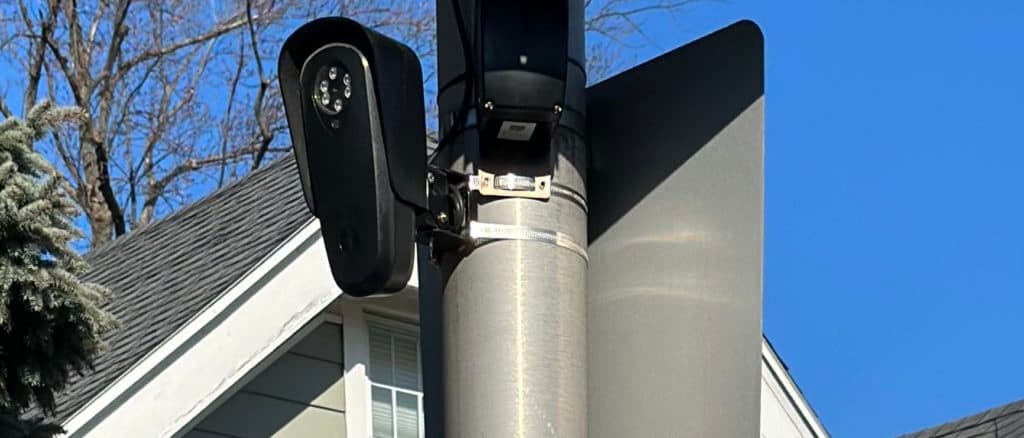

Police using Flock Safety’s artificial intelligence tools can now track a vehicle based only on its location and movements.
Flock’s OS Investigate, formerly known as Nightshift, is an AI tool that identifies vehicles and ranks drivers’ “associates” based on how frequently they appear together at the same Flock camera, WIRED reported. Flock website code reviewed by WIRED listed 45 functions available to OS Investigate, including plate scans, camera metadata, arrest records, case files and 911 dispatch logs to identify potential suspects.
“his really crosses a line from a tool that’s used to investigate suspicious people to deciding who is suspicious,” Jay Stanley, senior policy analyst with the ACLU’s Speech, Privacy and Technology Project, told the Daily Caller News Foundation. “t increases the chances that you are going to get put under the microscope by law enforcement because some algorithm thinks your driving patterns are ‘suspicious.'”
Stanley also believed the AI industry will shift toward models that organizations run in-house to combat privacy concerns.
“ lot of AI use is going to have to be local models,” he told the DCNF.
He believes homes and local institutions such as hospitals and police departments could soon have their own personal AI models for less powerful tasks as the technology advances.
“I think that’s the direction that a lot of organizations are going to go … I’ve talked to police officers who are like, ‘yeah, I want to use AI, but I can’t use AI in our internal stuff. We can’t let that leave the premises,'” Stanley told the DCNF.
Flock Safety, the Texas Municipal Police Association, the International Association of Chiefs of Police, Code Four Labs, Tyler Technologies and 3SI Security Systems each did not immediately respond to the DCNF’s request for comment.
For other critics, the real danger is how readily police may act on what this AI tool tells them.
“aw enforcement have not right now been receiving in-depth training on how to challenge and question the findings of an LLM as to who the top 10 bad guys are in their jurisdiction, and they’re probably not going to wait around a long time to parse it all out carefully,” Alex Marthews, national chair of Restore The Fourth told the DCNF, explaining that this technology gives law enforcement the ability to outsource its decision-making.
If police departments have “the ability to say ‘okay surface for me, ChatGPT, the top 10 real goddamn asshole problems that there are in my jurisdiction,'” and the AI hallucinates, then they could arrest innocent people without due process, he told the DCNF.
He said Calvary Chapel San Jose kept holding indoor services in defiance of COVID mandates, and the government later used phone-location data to monitor who was there. Marthews argued that just as those worshipers did not anticipate technology to be “deployed against them,” the same could happen with these AI tools.
This flock system “can be targeted against anyone. Governments change, ideologies change, state enemies change, and we do not know in setting up a system that 10 years down the line we won’t be the targets of it,” he explained.
Flock CEO Garrett Langley has argued that Americans have to accept a compromise between safety and privacy.
“hen people talk about just one of these, privacy or safety, they’re prioritizing the wrong thing. What we have to prioritize as a country is ‘compromise,'” Flock CEO Garrett Langley told Fox News in a Saturday interview, reposted by Sen. Rand Paul on X. “How do we have our safety, and how do we balance privacy.”
“hat was not my comment. We believe in the constitution at Flock,” Langley said in another post, responding to the Senator. “I hope you can agree that Americans deserve to be safe.”
Flock describes its FlockOS platform, which hosts OS Investigate, as a command center that can operate anywhere, according to the company’s website.
“We watched the vehicles enter through LPR, tracked them across the city, and our teams were in place before the suspects even got out of their cars,” Major Patrick Krieg of the Dunwoody, Georgia, Police Department said, according to Flock’s website. “It was the first time we said: this platform is powerful.”
AI’s real value in investigations is managing the sheer volume of material a single case generates, George Cheng, CEO and co-founder of Code Four told the DCNF. Body camera footage, jail calls, phone extractions and call records can bury a detective and cases go cold for lack of time. Code Four’s INSIGHTS product pulls an open case’s records into one place and lets a detective question all of it in plain English, with every answer tracing back to its source.
Cheng drew a hard line between analyzing evidence in an already-open case and searching the public to generate suspects, arguing a search should start from the former. Beyond that, he said, outputs should cite their sources, an officer should own whatever the software drafts, an audit trail should preserve machine versus human work and agency data should never train outside AI models or be sold.
A policy analyst argued the problem with Flock’s tracking tools is how the government wields the technology.
“AI is simply a tool. It’s going to get utilized in many ways that are great, and it’ll get utilized in many ways that are bad,” James Czerniawski, head of emerging technology policy at Consumer Choice Center told the DCNF. “ut we don’t regulate the tool itself, we regulate based on the outcome. In this case, the outcome is that you have people’s Fourth Amendment rights getting violated by the government, and there’s no good path to fixing that right now.”
Czerniawski pointed to one safeguard above all: warrants.
“‘Warrants’ is your best friend … for both law enforcement and for people’s due process consideration,” Czerniawski told the DCNF, arguing a warrant forces cops to justify AI-assisted searches.
“I think there needs to be legislation, both at the federal and state level,” Mayor of Knox County, Tennessee, Glenn Jacobs said in an August interview with the DCNF. “I think that as this issue becomes more prevalent around the country, Congress will take it up.”
One lawmaker is trying to write warrant requirement into federal law.
Rep. Keith Self: “The PRIVACY Act prohibits federal agencies from using output from applications such as Flock Safety’s OS Investigate without first obtaining a warrant,” Republican Texas Rep. Keith Self told the DCNF. “Flock Safety’s camera network is one of several emerging technologies that surveil everyday Americans, which requires Congress to implement processes to anticipate new technologies that must require warrants.”
Self’s proposed legislation would limit retention of data captured by these cameras to 30 days with a warrant, provided the information is not evidence for prosecution or a court grants an extension
“AI has supercharged the surveillance state, trampling our God-given right to be secure in our persons, houses, papers, and effects,” Self told the DCNF. “These cameras are no longer just license-plate readers looking for vehicles of interest; OS Investigate shows they are being used to aggregate an expanding amount of personal data, raising constitutional questions and putting individual privacy at risk.”
He called on Congress to act and impose restrictions on devices that surveil the public and infringe on Fourth Amendment rights.
Republican Missouri Sen. Josh Hawley began a Senate subcommittee investigation into Flock cameras on Wednesday, according to Hawley’s letter to Langley.
The Institute for Justice identified more than 100 cases of ALPR abuse, according toa database the group published Aug. 12. Among these cases was a Georgia police chief who conducted 600 searches to track his ex-girlfriend and her daughter, according to the Washington Post.
All content created by the Daily Caller News Foundation, an independent and nonpartisan newswire service, is available without charge to any legitimate news publisher that can provide a large audience. All republished articles must include our logo, our reporter’s byline and their DCNF affiliation. For any questions about our guidelines or partnering with us, please contact [email protected].