

Van Gogh’s ‘The Starry Night’ Proven Scientifically Accurate In Depicting Turbulent Skies
Vincent van Gogh’s The Starry Night, 1889. WIKIMEDIA COMMONS “> Vincent van Gogh’s painting The Starry Night is scientifically accurate, according to a new study. His sky is “alive with real-world physics” beneath the…
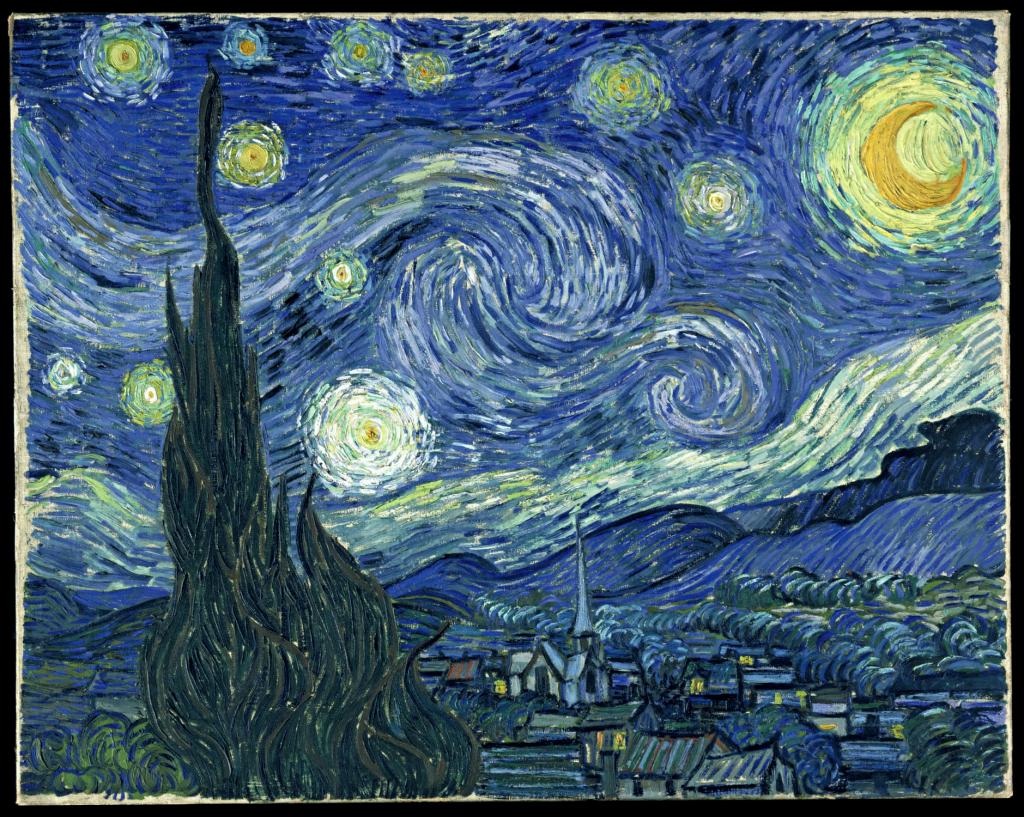

Vincent van Gogh’s The Starry Night, 1889. WIKIMEDIA COMMONS
“>
Vincent van Gogh’s painting The Starry Night is scientifically accurate, according to a new study.
His sky is “alive with real-world physics” beneath the brushstrokes, say researchers.
One of the most famous works of art ever created, the 1889 oil-on-canvas painting is widely regarded as the Dutch post-impressionist masterpiece.
It depicts a swirling blue sky with a yellow moon and stars as seen from the east-facing window of his asylum room at Saint-Rémy-de-Provence, France, just before sunrise, with the addition of an imaginary village.
Van Gogh’s brush strokes create an illusion of sky movement so convincing it led atmospheric scientists specializing in marine and fluid dynamics in China and France to wonder how closely it aligns with the physics of real skies.
They explained that while the atmospheric motion in the painting cannot be measured, the brushstrokes can.
And, after measuring the relative scale and spacing of the whirling strokes, the researchers say van Gogh “accurately captures” cascading energy.

They discovered what they described as “hidden turbulence” in the painter’s depiction of the sky.
Study author Dr Yongxiang Huang said: “The scale of the paint strokes played a crucial role.
“With a high-resolution digital picture, we were able to measure precisely the typical size of the brushstrokes and compare these to the scales expected from turbulence theories.”
