In the years after the Nazis took power in 1933, they instituted hundreds of laws and policies at the national, state and local levels to systematically remove Jews from German society. Bans were placed on Jews working as doctors and lawyers and in other professions, and quotas were set, limiting Jews in schools and universities.
By 1935 Nazi-institutionalized anti-Semitism had stripped Jews of their German citizenship and barred them from municipal hospitals, legal practice, the military and even World War I memorials, effectively excommunicating them from civic life and laying the groundwork for the Nazis’ future escalation to even more severe anti-Semitic persecution, according to the Holocaust Memorial Museum.
It’s tempting to look back at the dark days of 1930s Germany under the Nazis as a distant chapter in history when ignorance and racism fueled by hateful rhetoric were allowed to contaminate an entire society and national leadership. We want to believe that could never happen again in modern times.
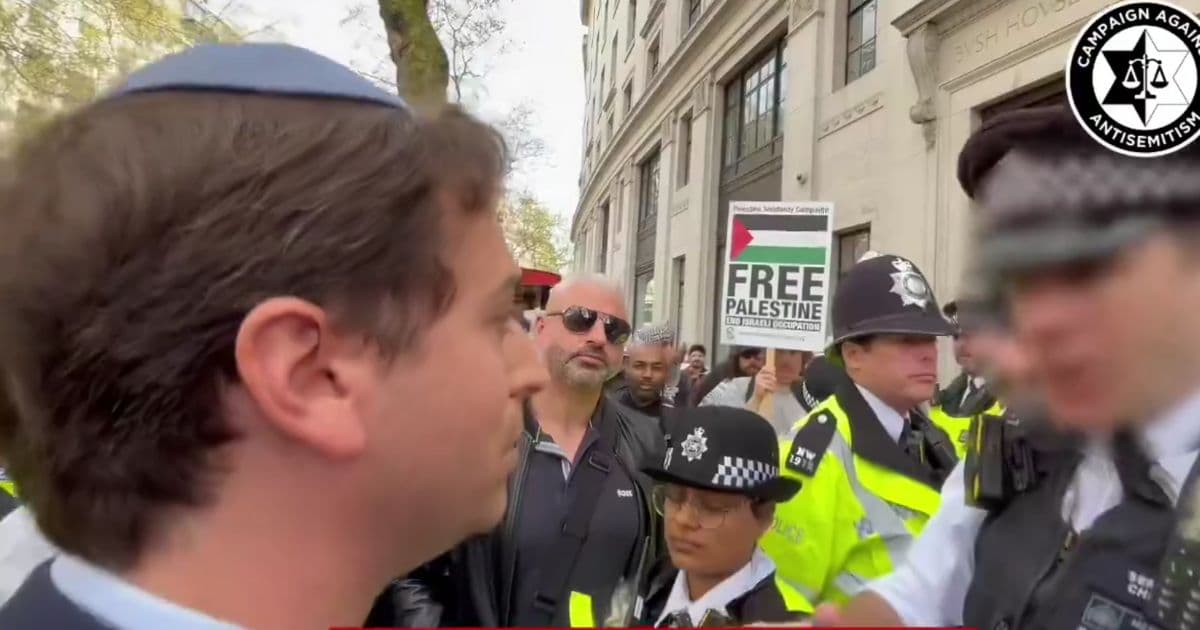
But a video shared by Campaign Against Antisemitism from a pro-Palestinian march in London reveals a scene that could have been right out of the 1930s.
In the video taken during the protest in central London, an officer can be seen blocking the path of Gideon Falter, a Jewish man wearing a kippah, a religious head covering, asking him to stay in place while the protesters march, according to the BBC.
Falter, who is the chief executive of Campaign Against Antisemitism said he was simply walking around London after synagogue, according to the BBC.
“I don’t want to stay here, I want to leave,” Falter replied, after being blocked by the officer.
“In that case sir, when the crowd is gone, I will happily escort you out,” the officer responded.
When Falter tried to move past the police officer, the officer blocked his path, preventing him from leaving.
“I don’t want anybody antagonizing anybody …” the officer said as Falter protested, saying, “I just want to walk across …”
“At the moment sir, you are quite openly Jewish,” the officer responded. “This is a pro-Palestinian march. I am not accusing you of anything, but I am worried about the reaction to your presence,” the officer said.
Later in the video, another police officer attempted to defuse the situation, explaining to Falter that they were just trying to protect him.
“Do you have any idea what it’s like being a Jew in London at the moment?” Falter asked the officer.
Falter went on to explain that every Saturday, as protest routes change unpredictably through neighborhoods, being visibly Jewish means having to cross and face down “huge groups of people” in an “intimidating” atmosphere.
He said they were told repeatedly that Jews were safe in the city, “and yet,” he said, “here I find myself in this bubble. This guy has just been shouting at me and shoving me because I want to cross the road.”
Later in the video, another police officer can be seen telling Falter, “There’s a unit of people here now. You will be escorted out of this area so you can go about your business, go where you want freely, or if you choose to remain here, because you are causing a breach of peace, with all these other people, you will be arrested.”
“If I remain here, you will arrest me?” Falter asks incredulously.
“Your presence here is antagonizing a large group of people that we can’t deal with all of them if they attack you … because your presence is antagonizing them,” the officer responds.
The video also shows some people shouting “Scum” at the Jewish man. Another protester shouted “Nazi,” while yet another brazenly confronted him in front of officers, telling him, “I’m watching your movement … that’s right. We’re all going to watch your movements and record you. The police ain’t gonna help you in this scenario.”
“After months of being gaslit by the , it’s not safe for Jews to be walking in the presence of these protests. And was there anything so crazy about what we were trying to do? Just walking around our home city on a Saturday?” Falter said in the accompanying video narrative.
“‘Is this something that we are willing to accept? That now the police have to keep Jews away? We mustn’t accept it,” he said.
“It has been six months now,” Falter said in the accompanying narrative, “six months, where every single weekend, we have to witness the streets of London awash with people, many of whom seem to have no problem at all declaring their full-throated support for Hamas, waving around anti-Semitic placards, calling for jihad, showing swastikas, waving anti-Semitic flags. It’s enough. Enough,” he said.
The police have since apologized for the officer’s choice of words, stating, “Being Jewish is not a provocation. Jewish Londoners must be able to feel safe in this city,” according to the BBC, but the incident is a clear example of a growing sentiment.
We are watching an eerie flashback of the 1930s playing right before our eyes.
And the U.S. is not far behind.
Chants of “From the river to the sea” have been heard on almost every city street and college campus, even in New York — a city that holds the largest population of Jewish people outside of Israel.
The 1930s did not begin with gas chambers and concentration camps, but with the pervasive mindset that one’s religious identity alone is a provocation worthy of exclusion from society.
It doesn’t feel like we have learned anything from that dark time in history.
This article appeared originally on The Western Journal.