



Why Scientists Say This Backflipping Bug Is Sonic The Hedgehog IRL
Composite image of a globular springtail jumping. DR. ADRIAN SMITH VIA SWNS. “> A tiny garden bug has been dubbed the real-life Sonic the Hedgehog because it does the fastest backflips on the planet. The “insanely fast”…
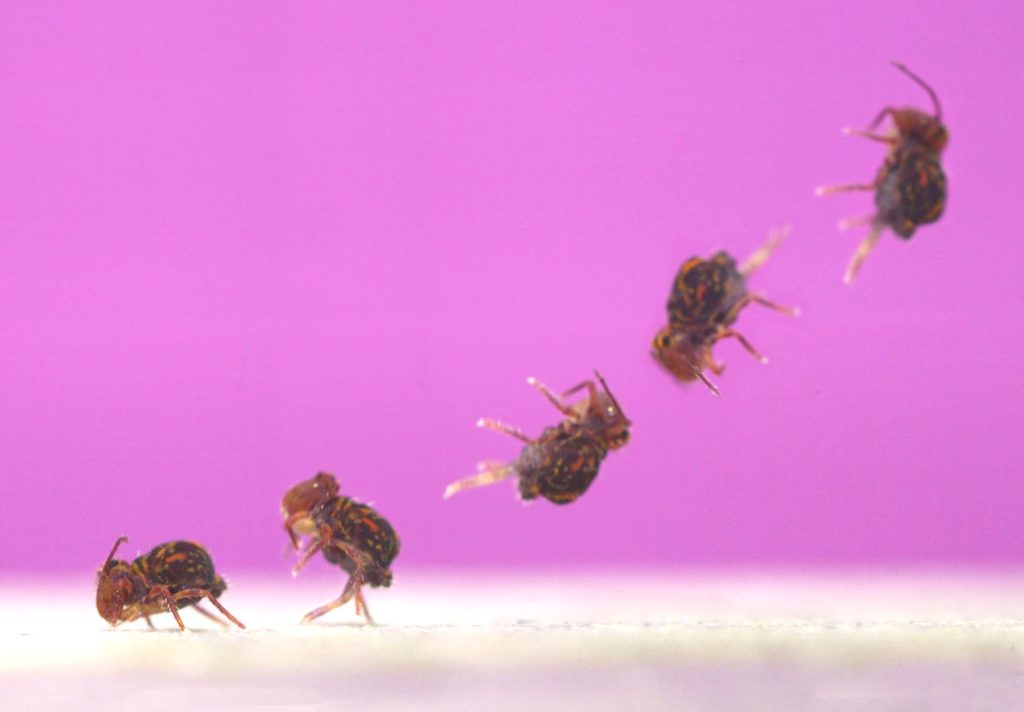

Composite image of a globular springtail jumping. DR. ADRIAN SMITH VIA SWNS.
“>
A tiny garden bug has been dubbed the real-life Sonic the Hedgehog because it does the fastest backflips on the planet.
The “insanely fast” globular springtail completes a full body rotation in less than one-hundredth of a second.
The hexapod, which is usually only a couple of millimeters in body length, can reach an astonishing rotational rate of 368 flips per second.
American researchers discovered the globular springtail backflips into the air, spinning to over 60 times its body height in the blink of an eye.
The new study, published in the journal Integrative Organismal Biology, features the first in-depth look at its jumping prowess using state-of-the-art camera technology
Researchers explained that the globular springtails don’t fly, bite, or sting, so rely on their amazing jumping prowess to avoid predators.
They are so good and so quick that, to the naked eye, they seem to vanish entirely when they take off.
Study corresponding author Dr. Adrian Smith said: “When globular springtails jump, they don’t just leap up and down, they flip through the air – it’s the closest you can get to a Sonic the Hedgehog jump in real life.
“So naturally I wanted to see how they do it.”
Dr. Smith, research assistant professor of biology at North Carolina State University, explained that finding the globular springtails was easy enough as they’re all around us.
The ones in this study are usually out from December until March.

