Will Sinema Sink Democrats’ Spending Bill Over Provision That Would Hurt Small Businesses, Pensions?
It was supposed to be as good as done: After secret negotiations, Senate Majority Leader Chuck Schumer of New York and Democratic Sen. Joe Manchin of West Virginia — who killed the so-called Build Back Better bill last…
It was supposed to be as good as done: After secret negotiations, 🏛️Senate Majority Leader 👤Chuck Schumer of New York and Democratic Sen. 👤Joe Manchin of West Virginia — who killed the so-called Build Back Better bill last year — reached agreement on a $433 billion federal spending package, most of which would be sent to climate and energy initiatives.
Getting Manchin on board was supposed to be the last step of the process — and the timing was deemed to be impeccable. After all, as The Hill noted, the negotiations on the spending package closed shortly after 🏛️Senate🐴Democrats and Republicans passed a $280 billion tech bill that the GOP would have otherwise blocked.
However, as 🏛️SenateDemocrats
Sponsored
Sponsored
Will Sinema Sink Democrats’ Spending Bill Over Provision That Would Hurt Small Businesses, Pensions? — IJR
🐴
and members of President
👤Joe Biden
’s administration started slapping themselves on each other’s backs, they forgot one thing: There are two Democratic swing votes in the deadlocked 50-50
🏛️Senate
, not one.
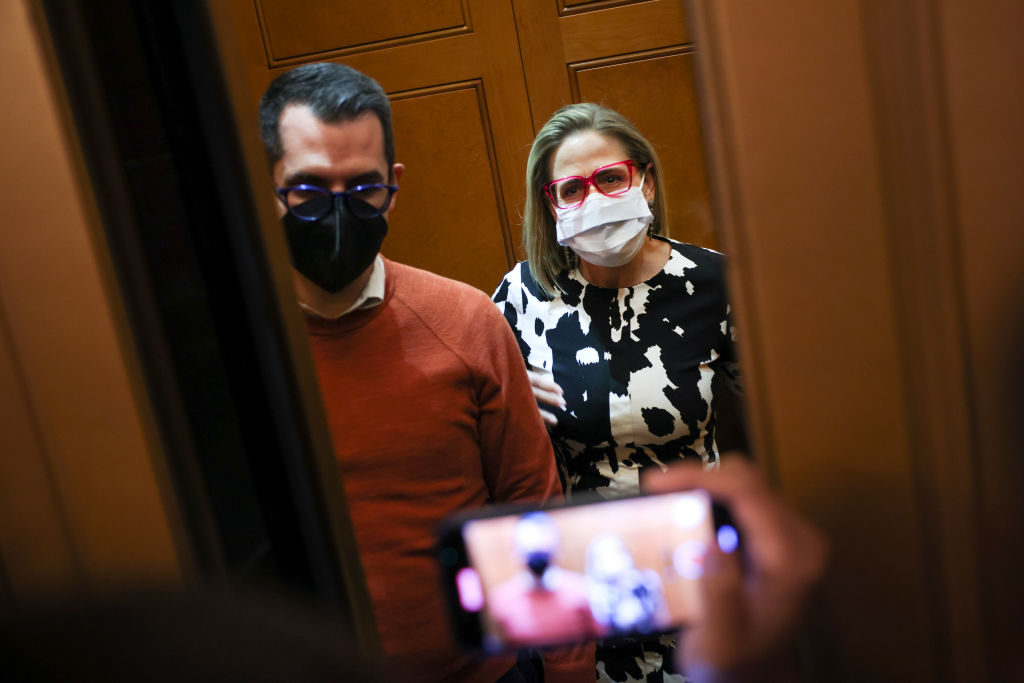
The other, Arizona Sen. 👤Kyrsten Sinema, was left out of negotiations for the agreement.
The legislation also contains a provision that was a top priority for Manchin — closing the so-called carried interest loophole. Sinema has vehemently opposed doing away with it, arguing it would hurt small businesses and pensions.
So far, she is staying mum on whether she’ll vote for the deal.
“Senator Sinema does not have comment,” her spokeswoman, Hannah Hurley, said on Monday, according to Bloomberg. “She’s reviewing the bill text and will need to see what comes out of the parliamentarian process.”
In addition, Sinema ignored questions posed by reporters at the Capitol on Monday evening.
If the Arizona senator doesn’t vote for the legislation, the bill is done for. If the carried interest provision is taken out, the fragile deal struck between Schumer and Manchin would arguably fall apart.
So, what is the carried interest loophole, anyway? Under the current tax code, asset managers who manage profitable investments are taxed at a 20 percent capital gains tax rate. The 🐴Democrats want asset managers to pay a higher rate, which they say would raise an estimated $14 billion over a decade, according to The Hill.
However, Wall Street says closing the carried interest loophole might generate tax revenue but would hit small businesses, pensions and endowments.
“Over 74 percent of private equity investment went to small businesses last year,” said Drew Maloney, American Investment Council president and chief executive, according to Reuters.
“As small business owners face rising costs and our economy faces serious headwinds, Washington should not move forward with a new tax on the private capital that is helping local employers survive and grow,” Maloney said.
Manchin has said he is “adamant,” however, that the carried interest provision remain in the legislation.
“I’m not prepared to lose” it, the senator said, according to the Hill. “What we have is a good bill that’s fair with everybody. It’s a give-and-take proposition.
“I think the people that have benefited from carried interest for years and years and years knew that they had a good run, it was long overdue to get rid of it and you can’t justify it anymore.”
The problem with the “give-and-take” proposition is that Sinema has seemed equally adamant in the past that the carried interest loophole remain — a House bill was changed last year because she indicated she wouldn’t vote for legislation that would close it — and that she wasn’t actually involved in the “give-and-take” process with Schumer and Manchin.
A former senior aide to Sinema told the Hill he was shocked Schumer agreed to eliminate the loophole without first asking the Arizona senator whether she would support the bill.
“The question that I have and what has confused me about Sen. Schumer’s strategy is not necessarily whether and when to loop her ,” former Sinema aide John LaBombard said.
“What perplexes me more is the idea that he would knowingly and — in my mind — somewhat randomly add in a tax policy provision that was not in the House bill, was not in the White House framework, and that he knew she had substantive concerns and questions about,” LaBombard said.
Instead, he said, the Senate majority leader “let her and the rest of the caucus learn about the agreement via press release.”
“That combination is what perplexes me and leads me to question whether this is a strategy that’s going to maximize chances of success,” LaBombard said.
“I think it may have been a little different if they had largely struck a deal that largely reflected what everyone knew Sen. Sinema supported at the end of last year,” he said.
Now, it almost looks like negotiations are going through Manchin. He told reporters on Monday that he hoped to talk to Sinema about the bill, adding the Arizona senator was “a good friend.”
“I’ve called and left a message for her,” Manchin said, according to Bloomberg, just before he entered the 🏛️Senate chamber to cast a vote. “I might see her on the floor.”
However, as Bloomberg noted, the two weren’t seen talking on the floor.
Sinema and Manchin are usually of one mind as these things go. That doesn’t represent a pleasant augury when it comes to this being a terminal stumbling block for the $433 billion deal — named the “Inflation Reduction Act,” a sign the 🐴Democrats’ sense of irony is still intact.
That said, Sinema has maintained radio silence for longer than one might expect, and the fact that she was left out of negotiations entirely raises some hope that, just like with Build Back Better, the Inflation Reduction Act will get torpedoed by a moderate Democrat.