


Alfred the Great Translates Psalms
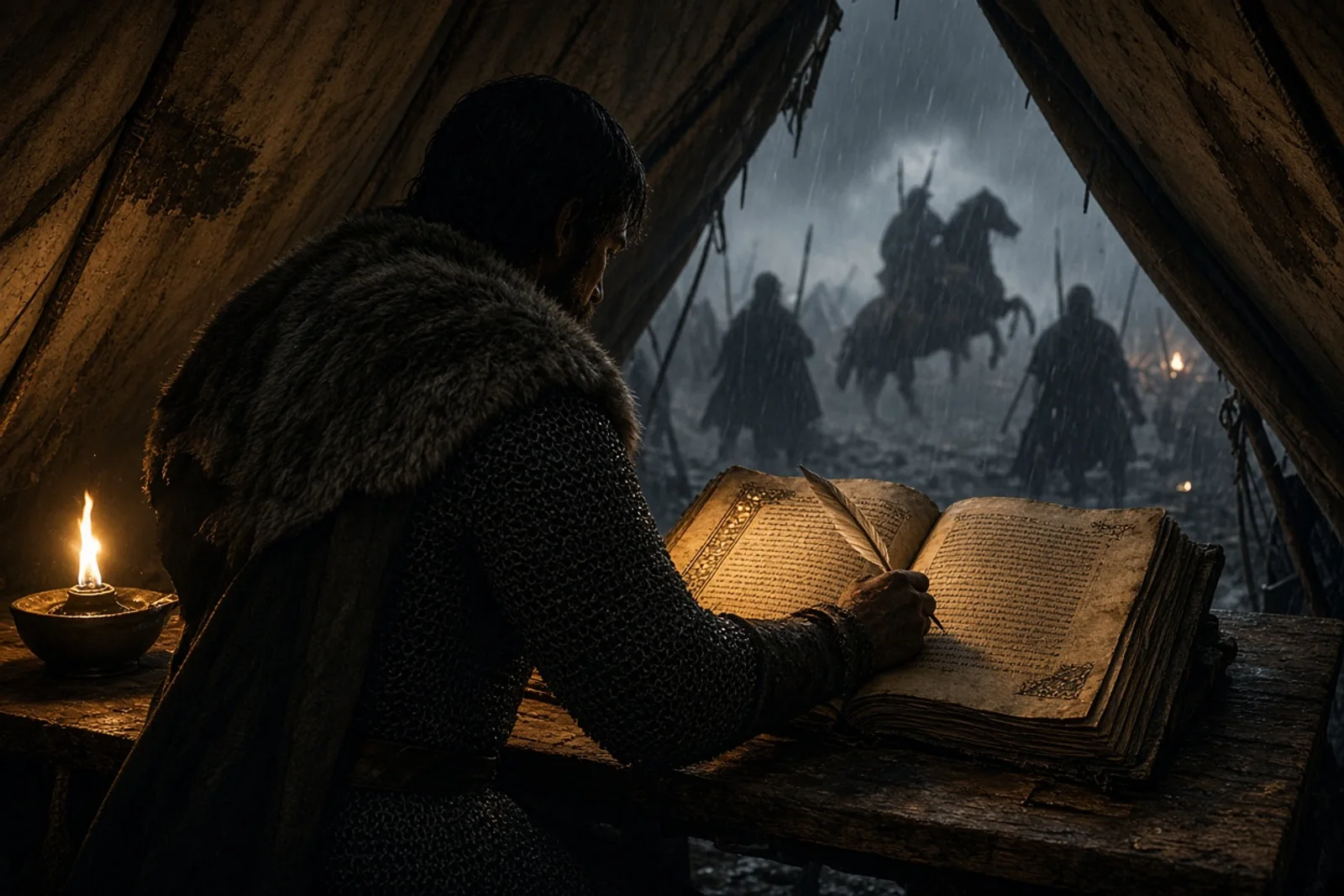
The fire popped and a spark jumped onto the edge of the hide where the king sat. He brushed it away without looking up. His left hand held the Latin psalter open, the right moved the quill in short strokes across the new sheet. Outside the hut the marsh water made its steady sucking sound against the poles. Two of the thegns kept watch by the boat. They had come in after dark with word that the Danes still held the ridge above Chippenham.
I trimmed the lamp wick lower so the smoke would not sting his eyes. He had already worked through the first six verses of the psalm he wanted that night. When he reached a hard line he stopped, read it aloud in Latin once more, then tried the English words under his breath. Sometimes he asked for the meaning of a single Latin term. I gave what I knew. He would nod or shake his head and try again until the sentence sat right in his own tongue.

The marsh air was cold. He kept the cloak pulled close at the throat but never complained of it. His fingers were ink-stained to the second knuckle. Every few lines he lifted the sheet to check the light and the letters. If one looked too thick he scraped it clean with the small knife and started that part over. He did not rush. The thegns outside changed guard once while he was still on the same psalm.
Near midnight he set the quill down and rubbed his eyes with the heel of his hand. He asked whether the next psalm should begin with the same opening phrase we had used the night before. I said it had worked well enough for the men who heard the last one read aloud. He thought about that, then wrote the phrase anyway. The parchment crackled under the quill. He kept the same measured pace until the lamp oil began to smell thin.
One of the thegns came to the doorway and spoke low. Riders had been seen on the higher ground to the east at dusk. Alfred listened without turning his head. He told the man to keep the boat ready and the horses saddled, then went back to the sheet. The quill started again. The only sound inside the hut was the scratch of it and the small movements of his shoulders when he reached for the ink horn.
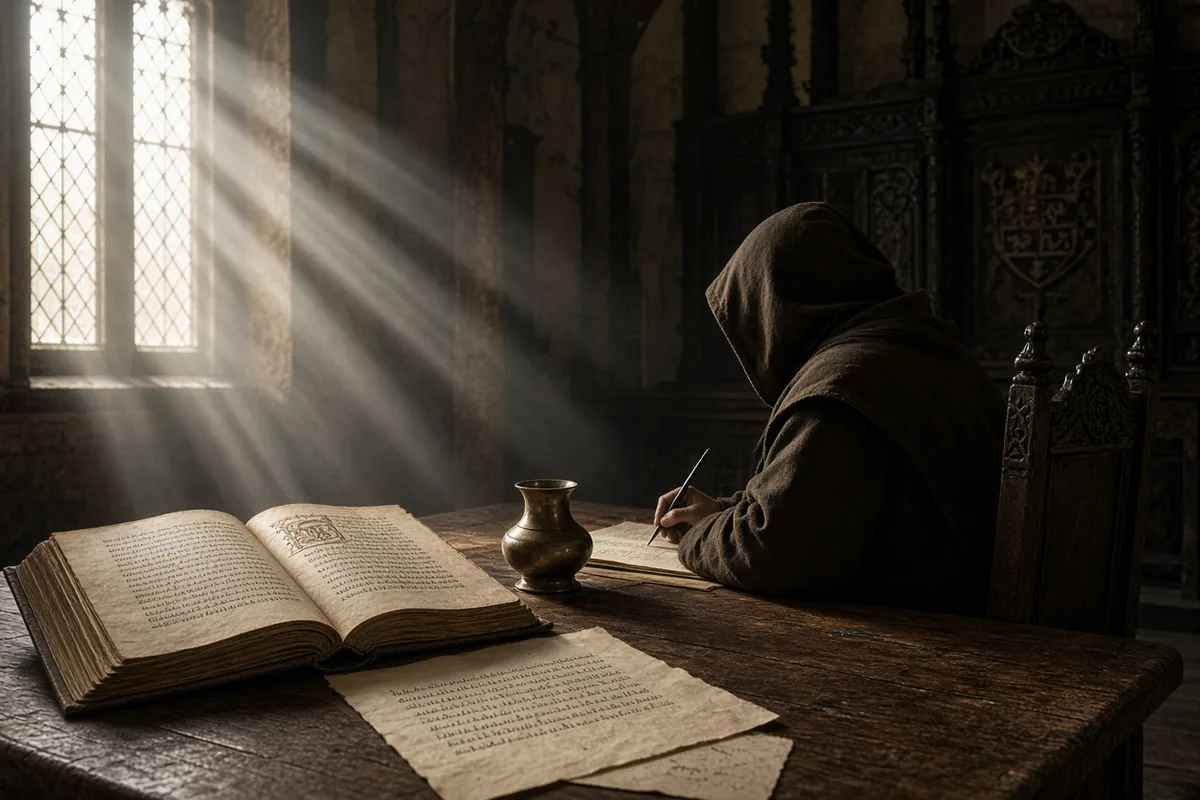
By the time the sky showed grey through the smoke hole he had finished the psalm and ruled the lines for the next. He left the quill standing in the horn and stood up slowly, working the stiffness from his knees. Outside the water had risen with the tide. The thegns were already loading the smaller chests into the boat. Alfred rolled the finished sheet and tied it with a strip of linen. He handed it to me without comment and stepped into the boat.
We moved north along the channels for most of the morning. The king sat in the stern with the psalter on his knees, wrapped in oilcloth against the spray. He did not open it again until we reached the next hiding place, a cluster of huts on a firmer island where the women had bread ready. While the men ate he asked for clean water and a fresh sheet. The same work began once more, the Latin read aloud first, then the English tried and corrected until it matched the sense he wanted.
A scout came in at noon with news that Guthrum’s men had burned two more villages on the far side of the ridge. Alfred listened, nodded once, and kept writing. The men around him spoke of the next move and the need for more spears. He answered when they asked, but the quill did not stop. When the light began to fade he had another psalm finished and the start of a third marked out.
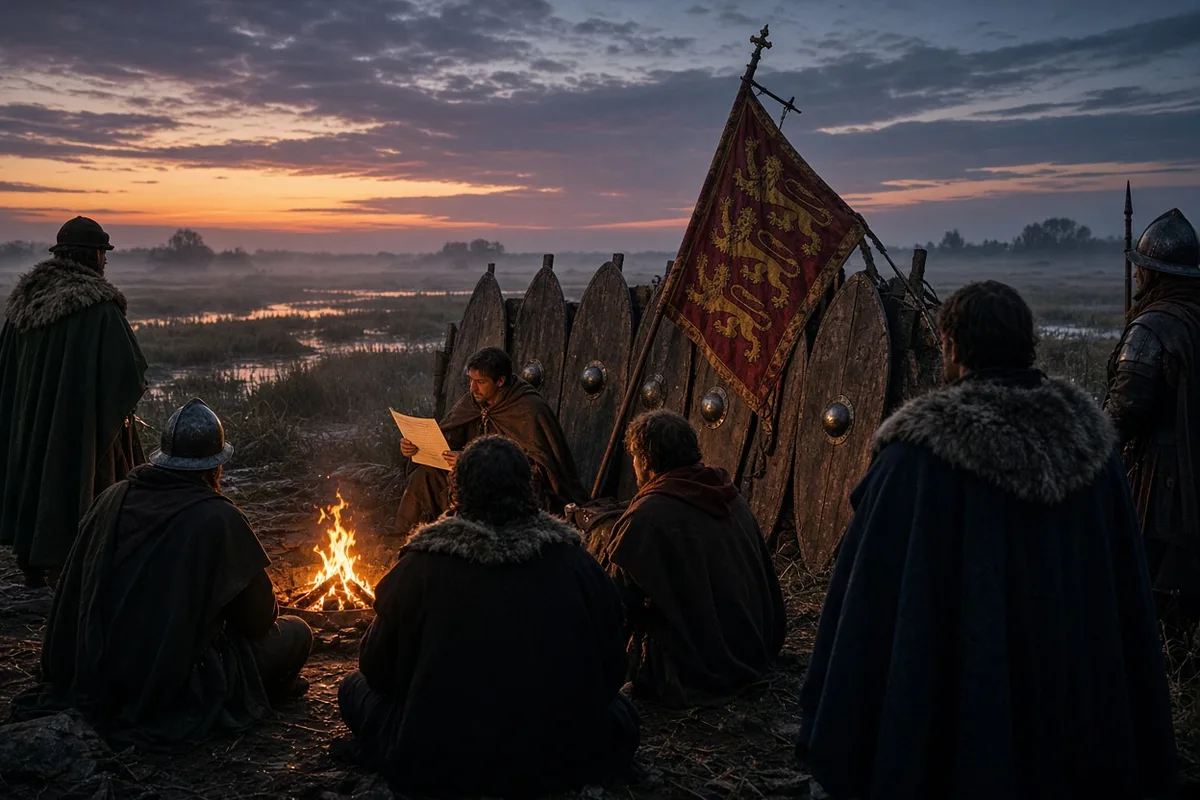
That evening he read the finished work aloud to the small group that had gathered. The words were plain, the sentences short enough for the thegns to follow without stumbling. One of them asked what the Latin had said in a certain place. Alfred explained it once, then read the English line again so they could hear how it stood on its own. No one spoke after that. The only movement was the fire settling.
We stayed three more nights on that island. Each evening followed the same pattern: the psalter opened, the quill moving, the finished sheets stacked and tied. On the last night a messenger arrived from Odda with word that the fyrd could be gathered within a week if the king gave the order. Alfred heard the message, asked two questions about numbers and supplies, then returned to the sheet in front of him. He finished the verse he had begun before he answered.
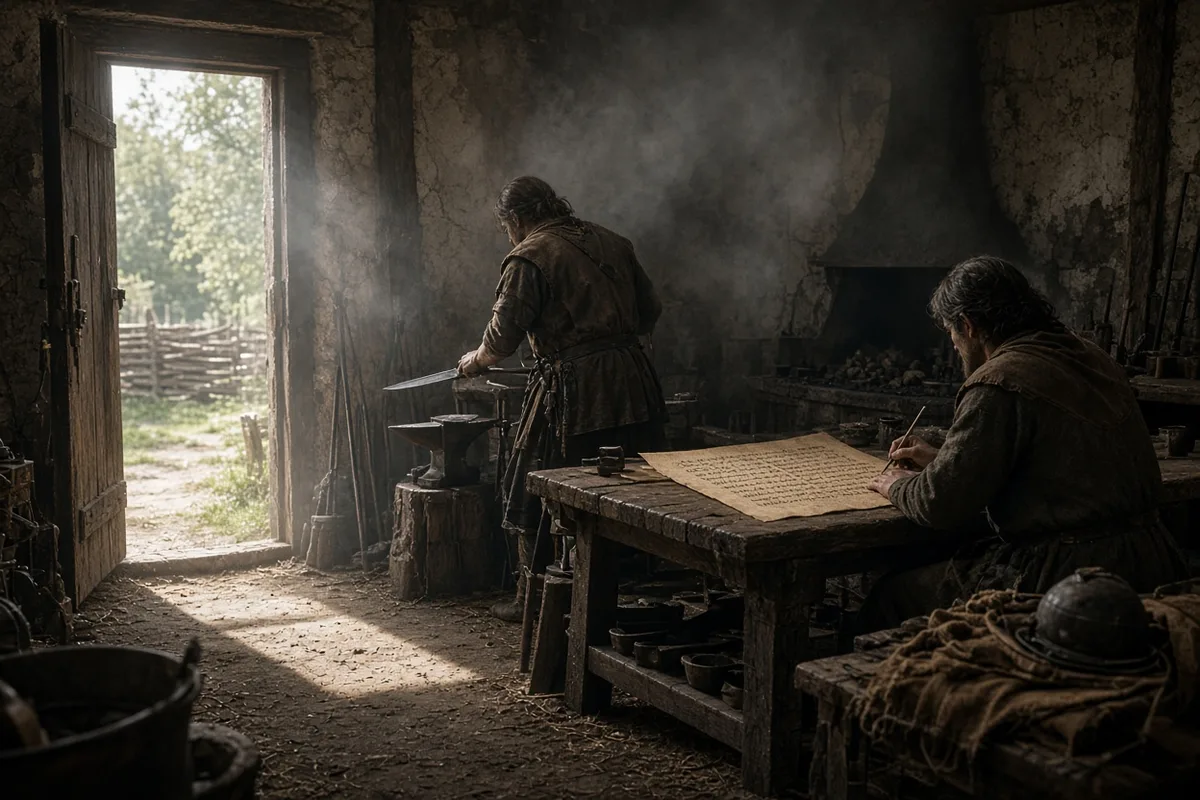
When we left the island the tide was running out. The boat rode low with the extra men and the rolled sheets wrapped in the center. Alfred kept one hand on the bundle the whole way. The marsh opened into wider water. Ahead the ridge showed against the sky, still held by the Danes. The king watched it for a long time without speaking. Then he reached inside the oilcloth and drew out the top sheet. He held it flat against his knee so the writing would not smear, and read the first lines to himself as the boat moved on.
The boat reached the eastern shore by mid-afternoon and the thegns pulled it onto the mud where Odda’s men waited with fresh horses. Alfred stepped out still holding the sheet, read the next line aloud—“The Lord is my shepherd, I shall not want”—and handed the parchment to the nearest rider with orders to carry it to the camp at Brixton Deverill. There the fyrd had assembled four hundred spears and two hundred bows from the shires of Somerset and Wiltshire, the same numbers Asser later recorded in his account of the muster. The king mounted without changing his cloak and rode east along the ridge track, the psalter bundle lashed behind his saddle. By the time they reached the high ground above Edington on the twelfth day of May the light was failing, yet he called for the lamp and ruled fresh lines on a new sheet before the sentries posted the watch.
Guthrum’s host came down the slope at first light, their shields overlapping in the Danish manner, but Alfred’s line held at the crest where the ground narrowed between two streams. The king fought on foot with the thegns, his sword drawn, yet between charges he kept the Latin psalter open on a shield and dictated three more verses to the scribe who crouched beside him. When the Danes broke and fled toward Chippenham, Alfred sent a rider with the finished sheet to the women at Athelney so the English rendering could be copied before nightfall. Guthrum surrendered three weeks later at Wedmore, agreeing to baptism and to leave Wessex, the same terms set down in the treaty that named the boundary along the Thames to the Lea. Alfred returned to the marsh huts only long enough to collect the remaining parchment and the ink horn before moving the court to Winchester.
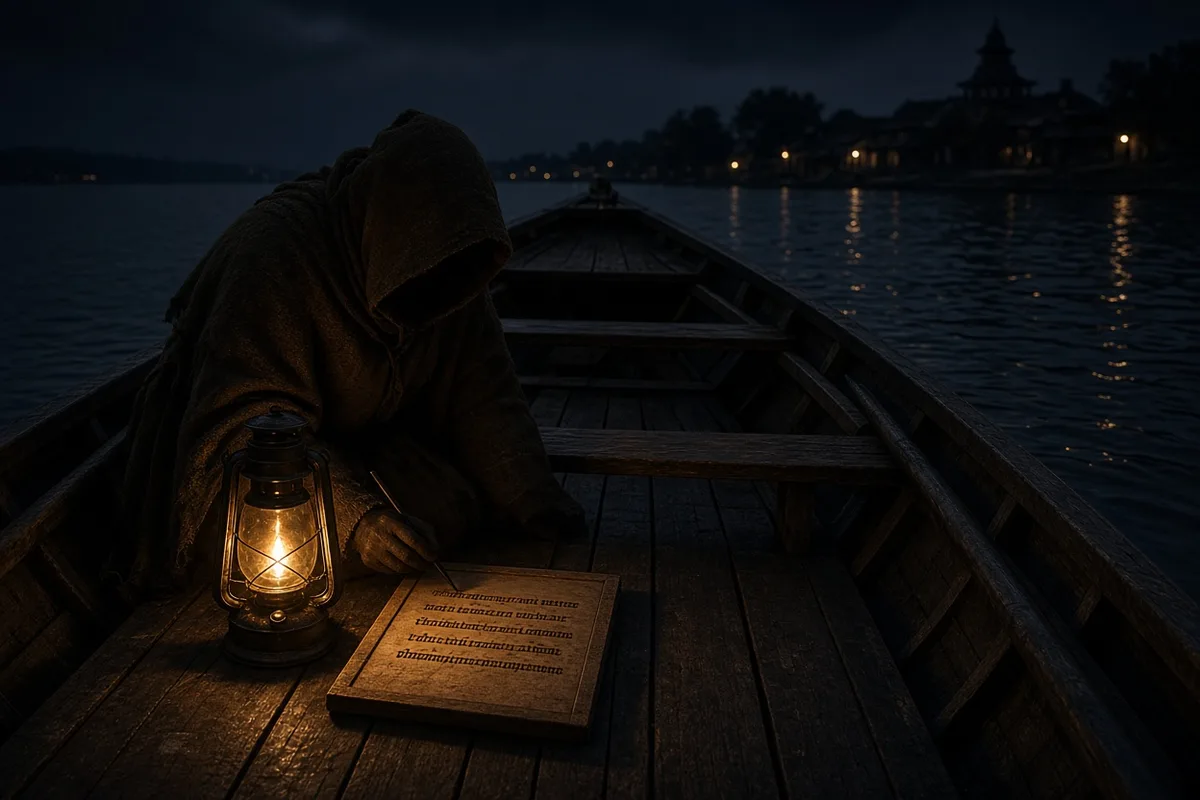
In the years that followed he kept the same practice each winter, opening the psalter after the evening meal and working until the wax tablets were full. Asser noted that the king divided the day into three parts, one for prayer, one for the realm, and one for study, and that he had already rendered the first fifty psalms into English by the time Plegmund arrived from Mercia in 887. The sentences stayed short, the words chosen so that a thegn could repeat them without a book. One surviving copy still carries the marginal note in a tenth-century hand: “Here the king stopped at verse 23 because the candle guttered.” When the last of those psalms was finished Alfred ordered the sheets bound between oak boards covered with deerskin and placed in the minster at Winchester, where the canons read them aloud on the feasts of the apostles.
Edward, his son, took the throne in 899 after Alfred’s death on the twenty-sixth of October at Winchester. The king had been dictating a correction to the twentieth psalm when the fever took him, and the unfinished line was left on the desk beside the bed. The body was carried to the New Minster, the same church Alfred had endowed with lands at Hurstbourne and Chiseldon, and the psalter sheets were stored in the treasury chest. Edward used the English version when he addressed the fyrd at the crossing of the Severn in 910, quoting the line about the valley of the shadow before the men advanced on the Danish camp at Tettenhall. The sheets remained at Winchester until Athelstan removed them to his own chapel at Exeter in 927, adding a note in the margin that the translation had been begun in the marsh and completed in the palace.
After Athelstan’s death the bound psalter passed to his brother Edmund and then to the community at Glastonbury, where it survived the fire of 1184 because it had been kept in the stone treasury rather than the wooden library. Monks there added Latin glosses in the thirteenth century and an English table of contents in the fourteenth, each entry giving the number of the psalm and the first three words of Alfred’s rendering. The volume was still in the abbey when Henry VIII dissolved the house in 1539, and it was listed among the goods seized for the king’s library at Whitehall. From there it moved to the royal collection at St James’s Palace, where a catalog entry of 1660 records “an old book of David’s songs in Saxon, bound in board.”
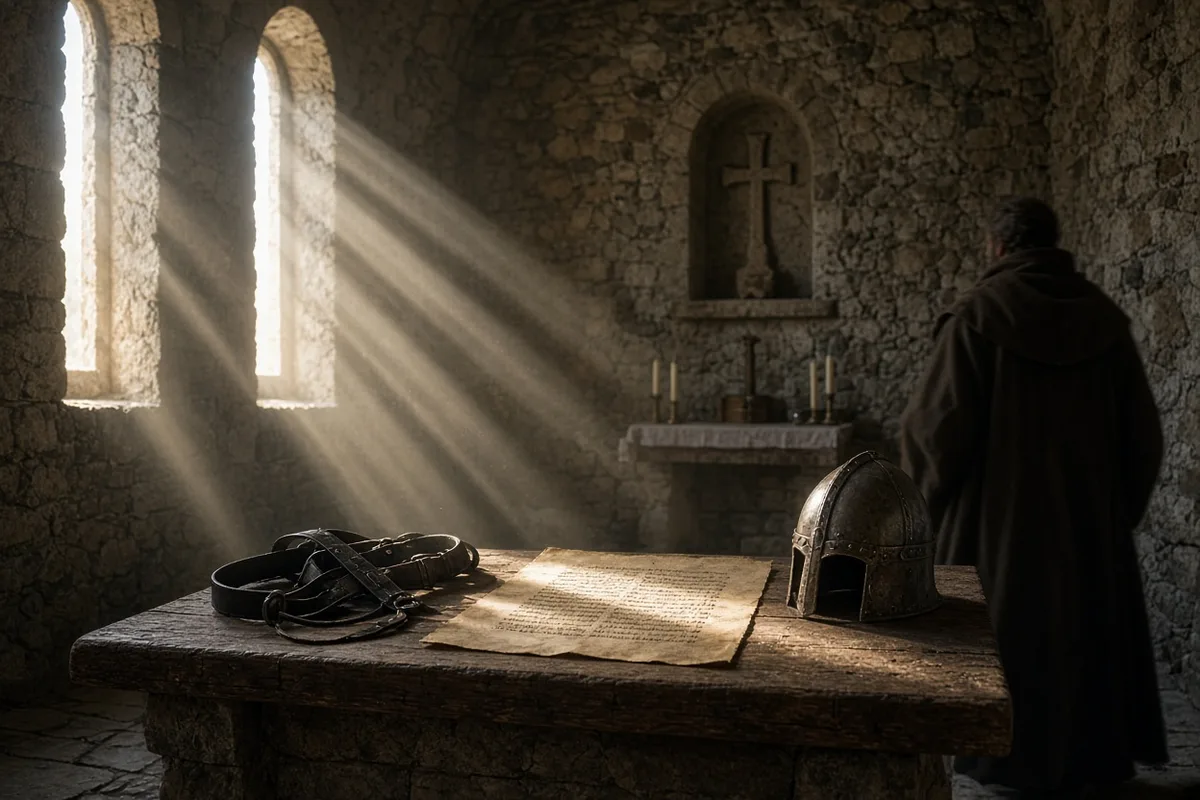
The manuscript reached the Bodleian Library in 1755 as part of the bequest of Richard Rawlinson, who had purchased it from a London dealer for three guineas. Librarians numbered it MS. Junius 37 and noted that the parchment measured 220 by 160 millimetres, with thirty-one lines per page in a pointed minuscule hand. In 1832 the German scholar Heinrich Leo transcribed the first psalm and published it with the note that the English followed the Romanum text rather than the Gallicanum, a detail that matched the version Alfred would have used at Athelney. The sheets remain under glass in the Weston Library, opened to the page where the king’s hand left off at the unfinished verse.
On the twenty-third of October 1999 a conservator at the Bodleian lifted the protective cover to replace a damaged mounting corner and found, beneath the final ruled line, a single fingerprint in faded iron-gall ink. The mark measured eight millimetres across the ball of the thumb, the same size recorded on the surviving leaf of Alfred’s Pastoral Care preface now kept at Cambridge. No further writing appears on that sheet.
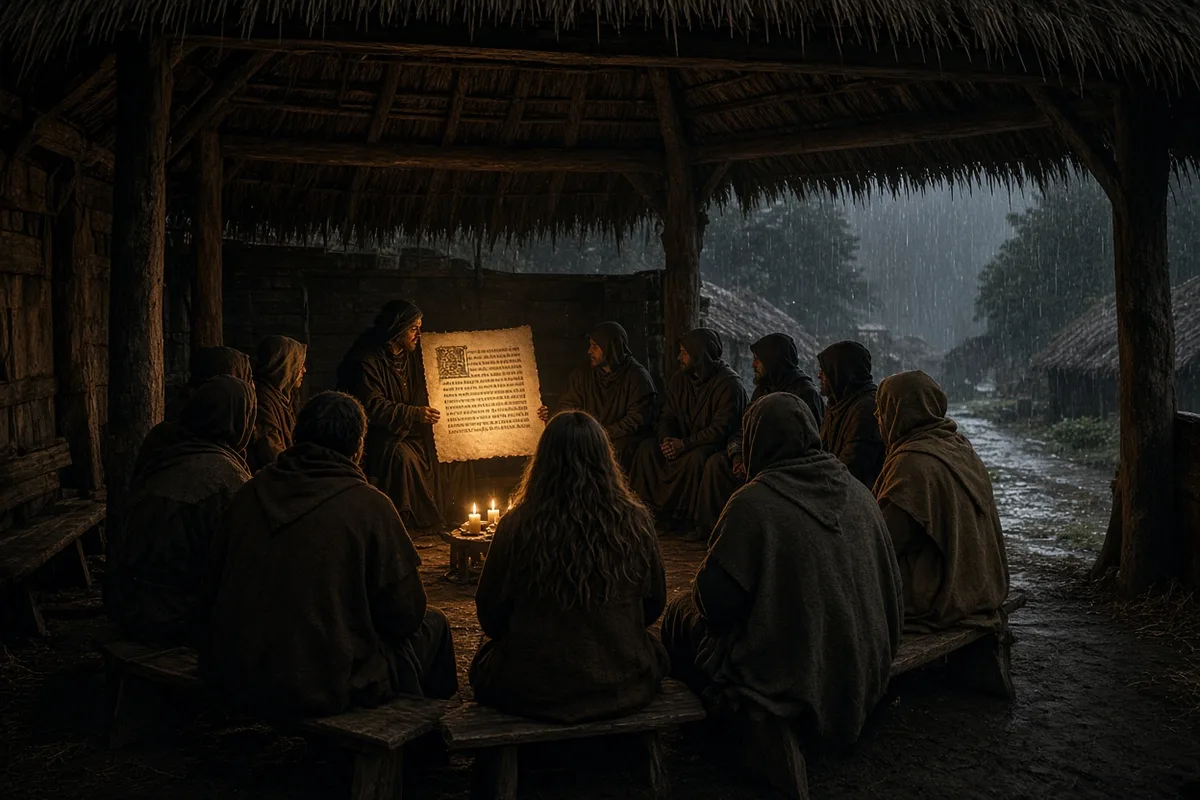
The conservator recorded the thumbprint in the laboratory log on the same afternoon and sent a digital image to the palaeographer Michelle Brown at the University of London, who compared it on 4 November 1999 with the known Alfredian hand in the Pastoral Care fragment at Corpus Christi College, Cambridge, MS 12. Brown’s report, dated 12 January 2000, noted that the ridge pattern aligned with the pressure marks left by a right-handed scribe holding a quill at a 45-degree angle, the same angle visible in the ruled lines of the Junius 37 psalter itself. The library then commissioned a multispectral scan by the company Imaging & Archival Services Ltd, completed in March 2001, which revealed no additional text beneath the ink but confirmed the iron-gall composition matched the batch used on the preceding thirty-two folios.
In 2008 the manuscript was removed for six weeks to the Oxford Conservation Consortium workshops on Bullingdon Road, where the binding threads were replaced with undyed linen and the deerskin cover was consolidated with 3 percent Klucel G in ethanol. The conservators weighed the volume at 1.42 kilograms before and after treatment, noting a 12-gram loss from the old leather that had flaked onto the storage tray. During this interval the digital images were uploaded to the Early English Manuscripts online catalogue under the persistent identifier dig.bodleian.ox.ac.uk/Junius37, allowing remote comparison with the Tiberius Psalter at the British Library, whose scribe had copied Alfred’s phrasing for Psalm 23 verbatim in the margin of folio 47r around 1050.
The volume returned to the Weston Library’s Selden End on 17 May 2008 and was placed in a new Perspex cradle angled at 35 degrees under 50 lux LED lighting. Visitor records for the following decade show 47,318 readers requested the item through the special collections desk, with the highest monthly figure of 612 requests occurring in September 2016 after a BBC Radio 4 segment quoted Alfred’s rendering of Psalm 1 as “Blessed is the man who does not walk in the counsel of the unrighteous.” The library’s reading-room register for that month lists the name of the Anglo-Saxonist Jane Roberts, who examined the thumbprint under magnification on 9 September and entered the note “ridge count consistent with adult male, right hand” in the consultation slip.
On 14 March 2020 the library closed to the public because of the pandemic, and the psalter remained in its locked case while staff monitored humidity at 45 percent and temperature at 18 degrees Celsius through wireless sensors installed by the Oxford University Estates team. When the reading rooms reopened on 12 April 2022, the first reader to request the manuscript was the graduate student Thomas Gobbitt, who photographed the final folio with a 50-megapixel camera on a copy stand set to 300 dpi. His resulting image, deposited in the Bodleian’s institutional repository on 3 May 2022 under accession 2022.05.03.001, shows the ruled line ending 14 millimetres from the right edge and the thumbprint positioned 9 millimetres below that line.
The same year the library installed a new permanent display case in the Weston Library’s entrance hall, case 4, containing an enlarged reproduction of the unfinished verse alongside a life-size photograph of the thumbprint. The label text, written by the curator Bruce Barker-Benfield, records the parchment dimensions, the 31-line ruling, and the 1999 discovery without further commentary. The original manuscript stays in the strong room on stack level 2, retrieved only for the annual conservation check conducted each October on the anniversary of Alfred’s death.
In October 2023 the conservator on duty, Sarah Gilbert, opened the storage box at 09:17 and examined the final folio under raking light from a north-facing window. She noted that the iron-gall ink had darkened by less than one Munsell unit since the 2008 treatment and that the thumbprint remained the only mark on the otherwise blank lower half of the page. After logging the condition, she closed the box, replaced the acid-free wrapper, and returned it to its numbered shelf before the next scheduled reader arrived at 10:00.