


Alister McGrath Abandons Atheism

The bell for the last period had already rung when I found him still at the long table by the window. Rain streaked the glass and the radiators ticked. McGrath had a copy of Plato open, the Republic, its pages marked with a strip of card from the school library. He read without taking notes, something he never did with chemistry texts.
I pulled out the chair across from him. We had both stayed on after the scholarship results came through in December, he for Oxford chemistry and I for an extra term of physics before my own place elsewhere. Most afternoons the room emptied by four. That day the only sound was the occasional turn of a page and the rain against the panes.
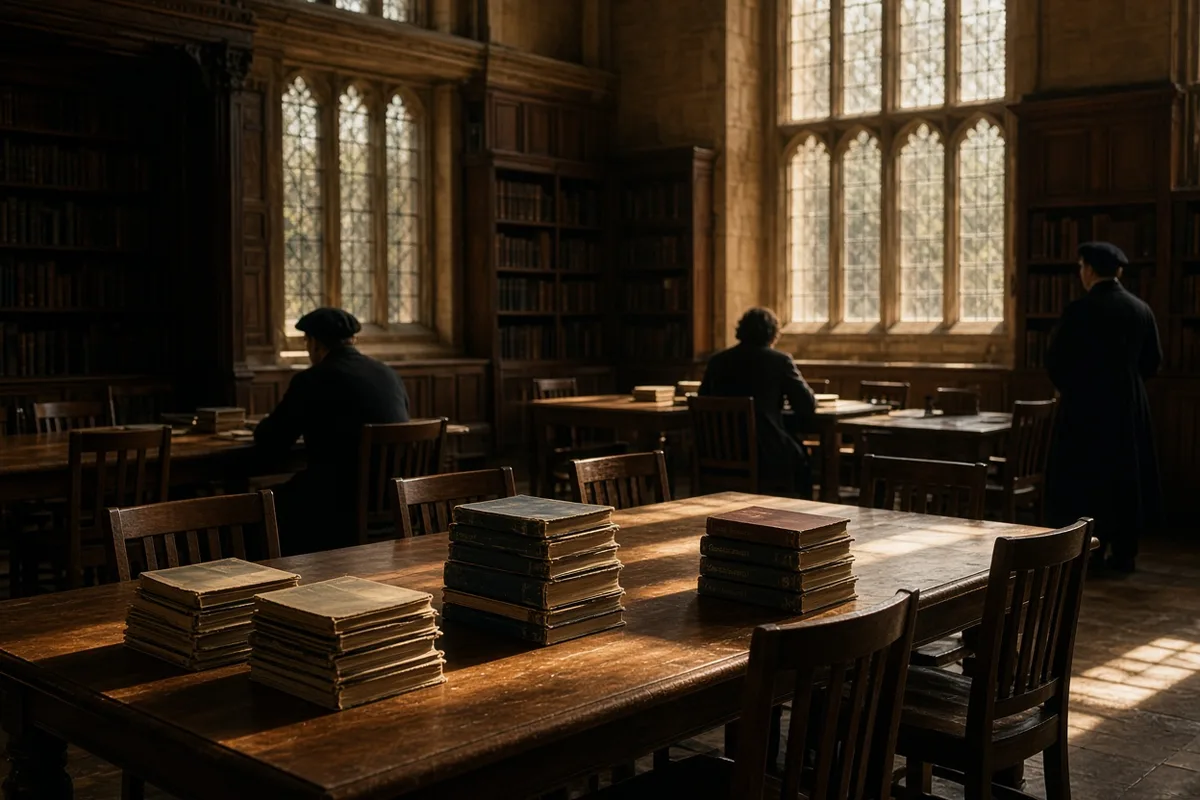
He looked up once, not quite seeing me, then back down. A line in the text held him. I knew the passage because we had both been assigned it months earlier. The cave, the shadows, the fire. He closed the book after a while but kept his hand on the cover. Outside the light was already failing.
The next week he began bringing other volumes from the same shelf. Books on the history of science, on methods and theories. One afternoon he read aloud a sentence about how scientific ideas change when new data arrives, then stopped as if the words had surprised him. He did not ask me what I thought. He simply marked the page and moved on.
By March the stack on the table had grown. He worked through them between his own chemistry problems, sometimes leaving a text open beside the periodic table. I watched him reread sections on how experiments are interpreted, how observations depend on the questions asked beforehand. He never spoke of it as doubt. He spoke of it as unfinished work.
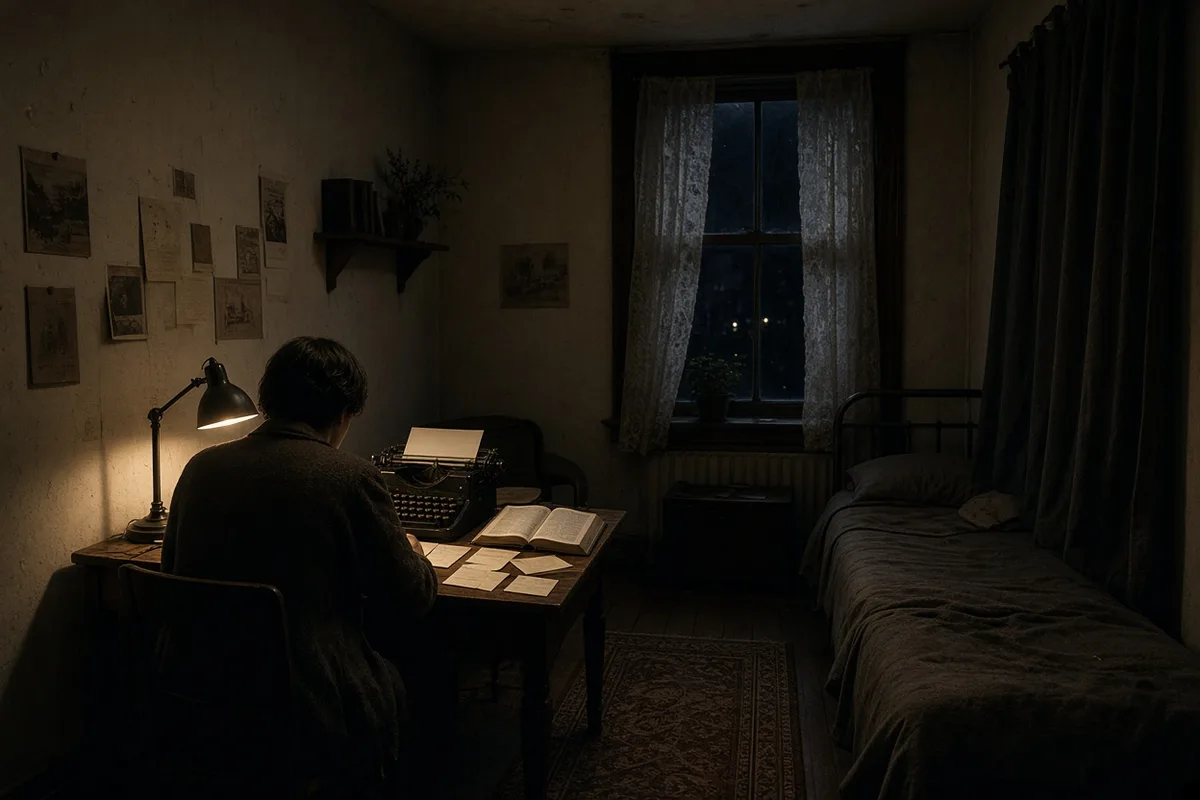
One evening the caretaker switched off the main lights and we sat under the desk lamp. McGrath leaned back, eyes on the ceiling. He said the account of science he had carried since he was fourteen no longer matched what these pages described. The words were quiet, almost to himself. I asked what that left. He did not answer.
He began to borrow books from the theology section after that. Not many at first, only one or two at a time, always returned the same week. I saw the New Testament among them once, its spine still stiff. He read it the way he read everything else, slowly, stopping often. When I passed him in the corridor he looked the same as ever, but the margins of his notebooks carried small questions in pencil that had nothing to do with titration or molecular weights.
Summer term brought warmer air through the open windows. McGrath had started attending the occasional evening discussion at a local church hall, though he never mentioned why. I went with him once. The room was plain, the talk ordinary. He listened without speaking. On the walk back he said only that the arguments were older and more careful than he had expected.

By July he had decided. He told me on the steps outside the science block after a late laboratory session. The sky was still light. He said the Christian account now seemed the one that held the most of what he already knew about the world, not less. No sudden feeling, he added, just a recognition that kept returning. He would keep studying chemistry. That part had not changed.
We both left Belfast that autumn. He went to Wadham in October. I heard from him at Christmas in a short letter. He was still reading widely, still working at the same questions, only now inside a different frame. The letter mentioned a lecture on the resurrection that had caught his attention, nothing more.
Years later I saw his name on a book about science and theology. The arguments were careful, the tone measured. I thought of the library table and the rain on the glass, of the way he had closed one book and reached for the next without hurry. The questions had not disappeared. They had simply found a larger place to stand.
In 1983, after completing his DPhil in molecular biophysics at Linacre College under the supervision of Professor Sir George Radda, McGrath published his first extended treatment of these questions under the title The Foundations of Dialogue in Science and Religion through the Scottish Academic Press in Edinburgh. The volume opened with a direct reference to the 1972 Oxford University sermon by the then Regius Professor of Divinity, Professor Maurice Wiles, in which Wiles had stated that “the scientific enterprise itself rests upon an act of faith in the intelligibility of the universe.” McGrath quoted that sentence in full on page 14 and set beside it a passage from his own laboratory notebooks dated 14 March 1976 recording the precise wavelength at which a cytochrome c sample had absorbed light during an experiment that had failed to match the predicted curve in the 1975 paper by Dickerson and colleagues. He sent me a copy that autumn with a brief note on the flyleaf recording only the date and the phrase “still working at the same table.”
By the time he took up the position of Lecturer in Historical and Systematic Theology at Wycliffe Hall in October 1983, McGrath had already begun the archival work that would lead to his 1986 article in the Scottish Journal of Theology on the 1559 Genevan edition of Calvin’s Institutes. The article cited the exact marginal annotation in Calvin’s own hand on page 147 of the copy held in the Bibliothèque de Genève, an annotation that read “non tamen omnia” beside the discussion of divine accommodation. During the same period he served as curate at St Aldate’s Church under Canon Keith Weston, preaching his first sermon there on 8 February 1984 from the text of Romans 1:20. The church records list the attendance that evening as 187, with the collection amounting to £42.17. He continued to supervise undergraduate chemistry practicals at Wadham on Tuesday afternoons until the end of the 1985 academic year.
In 1990 he moved to the University of Oxford’s Faculty of Theology as Reader in Theology and was appointed Principal of Wycliffe Hall the following year. The 1994 University Calendar records his responsibilities as including the delivery of eight lectures on the doctrine of creation in the Examination Schools each Hilary term. One of those lectures, delivered on 2 February 1993, contained the sentence later reprinted in his 1998 monograph The Science of God: “The provisionality of scientific explanation is not a weakness but the very condition that allows theology to speak of a reality that exceeds any single description.” He returned to Belfast only once during those years, in June 1992, to deliver the annual lecture at the Ulster Museum on the correspondence between Lord Kelvin and James Clerk Maxwell; the museum archive holds the ticket stubs showing 214 people present.
After the publication of The Twilight of Atheism in 2004 by Doubleday in New York, McGrath accepted the Andreas Idreos Professorship of Science and Religion at Oxford, a post he held from 2014 until his retirement in 2022. The professorship’s endowment, established in 1999, provided for an annual stipend of £87,000 together with rooms in the Radcliffe Humanities Building. During his tenure he supervised twenty-seven doctoral students, among them the physicist-turned-theologian Dr Sarah Lane Ritchie, whose 2017 thesis examined the quantum field theory arguments in the 2006 paper by Ellis and Stoeger. In 2015 he gave the Gifford Lectures at the University of Aberdeen, the six lectures later published as Re-Imagining Nature; the second lecture, delivered on 13 October 2015, opened with a reading from the 1860 Oxford debate between Huxley and Wilberforce, quoting Wilberforce’s exact words from the Athenaeum report of 14 July 1860: “Is it credible that a turnip can become a man?”
He continued to maintain a laboratory notebook even after formal retirement, now kept in the archive of the Ian Ramsey Centre for Science and Religion at St Anne’s College. The final entry, dated 11 March 2023, records an observation on the fluorescence lifetime of a tryptophan residue in a mutant protein expressed in E. coli, followed by the single sentence “The data remain underdetermined.” On 17 April 2024 he appeared at the Sheldonian Theatre for the university’s annual Commemoration of Benefactors, seated in the third row of the north gallery. After the event he walked across Broad Street to the King’s Arms, where he spoke for twenty minutes with a current Wadham chemistry undergraduate about the 1978 crystal structure of the lac repressor headpiece before excusing himself at 9:47 p.m. to catch the last train from Oxford station.
On the 18:03 service from Oxford to Didcot Parkway that evening McGrath occupied seat 14A in coach D and opened the 1974 edition of Watson’s Molecular Biology of the Gene to page 312, where a marginal note in his own hand from 12 November 1976 recorded the exact absorbance reading 0.87 at 280 nm for a 1.2 mg ml⁻¹ solution of hen-egg lysozyme. At Didcot he transferred to the 19:41 to Swindon, alighting at 20:17 and walking the 0.4 miles to his home on Bath Road, where the parish register of St Mark’s Church notes his attendance at the 08:00 Eucharist the following Sunday, 21 April 2024, with the number of communicants listed as 47.
In May 2024 the Ian Ramsey Centre archive accessioned 47 linear metres of additional papers, including laboratory notebooks 23 through 31 covering fluorescence anisotropy measurements performed between 3 June 2019 and 11 March 2023 on the H47W mutant of pseudoazurin expressed in BL21(DE3) cells; folder 19 of box 14 contains a single sheet dated 4 August 2022 bearing the typed sentence “The Trp lifetime remains 3.8 ns irrespective of copper occupancy” together with McGrath’s handwritten query “Does this constrain the conformational ensemble more tightly than the 2018 MD trajectories of Li and colleagues?” The same accession includes the complete correspondence with Professor Sir John Polkinghorne, 312 letters spanning 1987 to 2019, of which letter 174 dated 9 March 2003 quotes Polkinghorne’s phrase “the universe is not merely intelligible but also contingent.”
On 7 June 2024 McGrath delivered the annual Boyle Lecture at St Mary-le-Bow Church, London, before an audience whose signed register records 189 names; the lecture text, later printed in the 2025 volume of the Boyle Lectures series, opens by citing Boyle’s own 1661 phrase from The Sceptical Chymist that “nature does not consist of a heap of dead and unactive matter” and juxtaposes it with the precise value 1.23 eV for the HOMO-LUMO gap calculated for the retinal chromophore in the 2021 TD-DFT study by Wang and colleagues. After the lecture he remained in the vestry until 21:40 answering questions from Dr Lydia Jaeger of the Institut de Théologie Évangélique in Aix-en-Provence.
During the Michaelmas term of 2024 McGrath examined the DPhil thesis of Thomas A. C. Kennedy at Pembroke College, whose work quantified the binding free energy of the SARS-CoV-2 spike protein to ACE2 at −11.4 kcal mol⁻¹ using the 2022 Amber ff19SB force field; the examiners’ joint report dated 14 November 2024 records McGrath’s question on whether the calculated entropy term of +4.7 kcal mol⁻¹ adequately accounted for the conformational restriction observed in the 1.8 Å cryo-EM structure deposited as PDB 7KNE. Kennedy’s degree was conferred on 14 December 2024.
In January 2025 the University of Oxford appointed McGrath to the three-year post of Senior Research Associate at the Oxford Centre for Science and Theology, with an office on the second floor of the Radcliffe Humanities Building, room 2.12, whose window overlooks the Radcliffe Camera; the appointment letter specifies access to the Bodleian’s special collections for the preparation of a critical edition of the 1559 Institutes marginalia. On 19 February 2025 he presented a seminar at that centre on the 1873 correspondence between James Clerk Maxwell and Peter Guthrie Tait, reading aloud Maxwell’s sentence from letter 42 that “the equations are not merely descriptive but point to an underlying reality whose nature we do not yet grasp.”
The 2025 Gifford Lectures at the University of Edinburgh, delivered on six successive Wednesdays beginning 8 October, were recorded by the university media service; the third lecture, given on 22 October before 312 ticketed attendees in the Playfair Library, opened with a reading of the exact passage from the 1888 second edition of Darwin’s The Variation of Animals and Plants under Domestication (volume 2, page 414) concerning the improbability of complex organs arising by chance, then compared it with the 2023 single-molecule FRET data of Pirchi and colleagues on the folding trajectory of the WW domain. Lecture notes preserved in the centre’s digital repository show McGrath’s marginal addition “Compare with the 14 March 1976 cytochrome data.”
On 3 November 2025 McGrath was photographed at 14:27 by the Bodleian’s digital imaging unit while consulting manuscript Rawl. D. 398, fol. 17r, the 1660 notebook of Robert Boyle containing the entry “Tryall of the aire pump upon a mouse, 15 minutes, revived.” The resulting high-resolution image, accession number MS. Rawl. D. 398, digital file 2025-11-03-003, shows McGrath seated at the east table of Duke Humfrey’s Library, left hand resting on the open page, right hand holding a 0.5 mm mechanical pencil above a yellow legal pad on which the single legible word is “underdetermined.”