



All of recorded history fits in ten cosmic seconds
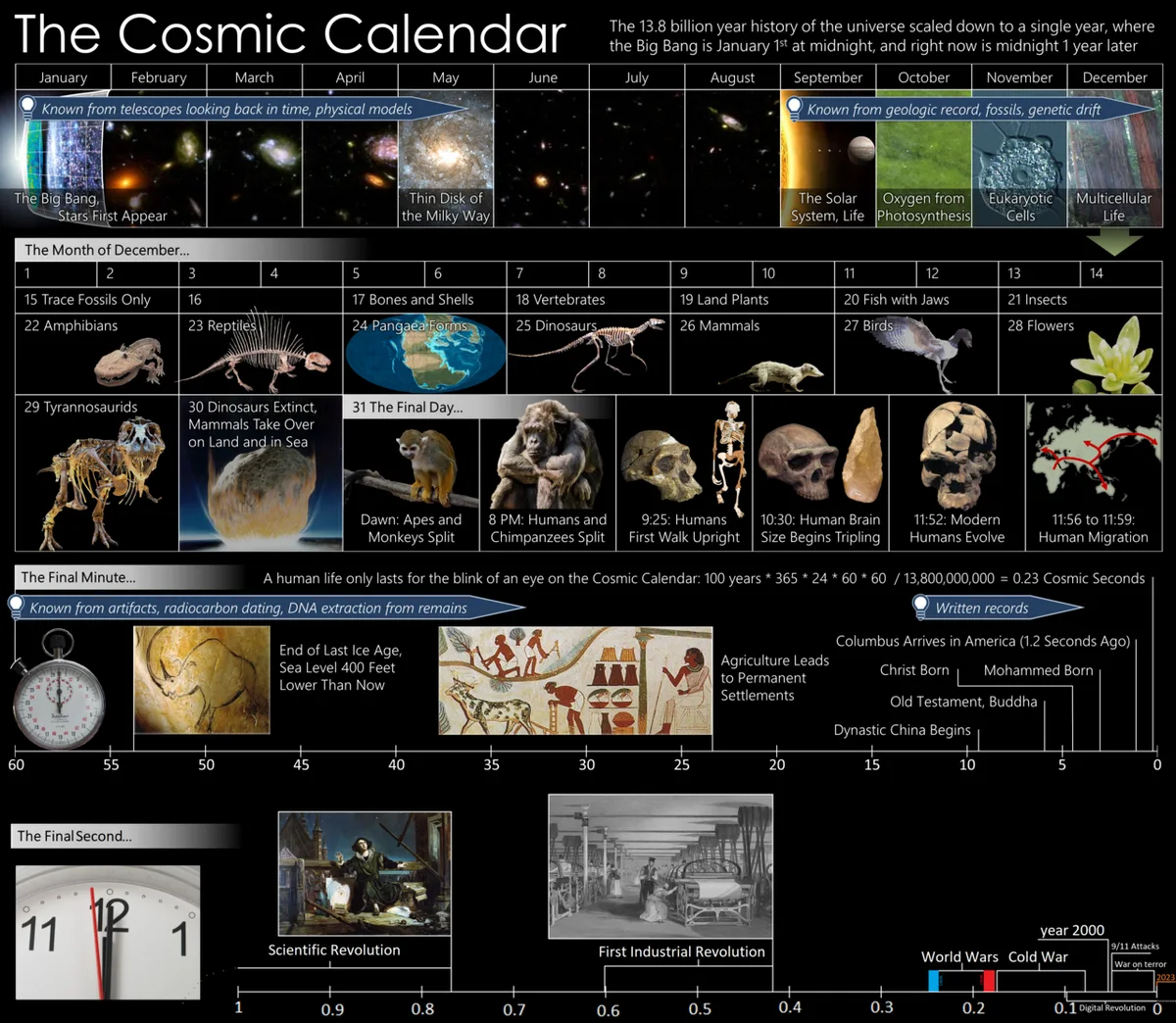
In 60 seconds
- Sagan compresses 13.8 billion years into one calendar year so recorded history occupies only the final ten seconds.
- He treats evolution as a branching DNA fugue, not a ladder aimed at humans, with eyes evolving independently many times.
- Kepler discarded nested Platonic solids when Brahe's Mars data refused them, yielding elliptical orbits instead of perfect circles.
- Venus's runaway greenhouse near 900°F shows planetary habitability is a delicate, non-guaranteed balance.
- Lowell's Martian canals and ambiguous Viking results model how wishful seeing must yield to repeatable evidence.
- From Alexandria's loss to nuclear arsenals, Sagan argues knowledge and technological civilization are fragile and not self-sustaining.
The big idea
Sagan argues the universe is knowable through observation, mathematics, and skepticism, and that this knowledge deepens wonder rather than shrinking it. Humans are a recent, contingent product of evolution who can understand the cosmos, yet the same tools that explore other worlds can end civilization, so only a shared species identity can supply the restraint survival now requires.
The book in brief
Sagan begins by shrinking 13.8 billion years of cosmic time into a single year so that Earth, humans, and all recorded history appear only in the final stretch, arguing that this scale should stop us treating present comforts and conflicts as permanent. He then traces life from self-replicating molecules through DNA's copy-and-error process, presenting evolution as many voices in a fugue rather than a march toward us, and noting that the human brain still carries older instincts alongside reason.
The middle arc follows evidence overturning cherished pictures of the sky and nearby worlds. Kepler abandons an elegant mystical model when precise Mars observations will not fit; spacecraft replace swampy fantasies of Venus with a crushing carbon-dioxide greenhouse; Lowell's canals dissolve under better scrutiny and Viking's ambiguous biology tests; Voyager finds volcanoes on Io, possible oceans under Europa's ice, and ring systems no pre-flight theory fully predicted.
He turns next to the historical fragility of inquiry itself, using ancient Alexandria's scholars and the library's destruction to show that empirical progress can be reversed by dogma, neglect, and violence. The book closes on the Drake Equation and Cold War nuclear stockpiles: a civilization able to broadcast into space is also able to destroy itself, so the open variable is whether any technological species, including ours, matures in time. Sagan's final demand is a species-level identity that can restrain the power the cosmic perspective has helped us gain.
Context
Published in 1980 alongside a mass-audience television series, Cosmos brought rigorous astronomy, physics, and biology to general readers. Sagan framed scientific literacy as a civic necessity rather than a specialist luxury, especially under nuclear threat.
The key ideas

1
The cosmic calendar
Sagan argues human history is a brief late event on a 13.8-billion-year timescale, and treating it as the measure of all things distorts proportion and importance.
He compresses the universe's age into one calendar year with the Big Bang on January 1 and the present in the last seconds of December 31. On that scale Earth appears around September 14, the first humans in the final hour of December 31, and all recorded history in the last ten seconds. The device is foundational, not decorative: once the brevity is felt, current arrangements stop looking like permanent fixtures of reality.
He pairs the calendar with the 'cosmic ocean'—vast mostly empty space occasionally punctuated by planets, stars, and living matter. Intelligent life, he argues, is likely a rare arrangement of ordinary atoms, so what we do with the moment matters because it may be unrepeated nearby.
Method sits beside scale. Claims about the universe must be tested against evidence rather than settled by authority. Ancient constellation maps and structures aligned to celestial events already show the impulse to understand through careful watching, long before modern instruments. Every later chapter returns to this redefinition of human significance by vastness rather than its erasure.
In practice: On Sagan's year-long cosmic calendar, the whole of recorded history occupies only the final ten seconds of December 31.
2
Evolution as fugue
Sagan treats life's history as a branching contingent process shaped by DNA's capacity for error and adaptation, not a ladder aimed at humans.
- Primate cortexReasoning layered last
- Mammalian additionsSocial and emotional circuitry
- Reptilian coreBasic survival drives
He follows self-replicating molecules in early oceans through diversification, with DNA as the medium that writes, copies, and occasionally alters survival information. Mutations arise mostly by chance; environments then filter which ones persist, so complexity accumulates because certain accidents worked, not because they were destined.
The eye evolving independently in unrelated lineages, from mollusks to vertebrates, shows natural selection can converge on similar solutions without a guiding plan. The fugue metaphor insists no single species is the point; each lineage is one voice among millions sharing genetic code from the earliest cells.
Brain evolution proceeds in layers—reptilian survival circuits, then mammalian and primate cortex—so human reasoning sits atop older instincts. That is why irrational fears and tribal impulses persist even in a species capable of calculus and spaceflight. Self-understanding, Sagan argues, therefore requires biology as much as philosophy.
In practice: Sagan cites the eye arising separately in mollusks and vertebrates as evidence that selection can rediscover similar solutions without any foresight.
3
Data over beauty
Sagan argues the shift from Earth-centered astronomy to a heliocentric, law-governed solar system required prioritizing hard data over intuition and inherited belief.
Inherited preference
Nested solids and perfect circular heavens
Data-driven revision
Elliptical orbits forced by Brahe's Mars measurements
Kepler begins committed to nested Platonic solids that elegantly explain planetary spacing. Tycho Brahe's precise Mars observations refuse to fit the model, and Kepler abandons the beautiful wrong idea. From the mismatch he derives three laws of planetary motion, including elliptical orbits that break two thousand years of assumed celestial circular perfection.
Sagan links the episode to institutional resistance: Bruno executed in 1600 partly for an infinite universe of many worlds, Galileo facing the Inquisition for telescopic evidence of Jupiter's moons defending Copernican heliocentrism. Evidence-based revision of cherished belief becomes the template for later progress, from Darwin to modern cosmology.
The change was neither instant nor safe. It took decades and real personal risk. The same species capable of superstition-driven persecution is also capable of the discipline that overturns its own myths when institutions fail to fully suppress the process.
In practice: Kepler drops his nested Platonic-solid cosmology once Brahe's Mars data will not conform, accepting ellipses instead of perfect circles.
4
Venus as caution
Comparing Venus and Earth, Sagan shows planetary habitability is a delicate non-guaranteed balance rather than a fixed property of orbital position.
Early hope
Thick clouds imagined as hiding a lush twin Earth
Measured reality
~900°F surface, crushing pressure, runaway CO₂ greenhouse
Early twentieth-century speculation pictured Venus as lush and swampy behind its clouds. Soviet Venera and American Mariner data revealed surface temperatures near 900°F, crushing pressure, and a dense carbon-dioxide atmosphere sustaining a runaway greenhouse.
A modest initial difference in solar heating and volcanic outgassing sent the two planets on divergent paths. If Venus once had oceans, they boiled away; carbon stayed locked in the atmosphere as gas instead of sequestered in oceans and rock as on Earth.
Sagan draws the parallel, striking for 1980, to Earth's own carbon-dioxide rise from fossil fuels: Earth's climate is far from Venus's extreme yet not immune to the same category of feedback if greenhouse gases accumulate unchecked. Planetary science becomes applied self-knowledge—stress-testing the physics that govern our own world.
In practice: Spacecraft showed Venus at nearly 900°F under a runaway carbon-dioxide greenhouse, overturning earlier swamp-world guesses.

5
Canals of the mind
Sagan uses the search for life on Mars to show both the seductive power of wishful pattern-seeking and the discipline required to correct it with better evidence.
Lowell's Mars
Canal networks and a dying irrigating civilization
Viking-era Mars
Ambiguous soil chemistry, no confirmed life, possible ancient water
Percival Lowell, in the late 1800s and early 1900s, claimed a network of canals and built a theory of a dying civilization irrigating a desert world. The canals were optical and psychological illusion—structure imposed on faint, ambiguous telescopic detail. Even trained observers can fool themselves; methodical repeatable observation outranks confident testimony.
The 1976 Viking landers, which Sagan worked on, ran biology experiments aimed at metabolic activity in Martian soil. Early results were ambiguous and raised hopes, yet were ultimately best explained by unusual chemistry rather than life. Sagan leaves the question unresolved rather than forcing certainty.
Mars itself—Olympus Mons, Valles Marineris, possible ancient rivers and lakebeds—suggests a wetter past. Present conditions do not reveal full history without direct investigation, and hopes for canals or microbes must be checked against data gathered without emotional investment in the outcome.
In practice: Lowell's elaborate canal civilization collapses into optical illusion once better observations replace confident individual seeing.
6
Unexpected outer worlds
Sagan argues robotic exploration of the outer solar system revealed environments so strange that no pre-mission theorizing could have substituted for direct observation.
- 1IoActive sulfur volcanism hundreds of km high
- 2EuropaSmooth cracked ice suggesting subsurface ocean
- 3Saturn's ringsCountless particles, not solid bands
- 4TitanThick nitrogen atmosphere and hydrocarbon haze
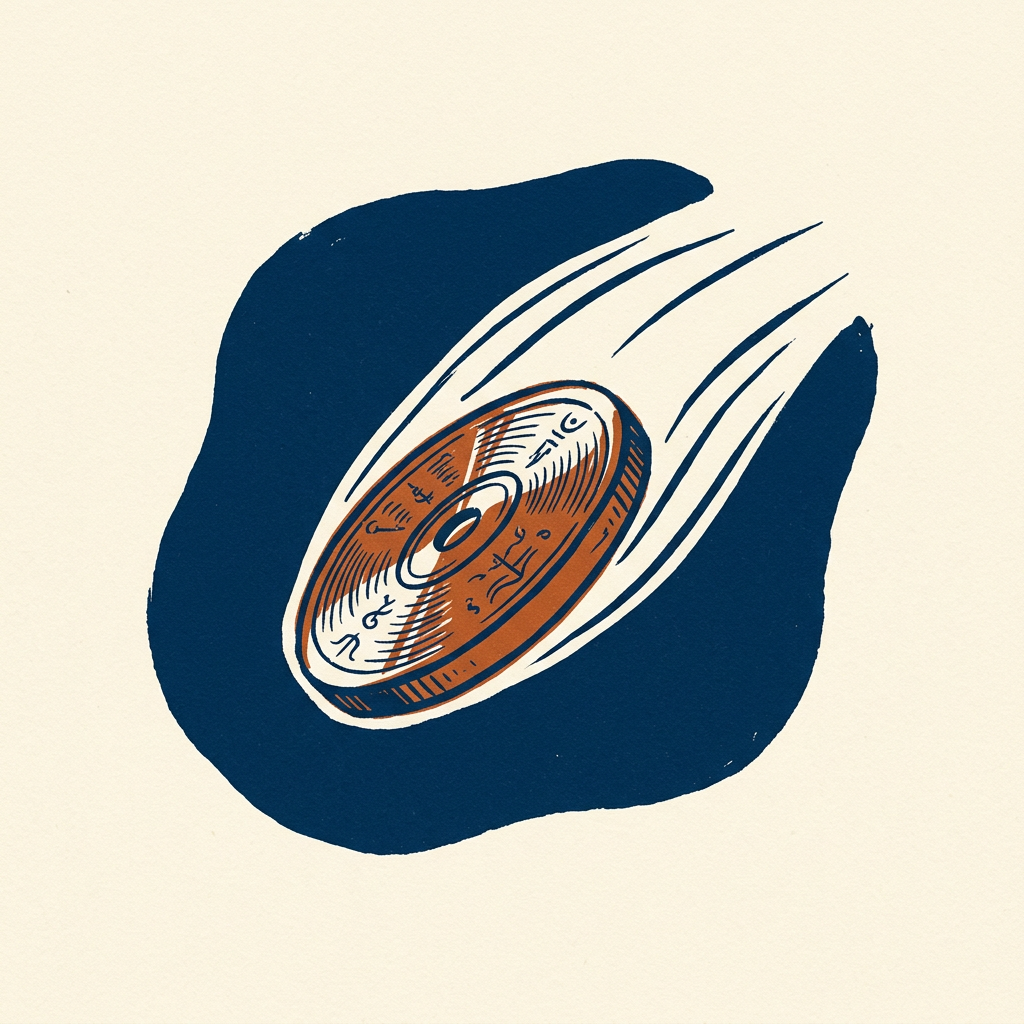
Voyager, launched in 1977 with instruments Sagan helped design and carrying Golden Records of Earth's sounds and images, flew past Jupiter, Saturn, Uranus, and Neptune. Findings repeatedly upended assumptions: active sulfur volcanism on Io hurling material hundreds of kilometers; Europa's smooth cracked ice hinting at a subsurface ocean; Saturn's rings resolved into countless individual particles rather than solid bands; Titan's thick nitrogen atmosphere and hydrocarbon haze.
Theoretical modeling before encounter, however sophisticated, consistently underestimated real diversity. Voyager becomes the physical extension of the same impulse that once drove Kepler to fit orbits to data—instruments now sent into the realm being studied.
Sagan also presses the practical case for continued exploration, arguing such missions return scientific value disproportionate to their cost relative to military budgets, countering contemporary skepticism about funding.
In practice: Io's active volcanoes and Europa's cracked icy surface were among the Voyager surprises no Earth-bound model fully predicted.
7
Fragile libraries
Sagan holds that suppression of inquiry—from the Library of Alexandria to Hypatia's murder—proves scientific progress is historically fragile and reversible.
- ~240 BCEEratosthenes measures Earth by shadows
- 415 CEHypatia murdered amid rising intolerance
- Later centuriesLibrary losses by conflict, neglect, suppression
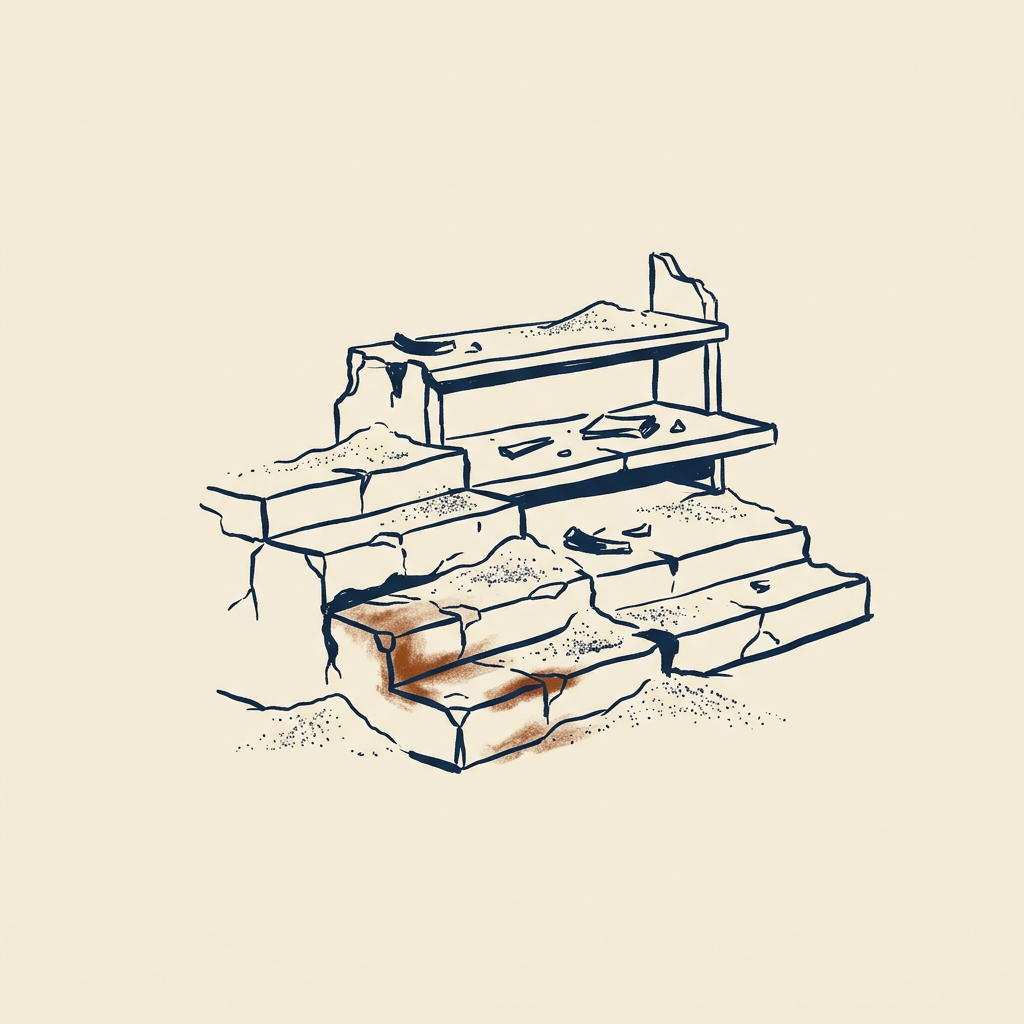
Ancient Alexandria marks a high point of empirical science. Eratosthenes around 240 BCE calculated Earth's circumference from shadow angles at different latitudes with striking accuracy. Hypatia, mathematician and philosopher, was murdered by a mob in 415 CE amid rising intolerance toward pagan learning.
The library's destruction, compounded across centuries by conflict, neglect, and deliberate suppression, is treated as a tragedy of choices that valued dogma over inquiry and set knowledge back for centuries. Collective memory now lives in books, libraries, and electronic archives, always one generation of neglect from loss.
The pattern recurs—Bruno, Galileo, and modern anti-intellectual currents and underfunded education. Knowledge is not self-sustaining; it survives only through active cultural investment in preserving and transmitting it, which is why Sagan treats public science education and funding as civic necessities.
In practice: Eratosthenes measures Earth's circumference with shadow angles around 240 BCE; centuries later Hypatia is murdered and the library's holdings erode through conflict and neglect.
8
Survival as the variable
Sagan argues the statistical chance of other civilizations, joined to the fragility of technological societies, makes long-term survival itself the urgent open question.
- 1Stars and planetsFormation rates and hospitable fraction
- 2Life and intelligenceFraction that develop both
- 3Communicating lifetimeHow long a tech civilization survives itself
The Drake Equation, framed by Frank Drake in 1961, multiplies star formation, planets, hospitable worlds, life, intelligence, and—crucially—the average lifetime of a technological civilization before it destroys itself or fades. Sagan treats that lifetime term as possibly decisive.
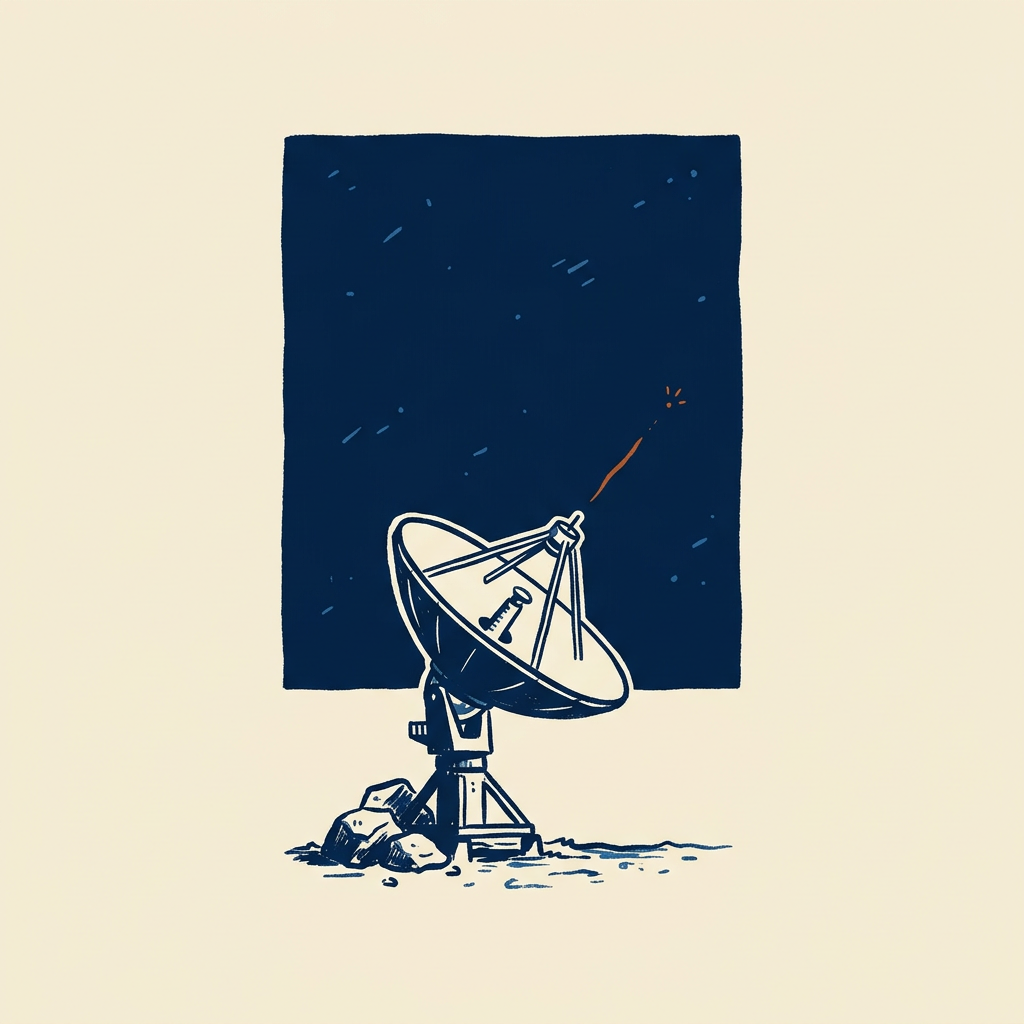
A society that can leak radio and television into space simultaneously holds the means of self-destruction, exemplified by nuclear weapons. SETI's telescope searches are presented as a low-cost, high-payoff gamble, yet the deeper issue is whether any civilization, including Earth's, survives its technological adolescence.
Written amid Cold War arsenals of tens of thousands of warheads, the chapter gathers the book's threads—cosmic scale, evolutionary contingency, fragile knowledge, planetary exploration—into one practical concern. 'Who speaks for Earth' becomes a call for species-level identity strong enough to generate cooperative restraint.
In practice: Sagan pairs Earth's radio leakage with its nuclear stockpiles to show the same technological moment enables contact and self-destruction.
Key terms
- Cosmic calendar Sagan's device that squeezes 13.8 billion years into one year so human history shrinks to the final seconds.
- Cosmic ocean The vast, mostly empty space between stars and galaxies, only rarely holding organized matter and life.
- Evolutionary fugue Life as many contingent branching voices on shared DNA, not a single ladder toward humans.
- Runaway greenhouse Feedback that locked Venus into extreme heat by keeping carbon in the atmosphere instead of rock and ocean.
- Drake Equation Framework multiplying astronomical and biological factors to estimate communicating civilizations, limited by how long they last.
- SETI Radio searches for extraterrestrial signals, framed as a modest-cost scientific gamble.
- Golden Record Voyager discs carrying sounds and images of Earth for any finder beyond the solar system.
What to do
- Test one belief you hold only on authority by spending thirty minutes finding its primary evidence.
- Support one concrete knowledge institution this week—a library, science museum, or school lab budget.
- Reframe one us-versus-them debate at species level and notice whether compromise or caution looks different.
- When a striking claim appears in a headline, pause and ask what observation would falsify it.
- Visit or revisit a planetarium, observatory, or NASA image archive and sit with the scale before checking your phone.
Questions to think with
- If recorded history is ten cosmic seconds, which present conflicts still deserve the weight we give them?
- Where do you still prefer an elegant story over an awkward measurement?
- What would a species-level identity actually require you to restrain or share?
- Which pieces of public knowledge infrastructure near you are one budget cycle from quiet loss?
- Does the absence of a SETI signal so far change how urgent Earth's own survival term feels?
The other side
Sagan's 1980 science is dated on exoplanets, dark energy, and Mars water evidence that arrived later. Historians argue he flattens messy discovery into hero narratives and overstates a single dramatic destruction of Alexandria's library. Non-Western astronomical traditions receive little attention. His cosmic insignificance claim sits uneasily beside the ethical urgency he assigns human survival. Decades of SETI have returned no signal, so the Drake lifetime variables remain as unconstrained as when he wrote.
Who it's for
Curious adults who want physics, biology, and history braided into one narrative without textbook dryness, plus readers wary of science who respond to wonder and story. Anyone seeking a still-pointed case for funding basic research and defending reason will get the most from the full book.