



Animals live in sensory worlds humans cannot share
In 60 seconds
- There is no single real environment, only as many Umwelten as there are sensory systems tuned to survival.
- Chemical senses came first and still structure most animals’ lives; dogs, elephants, catfish, snakes, and moths read the world at resolutions a human nose cannot match.
- Vision, touch, heat, vibration, sound, echolocation, electricity, and magnetism each open channels humans lack the receptors to enter.
- More receptors do not automatically mean richer experience; how a brain uses the signal matters more than the raw count.
- Human light, noise, and vibration are active assaults on other species’ primary senses even when habitat looks intact.
- Protecting animals requires knowing their Umwelten, because you cannot mitigate a harm you cannot perceive.
The big idea
Yong argues there is no single objective environment that animals perceive by degree—only separate sensory worlds, each assembled from whatever detectors a species evolved. Human senses are not a neutral baseline but one narrow configuration, which is why our light, noise, and vibration damage other minds in ways we never feel.
The book in brief
Yong starts from a simple corrective. The physical world is not the world any creature lives in. Each animal inhabits only the thin slice its sensors can detect, and that slice is the whole of its reality.
From there the book moves sense by sense, refusing to treat human categories as the master list. Chemical detection, color and polarized light, specialized touch and the open question of pain, dedicated infrared pits, vibration through water and ground, sound far below and above our hearing, and active biosonar each get their own full treatment. The point is cumulative: every channel can be elevated into a high-resolution system when survival depends on it.
The furthest edge arrives with electricity and magnetism—fields that have no human counterpart at all. Some of these systems are mapped in detail; others, especially magnetoreception, remain mechanistically unsettled. That uncertainty itself serves the argument: science is still only partially charting the space of possible experience.
The final turn is ethical. Once you see how specialized these channels are, human-generated light, shipping noise, and habitat quieting stop looking like background conditions. They become direct interference with the data streams other species need to navigate, mate, and find home. Conservation that counts only acres or chemicals leaves animals inside habitats that are sensorially broken.
The book closes by asking readers to drop the habit of treating human perception as the default and to treat curiosity about alien sensory lives as a practical requirement for sharing the planet.
Context
Ed Yong, a science journalist whose reporting carries Pulitzer-level craft, published An Immense World in 2022. It mattered because it gathered sensory-ecology research across many taxa into one accessible argument that dismantles the assumption that human senses are the complete or default version of reality.
The key ideas
1
No single real environment
Because every species detects only a narrow slice of stimuli, there is no single real environment—only as many Umwelten as there are sensory systems.
Full physical world
Colors, shapes, sounds, and every detectable stimulus present at once
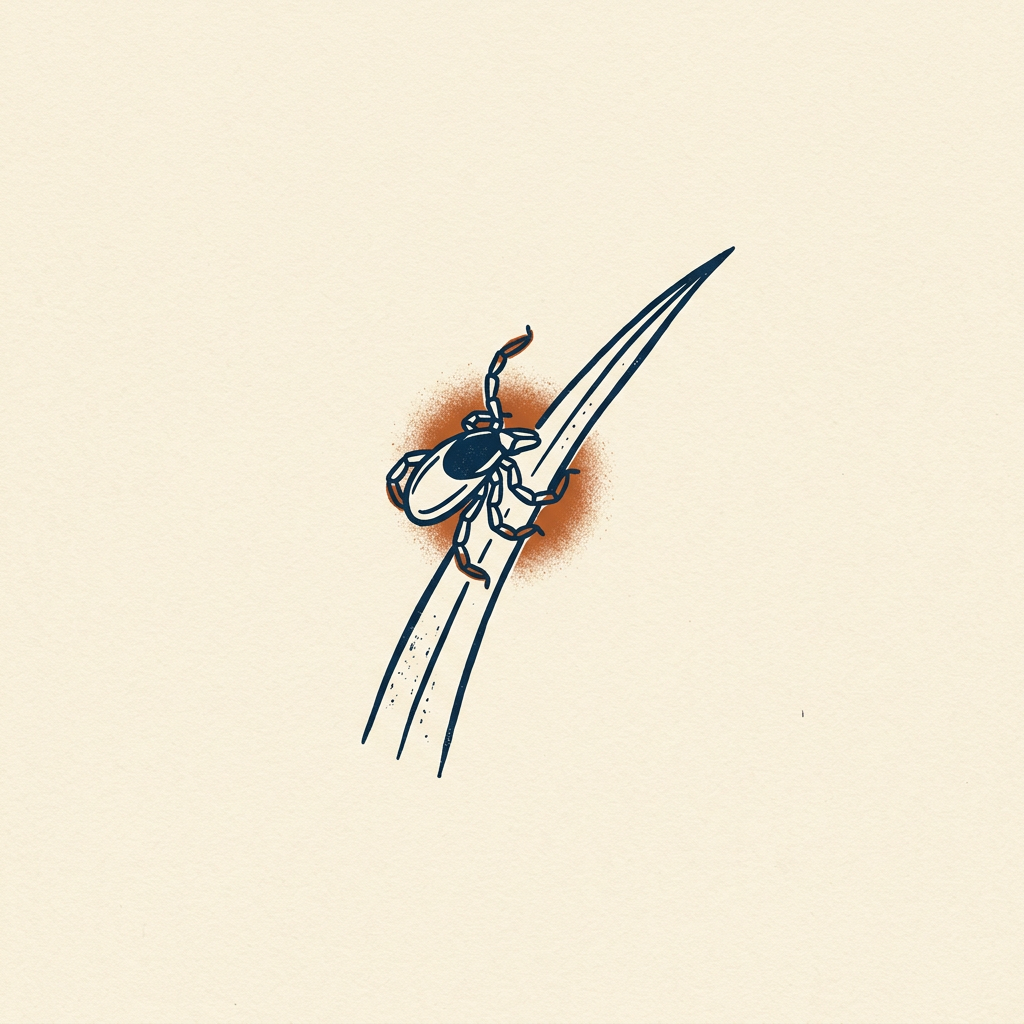
Tick Umwelt
Butyric acid, warmth, and hair texture only
Jakob von Uexküll’s early twentieth-century idea of the Umwelt names the perceptual world an organism actually inhabits, not the full physical surroundings. Yong opens here to break a stubborn human bias: the belief that our sensory bandwidth is the complete version of reality and that other species live in a faded copy of it.
Each lineage evolved detectors for the information that mattered to its survival and reproduction. Human senses are themselves a narrow, arbitrary subset of what is physically available. Once that frame is in place, an elephant’s infrasonic rumble or a shark’s electric sense stops looking like an exotic add-on to a human-like mind and starts looking like the organizing center of a different kind of consciousness.
Scientists cannot enter another head, so they infer Umwelten from anatomy, neural wiring, and behavior, knowing that human language always distorts what it describes. Calling a bat’s sonar world ‘seeing’ or ‘hearing’ is a working compromise, not a claim of sameness. Sensory diversity is therefore not a curiosity; it is the mechanism that turns one physical planet into millions of lived worlds.
In practice: A tick on a blade of grass responds only to butyric acid from mammalian skin, a rise in temperature, and the texture of hair—nothing else—yet that thin Umwelt is enough to find a blood meal.

2
Smell as primary channel
Smell and taste evolved before vision or hearing and remain, for most species, the main way the world is read—not lesser backup senses.
Olfactory receptor cells
Humans underrate chemical senses because our own smell is weak: roughly 400 functional olfactory receptor genes against more than 1,000 in mice and an even larger repertoire in elephants, the biggest known among mammals studied. That cultural downgrade hides how sophisticated chemical systems actually are.
Dogs carry roughly 300 million olfactory receptor cells against a human’s six million, and their nasal plumbing separates breathing air from smelling air, letting them work at parts-per-trillion concentrations. Catfish cover the whole body in taste buds and locate food by chemical gradients across the skin. Snakes add a second channel: the vomeronasal organ loaded by a flicking forked tongue that builds a three-dimensional chemical map from the two tips.
In insects the same logic reaches extreme range. A female moth’s single-molecule scent can draw a male from miles downwind; his antennae are packed with receptors tuned to femtogram amounts. Chemical senses are not primitive precursors to vision and hearing. They are high-resolution systems that structure navigation, mating, and danger avoidance for most insects, fish, and many mammals.
In practice: A dog can track a scent trail hours old or detect one drop of blood diluted into a swimming pool’s volume of water.
3
Colors we cannot register
Color vision differs so sharply across species that many animals live in visual worlds humans cannot imagine, because we lack the receptors for their wavelengths and combinations.
Human trichromacy uses three cone types. Many birds and reptiles are tetrachromats with a fourth cone for ultraviolet, so a flower that looks plain yellow to us carries ultraviolet nectar guides that steer bees to the reward. Polarized light, invisible to us, lets insects and some fish navigate by sky patterns that shift with the sun even under cloud.
The mantis shrimp pushes receptor count to an extreme—up to sixteen photoreceptor types—yet behavioral work from Justin Marshall’s lab found they are surprisingly poor at telling similar colors apart. The extra receptors appear to feed fast parallel channels for split-second decisions rather than fine discrimination. More hardware does not automatically mean a richer subjective palette.
Deep-sea animals stretch the same point in the opposite direction: some eyes register single photons; others abandon image-forming eyes for simple light patches. Comparing visual systems therefore requires asking how the brain actually uses the signal, not merely counting receptors.
In practice: Flowers that appear uniformly yellow to human eyes display ultraviolet patterns that function as nectar guides for bees.

4
Touch shaped by the body
Touch and pain are not uniform low-level senses shared identically across species; each is sculpted by the mechanical problems that body must solve.
120ms
star-nosed mole prey identification and eating time
The star-nosed mole rings its nose with twenty-two fleshy appendages packed with over 25,000 Eimer’s organs—more touch input per square millimeter than a human fingertip. Kenneth Catania’s work showed the mole can identify and eat prey in under 120 milliseconds, faster than a human blink, because cortex devotes huge territory to that tactile map. Manatees carry full-body vibrissae that read water movement with fingertip-like precision despite their bulk.
Pain is more contested. Lynne Sneddon’s trout studies found that fish given a painful lip injection, then offered a painkiller-laced zone, changed behavior in ways consistent with pain rather than pure reflex. Other cognition researchers still read the same data as nociception without subjective suffering. Yong leaves the dispute open.
The ethical stakes are immediate. How we classify an animal’s sensory life feeds directly into debates over fishing, lab standards, and food regulation. Assuming animal touch or pain either matches ours or is nothing like ours are both leaps; only species-by-species evidence will settle it.
In practice: A star-nosed mole identifies and consumes prey in under 120 milliseconds using its nose appendages alone.
5
Heat as its own channel
Some animals carry a dedicated infrared sense wholly separate from ordinary touch or vision, proving thermoreception can become an independent high-resolution system.
Human thermoreception
Diffuse skin warmth via TRP channels, no fine direction
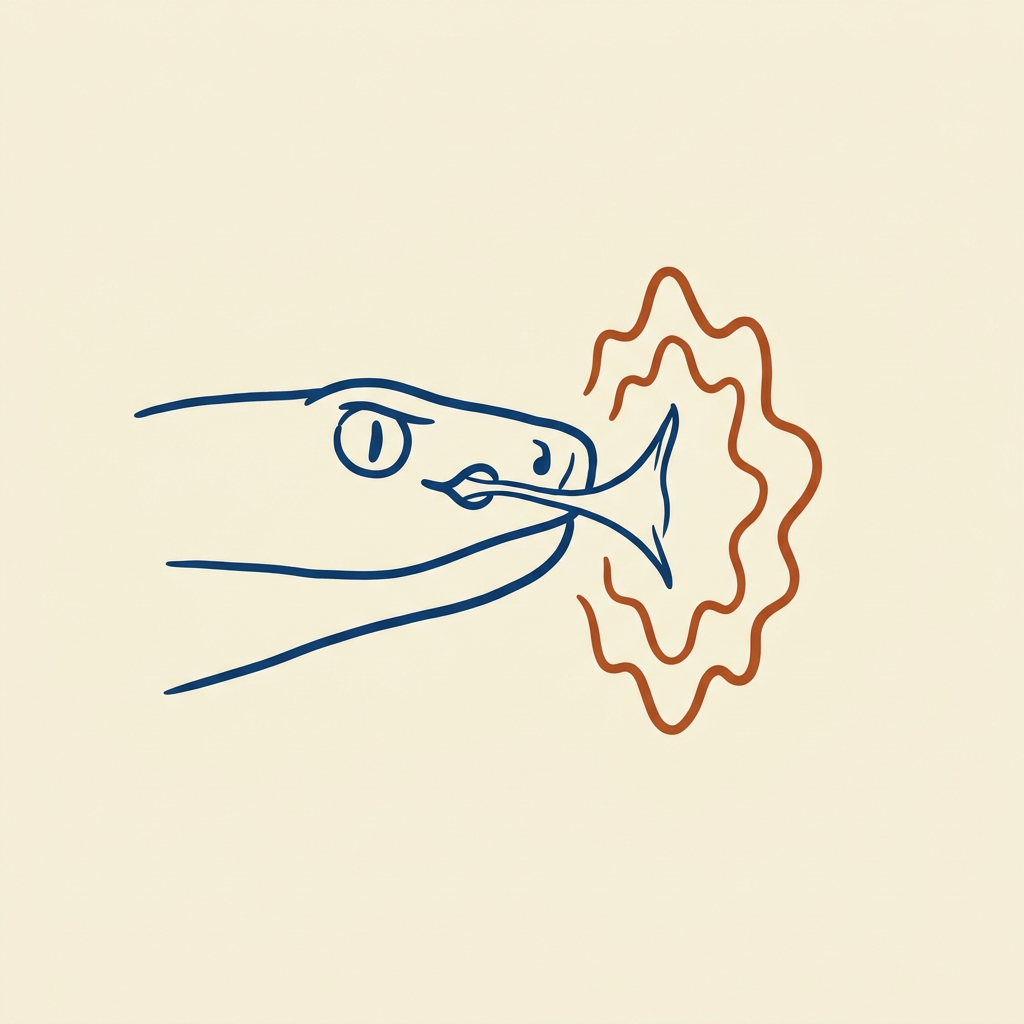
Pit-viper infrared
Membrane detecting thousandths of a degree, merged with vision
Pit vipers house facial pit organs whose thin, richly innervated membrane detects infrared from warm prey, registering differences as small as a few thousandths of a degree Celsius via the ion channel TRPA1. The snake can strike a mouse in total darkness. Imaging shows the brain merges infrared with ordinary vision in the optic tectum into something like a unified thermal image.
Vampire bats evolved a parallel but less sensitive nasal heat sense for locating blood vessels near a sleeping host’s skin. Across the rest of the animal kingdom, including human skin, TRP-channel proteins register temperature change without that directional precision or extreme sensitivity.
A sense that feels like vague background warmth in humans can be promoted by evolution into a full, independent detection system when survival requires it. Rankings that place vision and hearing as ‘major’ and temperature as ‘minor’ hold only for our own evolutionary history.
In practice: A rattlesnake strikes accurately at a mouse in complete darkness by reading the prey’s infrared glow through its pit organs.

6
Vibration without a common name
Mechanical vibration through solid surfaces or fluid flow carries as much information as hearing, even though everyday language gives it no single familiar name.
- 1Fish passesLeaves a decaying turbulence wake in the water
- 2Whiskers read flowSeal detects residual hydrodynamic trail
- 3Trail followedPath reconstructed minutes after the fish is gone
Fish lateral lines—rows of hair-cell clusters—detect water movement and pressure so a fish can sense a predator, a schoolmate, or an obstacle’s flow without sight or sound. Harbor seals, in Guido Dehnhardt’s research, follow the invisible hydrodynamic trail of a fish minutes after it passed, reading residual turbulence with their whiskers the way a dog follows a scent.
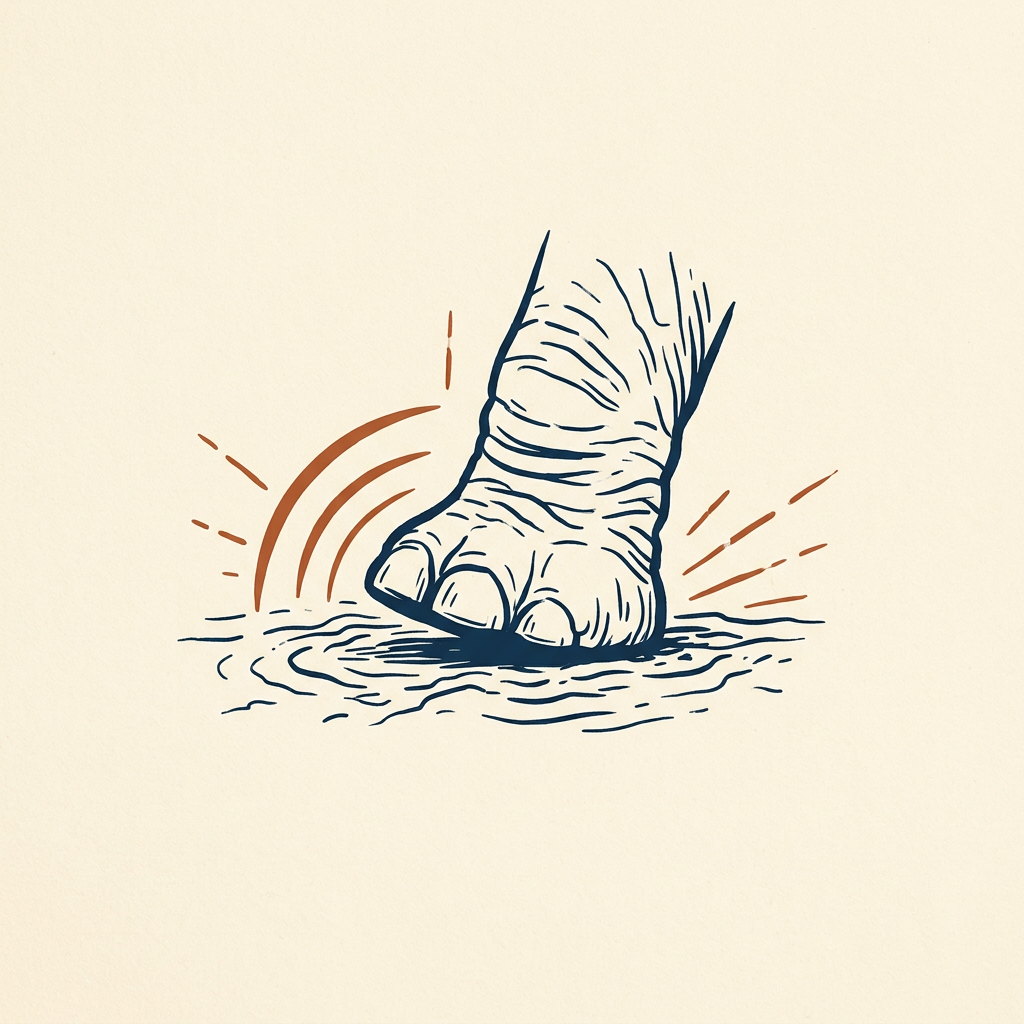
Spiders parse web-silk vibrations to judge prey size, location, and even species, separating a struggling moth from wind or a falling leaf; some tune strand tension to sharpen the signal. Elephants feel low-frequency ground vibration through feet and trunk, detecting other elephants’ footsteps or calls kilometers away and sometimes telling familiar from unfamiliar individuals by vibrational signature, work advanced by Caitlin O’Connell-Rodwell.
Yong groups these as substrate-borne mechanosense: oscillating mechanical energy read through ground, water, or silk rather than air. The familiar five-senses list is already incomplete for mechanical detection alone.
In practice: A harbor seal tracks a fish’s hydrodynamic trail minutes after the fish has gone, using only whisker detection of leftover turbulence.
7
Sound outside our range
Hearing ranges are so uneven that whole acoustic worlds far below and far above human hearing operate as active communication channels we never notice.
Hearing range extremes
Humans hear roughly 20 Hz to 20,000 Hz. Elephants rumble in infrasound as low as 15 Hz; the calls travel kilometers through air and ground and help coordinate herds, a discovery Katy Payne advanced after noticing unheard vibrations from captive elephants at the Portland Zoo in the 1980s. Whales produce low-frequency song that can, in principle, cross ocean basins, though how much of that range is truly used remains debated.
At the top end, the greater wax moth detects ultrasound near 300,000 Hz—an early-warning system against echolocating bats, a direct evolutionary reply to predation. Small animals face a physics problem: heads only millimeters wide receive sound at almost the same instant, so some parasitic flies evolved coupled eardrums or odd ear placement to amplify tiny timing gaps enough to localize cricket song.
Many species already listen far outside our band. That fact explains why active biological sonar could evolve as an extension of existing ultrasonic sensitivity rather than a sudden separate invention.
In practice: Elephants coordinate across long distances with infrasound rumbles as low as 15 Hz that humans feel, if at all, only as vibration.
8
Echolocation as active sensing
Echolocation is not better hearing; it is a different strategy in which the animal emits its own signal and builds a world from the returning echo, closer to self-directed radar than to passive listening.
- 1Emit callBat produces ultrasound up to 140 dB at the source
- 2Echo returnsTiming, intensity, and frequency shift carry object data
- 3Build modelReal-time three-dimensional map of prey and space
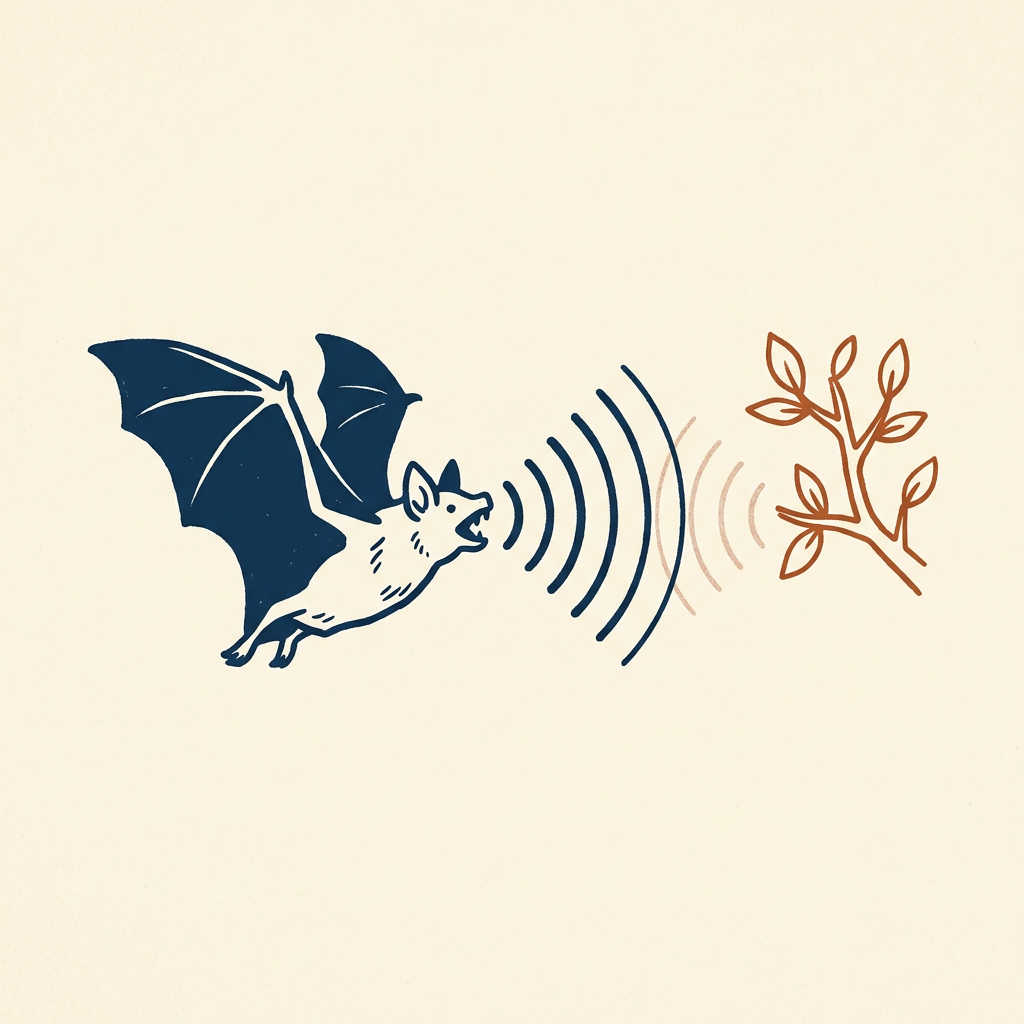
Bats launch calls sometimes above 100,000 Hz and up to 140 decibels at the source, then read echo timing, intensity, and frequency shift to model moving prey, foliage, and open space in real time. Species trade off call design: constant-frequency calls suit detecting wing flutter in clutter; frequency-modulated sweeps suit precise distance. The choice is like picking different instruments for different jobs.
Toothed whales evolved the system independently, clicking in nasal passages, focusing sound through the fatty melon, and receiving echoes through fat-filled lower-jaw channels. Some researchers argue the sense may resolve internal air pockets—an almost X-ray reading of solid objects—though that claim is still under active study. Oilbirds and certain swiftlets echolocate at lower, human-audible frequencies inside dark caves, showing the solution arose at least four separate times.
Bats and moths remain locked in an arms race: some moths grew wing scales that absorb ultrasound and shrink their echo signature, a stealth trick later mirrored by human radar-absorbing coatings.
In practice: Some moths evolved wing scales that absorb bat ultrasound, cutting their echo signature the way stealth coatings absorb radar.
9
Fields with no human equivalent
Electroreception and magnetoreception detect entire physical fields—electricity and magnetism—that have no counterpart in human senses, making them wholly separate categories rather than extensions of familiar ones.
Electroreception
Ampullae detect prey heartbeats at fractions of a microvolt per cm; some fish emit fields to sense objects
Magnetoreception
Turtles and birds navigate by Earth’s field; mechanism still disputed after decades
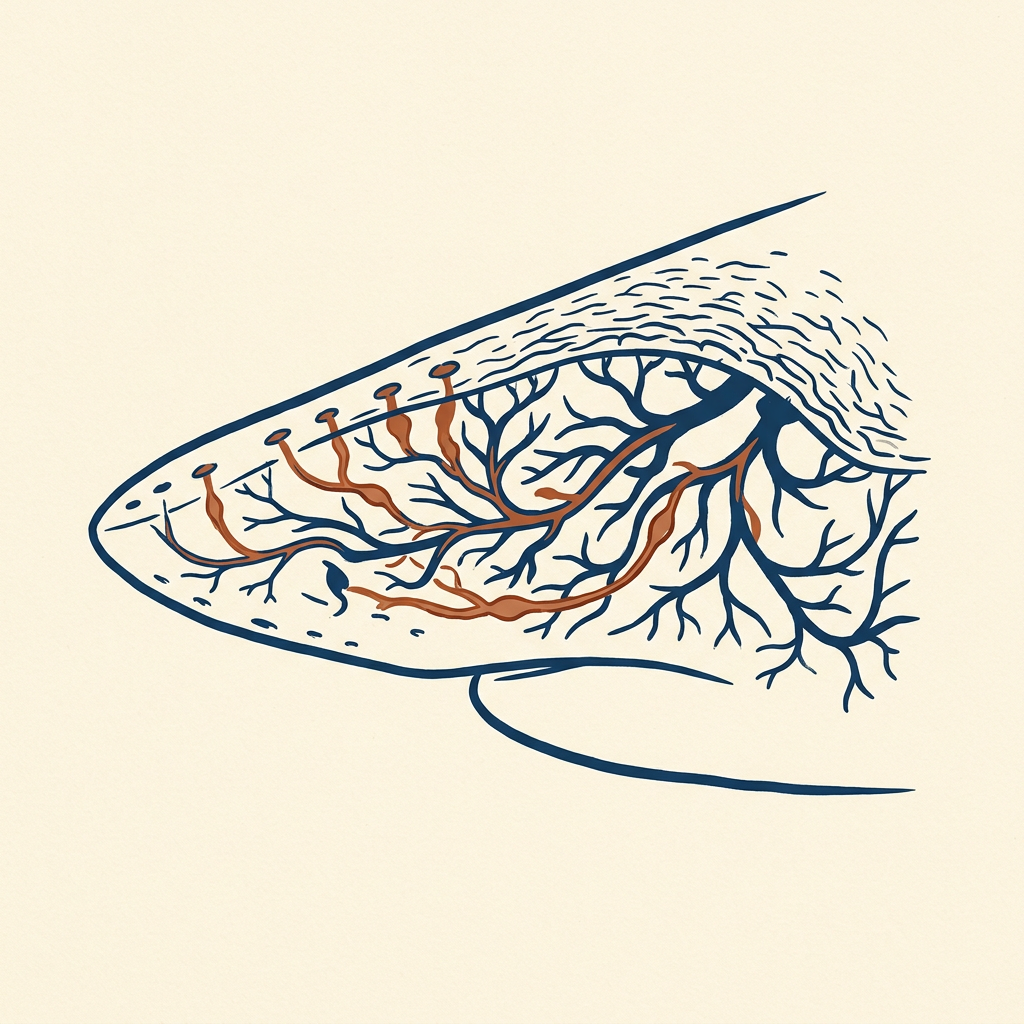
Sharks and rays sense weak electric fields through the ampullae of Lorenzini, jelly-filled snout canals that register fractions of a microvolt per centimeter—enough to feel a prey fish’s muscle twitches or heartbeat at a distance. Strongly electric species such as electric eels can discharge more than 600 volts for defense. Weakly electric fish like the elephantnose fish generate a mild field purely to sense distortions caused by nearby objects, an electrical parallel to echolocation.
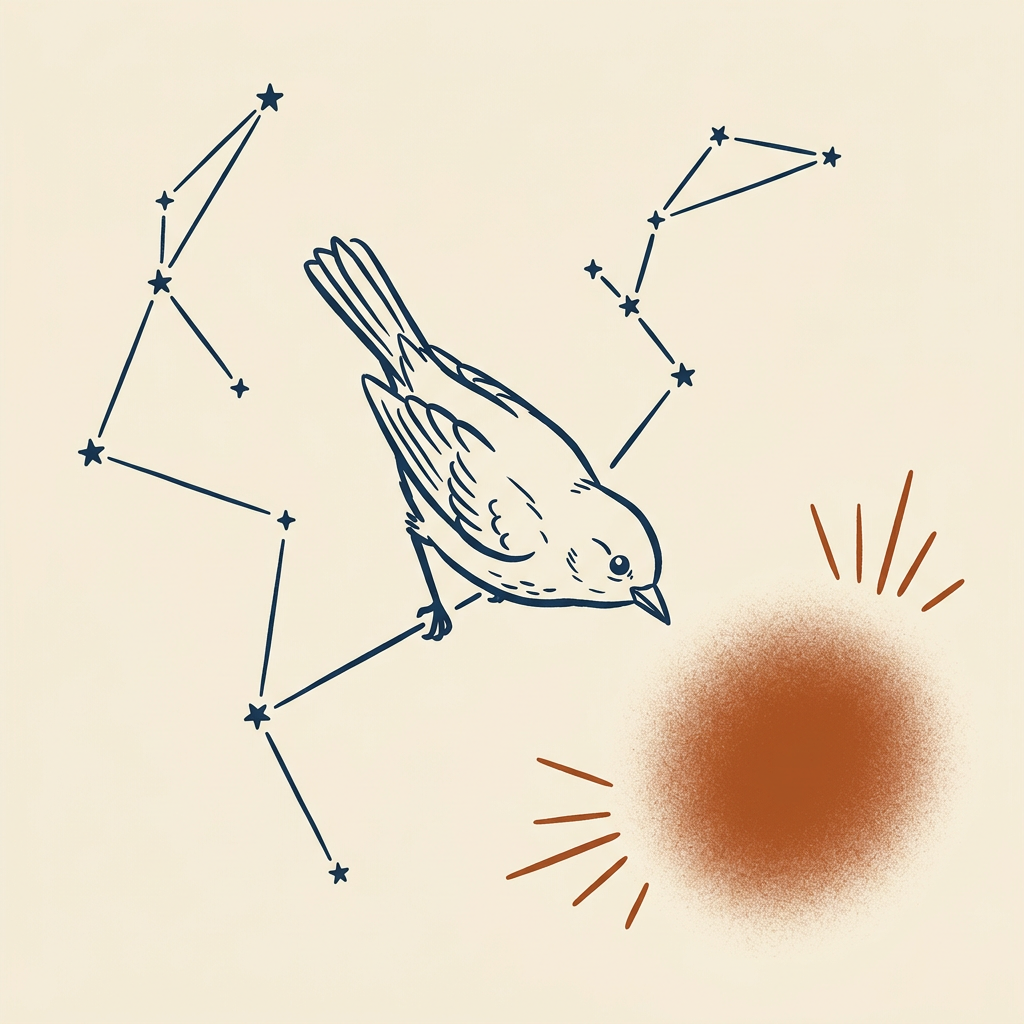
Magnetoreception is harder to pin down. Sea turtles, migratory songbirds, and salmon appear to use Earth’s magnetic field for long-distance travel. Kenneth Lohmann’s tank experiments showed loggerhead hatchlings change swimming direction when magnetic fields are shifted to match specific coastal locations, evidence for a map sense rather than a simple compass. The biological hardware is still unresolved: magnetite crystals and a light-dependent radical-pair mechanism in the eye remain competing hypotheses after decades of work.
These are the book’s boundary cases. They prove the human Umwelt is a small island inside a much larger space of possible experience, some of it still only half-mapped by science.
In practice: Loggerhead hatchlings in tank tests alter course when researchers shift magnetic fields to match particular coastal signatures.
10
Pollution of other senses
Human light, noise, and vibration are not neutral background; they actively wreck other species’ primary sensory channels, so conservation must treat sensory ecology as seriously as habitat area or chemicals.
Looks intact
Habitat area and chemistry appear acceptable on standard metrics
Sensorially broken
Light, noise, or missing reef sound render the same place unusable
Artificial night light pulls migratory birds off star routes toward lit buildings and skyglow; decades of collision data from monitoring groups in cities such as Chicago and New York document the resulting mass deaths. Shipping and sonar noise sit in the same bands whales use; some species raise pitch or volume like a person shouting over din, paying an energy cost and shrinking the range at which they can still be understood.
Coral-reef fish larvae home in on the sound of a healthy reef—snapping shrimp and fish choruses. Experiments show quieter, degraded reefs attract fewer settlers, so acoustic loss compounds the damage of dead coral. Streetlights wash out the polarized skylight and star patterns many insects use to navigate and mate.
An intact-looking habitat can still be sensorially uninhabitable. Policy that tracks only acres, temperature, or chemical pollutants misses an entire harm category. Understanding another species’ Umwelt is no longer optional curiosity; it is the precondition for protecting that species at all.
In practice: Degraded reefs that have gone acoustically quiet fail to attract as many settling fish larvae as healthy, noisy reefs.
Key terms
- Umwelt The narrow perceptual world an animal actually lives in, set by the senses it has, not by the full physical surroundings.
- Echolocation An active sense: the animal sends its own sound and builds a picture from the returning echo.
- Electroreception The ability to detect weak electric fields, such as those made by another animal’s muscles or heartbeat.
- Magnetoreception The still-mysterious ability of some animals to sense Earth’s magnetic field for navigation.
- Lateral line A row of hair-cell sensors on a fish’s body that reads water movement and pressure.
- Vomeronasal organ A second smell channel, used by snakes, that receives particles delivered by the forked tongue.
- Nociception A reflexive response to tissue damage that may or may not include felt suffering.
- Sensory pollution Human light, noise, or vibration that wrecks the sensory channels other species depend on.
- Ampullae of Lorenzini Jelly-filled canals in shark and ray snouts that pick up tiny electric fields.
What to do
- Look up the actual sensory strengths of any animal you meet this week—pet, garden insect, or window bird—instead of assuming it experiences the scene as you do.
- Dim or fully shield outdoor lights during peak bird-migration periods to cut collision deaths from skyglow.
- Treat noise near waterways as its own conservation problem; reduce unnecessary motor and machinery sound where whales, fish, or larvae navigate by hearing.
- When a striking animal-sense claim appears, check whether the source calls it well-established or still contested before repeating it.
- Add sensory harm—light, noise, vibration—to any local conservation or pest-control decision alongside habitat and chemicals.
Questions to think with
- If human senses are just one arbitrary configuration, what everyday judgments about animal intelligence or feeling quietly smuggle in our own Umwelt as the standard?
- Where should the burden of proof sit on fish pain—require clear evidence of suffering before changing practice, or require clear evidence of its absence?
- How much conservation money should shift from buying acreage toward fixing light and noise inside habitat already protected?
- Does describing a bat’s world in human sensory words inevitably distort it, and is there a better practical alternative?
- Which of your own daily habits would look like sensory vandalism if you could suddenly hear or see through an elephant’s or moth’s receptors?
The other side
The book’s vivid, study-by-study storytelling can leave readers more certain than the underlying science supports—magnetoreception mechanisms stay unresolved and some findings resist replication; the sympathetic arc may tilt readers toward believing fish suffer even where Yong withholds a verdict; coverage heavily favors vertebrates and a few well-known invertebrates while skipping most invertebrates and organisms without conventional nervous systems; breadth comes at the cost of neural-mechanism depth; and the Umwelt frame quietly assumes sensory data equals subjective experience without facing the unsettled philosophy-of-mind debate.
Who it's for
Curious readers who want ordinary senses made strange, biology students or naturalists needing a cross-taxa synthesis of sensory ecology, and anyone in animal welfare or conservation who must grasp how light, noise, and vibration wreck channels humans do not share.