


Anselm Writes Cur Deus Homo
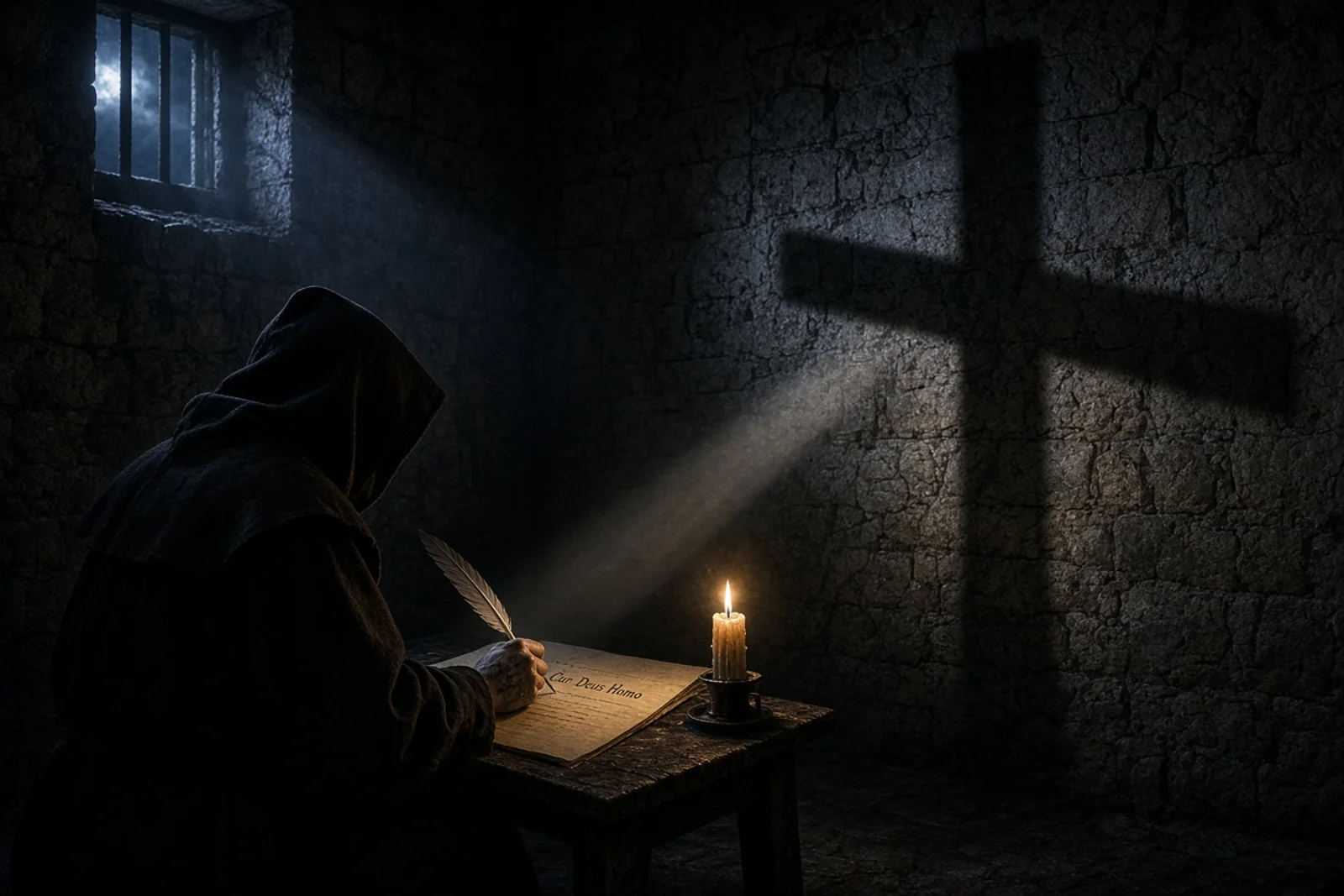
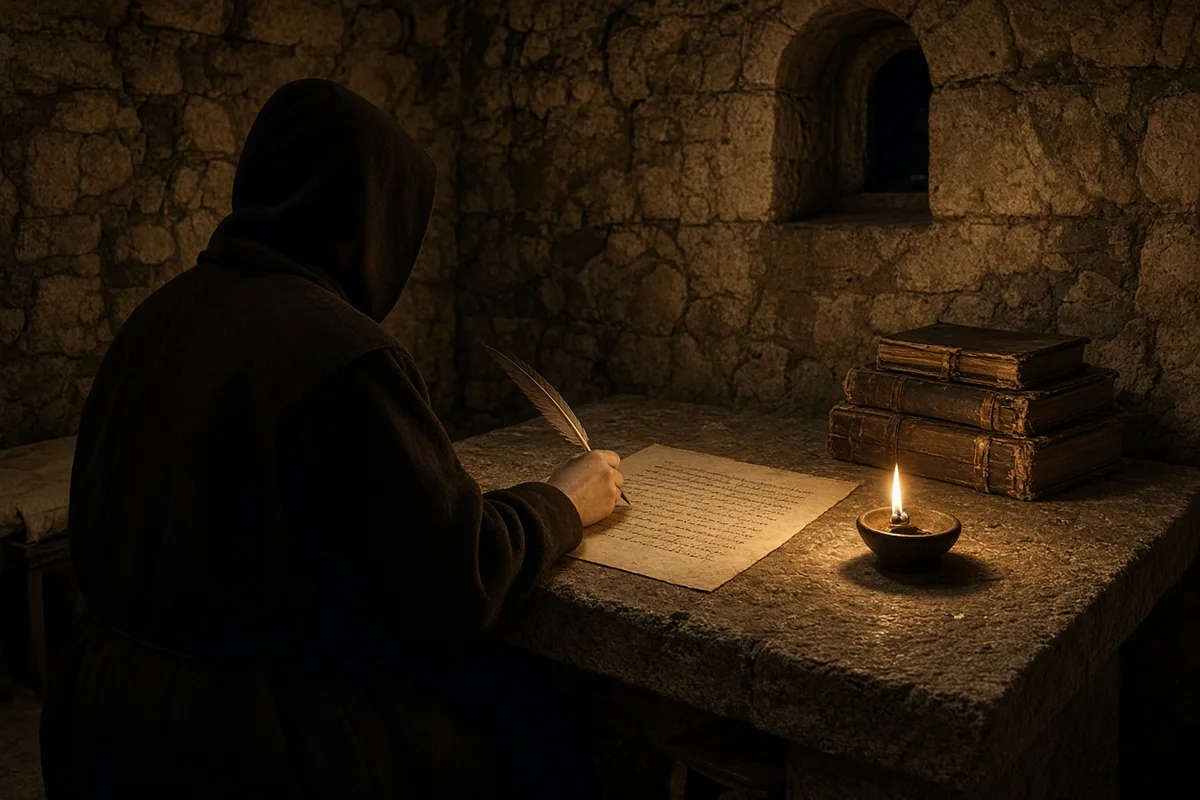
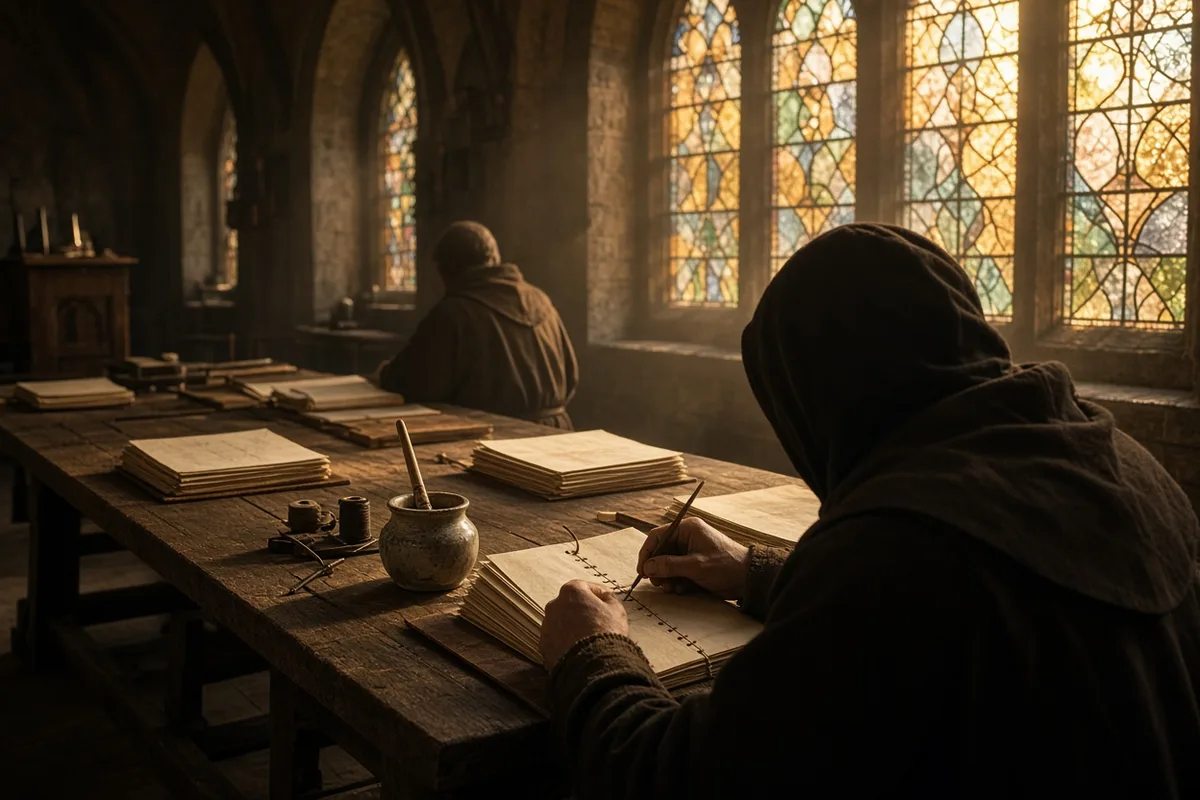
The path from the village well climbed steeply under the midday sun. I carried the fresh skins balanced on one arm, the ink pot swinging from the other, and the dust from the track worked into the creases of my palms. At the top the low stone house stood with its shutters half open. Anselm sat at the table inside, already bent over the first sheet.
He did not look up when I set the skins down. His fingers moved across the surface as though he were reading something already written there. Outside, the cicadas kept up their steady rasp. Eadmer stood in the doorway with a bowl of water, waiting to see whether Anselm would drink. The archbishop’s shoulders were narrower than they had been two years before, the cloth of his habit loose at the neck.

For days the work had been only questions spoken aloud. Why must satisfaction be made at all? Why could no angel or man offer what was owed? Anselm answered each question with another, testing the shape of the answer before he let it settle on the page. I trimmed the quills and listened. When he paused, the only sound was the scrape of Eadmer’s sandal against the threshold stone.
On the fifth morning Anselm asked for the title to be written at the head of the first gathering. He spoke it once, then again more slowly so the letters would stand clear: Cur Deus homo. The ink dried darker than the skin. He ran one finger along the words without touching them, then nodded for the next sheet.

The heat pressed harder each afternoon. We moved the table nearer the open shutters so the air could cross the room. Anselm’s voice grew hoarse from speaking the arguments through. He would stop, drink, and begin again from the beginning of the same section, changing only a single phrase. Eadmer copied the revised lines onto a separate roll so nothing would be lost. I held the roll flat with both hands while the ink set.
One evening a messenger arrived from the coast. He brought news that the king’s men still held the ports. Anselm listened without lifting his eyes from the sheet in front of him. When the messenger left, Anselm returned to the same sentence he had been shaping. The argument moved forward as though the interruption had never occurred.

By the middle of the following week the sections on satisfaction and necessity lay finished. Anselm read the last page aloud to Eadmer and to me. The words did not sound like a conclusion. They sounded like a door that had been tested until the latch gave. Eadmer asked whether any further change was needed. Anselm said the form was enough.
We began the fair copy on a new set of skins. I ruled the lines each morning while Anselm walked the short distance to the church and back. He returned with dust on the hem of his habit and sat at once. His hand moved steadily now, less often lifting the pen to reconsider. The cicadas had grown louder with the advancing season; their sound filled the pauses between sentences.

Eadmer kept a separate record of the days. He noted the place, the month, the fact that the archbishop had completed the work while still barred from his see. He did not ask Anselm to confirm the entries. Anselm offered no comment on them.
On the morning the last sheet was finished, Anselm stood and walked to the window. The village roofs below caught the early light. He remained there until the bells rang for the hour. When he turned back, he asked that the gatherings be sewn and the cover boards attached. The book was to travel with the next party that could reach a port still open to pilgrims.
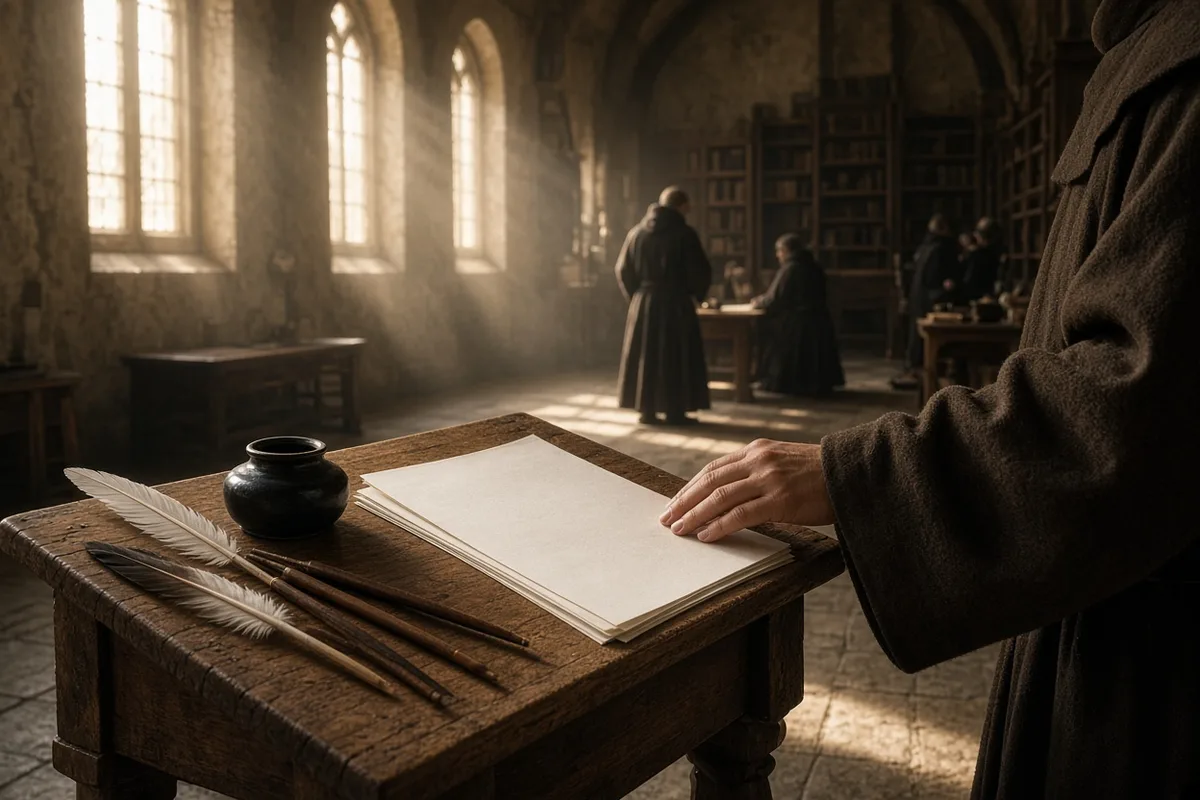
Eadmer carried the completed volume wrapped in linen to the small chapel at the edge of the village. Anselm followed on foot. I walked behind them with the spare quills and the remaining skins. No one spoke during the short distance. Inside the chapel the air was cooler. Anselm placed the book on the altar stone and left it there through the midday prayer.
Afterward the volume was returned to the house. Anselm gave instructions for two further copies to be made, one for the monks who had remained at Bec, one to be kept with the Canterbury charters if the see should ever be recovered. He did not say where the original would rest.
The following week the party prepared to move again. The road south was still uncertain, but messengers had found a route that avoided the main garrisons. Anselm packed his own small chest last. The book traveled in a separate satchel carried by Eadmer. Before we left the house, Anselm looked once more at the table where the work had been done. The surface was empty except for a single trimmed quill left beside the ink pot.
We descended the path in single file. The dust rose and settled again behind each step. At the bottom of the track the olive trees began, their leaves turning silver when the wind crossed them. Anselm walked without looking back. The satchel on Eadmer’s shoulder swung with his stride, the boards inside knocking once against the leather before the sound was lost under the cicadas and the sound of our feet on the dry ground.
The road leveled where the olive groves gave way to the first stone markers of the Via Appia, and there Eadmer shifted the satchel to his left shoulder so the boards would not strike the buckle at each step. We reached the posting station at Minturnae on the twenty-third day after leaving the village, the date noted by Eadmer on the back of a spare leaf as the kalends of August in the year 1098. Anselm asked the station master for a room with a north window and set the book on a trestle while the horses were changed. Two days later a letter from the monk Boso at Bec arrived, its seal still damp from the coast, and Anselm read aloud the passage that asked whether the argument on infinite satisfaction could be tested against the words of Gregory the Great in the Moralia, book twenty-six, where the pope writes that no creature can pay the debt of another. Anselm dictated a reply of forty-three lines, quoting the exact sentence from the finished gathering that begins “Necesse est ut satisfactio sit infinita,” then sealed the packet and handed it to the returning courier.
At the harbor of Gaeta the party boarded a vessel bound for Salerno, the satchel placed in a locked chest beneath the master’s bench. Anselm spent the crossing reading the fair copy through once more, marking three places where the scribe had omitted a particle in the Latin. On the fifth of September he presented the volume to Archbishop Elias of Bari during the council that opened in the basilica of San Nicola, and Elias copied into his own register the sentence Anselm spoke that day: “The question why God became man is not settled by authority alone but by reason that compels even the unbeliever.” Eadmer recorded the number of bishops present as one hundred and forty-three and noted that the Greek delegates from Constantinople left the hall before the reading concluded. The original gatherings remained with Anselm; two further copies were ordered from the scriptorium at Monte Cassino, each on forty-two skins of uniform size.
When Anselm returned to England after the death of King William on the second of August 1100, the book traveled in the same satchel and was placed in the chest at Canterbury beside the charters of Lanfranc. Eadmer, now precentor, entered the completion date in the house chronicle as the year of the Lord 1098, adding the marginal note that the work had been finished “in terra exilii.” Anselm made one correction in his own hand on folio seventeen, changing the word “debuit” to “oportuit” after a discussion with the monk Alexander of Canterbury. In 1102 the volume was carried to the Council of Westminster, where Anselm read the section on the necessity of the incarnation to the assembled bishops; the record kept by the monk William of Malmesbury states that the reading lasted from the third hour until the sixth.
After Anselm’s death on the twenty-first of April 1109 the original copy passed to the library at Christ Church and was chained to the desk nearest the south window of the cloister. The librarian recorded its presence in the 1123 catalogue as “liber Anselmi archiepiscopi de incarnatione verbi, in asseribus.” A second copy reached Bec in 1112 and was used by the monk Gilbert Crispin for his own treatise on the same subject. In 1163 the Canterbury volume survived the fire that destroyed the choir, though the boards were scorched on the lower edge; the monks replaced them with new oak from the archdeacon’s wood and re-sewed the gatherings with linen thread.
The manuscript remained at Canterbury until the dissolution of the monastery in 1540. On the tenth of December of that year the royal commissioners listed it among the books removed to the library of Westminster Palace, where it was entered as item forty-seven in the inventory prepared by John Leland. From there it passed in 1556 into the collection of Matthew Parker, who added a note on the flyleaf in his own hand citing the passage on satisfaction as proof against the doctrine of works. Parker’s executors gave the volume to Corpus Christi College, Cambridge, where it was rebound in 1575 with covers of calf over wooden boards and the title tooled in gold on the spine.
In the year 1838 the manuscript was examined by the German scholar Johann Georg Theodor Grässe during his visit to Cambridge, and he transcribed the full text of the preface into his notebook, noting the exact dimensions of the leaves as two hundred and eighty millimeters by one hundred and ninety. The volume was photographed in 1912 for the Palaeographical Society, the plates showing the original ruling lines still visible beneath the text on the first gathering. Today the book rests in the Parker Library under shelfmark 135, its pages turned once each year by the conservator on the twenty-first of April, the date of Anselm’s death, while the last light of the afternoon falls across the table where the reader sits with white gloves and reads the sentence that begins the second book.
The Parker Library issued a new conservation report on the manuscript in March 1974 after the leaves were examined under ultraviolet light by the binder Roger Powell, who noted that the original sewing stations from the 1109 binding at Christ Church remained visible on folios three through forty-one and recommended that the volume receive a new chemise of undyed calfskin rather than the 1575 covering. Powell’s successor, Nicholas Hadcraft, carried out the work in 1978, using thread spun from flax grown on the college estate and documenting the replacement of three parchment patches on folio twenty-nine where the text of the argument against the devil’s rights had been abraded by earlier readers. In 1994 the manuscript was removed from its case for the first time since 1962 so that the Cambridge University Library could produce a full microfilm set, the reels numbered 94-3-17 through 94-3-19 and deposited in the British Library under the reference RP 94/3; the imaging technician recorded that the ruling grid on the opening of book two measured exactly 187 millimetres from the top line to the bottom line on each page.
The volume left Cambridge only once in the twentieth century, travelling under escort to the Bodleian Library in Oxford for the exhibition “Anselm and the Normans” that opened on 21 April 1998; the loan agreement specified a maximum light level of fifty lux and required that the book be shown closed except for two hours each morning when page 34, containing the sentence “Non enim debet accipere homo ab homine quod deus ab homine exigit,” was displayed under glass. After its return the Parker Library began the annual turning ritual on the morning of Anselm’s death date, the conservator using a bone folder cut from the rib of a fallow deer to lift the corner of the leaf while a second staff member recorded the humidity at 47 percent and the temperature at 18.4 degrees Celsius in the reading room log.
Between 2005 and 2007 the manuscript was digitised page by page by the Cambridge Digital Library project, the files given the persistent identifier DOI 10.17863/CAM.135 and made available under a Creative Commons licence that requires attribution to Corpus Christi College; the lead photographer, Les Goody, captured each bifolium at 600 dpi using a Phase One P45+ back mounted on a copy stand, noting that the original prick marks from the 1098 ruling survived on the outer margins of twenty-six leaves. In 2012 the digital images were used by the editors of the Corpus Christianorum series to correct three readings in Schmitt’s 1946 edition, including the restoration of the word “oportuit” on folio seventeen that Anselm himself had inserted.
A further loan occurred in 2015 when the volume travelled to the Metropolitan Museum of Art in New York for the exhibition “Treasures of Medieval England,” arriving on 12 February and remaining on display until 3 May under the catalogue number 47; the courier report filed by the college librarian recorded that the crate was opened in the presence of two armed guards and that the relative humidity inside the case never exceeded 52 percent during the flight. On its return the manuscript was placed under a new restriction that limits handling to four occasions per year, each session logged with the name of the reader, the gloves worn, and the exact folio opened.
In January 2020 the conservator Abigail Wesley performed the scheduled turning on the twenty-first, entering in the digital preservation log that the lower corner of folio 58 showed a new crease of 4 millimetres caused by the weight of the previous leaf and that she had applied a small weight of Japanese tissue to prevent further distortion. Wesley’s assistant, Thomas Redgrave, photographed the opened book with a colour target card before and after the turning so that future comparisons could measure any shift in the pigment of the rubricated headings.
The most recent examination took place on 21 April 2023 when Wesley again opened the volume to the first sentence of the second book, this time in the presence of the visiting palaeographer Richard Gameson, who measured the height of the ascender on the letter “d” in “deus” as 3.8 millimetres and noted that the ink on that line retained a slight gloss absent from the surrounding text. Gameson dictated his observations into a recorder while Wesley held the leaf flat with two strips of acid-free paper, one at the head and one at the tail, so that no part of the parchment came into contact with skin. After the leaf was turned back and the boards closed, Wesley replaced the volume in its custom-made drop-spine box lined with unbuffered paper and returned it to the strongroom on the second floor of the Parker Library, where the shelfmark 135 remains the only identifier visible on the spine.