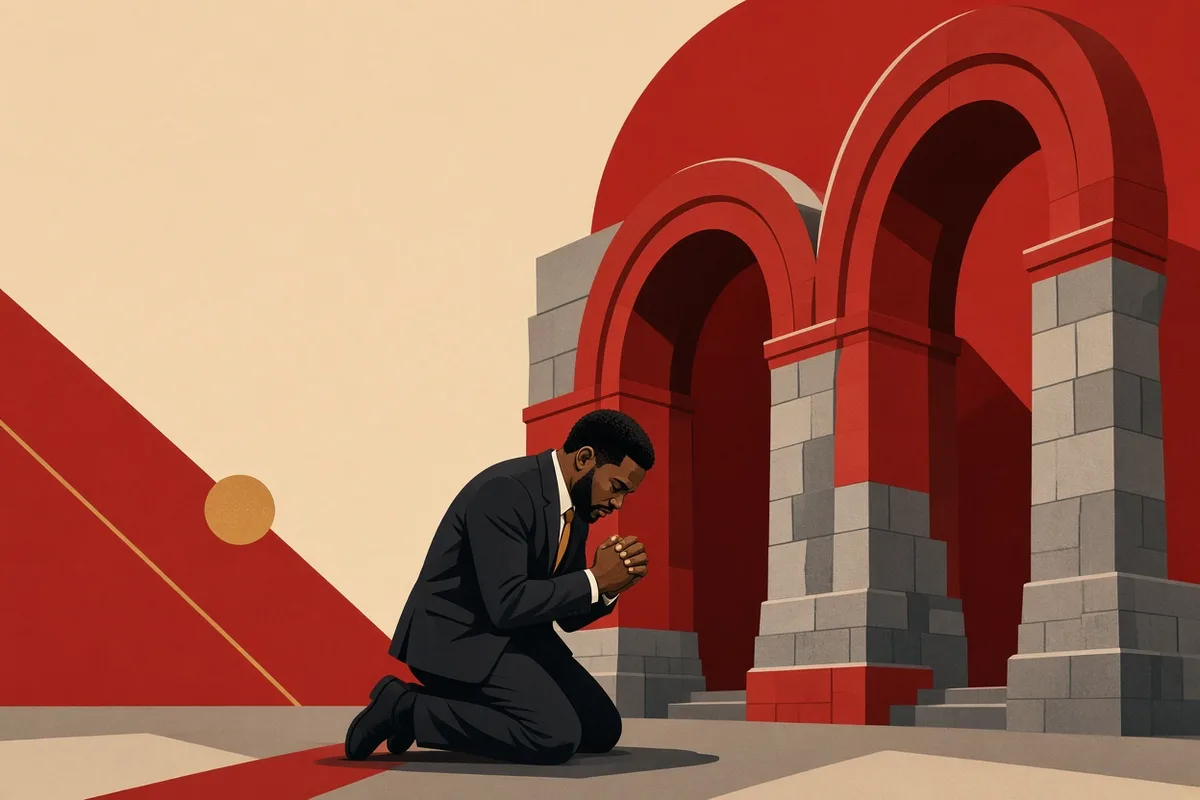



Apollo 8 Reads Genesis From the Moon
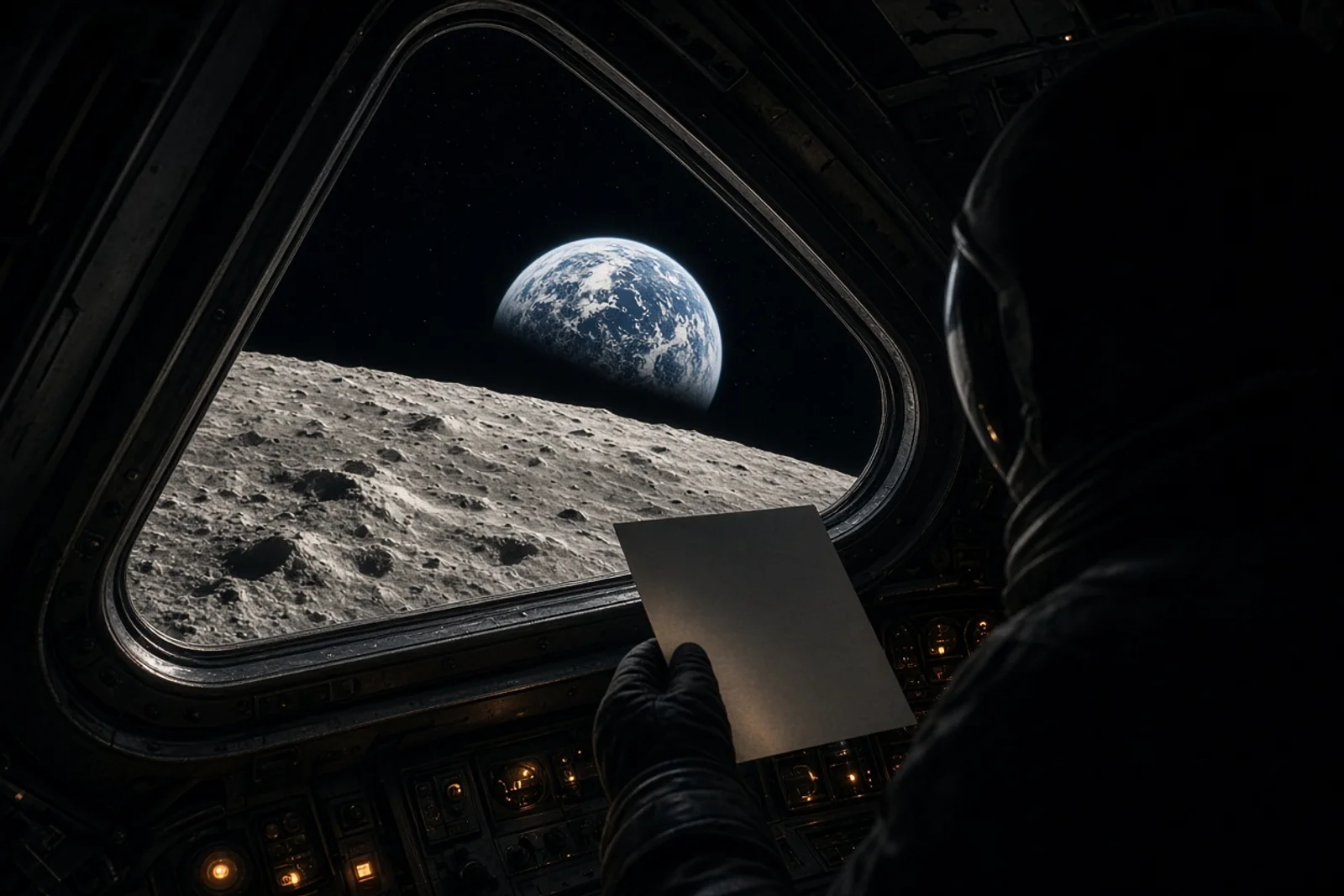
The countdown clock in the Mission Operations Control Room read seconds, and I had my hand flat on the console edge, the way you brace yourself before a car crash you can see coming but cannot stop. Outside, in Florida, it was still dark. On the screen in front of me the Saturn V stood lit up white against the pad lights, taller than anything I had ever watched breathe fire. December 21, 1968. Seven-fifty-one in the morning, Eastern time. I felt the room hold its breath with me.
The year behind us had been a wound that would not close. Two assassinations. Cities on fire. A war that ate boys my age by the thousand. Nobody in that room said any of it out loud that morning, but it sat behind every headset and every cup of cold coffee, and I think all of us understood, without saying so, that we needed this thing to go right more than we needed almost anything else that year.

They had never meant to send Borman, Lovell, and Anders all the way to the Moon, not on this flight. The lunar module wasn't ready. It was behind, badly behind, and somebody at the top decided that instead of waiting on a piece of hardware that wasn't finished, they would send three men and a command module alone, on the first manned ride of a rocket that had never carried a human being before, out past Earth orbit entirely, out to loop around another world and come home. It was the kind of decision that sounds obvious only after it works.
Then the engines lit, five of them, and the sound reached us on the feed a half-beat behind the picture, and the whole tower of metal began to rise so slowly it seemed impossible it would ever clear the gantry. It cleared it. My chest was doing something strange, half cheer, half prayer. Frank Borman was in the left seat, Jim Lovell in the center, Bill Anders on the right, and within minutes they were higher and faster than any of the men who had flown before them, and by the end of that day they were headed somewhere no human being had ever been sent.
Two days out, we got our first look inside the can. Borman had fought against carrying a television camera at all — twelve pounds felt like twelve pounds too many to him, when they were stripping ounces off the food packs to save weight — and NASA overruled him, and it turned out NASA was right, because that camera was about to hand the whole world a window. We watched Borman at the controls, calm as a man reading a gauge on his own porch. We watched Lovell sighting stars, then floating a spoonful of chocolate pudding across the cabin like it was the funniest thing he'd ever done. We watched Anders wrestling his toothbrush in zero gravity like it had a mind of its own. Lovell turned to the lens and wished his mother, Blanche, seventy-three years old that day, a happy birthday, and I remember somebody in the row behind me laughing out loud at the sight of it.
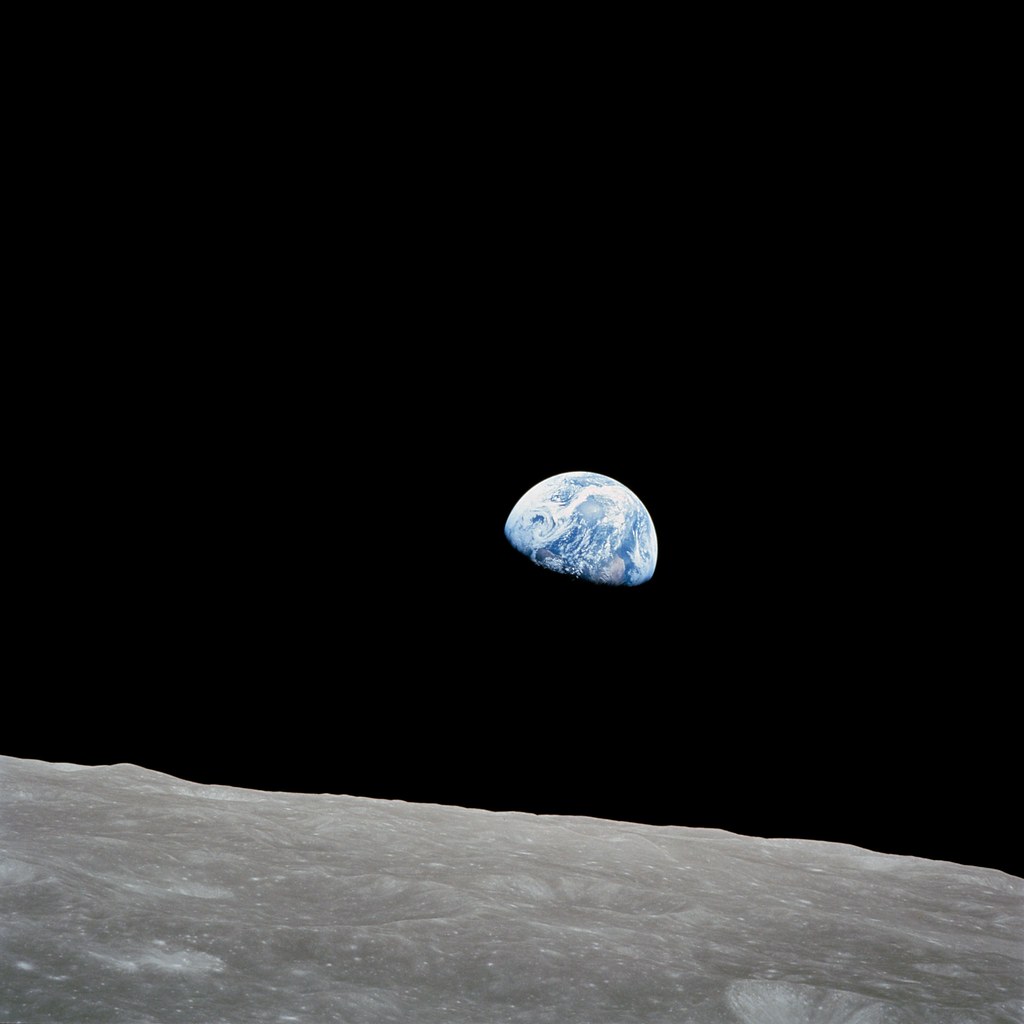
Not everyone back on Earth wanted the interruption. CBS had cut into the Vikings-Colts playoff game to carry the broadcast, and the switchboard lit up with people who wanted their football back more than they wanted to see three men floating between the stars. Borman laughed about it later — maybe, he said, they should have thrown a football around up there instead. But by the second transmission, when the crew turned the camera around and showed the Earth a picture of itself, hanging small and round and alone in the black, I noticed the room around me had gone quiet in a different way. Nobody complained about that one.
Christmas Eve came, and with it the maneuver that mattered more than any camera trick. To slip into orbit around the Moon, the spacecraft had to fire its engine at exactly the right moment while flying behind the far side, where no radio signal from Earth could reach it. If the burn ran long, they'd crash. If it ran short, they'd sail past into the dark forever. There was no lunar module to rescue them if something went wrong. There was only the burn, and the silence, and us.

We lost them at the appointed second, right on schedule, and the room held that silence for what felt like the longest thirty-some minutes of my life. Nobody spoke much. Somebody's pen kept clicking. Then the signal came back, on time, on trajectory, and the voice on the loop confirmed it: Apollo 8 was the first crewed spacecraft in history to leave the gravity of its home world and fall into orbit around another one. Ten times they would circle that gray, pitted, silent ball before they were done, and somewhere in that room a controller who'd been rigid for half an hour let his shoulders finally drop.
We had been told, days before, that this Christmas Eve broadcast would draw the largest audience that had ever listened to a single human voice — more people, all at once, than had ever heard anyone speak. Borman had asked the obvious question of NASA's public affairs chief, Julian Scheer: what exactly did they want the crew to say. The answer that came back gave him nothing and everything at once. Do something appropriate. That was all. No script, no committee line, no talking points. Just three men, a hundred thousand miles from anyone who could help them, and an instruction with no bottom to it.
They had tried, in the days crossing over, to write something themselves. Verses set to "The Night Before Christmas." A private joke tucked into "Jingle Bells." None of it held up against what they were actually looking at out the window. Somewhere in that search it settled on them — Genesis, the first ten verses, the oldest telling anyone had of how it all began, a text that sat underneath not just one faith but nearly every one that had ever tried to explain the world to itself. It was the one thing big enough for where they were.

The signal opened on Christmas Eve and the camera found the surface sliding beneath them, gray and cratered and endless, a landscape with no weather and no color and no give. And then the voices started, taking it in turn, unhurried, the way you'd read something you meant. In the beginning, God created the heaven and the earth. And the earth was without form, and void. Anders first, then Lovell, then Borman, passing the ten verses back and forth between them like men passing a candle hand to hand so it wouldn't go out.
In the control room in Houston nobody moved. I had a headset pressed so hard against my ear it hurt, and I didn't loosen it. Two hundred and forty thousand miles away three men were reading the opening lines of the Bible over a two-way radio channel, out loud, to what turned out to be roughly a billion people on the planet behind them, and the room I was standing in had gone as still as a church.
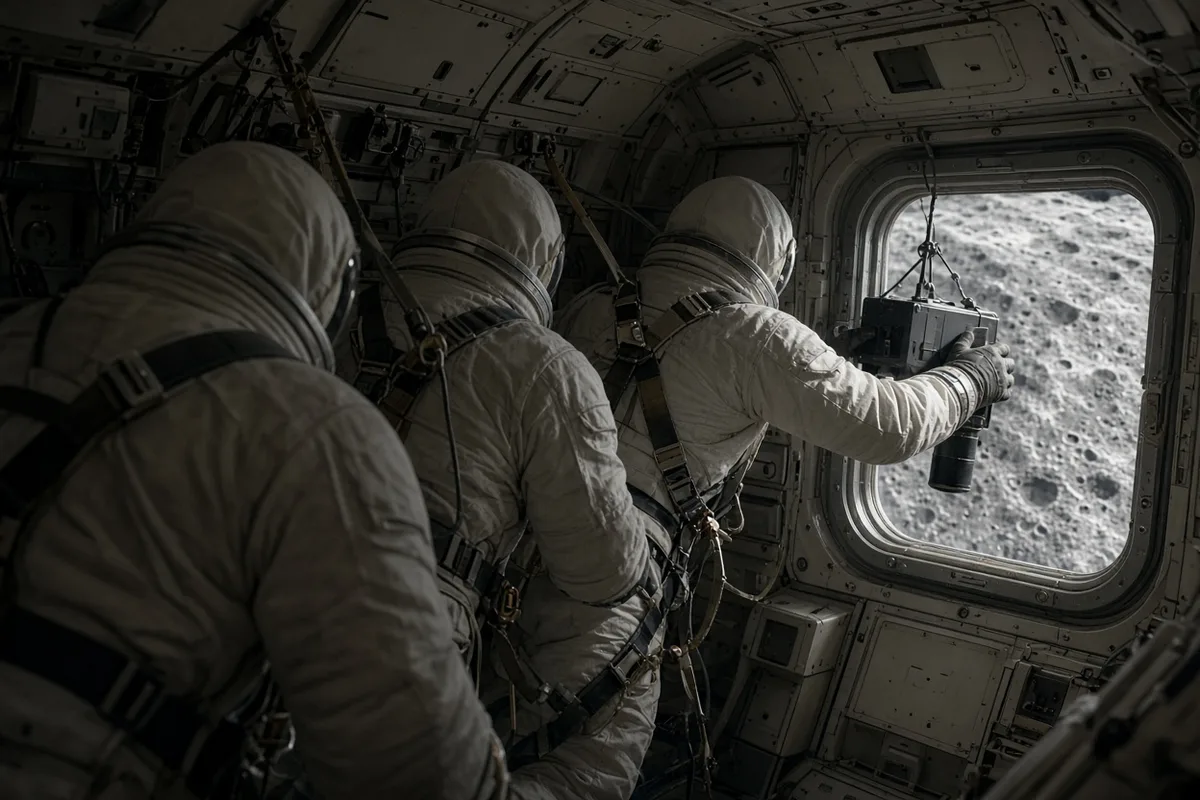
Earlier in that same swing around the far side, Anders had caught sight of something out the window that stopped him cold — the Earth itself lifting up over the Moon's gray horizon, blue and white and whole, rising the way no earthbound sunrise ever had, because nothing on Earth ever rises the way a world rises over an alien landscape. He grabbed the camera and got the shot before it was gone. He would say afterward that they had trained for months to explore the Moon, and what they ended up discovering instead was their own planet, small enough to cup in two hands.
The reading closed the way it opened, plain and unadorned. And from the crew of Apollo 8, we close with good night, good luck, a Merry Christmas, and God bless all of you — all of you on the good Earth. Nobody in that room said a word for a second or two after the line ended. Then someone exhaled, and the ordinary noise of the console room came back up around us, quieter than usual, like people leaving a service.
A telegram arrived afterward, one among a flood of them, from a viewer who put it more plainly than any of us could have: the mission, that message, had saved 1968. Not everyone felt that way — an atheist activist named Madeline Murray O'Hare would later bring a lawsuit over the reading, arguing it had no business coming from a government spacecraft. But that came afterward, argued in courts and newspapers, far from the quiet of that room on Christmas Eve, where for a few minutes the year's whole freight of grief had seemed to lift, just slightly, just enough to notice.
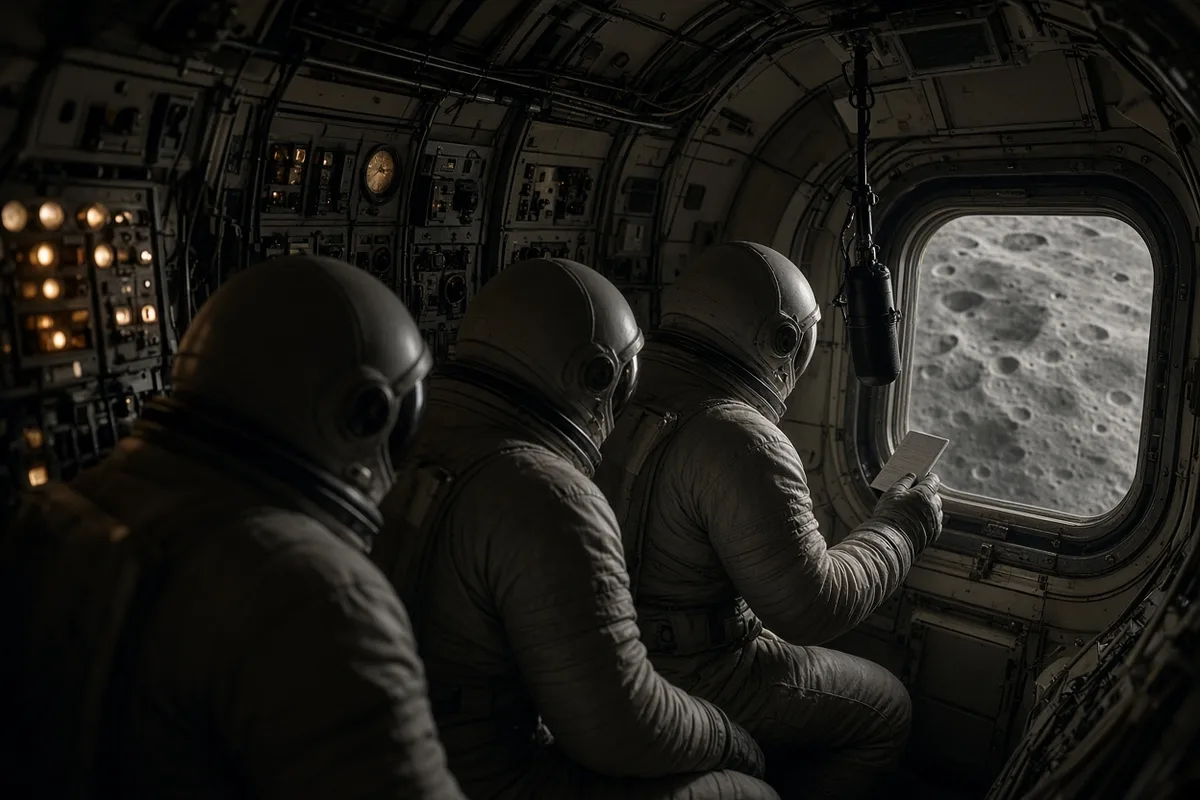
Christmas morning brought its own kind of dread, quieter than the first one but every bit as real. To come home, the spacecraft needed one more burn, behind the Moon again, out of contact again, the engine that had put them into orbit now required to pull them back out of it. No lunar module. No second chance if it failed. We waited through the blackout the way you wait through anything you cannot influence and cannot look away from, watching a clock that seemed to have stopped moving.
Then Lovell's voice came back over the link, level and almost amused, delivering the line that told us everything we needed before the numbers even confirmed it: Roger, please be informed there is a Santa Claus. The room came apart. Not loudly — nobody stood on a chair — but I remember hands slapping backs and someone laughing with something close to tears in it, because the burn had worked, and three men who had left Earth's gravity for the first time in human history were now, for the first time, coming back to it.
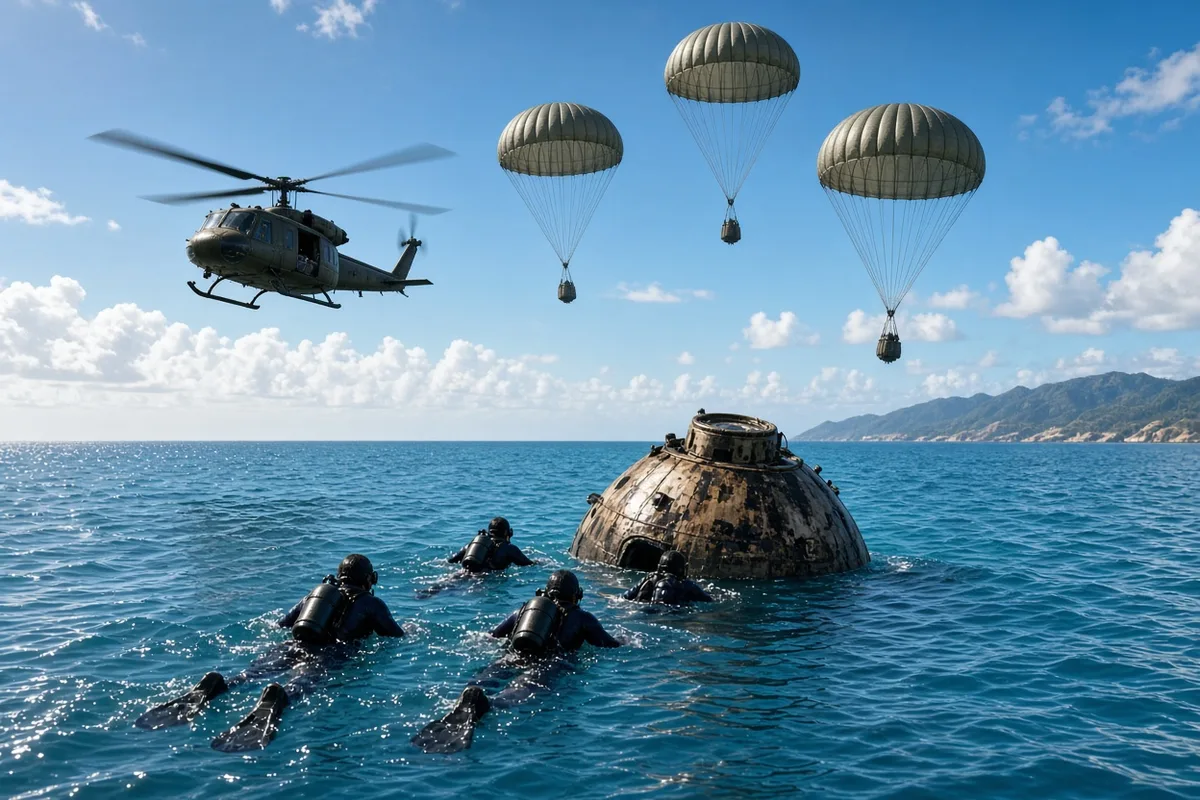
They splashed down in the Pacific on December 27, the command module rocking in the swells until the recovery ship reached them, and it was, by every measure that mattered, an ordinary end to an impossible week — men pulled from the water, a hatch opened, three tired faces blinking in the sun. A lunar landing was still half a year away. But something had already changed. Human beings had traveled to another world and come home whole, and the photograph Anders carried back with him, of a blue Earth rising over a gray horizon, would go on to move something in people who never gave a thought to rocket engines or trans-earth injection burns — it would end up on a postage stamp, in textbooks, credited by people far from any space program with helping start a movement to protect the very planet it depicted.
Lovell would fly again, further into the record books than he probably wanted — the one man to circle the Moon twice and never once walk on it, the second time coming home not with a Santa Claus line but with the words "Houston, we've had a problem," on a mission called Apollo 13 that nearly didn't make it back at all. Borman stepped away from spaceflight not long after, carrying the mission's caution in him the rest of his life. Anders went on believing, more than anything else that flight had shown him, that he had gone looking for the Moon and found the Earth instead.
I still think about that room, the headsets, the silence during the verses, more than I think about almost anything else from those years. Ten orbits around a dead world, and what came back to us was a photograph of a live one, and a voice reading ten verses older than any rocket, older than any war, closing with a wish sent down to everyone still standing on the ground below — on the good Earth, still turning, still there.