



Amazon Says New ‘Feeling’ Robot Is Augmenting — ‘Not Replacing’ — Human Workers
Amazon’s new “Vulcan” warehouse robot — capable of picking, stowing and rearranging three-quarters of the items Amazon stocks — could put a vast swath of America’s blue collar workforce in the crosshairs. Vulcan…
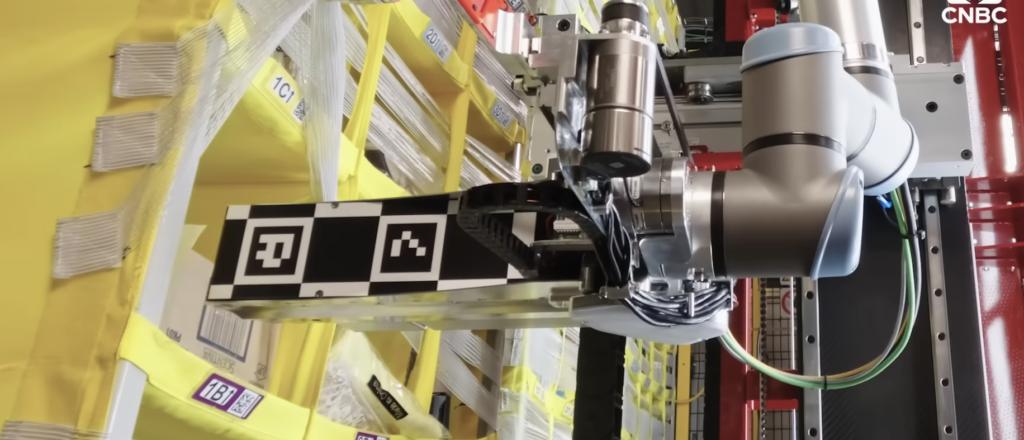

Amazon’s new “Vulcan” warehouse robot — capable of picking, stowing and rearranging three-quarters of the items Amazon stocks — could put a vast swath of America’s blue collar workforce in the crosshairs.
Vulcan, already operating in Spokane, Washington, and Hamburg, Germany, uses a sense-of-touch system to navigate shelves that once required the human mind and hand, reaching bins eight feet high or inches from the floor — all while learning from its missteps. Amazon plans to roll out the machines across the U.S. and Europe within “the next couple of years.”
“Fitting an item into or plucking one out of this crowded space has historically been challenging for robots that lack the natural dexterity of humans,” the company wrote in a press release. “Vulcan is our first robot with a similar kind of finesse. Vulcan can easily manipulate objects within those compartments to make room for whatever it’s stowing, because it knows when it makes contact and how much force it’s applying and can stop short of doing any damage.”
An articulated arm tipped with a spatula-like “paddle” slides into crowded cubbies, guided by force-feedback sensors that measure pressure in real time, while a second arm’s suction cup and AI vision system pluck single items without grabbing extra merchandise. The robot can detect when it can’t grasp an object and flags a nearby coworker; otherwise it rearranges existing inventory, “zhoops” new goods into place via miniature conveyor belts, and logs each move for a machine learning review.
The hardware is backed by physical-environment AI software trained on thousands of real-world touch scenarios — from toothpaste tubes to fragile electronics — so Vulcan steadily refines its grip and speed. Amazon says it already relies on more than 750,000 mobile bots to ferry shelves around its network; adding dexterous handling machines closes one of the last gaps between human and robotic labor on the warehouse floor.
Amazon