




Hundreds Of New Chemicals Await EPA Approval While American Manufacturers Look Abroad
Hundreds of new chemicals await Environmental Protection Agency approval while manufacturers say delays push production overseas.
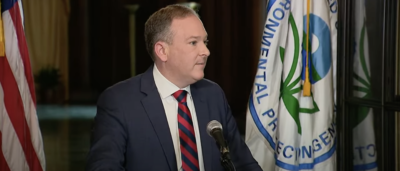

Hundreds of new chemicals await Environmental Protection Agency approval while manufacturers say delays push production overseas.
The Environmental Protection Agency (EPA) had 421 new chemical notices pending on Sept. 1 and must review each within 90 days, according to agency statistics. Congress extended the EPA’s authority to collect fees from chemical makers through Dec. 11 in the spending law President Donald Trump signed Sept. 2, the enacted text states.
The EPA listed 11 submissions for battery components or materials as received and under review in Federal Register notices it published July 28 and issued Aug. 27, according to a Daily Caller News Foundation analysis of the notices. The same documents list two heat transfer fluids, a chemical for electronic component manufacturing and an ingredient of photoresist, a coating used to make computer chips.
One company chose to manufacture an advanced cooling chemical for semiconductor chips in France because of delays in the U.S. review process, the American Chemistry Council (ACC), a trade group for chemical manufacturers, said in a statement to the DCNF. The council did not name the company.
“In practical terms, when a new chemical remains under EPA review for more than a year past its statutory deadline, a manufacturer cannot confidently commercialize it, scale production, or make the long-term investments needed to bring it to market,” the ACC told the DCNF. “Their customers must continue using existing materials or potentially wait longer for other alternatives.”
The proposals in Congress to change the review process remain discussion drafts. The House Energy and Commerce Committee and the Senate Environment and Public Works Committee each released a draft this year that would reauthorize the fees, and neither had been formally introduced as of March, according to the law firm Wiley.
The ACC supports reauthorizing the fees and pairing that step with changes that make reviews “more timely, transparent, predictable, and grounded in the best available science,” the council told the DCNF in response to questions about Congressional legislation.
“This is not an argument for weaker reviews,” the ACC said. “Safety and timely, science-based decisions can and should go together.”
Most companies behind the battery submissions claimed their names as confidential business information, the notices show. Those identified include Quino Energy, which is seeking approval for an electrolyte that stores electrical energy.
More than 60% of chemical manufacturers surveyed reported EPA review times longer than one year, the Society of Chemical Manufacturers and Affiliates (SOCMA) said in an Aug. 13 press release. Respondents also said prolonged reviews hurt their business, with 82% losing opportunities and 70% canceling projects.
Two-thirds said the delays affect decisions about locating manufacturing in the United States. Nearly 93% said a faster and more predictable process would make them more likely to move production back to the country, the survey found.
“Updating TSCA will also help the United States compete more effectively with foreign adversaries such as China for the next generation of advanced manufacturing,” the ACC said.
TC Energy, which operates natural gas pipelines in 36 states, referred the DCNF to a Dec. 3, 2025, company statement in which President and CEO François Poirier called predictable permitting “foundational to American competitiveness.” Poirier chaired a National Petroleum Council report recommending limits on litigation and wider use of fast-track permits, according to the company.
The EPA asked the DCNF to allow until Sept. 21 for it to respond and had not provided a comment as of publication.
Republican Nebraska Sen. Pete Ricketts introduced the Sound Science Act, S. 4397, on April 27, and the Senate referred it to the Environment and Public Works Committee the same day. The introduced text names no cosponsors, and Congress.gov lists no reported action since.
The bill addresses the science the EPA uses in chemical risk evaluations, Ricketts said in an April press release.
The ACC reports on its online tracker that 409 of 446 new chemicals under review had passed the 90-day mark and 307 had been pending for a year or longer. The median wait was 469 days in the first quarter of 2026 compared with 520 days in 2025, the council says on a separate page of its website.
Companies must notify the EPA before they manufacture or import any substance missing from the federal inventory of existing chemicals, the agency states in the Federal Register notices.
Of the 421 notices pending on Sept. 1, 267 were with the EPA, and 154 were with the companies that submitted them, the agency’s statistics show.
The agency cleared 19 new chemicals for sale without restrictions in fiscal year 2026 through Sept. 1, compared with 267 in fiscal 2019. The EPA also completed 151 notice reviews over the same period, more than the 148 it finished in all of fiscal 2025, the agency’s figures show.
EPA Administrator Lee Zeldin announced in a Sept. 18, 2025, press release that the agency would prioritize new chemicals intended for data center projects.
The Alliance for Health and Safe Chemicals, a coalition of health and environmental groups, said in a Feb. 26 press release that the Senate draft would “make it easier for toxic chemicals to enter homes, schools and workplaces.”
Democratic Rhode Island Sen. Sheldon Whitehouse, the Senate committee’s ranking member, said at a March 4 hearing that some provisions could weaken the EPA’s authority over new chemicals when the agency lacks enough data to determine risk, according to the law firm Bergeson & Campbell.
Michal Freedhoff, a former assistant administrator of the EPA’s chemicals office, testified at the hearing that about 25% of EPA staff had left in the past year, the firm wrote in a separate summary.
The fees cover roughly one-quarter of the new chemicals program’s cost, Bergeson & Campbell wrote.
The EPA is accepting public comments on its Aug. 27 notice through Sept. 28, according to the document.
All content created by the Daily Caller News Foundation, an independent and nonpartisan newswire service, is available without charge to any legitimate news publisher that can provide a large audience. All republished articles must include our logo, our reporter’s byline and their DCNF affiliation. For any questions about our guidelines or partnering with us, please contact [email protected].