Trump Insists He Will Never Nuke Iran Despite His Own Pentagon Reportedly Saying They Were Considering It
The Iranian regime has proven to be a tough nut to crack, so tough that the U.S. military had reportedly considered the use of nuclear weapons in the Middle Eastern country.

The Iranian regime has proven to be a tough nut to crack, so tough that the U.S. military had reportedly considered the use of nuclear weapons in the Middle Eastern country.
The U.S. military has burned through an immense amount of munitions in the Iran war to little effect, pushing the U.S. to allegedly consider escalating the conflict through the use of nuclear weapons. A slideshow was circulated within the Department of War detailing a specific proposal for a nuclear strike in Iran, Tucker Carlson said Friday on “The Tucker Carlson Show.”
“Offensive use of nuclear weapons has been discussed in Pentagon meetings and put in slide decks,” Carlson said on Friday. “And Marjorie Taylor Greene tweeted that a couple of weeks ago and was, you know, dismissed; that’s not true. Well, it is. It’s factually true, and now everyone in the administration knows that it’s true.”
The Daily Caller News Foundation independently confirmed that Carlson received this information from an anonymous senior U.S. official with knowledge on the topic.
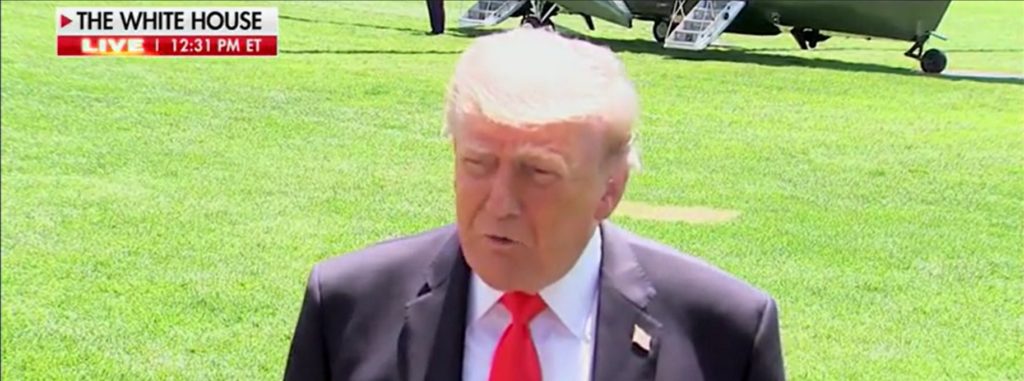
President Donald Trump said that he would not use a nuclear weapon in Iran while speaking to reporters in the Oval Office on Monday.
“There’s no reason for it,” Trump said. “What a stupid question that is, actually. Here they are, they’re totally defeated militarily. So now I defeat them, and now I should use a nuclear weapon on top of them? What a stupid question.”
However, now-outgoing White House press secretary Karoline Leavitt previously said that “all options are on the table” in the Iran War, Reuters reported on April 11, 2025.
Trump previously leveled threats against Iran that may have hinted at a nuclear strike.
“A whole civilization will die tonight, never to be brought back again,” Trump said in a Truth Social post on April 7. “I don’t want that to happen, but it probably will.”
“I think a limited-use nuclear weapon, something that’s more targeted towards penetrating Pickaxe Mountain would be the most likely,” former Director of the National Counterterrorism Center Joe Kent told the DCNF. “I don’t have any, and I couldn’t give any if I did have access to classified information. My general theory of the case has always been based on the parameters the president has laid out publicly when he says that Iran basically has to surrender.”
Kent explained that after President Donald Trump, or any commander-in-chief, makes statements about their military goals in an armed conflict, the Pentagon immediately begins working on options that it can use to make that a reality.
“I know from my military experience and time in the government that when he says things like that, people at the Pentagon will inherently start planning, and so I think the more he becomes frustrated with not being able to get a military victory based on the parameters of limited airstrikes, then he’s going to go to the Pentagon and say, ‘Well, what else do you have?'” Kent told the DCNF.
“They kind of have two more options that remain. One is some form of a ground incursion, which, if they’re being honest, is going to have high casualties, and then the president doesn’t want to do that. Now, I think he could still be, you know, talked into it, unfortunately, or you have the use of a nuclear weapon in some way, shape, or form,” he added.
Israel is widely believed to possess roughly 90 nuclear warheads, although the country has never publicly acknowledged having nuclear weapons, according to the Stockholm International Peace Research Institute. Kent warned that the Israelis may choose to launch a nuclear strike on Iran rather than relying on the U.S. military.
“I think the Israelis could easily go to President Trump and just say, ‘Hey, we’ll take care of this for you, and you have plausible deniability because we’ve already publicly said that you know we’re not going to be constrained by what the Americans do’,” Kent told the DCNF. “And then Israel comes in, and either does the dirty work for us with something precision, or because the Israelis aren’t really known for precision, they do something that we would never do.”
Using a nuclear weapon in Iran could change global norms, justifying the use of nuclear weapons by other global powers, analysts told the DCNF.
“I wouldn’t put anything past anybody after that lines crossed,” the Director of the National Security Reform Program at the Stimson Center, Dan Grazier, told the DCNF. “But sure, if the United States launches a tactical nuclear weapon, even one against Iran in this current conflict, sure, why would the Russians really have any qualm about doing it in Ukraine? Again, there’s like absolutely anything is possible after after after that threshold is reached.”
“I think almost immediately after us or the Israelis use one in Iran, Putin uses one in Ukraine, because I think Putin’s already at least considering that,” Kent told the DCNF. “Putin has people to his right that are pressuring him to do something more aggressive and dramatic to end the stalemate in Ukraine, and it’s not really a stalemate. The Russians are slowly kind of grinding it out, but I think the second that we uncork the bottle of nuclear weapons, then Putin would just say, ‘Okay, well, if that’s the new norm, if a greater power is now justified to use a nuclear weapon to end a conflict, that’s exactly what I’m going to do.'”
Kent called for the Trump Administration to put pressure on the Israeli government and Israel Defense Forces to prevent them from continuing escalations in the Iran War, including a potential nuclear strike.
“To President Trump, I would say don’t consider it in the war now, and I would say you have to restrain the Israelis,” Kent told the DCNF. “We need to start cutting off a lot of the support that we give them . I would say we need to completely stop the military support, the economic support that we give them, and then make it very clear to them that any expansion outside their borders … we will not support them.”
The Pentagon referred to U.S. Central Command (CENTCOM). CENTCOM and U.S. Strategic Command (STRATCOM) declined to comment on the ongoing conflict, citing operational security.
“STRATCOM is committed to maintaining a strong, credible deterrent that is ready to respond to global threats at the President’s direction,” a STRATCOM spokesperson told the DCNF.
“Using nuclear weapons — particularly against a country that doesn’t have them — for the first time since 1945 would change the world, making it much more likely that other countries would use nuclear weapons in the future,” Matthew Bunn, James R. Schlesinger Professor of the Practice of Energy, National Security and Foreign Policy at Harvard Kennedy School, told the DCNF. “That would pose a grave danger to U.S. national security. Remember that a single nuclear weapon can obliterate a city: nearly all of the over 12,000 nuclear weapons in the world today … have explosive power far larger than the bombs that turned Hiroshima and Nagasaki into smoking ruins.”
There are roughly 12,187 nuclear weapons in the world. About 9,745 were considered potentially operationally available at the start of 2026, roughly 4,012 were deployed with operational forces, and between 2,100 and 2,200 were maintained on high operational alert, according to the Stockholm International Peace Research Institute.
The world’s nuclear stockpile is large enough to destroy the planet many times over, United Nations Secretary-General António Guterres said on March 5, 2023.
Nuclear powers such as the Russian Federation and the United States have recently updated their nuclear policies, further substantiating the claim that the U.S. military is considering the use of nuclear weapons in Iran.
“The U.S. is deploying additional ‘low-yield’ nuclear weapons and regional nuclear forces. Low-yield is a relative term: the largest U.S. conventional bomb has an explosive yield equivalent to about 11 tons of TNT, while typical ‘low-yield’ nuclear weapons range from 10 to 800 times that figure,” Bunn told the DCNF. “These weapons are intended in part to deter the use of such weapons by American adversaries — but also to give the U.S. President additional options in a crisis or conflict … Remember that in the United States, the President has sole authority to launch nuclear weapons at any time — and for now, that authority is vested in Donald Trump.”
Russian military doctrine states that in the event of an existential threat, it would be forced to respond with nuclear weapons, according to a recent amendment of the doctrine by the Kremlin.
The Pentagon is separately reviewing U.S. nuclear employment strategy in an effort to “expand the president’s options” and provide additional credible nuclear options, including counterforce options, Under Secretary of War for Policy Elbridge Colby said during an Aug. 5 U.S. Strategic Command symposium.
“Pentagon efforts to expand the range of nuclear options are quite significant. These are more a further evolution of previous trends rather than a radical new development,” Jeff Knopf, professor and program chair of Nonproliferation and Terrorism Studies at the Middlebury Institute of International Studies, told the DCNF. “Proposed new weapons are partly an effort to fill in rungs in a hypothetical ladder of nuclear escalation in the belief this will better deter Russia and maybe China from contemplating nuclear use. But these efforts also signal a move toward greater U.S. willingness to consider so-called tactical or low-level nuclear use as a usable option that complements conventional precision strike capabilities.”
“I can tell you that multiple administrations have been reevaluating limited nuclear war options,” Grazier told the DCNF. “I knew the Biden administration was doing this because I got a personal briefing from them like two years ago about this, and so I’m sure those options carried over to the Trump administration, and considering how, let’s just say, ineffective so far the military campaign has been in Iran, like bringing the Iranians to the negotiating table. It doesn’t surprise people a bit.”
The U.S. military has used up a significant amount of its conventional offensive munitions and defensive capabilities in the Iran War.
The U.S. has burned through “virtually all” of its available Army Tactical Missile Systems (ATACMS) and newer Precision Strike Missiles (PrSM) during the Iran war, while also expending slightly less than half of its global stockpile of Tomahawk cruise missiles, Reuters reported on Aug. 4, citing two anonymous individuals familiar with U.S. munitions data.
U.S. defensive capabilities have also taken a significant hit, with the military’s Patriot interceptor stockpile falling to less than half of the prewar inventory and its Terminal High Altitude Area Defense (THAAD) inventory declining to roughly 250 after extensive use against Iranian missile attacks, according to the Center for Strategic and International Studies.
Even if the U.S. military does decide to use a nuclear weapon in Iran, the Iranian regime still may not fall, one analyst told the DCNF.
“I don’t care if it’s a conventional bomb or if it’s a nuclear bomb. I don’t think any bomb dropped on whatever target in Iran is gonna is gonna convince the Iranians to ,” Grazier told the DCNF. “We killed the Ayatollah on the opening night. That was a maximalist effort, like a pure decapitation strike. And according to air power theory, that should have been it. But clearly, bombing alone doesn’t win wars, and it doesn’t matter what size bomb it is. So yeah, this is a terrible option.”
Although there is widespread concern from American commentators and pundits surrounding the Iran War, Republicans and Democrats have generally supported the Iran War with little to no pushback, Kent said.
“I would just say this war is a byproduct of the so-called bipartisan consent in Washington, D.C. We don’t see the Democrats pushing back on this in a meaningful way,” Kent told the DCNF. “So I think this is a good time for all Americans to reflect on what we want from our foreign policy and what we want from our presidents going forward, like us trying to prop up this American empire that’s never really served the American people; it’s literally killing our republic. And regardless of who we vote for, we seem to get more wars.”
All content created by the Daily Caller News Foundation, an independent and nonpartisan newswire service, is available without charge to any legitimate news publisher that can provide a large audience. All republished articles must include our logo, our reporter’s byline and their DCNF affiliation. For any questions about our guidelines or partnering with us, please contact [email protected].