



As Trump Meets Xi, Experts Say China Targets Weak Spots In Western Tech
Experts warn that China is gaining ground in the artificial intelligence race as the world's two largest competitors meet to discuss the technology.
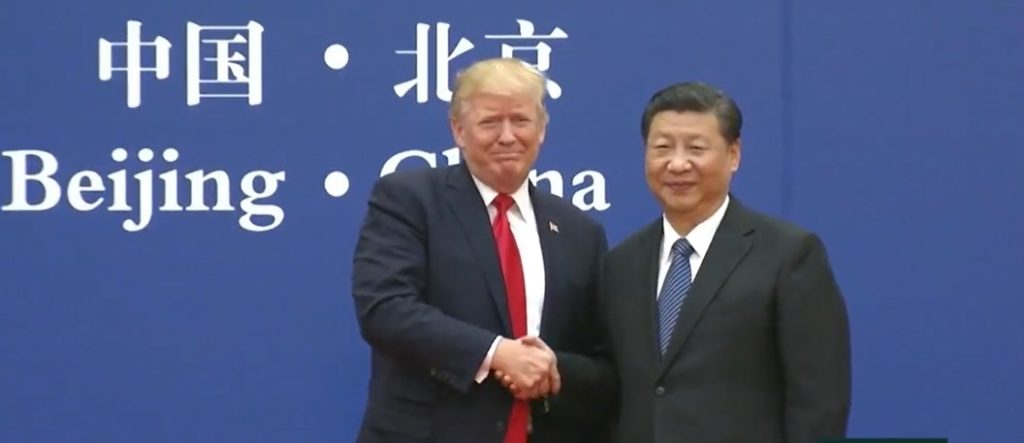

Experts warn that China is gaining ground in the artificial intelligence race as the world’s two largest competitors meet to discuss the technology.
As President Donald Trump meets with Chinese President Xi Jinping in Washington, D.C. for Thursday’s summit, China may pull ahead by putting AI to work and leading in open-source models, experts told the Daily Caller News Foundation. This summit, which is the second meeting between the world leaders this year, follows the Trump administration’s recent proposal for an AI incident “notification mechanism” with Beijing, the Associated Press reported Sunday.
“here the U.S. has advanced its enterprise, China has invested in the application of what exists today … Because of that, they’ve been able to work out a lot of the kinks around how to apply it in effective ways,” Jason Rathje, a former Biden administration Department of Defense official, told the DCNF. “hile I can’t discuss anything related to where I’ve seen China use AI from a national security perspective … it just seems that they’ve been focused on the application layer, as opposed to just the scientific advancement of the technology itself.”
Rathje is the president of public sector at webAI, an Austin-based private U.S. AI company which says it can “create personalized models that are tailored to your work” and that run on local devices, according to the company’s website.
“e, at webAI, are actively engaging in open source models, and we’re pacing off of where China is, right? Because they are leading in the open source category,” Rathje told the DCNF.
Regarding the summit, Rathje warned against any outcome that holds back U.S. open-source AI developers.
“hat I hope to see coming out of this is a renewed or continued advancement of U.S. open source models as we think towards making sure the U.S. can maintain technological superiority, not just at the frontier, but also in the application itself … I don’t want to see anything that regulates or slows down our ability to compete in the open source domain,” Rathje told the DCNF.
The White House and the Chinese Embassy in Washington, D.C. each did not immediately respond to the Daily Caller News Foundation’s requests for comment
Thomas Duesterberg, a senior fellow at the Hudson Institute, argued that China’s push into the open-source AI market is a direct response to U.S. export controls.
“ince they don’t have access to the most powerful chips, thanks to our export controls, their strategy is releasing these open weight AI systems that can do 80 or 90% of what the leading edge stuff does,” Duesterberg told the DCNF.
That puts America’s investments in AI at risk, he argued.
“e are spending trillions of dollars building data centers and building AI models,” Duesterberg added. “f that continues, then we’re not going to be able to recover the massive investments we’ve been putting in to our AI systems and infrastructure, and that’d be a blow to our economy.”
Chinese open-weight models have gained users faster than American models because Beijing heavily subsidizes them, Duesterberg explained.
China also gets around U.S. export controls by routing advanced chips through buyers in third countries, often companies that hide where the money comes from, Duesterberg said.
“There’s a lot of that going on,” he told the DCNF.
Nvidia, whose chips face U.S. export restrictions on sales to China, declined to comment. Ukrainian officials alleged in August that Russian drones used AI-powered Nvidia chips that aided in selecting targets.
Duesterberg further pointed out that Huawei, a Chinese telecommunications company, is heavily subsidized and has built its equipment into networks around the world.
“he allegation is, and I think it’s probably true, that they configure their phone systems so that they have access to what goes over those phone systems,” Duesterberg told the DCNF.
Federal prosecutors have accused Huawei of stealing U.S. trade secrets, hiding business in Iran and North Korea, and aiding Iranian domestic surveillance, allegations the company denies and that are now being tried in federal court in Brooklyn, according to the New York Times.
The Federal Communications Commission placed Huawei on its Covered List of gear that “poses an unacceptable national-security risk” and has barred that equipment from U.S. networks.
“ did it in steel, they did it in solar, they did it in wind, they did it in electric vehicles, they did it in telecom stuff … Now they’re trying to do the same thing in AI,” Duesterberg said.
Public Policy Solutions, a Washington policy firm, released a report last year which argued the European Union targets American tech companies with discriminatory laws while leaving the door open to Huawei and other Chinese firms.
“China’s relentless pursuit of global tech dominance paired with Europe’s antagonism toward U.S. tech is a dream come true for Beijing,” John Czwartacki, co-founder and principal of Public Policy Solutions, said in a statement to the DCNF. “By targeting American companies with protectionist regulations while slow walking their decoupling from Chinese state-backed technology, the EU is prioritizing punishing successful American companies over mitigating serious national security risks. It’s not too late for our European allies to course correct and secure their tech stack from undue malign influence.”
Duesterberg said Europe’s telecom companies are losing their market share globally, which gives European allies a reason to work with Washington against China, despite their reluctance to do so.
“he United States needs to do a better job of working with our allies and convincing them that it’s in our mutual interest to try to work together to push back against … China,” Duesterberg said.
All content created by the Daily Caller News Foundation, an independent and nonpartisan newswire service, is available without charge to any legitimate news publisher that can provide a large audience. All republished articles must include our logo, our reporter’s byline and their DCNF affiliation. For any questions about our guidelines or partnering with us, please contact [email protected].