



Mexican Border State Pushes False Image of Safety as Cartels Continue to Operate with Impunity
Officials in the Mexican border state of Tamaulipas have been pushing a false narrative. They try to claim their region is safe, while in reality, terrorist cartels operate with almost complete impunity.
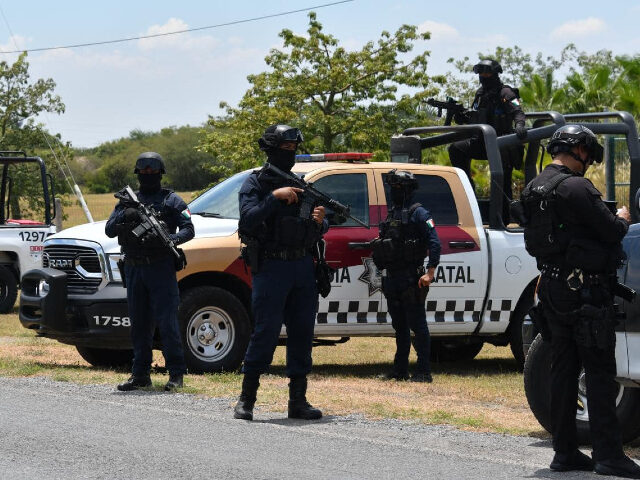
Officials in the Mexican border state of Tamaulipas have been pushing a false narrative. They try to claim their region is safe, while in reality, terrorist cartels operate with almost complete impunity.
Rather than using their security forces to fight designated terrorist groups like the Gulf Cartel and the Cartel Del Noreste faction of Los Zetas, the Tamaulipas government simply has been announcing police deployments and operations that have yielded no real results.
Additionally, rather than investigating and prosecuting the numerous atrocities carried out by these cartels, government officials use doctored crime statistics to claim that crime is constantly dropping despite cartels being able to freely move convoys of gunmen and even fire at U.S. law enforcement from across the Rio Grande.
Last month, Breitbart Texas reported on how gunmen from the Gulf Cartel had fired across the Rio Grande at U.S. Coast Guard boats that were patrolling the river. The move led the U.S. government to deploy hundreds of troops to the region in an attempt to shut down an area that is a known cartel corridor.
As Breitbart Texas reported, Mexico’s President Claudia Sheinbaum publicly claimed that her troops went to the scene of the shooting and found no evidence of an incident having taken place.
The rhetoric of minimizing cartel violence by Sheinbaum is matched by the Tamaulipas government, which is constantly claiming that crime is decreasing.
NGO’s such as the National Citizens Observatory and Common Cause in Mexico paint a very different picture. The groups point to black stats, which are crimes that are unreported or undercounted by the government, that double or triple the reported crimes. Additionally, surveys by Mexico’s own INEGI (National Institute of Statistics and Geography) show that perceptions of public safety in parts of Mexico, such as Tamaulipas, are dismal.