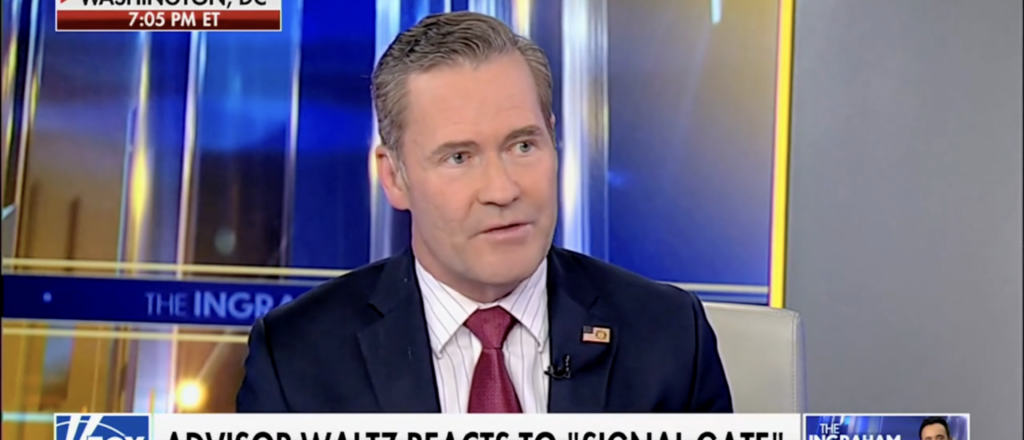
Trump’s UN Rep Mike Waltz Spotlights Taiwan Arms Sale Following China State Visit
U.S. Ambassador to the United Nations Mike Waltz defended the White House's position on a seemingly stalled arms sale to Taiwan during a "State of the Union" interview Sunday.
Spencer Lombardo·Sep 27, 2026·4 min read
🌐Foreign Affairs
Sponsored
U.S. Ambassador to the United Nations Mike Waltz defended the White House’s position on a seemingly stalled arms sale to Taiwan during a “State of the Union” interview Sunday.
CNN’s Jake Tapper asked Waltz about U.S.-China relations following Chinese President Xi Jinping’s recent visit to the White House. Ahead of President Donald Trump’s previous summit with Xi in May 2026, Trump paused a $14 billion arms deal with Taiwan, framing it as a bargaining chip.
WATCH:
📺 Embedded media — coming soon
“CNN‘s reporting that U.S. intelligence — the Intelligence Community — believes that the Chinese government allegedly provided Iran with satellite images that were used to coordinate a deadly attack against a U.S. base,” Tapper stated before asking Waltz, “How much did President Trump push President Xi on that issue and on whatever China is doing tacitly, or any other way to support Iran in the war?”
“Well, Jake, obviously, I’m not going to get into leaked intelligence assessments, but what I can tell you: President Trump has raised it multiple times, raised it in Beijing, raised it during this summit,” Waltz replied. “And I think we have seen movement in a positive direction. But President Trump has made it clear it’s unacceptable.”
Iran obtained satellite imagery from Chinese entities before launching a July 17 strike which killed three American service members and injured four others at the Muwaffaq Salti Air Base in Jordan, The Wall Street Journal reported
Sponsored
Sept. 11, citing U.S. officials familiar with the details. Chinese officials, however, denied the allegations.
Xi reportedly then threatened to cancel the upcoming summit if Trump approved additional arms sales to Taiwan. A senior U.S. official, however, stated such reporting was inaccurate, the Daily Caller News Foundation reported Sept. 17.
“On the matter of China and Taiwan, Congress, as you know, has signed off on this $14 billion arms deal, the U.S. selling arms to Taiwan. The Taiwanese, as I understand it, have already given us the money, and the world is just waiting for President Trump’s official signoff for those weapons to start going to Taiwan,” Tapper stated before asking Waltz, “When can the Taiwanese expect us to honor our end of this deal?”
“Well, I mean, Jake, just the fuller picture is that, in just last year, the United States and this administration has granted more arms sales in a year — in its first year — than the last administration in its entire term,” Waltz replied. “There is a huge backlog of arms, and a lot of this is about our industrial base and being able to produce not only what they are requesting, but what the Europeans are requesting. Some of these things are overlapped, and, of course, what our military needs.”
President Joe Biden’s administration gave nearly $8.4 billion to Taiwan between January 2021 and January 2025, according to the Forum on the Arms Trade.
“So this is part and parcel to why Secretary Hegseth, Secretary Bessent, and others are investing so much into our industrial base to get after some of these backlogs that we’re seeing to the tune of $18 billion, $20 billion, $25 billion,” Waltz continues. “So there’s a lot I have— I think — going into these decisions, but it’s important to remind folks that we have given— the United States has given quite a bit to Taiwan just in the first year.”
U.S. Secretary of State Marco Rubio expressed a similar view Wednesday to reporters at the U.N. General.
“People think … we view arm sales through the limited vacuum of the one particular place,” Rubio said. “A lot of this also involves balancing our industrial capacity and our military industrial base.”
Rubio, who replaced Waltz as Trump’s national security adviser, also told reporters that the pause “is not about Taiwan in specific, but when we sell something, that means we don’t have it anymore” and that “we can get it in the future, but we don’t have it now.”
“So anytime we do any sales, not to Taiwan, to anybody, it is always balanced against what are our own needs in different parts of the world, and whether we can afford to sell something because we may need it for ourselves,” Rubio continued. “So that’s going through that process.”
All content created by the Daily Caller News Foundation, an independent and nonpartisan newswire service, is available without charge to any legitimate news publisher that can provide a large audience. All republished articles must include our logo, our reporter’s byline and their DCNF affiliation. For any questions about our guidelines or partnering with us, please contact [email protected].