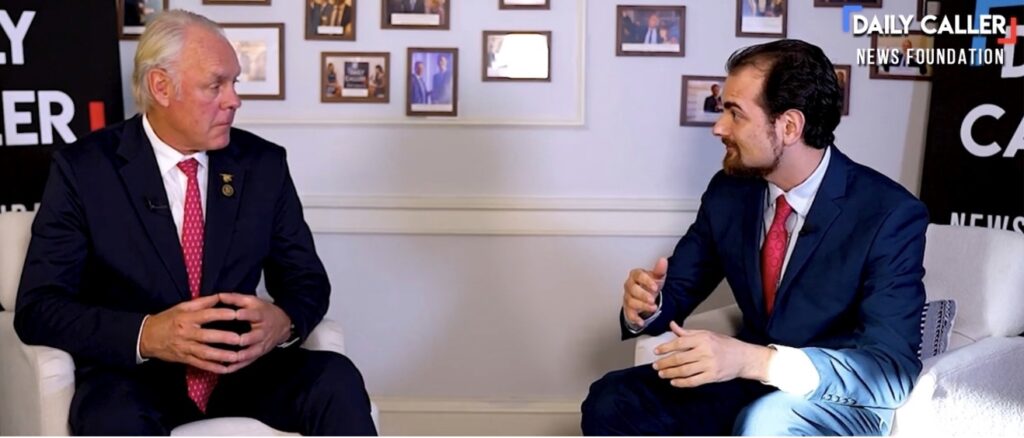
EXCLUSIVE: Rep. Ryan Zinke Doubles Down On Trump Policies After GOP’s Midterm ‘Mauling,’ Says Messaging Was To Blame
After serving in two of the three branches of the federal government as well as 22 years as a Navy SEAL, outgoing Montana Republican Rep. Ryan Zinke will soon be on the outside looking in as a Democrat-controlled Congress assumes the reins to steer Washington toward an unknown future.
Anthony Iafrate·Nov 24, 2026·8 min read
Sponsored
WASHINGTON — After serving in two of the three branches of the federal government as well as 22 years as a Navy SEAL, outgoing Montana Republican Rep. Ryan Zinke will soon be on the outside looking in as a Democrat-controlled Congress assumes the reins to steer Washington toward an unknown future.
Zinke — who served as secretary of the interior during President Donald Trump’s first administration — told the Daily Caller News Foundation in an interview that he believes his party’s midtermwipeout was more due to its severe messaging failures than its policies. Zinke, who did not seek reelection and saw his GOP-leaning seat won by a Democrat, pointed to the historicallyunpopularIran war, Trump’s tariffs, and data centers as examples.
“In Montana terms I would say it was a mauling,” the Republican told the DCNF of the 2026 midterm elections’ outcomes. He believes that, across the country, including in his home state, many Republicans stayed home and did not turn out to vote.
Sponsored
Sponsored
The Democratic Party won the generic House ballot by a whopping 14 percentage points, several points ahead of expectations set by most polls. To succeed Zinke in Montana’s First Congressional District, voters elected Sam Forstag, a Democrat endorsed by socialist Independent Vermont Sen. Bernie Sanders. Forstag beat Republican nominee Aaron Flint by four points in the seat Trump won by nearly 12 in 2024.
The cycle saw Democrats win both comfortable majorities in the House and Senate as well as statewide elections in the longtime deep red states of Texas, South Carolina, and Mississippi. Observers widely labeled the result a “blue tsunami” and agreed the administration’s decision to start a war which caused major economic disruptions — in contrast to perceived deviations from Trump’s 2024 “America First” foreign policy platform — was a decisive factor in the lopsided result.
‘Issues That We Needed To Address’
During his long career in public service, Zinke held many titles, including two separate stints as a congressman and nearly two years as Trump’s very first interior secretary. He told the DCNF, however, that his favorite one is “commander,” the rank he attained before retiring from the SEALs.
“There were issues that we needed to address that I think the Republican Party failed in,” he said during the interview, immediately naming the Iran war while pointing out he agrees with the conflict. He also claimed Trump and the GOP “could have done a much better job of shaping the argument of why we cannot let Iran have a nuclear weapon.”
When pressed by the DCNF on the war’s unpopularity and Trump’s perceived betrayal of his campaign promise to avoid bogging the U.S. in endless wars, Zinke said there was an “anticipation” the Iran conflict would be “over in a weekend.”
WATCH:
“I did not think we did a good enough job as we could have on messaging,” he said, referring to the war. “I think the expectations were it’s going to be a weekend, were not reviewed, and I think we paid a price for it.”
The vast majority of 2026 voters — 85% — believe the war raised their costs of living, with 59% saying it had raised them “a lot,” according to a post-midterm survey by American Compass. Vice President JD Vance also said the day after the midterms that many voters who switched their votes from Republican to Democratic candidates expressed, in part, a strong desire to end the war and change the U.S.’s relationship with Israel.
Zinke, however, pushed back on the notion that the U.S.’s war against the Iranian regime was Israel’s fault.
“When the president acted, he acted. He takes full responsibility for it,” he said, regarding Trump’s decision to launch Operation Epic Fury on Feb. 28. “I support Israel many times. But I don’t fight for Israel. I fight for the United States. … When the United States decided to engage, the United States decided to engage and we did.”
Polling during the conflict showed that the percentage of American respondents viewing the Middle Eastern state as an ally collapsed in a matter of weeks. Meanwhile, the numbers of American respondents — including Republicans — viewing Israel unfavorably and those believing it influences U.S. foreign policy too much has increased.
Israeli officials persuaded Trump to go to war during a secret February meeting at the White House laying out a plan, elements of which Secretary of State Marco Rubio called “bullshit,” The New York Times first reported in April. Rubio said in March, days after the strikes began, that the administration “knew that there was going to be an Israeli action … that would precipitate an attack against American forces,” and the U.S. struck preemptively to reduce American casualties.
‘Evil In People’s Mind’
“The tariffs in Montana also could have been better articulated,” the secretary-turned-congressman added during his interview with the DCNF. He noted that, due to Montana’s long border with Canada, it was notably affected more by Trump’s levies against the U.S.’s northern neighbor than by other states.
“And why tariffs? We need manufacturing jobs here. So, when countries don’t participate in fair trade … it affects jobs at home,” he added, emphasizing the GOP did not sufficiently articulate this line of reasoning to voters.
A whopping 79% of respondents said tariffs had raised their costs, including 53% who said they raised them “a lot,” according to American Compass’s poll. Only 5% indicated tariffs lowered their costs.
Zinke went on to identify data centers as an issue he believes “we all should be concerned about,” saying they have “become evil in people’s mind.”
Post-midterm CNN exit polls found that 76% of voters opposed building data centers in their local communities. More than one in five voters — 23% — said the centers were “crucial” to how they voted; voters backed Democratic House candidates in a landslide 66%-31% margin. In addition, many Democrats who won upset midterm victories, such as Texas Governor-Elect Gina Hinojosa, heavily campaigned on limiting data centers.
Zinke said in many cases voters have soured on the infrastructure bolstering artificial intelligence despite having never seen any. He attributed this skepticism to “foreign influence,” specifically naming China and Russia.
“I can tell you a Walmart or a Home Depot is far more disruptive to a neighborhood than a data center,” he told the DCNF. He added that they have “become a big demon and an evil and a played a role even in Montana” which has relatively few data centers compared to other states.
‘Starts At The Top’
Looking to the future, Zinke said leadership is critical if the Republican Party wants to keep the White House and take back control of Congress in 2028
“It starts at the top. When it’s a presidential year, our people come out if they believe in our candidate,” he said, before praising both Rubio and Vance, who have long been regarded as the two most likely 2028 GOP nominees.
Zinke also had words of encouragement for Republican Ohio Rep. Jim Jordan, whom the House GOP conference just elected to be the next minority leader after outgoing House Speaker Mike Johnson decided to not seek the position.
“Jim’s a fighter,” he said, alluding to his 156–1 record in high school wrestling.
The outgoing Montana lawmaker, however, also noted Jordan’s job will be challenging as he now has to lead a party during its “wilderness moment” following the historic rebuke of the GOP at the ballot box
“It’s going to be really difficult,” Zinke told the DCNF. “Votingwise, it’s going to be easy: just vote ‘no’ because you’re in a minority and try to articulate.”
He challenged Republicans who vote against Democratic legislation during the next Congress to “give a better reason why” to explain their opposition.
“On policy, we can agree to disagree. Let’s not be disagreeable,” Zinke said. “And secondly, I’m going to try to convince you why my policy is better. And I think sometimes we lose sight of that. And as an opposition, you should criticize when they’re wrong; you should compliment when they’re right. The Democrats are going to do some things right. The Republican minority will get some things done.”
“But a lot of the focus is making sure our system is healthy and works,” Zinke added. “And we need to provide a better message for a better future, especially for the working class.”
All content created by the Daily Caller News Foundation, an independent and nonpartisan newswire service, is available without charge to any legitimate news publisher that can provide a large audience. All republished articles must include our logo, our reporter’s byline and their DCNF affiliation. For any questions about our guidelines or partnering with us, please contact [email protected].