Trump Could Bring Putin, Xi To Table As Nuclear Arms Race Looms
President Donald Trump could meet with the leaders of America's two largest nuclear adversaries next week as Washington pushes for a historic three-way agreement on nuclear weapons.
Francis Kapper·Nov 12, 2026·5 min read
🔍Investigations
Sponsored
President Donald Trump could meet with the leaders of America’s two largest nuclear adversaries next week as Washington pushes for a historic three-way agreement on nuclear weapons.
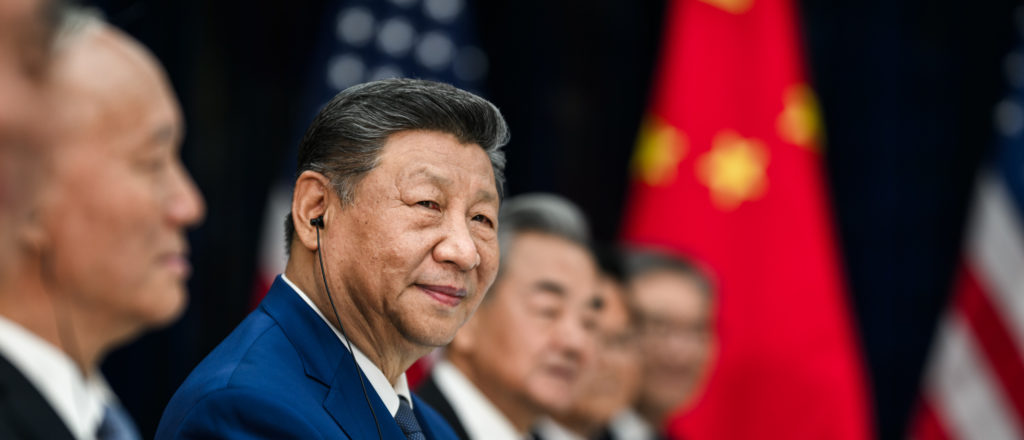
Secretary of State Marco Rubio raised the possibility of a summit involving Trump, Chinese President Xi Jinping and Russian President Vladimir Putin during a Wednesday phone call with Chinese Foreign Minister Wang Yi, according to a State Department readout. The potential three-way meeting could take place on the sidelines of next week’s Asia-Pacific Economic Cooperation (APEC) leaders’ summit in Shenzhen, China, where Trump and Xi are already expected to meet, although Putin’s participation has not been confirmed.
“First, arms control can no longer be a bilateral issue between the United States and Russia,” Rubio wrote on the official U.S. State Department Substack on Feb. 6. “As the President has made clear, other countries have a responsibility to help ensure strategic stability, none more so than China. Second, we will not accept terms that harm the United States or ignore noncompliance in the pursuit of a future agreement. We have made our standards clear, and we will not compromise them to achieve arms control for arms control’s sake.”
Rubio and Wang discussed advancing peace and nuclear disarmament through direct conversations between world leaders, including a potential meeting with Russia, according to the State Department.
The two diplomats “agreed on the importance of meaningful leader-level conversations to advance goals such as peace and denuclearization, including at any potential trilateral leaders meeting with Russia,” the department said.
American, Chinese and Russian representatives have spent weeks negotiating the possible summit’s agenda, with discussions increasingly focused on restricting artificial intelligence in nuclear weapons systems, the
reported Wednesday, citing sources familiar with the negotiations.
One possible agreement could establish limits on the use of AI in nuclear command-and-control systems, which govern how nuclear weapons are authorized and deployed, the outlet reported.
The negotiations have reportedly shifted away from other major geopolitical disputes, including Russia’s war in Ukraine and North Korea’s nuclear weapons program, as diplomats search for areas of potential agreement, according to the South China Morning Post.
However, Beijing has historically resisted American attempts to bring China into nuclear arms control negotiations alongside Russia, arguing that its arsenal remains considerably smaller than those of the two countries.
China’s nuclear capabilities are “by no means at the same level with that of the U.S. and Russia,” Chinese Foreign Ministry spokeswoman Mao Ning said during an October press briefing.
“It is neither fair, reasonable nor realistic to ask China to join the so-called trilateral nuclear disarmament negotiations at this stage,” Mao added.
China possesses approximately 620 nuclear warheads, compared with roughly 3,700 in the American military stockpile and 4,400 in Russia’s, according to 2026 estimates published by the Federation of American Scientists.
However, Beijing is rapidly expanding its nuclear capabilities, with American military intelligence previously projecting that China could possess more than 1,000 nuclear warheads by 2030, according to a Defense Intelligence Agency assessment.
Beijing’s official account of Wednesday’s conversation notably omitted any reference to nuclear disarmament or a potential meeting involving Putin, according to the Chinese Foreign Ministry.
Instead, Chinese officials characterized the discussion as positive and constructive, emphasizing improved relations and continued cooperation between Washington and Beijing, according to the ministry.
The potential talks follow the expiration of the New Strategic Arms Reduction Treaty (New START) on Feb. 5, which left Washington and Moscow without legally binding restrictions on their strategic nuclear arsenals for the first time in decades, according to the Arms Control Association.
The agreement previously limited each country to 1,550 deployed strategic nuclear warheads and 700 deployed strategic missiles and heavy bombers, according to the Arms Control Association.
Trump declined to accept a Russian proposal to continue observing the treaty’s central limits for another year, instead advocating a broader nuclear agreement that would include China, according to the Arms Control Association.
The administration has maintained that any meaningful nuclear arms control agreement must include China, whose expanding nuclear arsenal threatens to undermine existing agreements between Washington and Moscow, Rubio wrote in a February statement.
The possible meeting could also provide an opportunity to discuss the ongoing war with Iran, which Trump recently suggested he wanted to address alongside Xi and Putin, the Associated Press reported.
However, the three governments have not announced a formal summit agreement, leaving open whether the leaders will meet together or whether negotiations will produce substantive nuclear restrictions.
All content created by the Daily Caller News Foundation, an independent and nonpartisan newswire service, is available without charge to any legitimate news publisher that can provide a large audience. All republished articles must include our logo, our reporter’s byline and their DCNF affiliation. For any questions about our guidelines or partnering with us, please contact [email protected].