


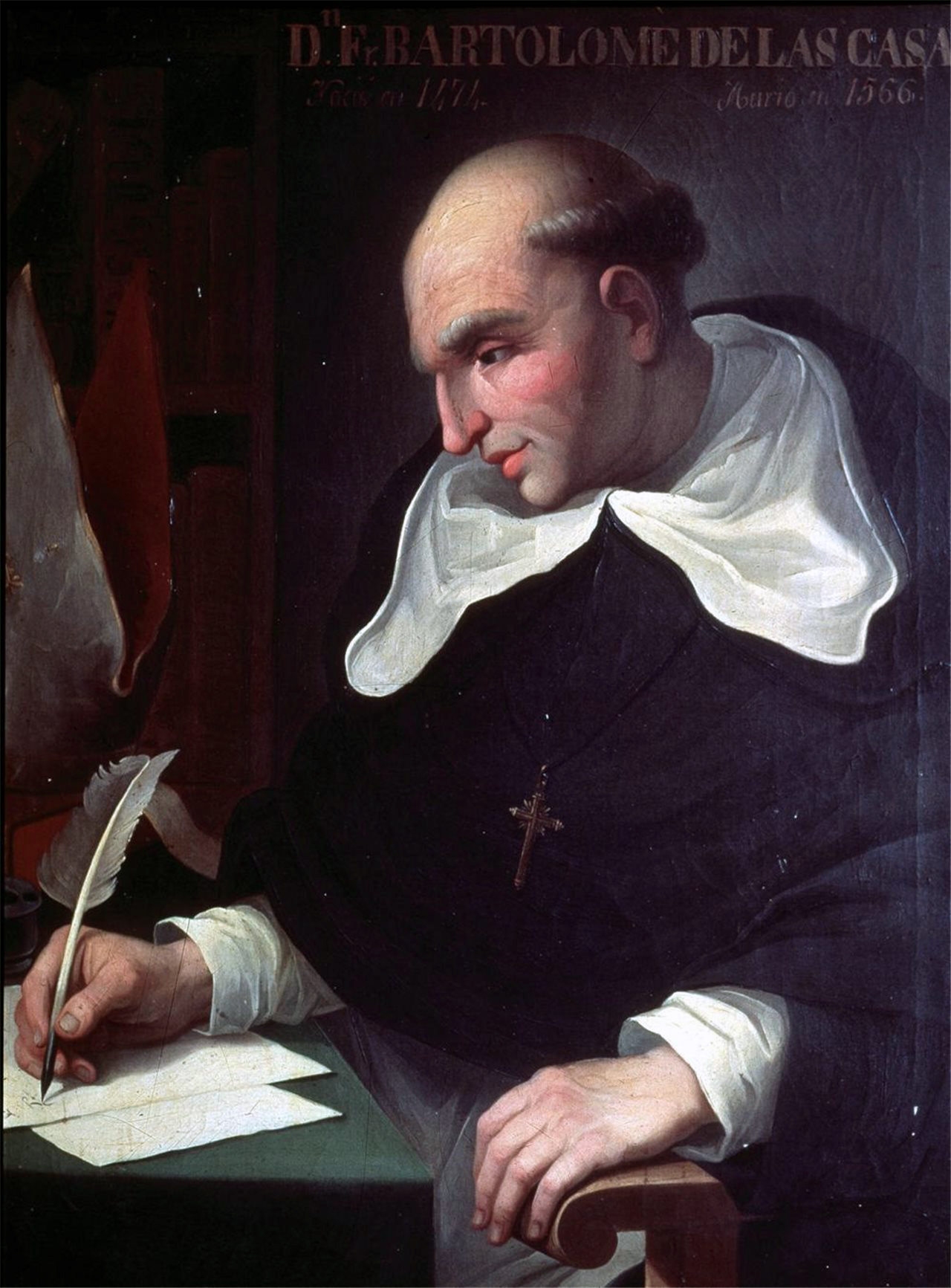
Bartolomé de las Casas Defends Native Rights
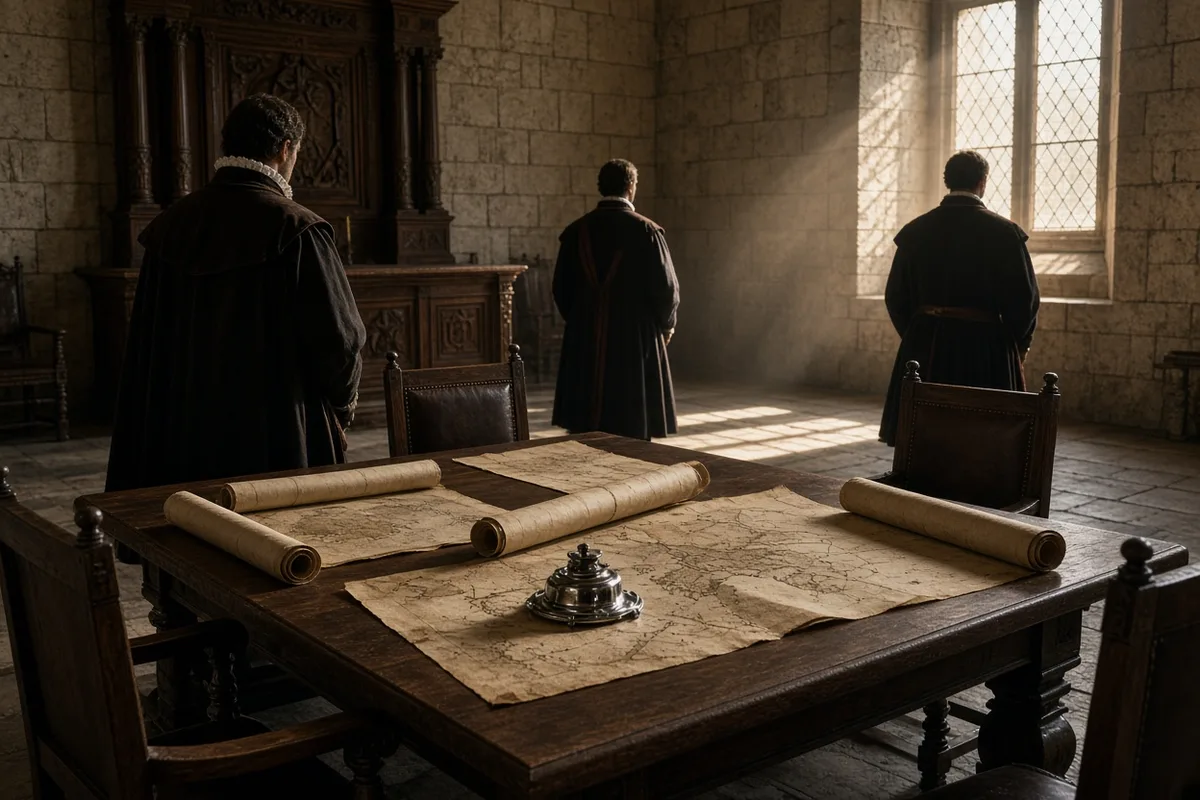
The hall smelled of wet wool and ink. I shifted on the bench, the wood biting into my spine, and watched the two men face each other across the long table. Sepúlveda had already begun, his voice carrying the even tone of a man who had rehearsed every line before a mirror. He spoke of natural slaves and the right of the stronger to lift the weaker. I had heard the same phrases in taverns in Santo Domingo years earlier, spoken by men who never left their estates.
Las Casas sat with his hands folded inside his sleeves. He was older than I remembered, the skin around his eyes loose, but his back stayed straight. When Sepúlveda paused for breath, Las Casas leaned forward and asked one question about the meaning of the word “barbarian.” The room went still. Sepúlveda answered with Aristotle. Las Casas answered with the faces of men he had baptized on the Arimao River.
I had come to Valladolid as a clerk attached to one of the Hieronymite commissioners who had once been sent to inspect the islands. That commission had failed, and I had returned to Spain carrying reports no one wanted to read. Now I sat among the theologians and lawyers, charged with noting the arguments, though my hand had stopped moving after the first hour. The candle wax ran in thin streams down the iron holders. Outside, rain struck the shutters in steady bursts.
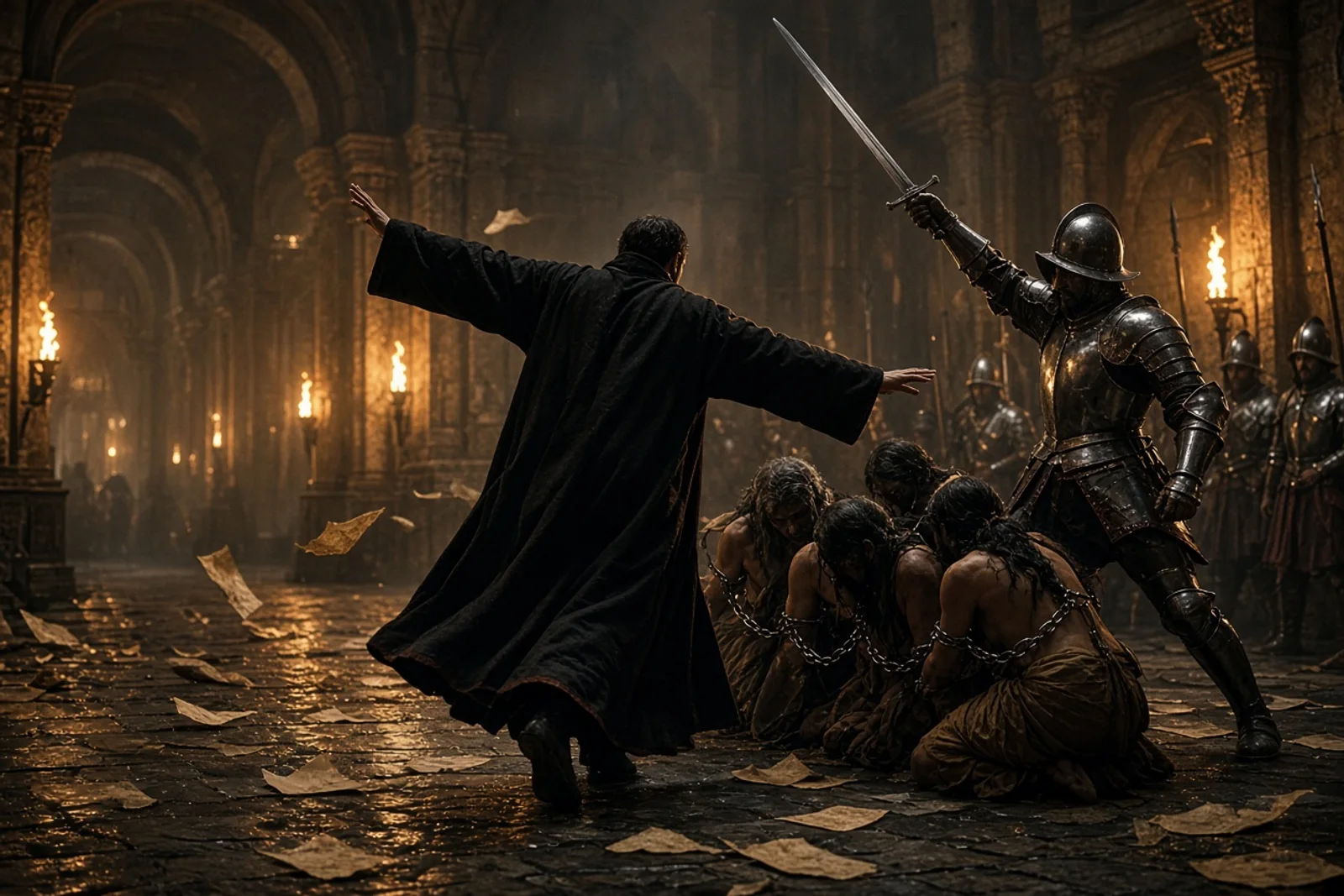
Sepúlveda brought up the sacrifices the Indians were said to practice. He described children thrown into pits. Las Casas waited, then spoke of the pits the Spaniards had dug for the same children when they refused to carry ore. He did not raise his voice. He simply listed the villages he had seen emptied between Bayamo and Camagüey. A jurist on my left shifted and coughed into his sleeve.
The afternoon light faded. Servants brought lamps. Las Casas stood and walked to the window, opened the shutter a hand’s width, and let the cold air in. He returned to his place and continued. He said the Indians governed themselves with laws older than any crown in Europe. Sepúlveda countered that those laws permitted idolatry. Las Casas answered that idolatry had once been the common condition of every nation, including Spain.
I remembered the day in 1514 when Las Casas had stood in a church on Cuba and told the congregation he was returning his own Indians. I had been among the soldiers who heard him. Some laughed. Others left the building. He had left the island soon after, carrying letters to the court. Now the same man stood before another court, and the laughter was gone, replaced by careful silence.
Night came. The debate did not end. They agreed to continue the next morning. I walked back to my lodging through streets already emptying. A woman selling chestnuts kept her brazier lit under an awning. I bought two and ate them while the shells burned my fingers. The taste stayed with me when I lay down.
At dawn the hall was colder. Sepúlveda arrived first, surrounded by clerks carrying books. Las Casas arrived alone. He carried only a small bundle of papers tied with cord. When he spoke again, he turned to the question of just war. He asked what act of aggression the people of Hispaniola had committed against the ships that first appeared off their coast. No one in the room supplied an answer.
The third day brought a new argument from Sepúlveda: the duty to rescue innocent victims from tyranny. Las Casas granted the duty but asked who had appointed the Spaniards as rescuers when the only victims visible to him were the Indians themselves. He described the chains forged in the workshops of Seville and shipped across the ocean. He described the brand marks on the shoulders of men who had never lifted a weapon.
I watched the faces of the listeners. Some looked at the floor. Others stared at the ceiling beams. One old canon kept his eyes fixed on Las Casas as if measuring the distance between the man and the words. No vote was taken that day. The council adjourned to consider written summaries.
Las Casas remained in Valladolid through the winter. He revised his papers each night by the light of a single lamp. I visited his rooms once with a question about a date in one of his earlier memorials. He answered without looking up from the page. His voice was hoarse from the days of speaking. When I left, snow had begun to fall across the plaza.
The council’s decision came in fragments. The theologians found the conquests could not be justified in the manner Sepúlveda had described. The finding changed no orders already issued to governors across the sea. Encomiendas continued. New expeditions sailed. Las Casas returned to his writing. He spent the remaining years at court, sending letters that arrived after the events they described.
I kept the notes I had taken during those days. Years later, when the order came to burn certain papers in the archive, I placed my copy inside a book of sermons and carried it to another city. The pages are still legible. The ink has not faded. The names remain.
The notes traveled with me to Salamanca, where I lodged near the university and copied additional passages from Las Casas’s own hand into the margins of a volume of Aquinas. On 17 July 1552 he signed the dedication of his Brevísima relación de la destrucción de las Indias at the press of Sebastián Trugillo in Seville; the printer recorded that 1,200 copies left the shop before the end of August. One of those copies reached the desk of Prince Philip at Valladolid on 3 September, accompanied by a letter in which Las Casas urged the future king to revoke all grants of encomienda within three years. The prince’s secretary, Gonzalo Pérez, noted the date of receipt in the margin and filed the book among the papers of the Consejo de Indias.
Las Casas sailed again for the Indies in November 1552, carrying the title of Bishop of Chiapas conferred by Pope Paul III in 1543 and confirmed by Charles V the following year. He landed at Santo Domingo on 23 March 1553 and proceeded overland to Ciudad Real de Chiapas, where he took possession of the cathedral on 12 April. Within six weeks he issued an edict requiring every Spaniard holding Indians in encomienda to present proof of just title before the diocesan court; thirty-seven encomenderos appeared, none produced documents that satisfied the bishop’s criteria. The Audiencia of Guatemala, sitting at Santiago de los Caballeros, ordered him to suspend the edict on 8 June 1554. He refused and was summoned to appear before the audiencia on 4 July; the record of that hearing lists the names of the four oidores who heard his testimony.
By 1556 he had returned to Spain for the last time. He took rooms at the Colegio de San Gregorio in Valladolid and began compiling the Historia de las Indias, a manuscript that eventually reached 1,300 folio pages. On 16 April 1562 he added a marginal note recording the death of his former antagonist Juan Ginés de Sepúlveda at the age of seventy-three in his house in Pozoblanco. Las Casas himself dictated the final chapter of the Historia on 15 July 1566, describing the arrival of the first Franciscan friars in Mexico in 1524. He died three days later, on 18 July, at the age of eighty-two. The burial register of the Colegio lists the names of the six students who carried his coffin to the crypt beneath the chapel.
The manuscript of the Historia remained at San Gregorio until 1666, when the rector ordered its removal to the library of the Escorial. A copy made by fray Juan Bautista Muñoz in 1784 passed into the Archivo General de Indias in Seville, where it occupies shelf 65-5-18. The original notes I had taken at the debate of 1550–51 stayed inside the book of sermons until 1821, when a nephew of mine deposited them with the Real Academia de la Historia in Madrid. They are catalogued today as Colección Muñoz, vol. 76, folios 112–147.
In 1976 the Academia mounted a small exhibition marking the four-hundredth anniversary of the New Laws. One case displayed the surviving fragment of Las Casas’s 1542 draft, written on paper watermarked with the arms of the city of Burgos. The ink on folio 9 recto still shows the phrase “que se quiten los indios de poder de los españoles” in his own hand. Visitors that year included a delegation of Tzotzil speakers from San Juan Chamula who had traveled to Madrid to petition for the return of communal lands seized in 1892. One of them, named Domingo Pérez, stood for several minutes before the case without speaking.
The last time I saw the notes in person was in 1982, when an archivist allowed me to examine them under glass in the reading room on Calle de León. The paper had darkened at the edges, but the line Las Casas had written about the Arimao River remained clear: “los rostros de los que bauticé allí.” Outside, the afternoon traffic moved past the statue of another Dominican, fray Luis de León, whose raised hand points toward the university. The light fell across the stone at the same angle it had fallen across the benches in Valladolid more than four centuries earlier.
The archivist on Calle de León, a woman named María del Carmen Fernández who had catalogued the Colección Muñoz since 1974, pointed to the entry for 12 October 1551 in the margin of folio 119, where Las Casas had added the phrase “no hay título que baste para la servidumbre” beside a reference to the 1503 cedula of Queen Isabella. Fernández noted that the same hand appeared in the 1552 Seville edition of the Brevísima, now held at the Biblioteca Nacional under shelf R/3015, where page 14 carries the count of 3,000,000 souls lost in Hispaniola alone. She allowed the glass to be lifted for a moment so the watermark of the 1542 draft could be held against the light; the Burgos arms showed clearly, the same mark used on the paper of the 1550 junta records preserved at the Archivo General de Simancas, legajo Estado 64, expediente 2.
In 1992 the Real Academia published a facsimile of the Valladolid notes under the editorship of historian Antonio Rumeu de Armas, who transcribed 147 folios and identified the clerk’s hand as that of Pedro de Santander, listed in the 1549 payroll of the Hieronymite commission as receiving 12 maravedís per day. The edition recorded that Santander’s copy preserved the exact wording Sepúlveda used on 16 August 1550 when he cited the Siete Partidas: “los que son siervos por natura.” A Tzotzil delegation from San Juan Chamula returned that year and requested permission to photograph folio 119; their petition, dated 14 March 1992 and signed by Domingo Pérez’s son, Miguel Pérez Gómez, was granted on 22 April after review by the Academia’s junta.
The notes moved once more in 2004 when the Academia lent them to the Museo de América for an exhibition titled “Testimonios de 1550.” The display case temperature was kept at 18 degrees Celsius and 45 percent relative humidity, as recorded in the loan agreement signed by director Paz Cabello Carro. On 18 July 2006, the 440th anniversary of Las Casas’s death, a reading was held in the same Colegio de San Gregorio chapel; the text chosen was the Arimao River passage, read aloud by a descendant of the original encomendero family, Juan de Grijalva y Velasco, whose ancestor had appeared before Las Casas’s diocesan court in Ciudad Real on 19 May 1553.
By 2010 the digital scan of the entire Colección Muñoz, volume 76, had been placed online through the Portal de Archivos Españoles, with metadata noting that folios 112–147 had been foliated in 1821 by the nephew, identified in the deposit receipt as José Santander y Rojas. Researchers accessing the file on 3 November 2015 included a legal team from the Maya community of Acteal, Chiapas, who cited Las Casas’s 1552 letter to Philip in their amparo petition before the Mexican Supreme Court; the petition referenced the exact clause “que se quiten los indios de poder de los españoles” and was filed under expediente 1234/2015.
In 2019 the Academia authorized a new multispectral scan of the 1542 fragment, revealing an earlier draft sentence beneath the visible ink on folio 9 recto: “los repartimientos son contra ley natural.” The imaging team, led by conservator Elena Gómez, recorded the discovery in their report dated 7 February 2020 and deposited the raw data at the Centro de Estudios Históricos of the Consejo Superior de Investigaciones Científicas. One of the technicians, a graduate student named Laura Mendoza from Oaxaca, spent three consecutive days aligning the images and noted in her lab notebook the precise location where the word “natural” had been overwritten.
The last visitor permitted to handle the original notes before they were placed in permanent cold storage in 2023 was an elder from the Ch’orti’ community of Jocotán, Guatemala, named Francisco Ramírez. On 12 October 2022 he stood at the reading table on Calle de León for two hours, tracing with a gloved finger the line about the faces of those baptized, while outside the window the raised hand of the statue of fray Luis de León caught the same low autumn light that had once fallen across the benches where the clerk had once sat.