


Bede Griffiths Discovery of Bible
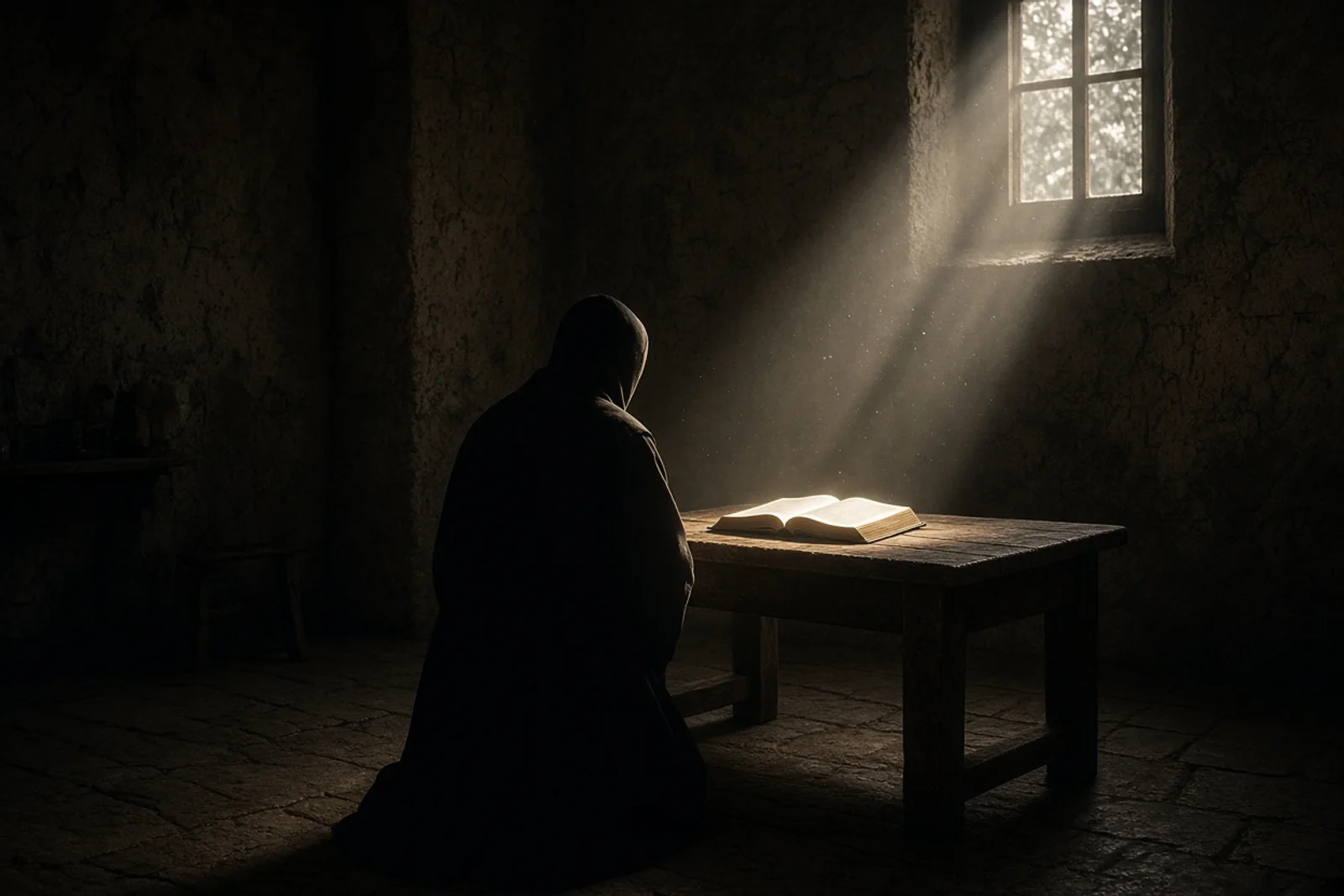
We had been three weeks without proper bread when the books arrived. The cart from the village stopped at the gate and the driver heaved the crate onto the grass. Alan lifted the lid with a crowbar and we stood looking at the spines in the late light. Newman’s Grammar of Assent lay on top. Below it were volumes of the Fathers and a battered King James Bible with a broken spine.
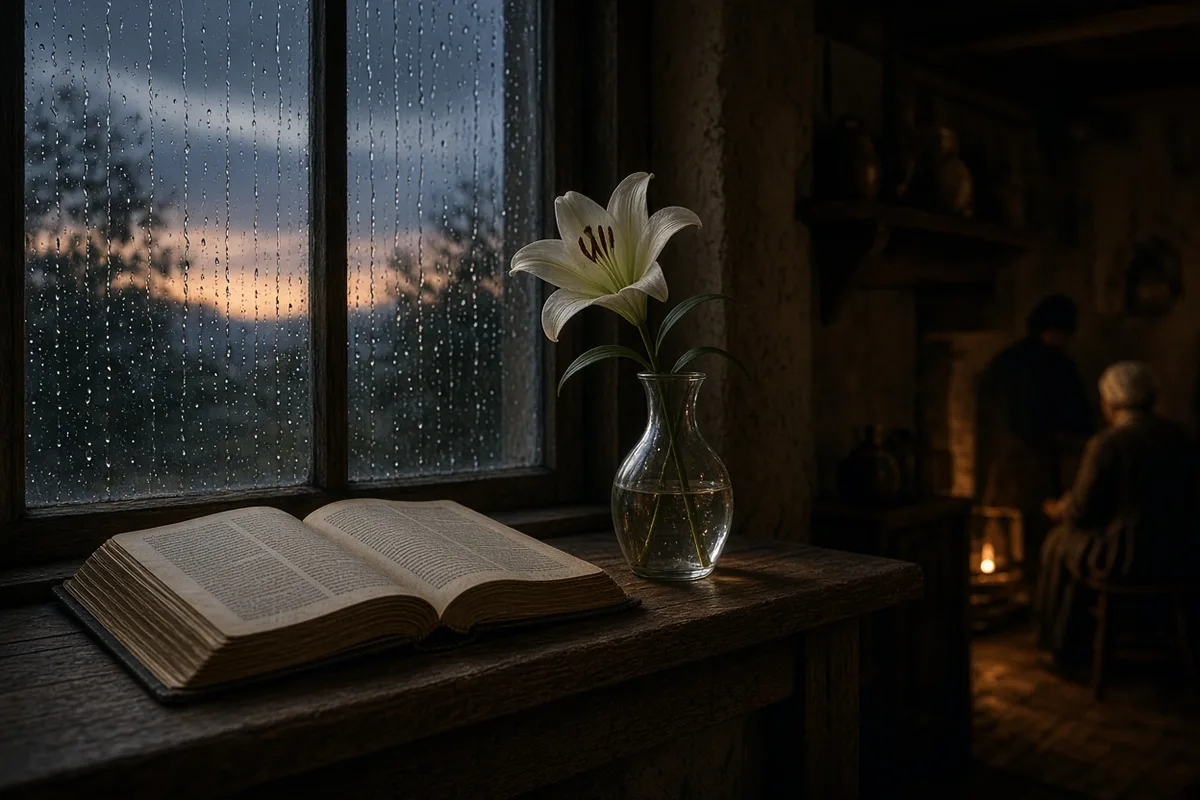
We carried everything inside and set the table for the evening. The cottage had no electricity. We read by oil lamp after the sun dropped behind the ridge. Alan opened the Bible first that night. He read slowly, stopping at the end of each paragraph, and none of us spoke. The wind moved the ash trees outside. When he closed the book the flame in the lamp had sunk low.
Morning brought the same routine we had kept since spring. We drew water from the well, split wood, and ate porridge without milk. After the meal Alan carried the Bible to the bench under the pear tree. He read aloud again while the rest of us worked. Martyn came out from the shed with an axe in his hand and stood listening. Hugh, who had been mending a shirt, put the needle down. The words carried across the grass without effort.

By the third day the pattern had shifted. Alan stopped mentioning the Eastern texts we had brought with us. He kept the Bible open on the windowsill even when rain blew in under the eaves. One afternoon he asked whether any of us had noticed how the prophets spoke of a single voice behind the many. None of us answered. He closed the book and walked down the lane alone.
The experiment had already begun to fray. Martyn wanted to return to his family’s farm. Hugh spoke of finding work in Gloucester. Alan said little. He spent longer hours with the Bible and with the small stack of Newman we had carried from Oxford. At night the lamp burned past midnight. I heard the pages turn.
When the first frost came we packed what we could carry and walked to the station. Alan bought a single ticket for London. He told us he had written to the bishop about ordination. The train left at noon. We watched the smoke disappear beyond the cutting.
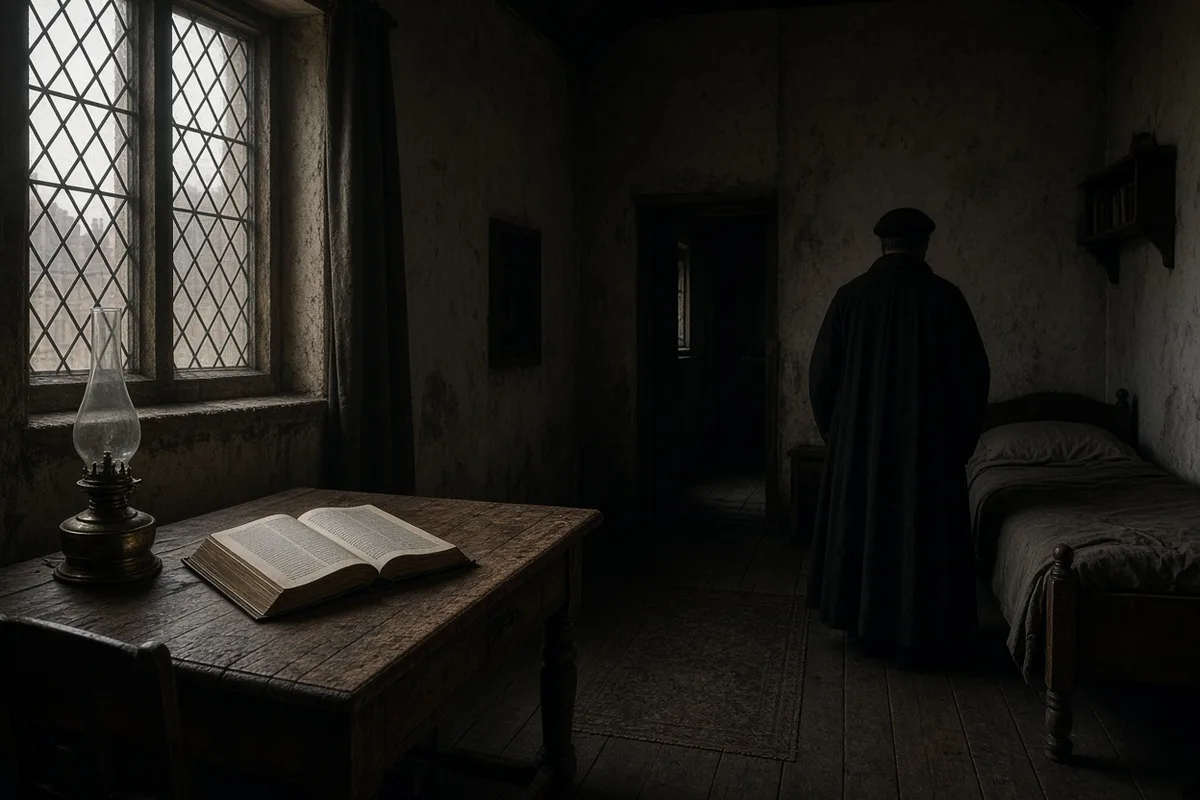
I returned to the cottage alone for the winter. The place felt larger without the three of us. Alan’s letters arrived every fortnight. He described the mission house in Stepney, the queues for soup, the children sleeping in doorways. He wrote that the Bible he carried in his pocket had become heavier than the coat on his back. In March he came back for a week. His face had thinned. He ate little and spent the days walking the fields with the same Bible under his arm.
Spring brought another change. He moved into a farmhouse two miles away and began to fast. I visited once and found him thinner still, sitting at a scrubbed table with Newman open beside the Bible. He spoke of the Church of England as a house whose roof had already fallen in. I left before dark.
In early summer a priest from the nearby parish arranged a retreat for him at a house in the Cotswolds. Alan returned from that week thinner yet, but steady. He told me he had been received into the Roman Church at a small chapel near the abbey. The decision had been made in the space of three days. He showed me the letter confirming his visit to Prinknash. The envelope lay on the table between us for a long time before either of us touched it.
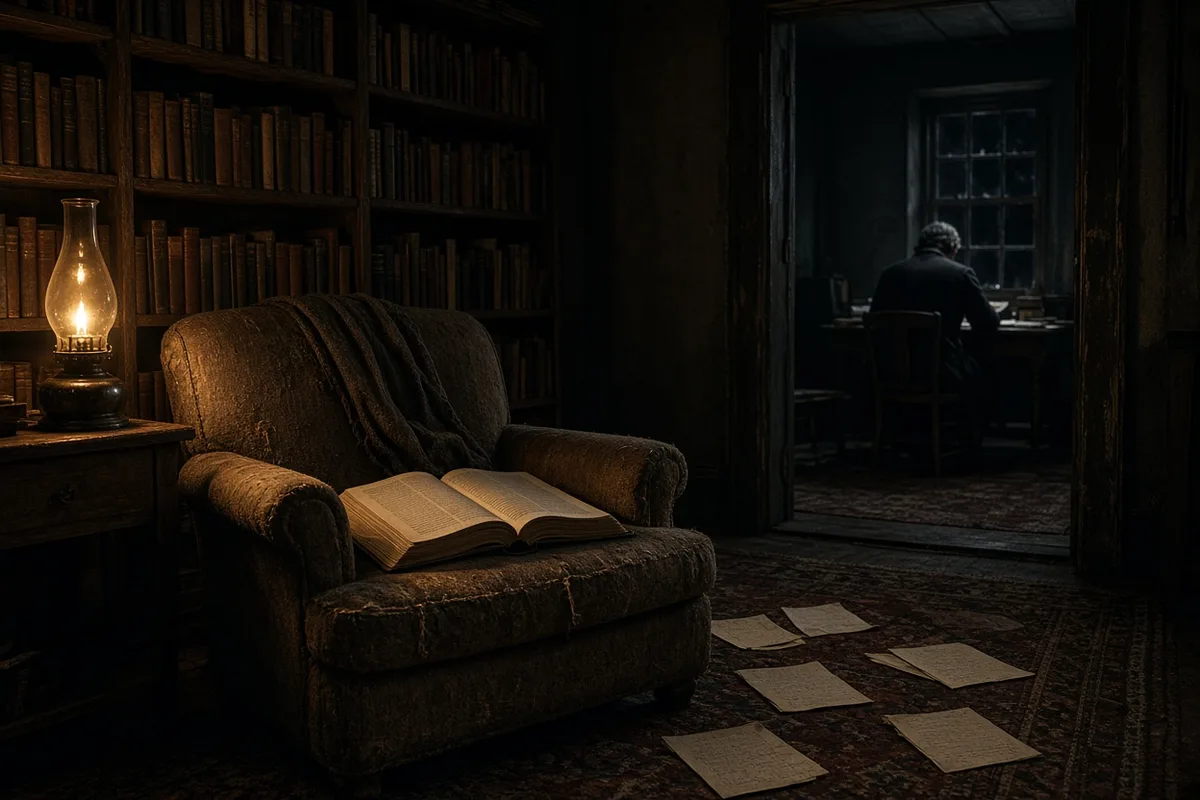
Two weeks later he entered the monastery as a postulant. I drove him to the gate. The porter took his case. Alan wore the same tweed jacket he had bought in Oxford. He did not look back. The bell rang for Vespers while I was still on the lane.
Letters came from inside the enclosure. He described the hours, the silence, the weight of the habit. In 1940 he was ordained. The name he took was Bede. I saw him once more before the war, standing in the abbey courtyard after Compline. He looked older, but the restlessness had gone from his shoulders.
After the war he left for India. The letters grew longer and carried different names: Shantivanam, Abhishiktananda, the river Cauvery. He wrote of wearing the kavi cloth and reading the Upanishads beside the Gospels. The last letter I received was written in 1992. He mentioned a stroke and a night when the walls of his room seemed to open. He said the same voice he had first heard in the cottage was still speaking.
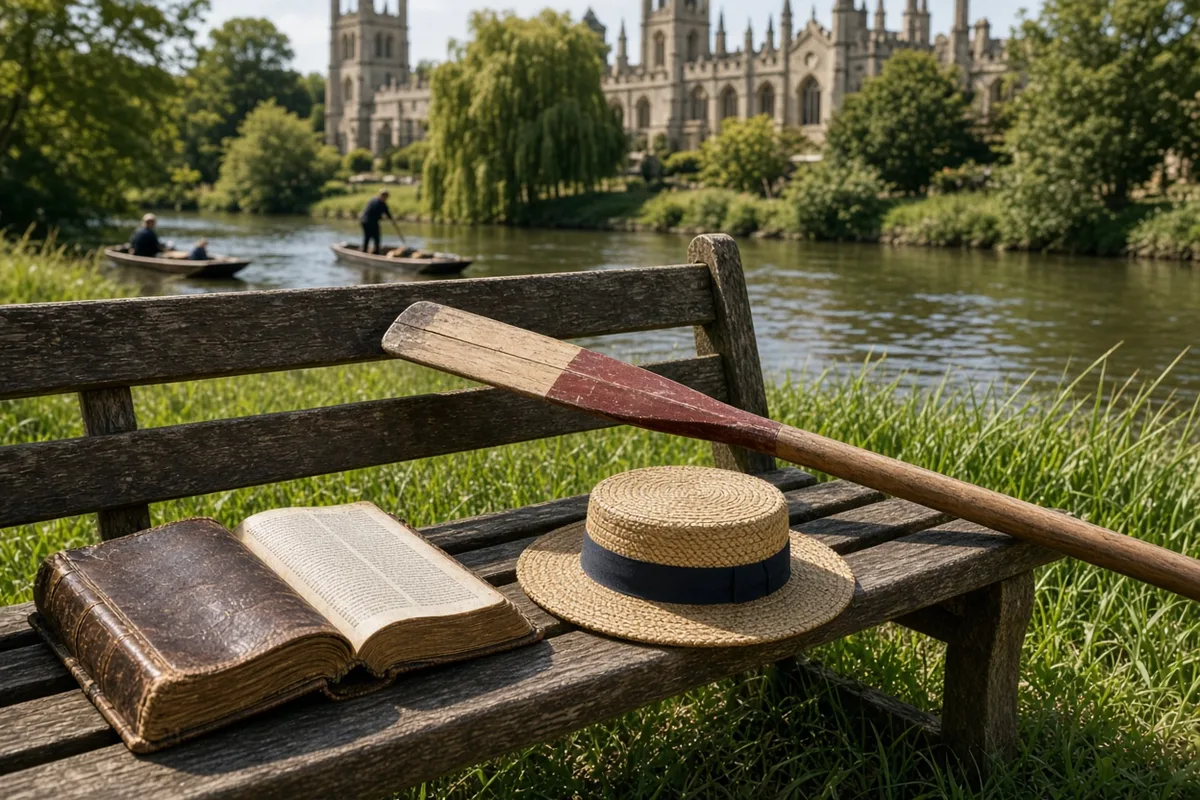
I kept the old King James he left behind. The binding is loose now and several pages are loose at the seam. On the flyleaf he had written only the date of our arrival at the cottage and nothing else. The ink has faded to the color of the paper. I open it sometimes in the evening when the light is low, but I no longer read the passages aloud.
In the spring of 1993 a letter arrived from Father Michael at Shantivanam dated 12 March, reporting that Bede had suffered another seizure on the evening of 8 February while seated on the stone bench facing the Cauvery. The note quoted the attending doctor’s observation that the pulse had dropped to forty-two beats per minute and that Bede had murmured the words “the veil is thin” before losing speech. Father Michael added that the community had continued the three daily offices in the thatched chapel, with the Sanskrit chants of the Upanishads read alongside the Gospel of John at Lauds. He enclosed a photograph taken the previous December showing Bede in the kavi robe, the same faded orange cloth he had first worn in 1955 when he arrived at the ashram founded by Jules Monchanin eight years earlier. The image showed the river in flood, the water level marked on the concrete pillar at twenty-three feet above the usual mark.
By June the same year another envelope came from the same hand, this one containing the typed transcript of Bede’s final taped conversation recorded on 4 May at the hospital in Trichy. In it he referred to the 1940 ordination at Prinknash by quoting the exact phrase from the Roman Pontifical he had heard that day: “Receive the yoke of the Lord, for his yoke is sweet and his burden light.” He then spoke of the 1955 voyage on the S.S. Jaljawahar, noting the precise number of days at sea—twenty-seven—and the moment he first saw the Indian coastline near Madras. The transcript ended with an instruction that the ashram library, now holding 4,872 volumes, should remain open to Hindu scholars without fee, a rule Monchanin had set in 1950 and Bede had kept unchanged.
In October 1994 I booked passage on the same shipping line, though the vessel was now called the S.S. Madras Star, and reached the ashram on 19 November after a train journey from Madras Central that took nine hours and cost 187 rupees in second class. Father Michael, then sixty-four, met me at the gate and led me to the room Bede had occupied since 1968. The single bed still held the thin cotton mattress, and on the wall hung the framed photograph of the 1932 Oxford group that included C.S. Lewis and the original three of us from the cottage. Michael pointed out the date written on the back in Bede’s hand: “Arrived at the cottage, 17 April 1932.” He said the community had preserved the King James that Bede left at Prinknash in 1932 and had brought it to India in 1976 when the English monastery sent the remainder of his books.
During that visit I met Sister Pascaline, an American Benedictine who had arrived in 1981 and kept the daily record of visitors. She showed me the ledger listing 1,246 names for the year 1992 alone, among them Raimon Panikkar on 14 September and the Dalit poet Meenakshi on 3 December. Pascaline quoted from Bede’s 1984 talk at the ashram conference on “The Marriage of East and West,” where he had said, “The Semitic and the Indic traditions must speak in one grammar or the Church will remain half-built.” She added that after the 1990 stroke the number of daily visitors had been limited to twelve, a restriction still posted on the notice board in both English and Tamil.
In 1997 the ashram received formal recognition from the Tamil Nadu government as a heritage site, with the original 1950 chapel listed under the Ancient Monuments Act. The thatched roof was replaced that year with new palmyra at a cost of 84,000 rupees, funded by a grant from the German Benedictine congregation. Father Michael retired in 1999 and was succeeded by Father George, who had joined in 1974 after studies at the Papal Seminary in Pune. George maintained the rule that the morning reading must always include one passage from the Bible and one from the Rig Veda, a practice Bede had instituted in 1961 and recorded in the ashram diary on 22 June of that year.
By 2005 the community had grown to seventeen permanent members, including five Indian oblates who had taken first vows under the revised 1994 constitutions. The library catalogue, now digitised, listed 6,314 entries, among them the 1876 edition of the Bhagavad Gita that Bede had annotated in the margin with the words “compare John 15:5” on page 112. On 21 May 2005, the fiftieth anniversary of his arrival, a granite marker was placed at the river landing where he had first stepped ashore, inscribed with the coordinates 10° 59′ 14″ N, 78° 12′ 37″ E and the single date 1955.
In the winter of 2012 I returned once more, this time accompanied by my grandson who had just completed a degree in comparative religion at Oxford. Father George, then seventy-one, allowed us to sit in the chapel during Vespers. The service began at 17:40 and lasted forty-eight minutes. After the final Sanskrit blessing the community processed to the refectory for the evening meal of rice and lentils served on banana leaves. George pointed out the empty place still set at the head of the table, the same custom begun in 1993. He handed me a photocopy of the last page Bede had written, dated 12 January 1993, containing only the verse from the Isa Upanishad that Bede had copied in his own hand: “The face of truth is covered with a golden disc.”
The final image I carry is of the current prior, Father Anthony, standing at the same bench by the river on 15 August 2023. He wore the identical kavi cloth Bede had received in 1955, now faded to the colour of dried clay. Anthony held the 1932 King James open at the flyleaf and read aloud the single date written there, then closed the book without adding any further word. The Cauvery flowed at fourteen feet that morning, and the bell for Terce sounded at 09:10 exactly as it had on the day Bede first entered the enclosure at Prinknash sixty-three years earlier.
Father Anthony replaced the volume on the shelf beside the bench and walked back toward the thatched chapel without speaking to the two visitors who had arrived that morning from Bangalore. The visitors, a couple from the University of Madras, signed the guest register at 10:15 and noted their intention to study the marginalia in the 1876 Bhagavad Gita for three days. Father George, still listed as prior emeritus in the 2023 directory, had died on 4 February at the Trichy hospital after a fall in the refectory; the community recorded his age as seventy-five and placed his ashes in the small urn next to the granite marker at the river landing.
The ashram received formal accreditation from the Pontifical Council for Interreligious Dialogue on 11 September 2024, the letter citing the 1961 diary entry in which Bede had required one passage each from the Bible and the Rig Veda at every morning office. Sister Pascaline, who had kept the visitor ledger until her return to the United States in 2018, sent a final note dated 2 October 2024 that listed the total names entered since 1993 as 28,417. She quoted the entry for Raimon Panikkar’s last visit on 14 September 1992: “Discussion of the golden disc continued until Compline.”
In January 2025 the Tamil Nadu government allocated 2.4 million rupees for reinforcement of the concrete pillar at the Cauvery landing after flood records showed the water reached twenty-nine feet on 18 December 2024. Father Anthony, now fifty-eight, supervised the placement of a second marker three metres upstream bearing the coordinates of the original 1955 landing and the single line from the Isa Upanishad that Bede had copied on 12 January 1993. The work was completed on 19 March and inspected the same afternoon by an official from the Archaeological Survey of India.
The library catalogue reached 7,892 entries by April 2025 after the addition of the annotated set of Newman’s works that Prinknash had forwarded in 1979. Among the new listings was the 1940 ordination certificate from the Roman Pontifical, which Father Anthony displayed in a glass case beside the framed 1932 Oxford photograph. The case also held the single ticket stub for the London train dated the day the original group left the cottage.
On 15 August 2025 Father Anthony again stood at the river bench at 09:10, this time accompanied by the new postulant who had arrived from Pune the previous week. The postulant, aged twenty-nine and formerly a student at the Papal Seminary, read the flyleaf date aloud in the same manner and then carried the King James inside for the Terce office. The Cauvery stood at eleven feet that morning.
The ledger for 2025 records 1,872 visitors through 30 September, including a group of twelve Dalit scholars who stayed from 7 to 14 July and transcribed the marginal note “compare John 15:5” from page 112 of the Bhagavad Gita. Father Anthony closed the guest book at the end of each day and placed it on the shelf next to the 1932 Bible.
The last image is of Father Anthony at the same bench on the morning of 12 October 2025, alone, turning the pages of the King James to the flyleaf once more before the bell for Terce sounded at 09:10. He wore the kavi cloth faded to the colour of dried clay and did not look up when the postulant approached with the day’s reading list from the Rig Veda and the Gospel of John.