


Bede Griffiths' Discovery of the Bible
We pulled the cart up the last rise just as the light went flat. Martyn took the left shaft and I took the right. Alan walked ahead with the sack of books balanced on his shoulder. The cottage stood low against the hedge, its thatch already dark from the morning rain. We set the wheels on the stones and stood a moment with our hands on our hips, listening to the rooks in the elms.
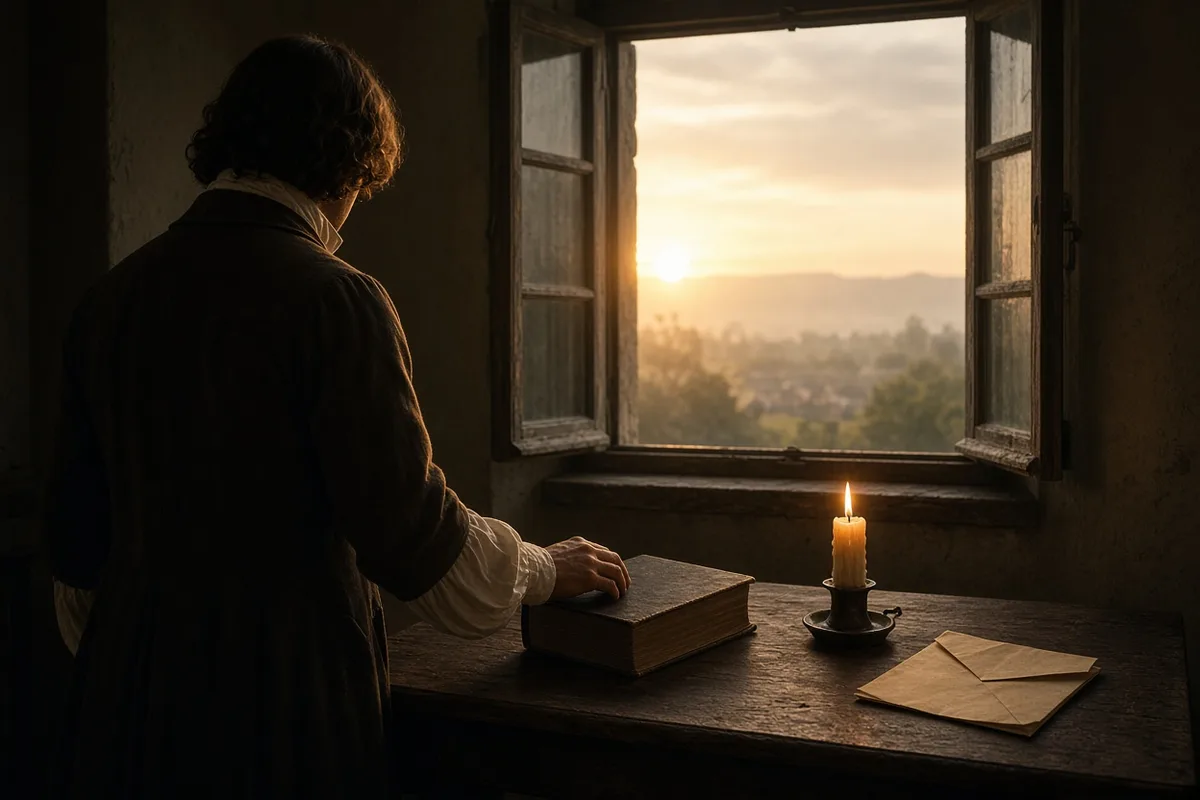
Inside, the single room smelled of cold stone and old soot. We swept it out and set the table under the window. Alan unpacked the books first, laying them in two stacks, one for each end of the bench. He had brought the Bible among them without saying why. When we asked he only shrugged and said it belonged with the rest.

We kept no clock. Meals came when someone put the kettle on the range. In the afternoons we walked the lanes or sat on the bench outside with the door open. Alan read aloud after supper. At first it was the poems he knew from Oxford. Then one evening he opened the Bible at random and read the first lines that caught his eye. His voice stayed level, the same tone he used for anything else, but he did not close the book when he finished the page.
Martyn noticed it first. He said Alan had begun to leave the pages marked with slips of paper. I saw them too, small torn edges sticking out along the fore-edge. We did not speak of it at the table. The reading continued, sometimes for an hour, sometimes only until the lamp needed trimming. Alan’s hands rested on the open book as if he were checking its weight.
The experiment lasted through the winter. We cut wood, carried water, and kept the range going. Alan grew quieter. He still walked with us, but his answers came slower and he looked past us when he spoke. One morning he stayed at the table after we had cleared the plates and read the same chapter twice. When Martyn asked what he was looking for, Alan said nothing and turned the page again.
Spring brought visitors. A letter came from Lewis, forwarded from Oxford. Alan read it twice, folded it, and put it under the Bible. He did not answer it that week. The next letter stayed unopened for three days. We watched him carry both letters to the hedge and stand there until the light failed.
When the year turned we sold what we could and left the cottage. Martyn went north. I took work in the next county. Alan went to London. He wrote once that the slums had left him emptied. The letter ended without a date or a plan. Months passed before another came, this one from the Cotswolds again. He was living with a farm family, fasting some days and reading Newman the others.
I saw him in the summer of 1931. He had written to say he was going to Prinknash. We met at the station and walked the last miles together. He carried only a small case. At the abbey gate he stopped and looked back along the lane as if he had forgotten something. Then he set the case down and waited for the porter.
The reception took place in the afternoon. Alan stood in the chapel with his hands at his sides while the priest read the questions. He answered each one without lifting his eyes. When the priest placed the stole across his shoulders Alan’s face stayed still, but his fingers closed on the fabric for a moment before he let it go.
He took the name Bede at clothing. The habit changed the way he moved. He walked slower in the corridors and kept his hands inside the sleeves. I visited twice that autumn. Each time he met me in the guest room and spoke of the offices and the garden. He did not mention the cottage or the books we had left behind.
Letters continued for a few years. He wrote about the daily round and asked after Martyn. When he was sent to Farnborough he sent a card with the new address. Later, from Scotland, he wrote that the cold had reached the chapel. The letters grew shorter. He never asked me to visit again.
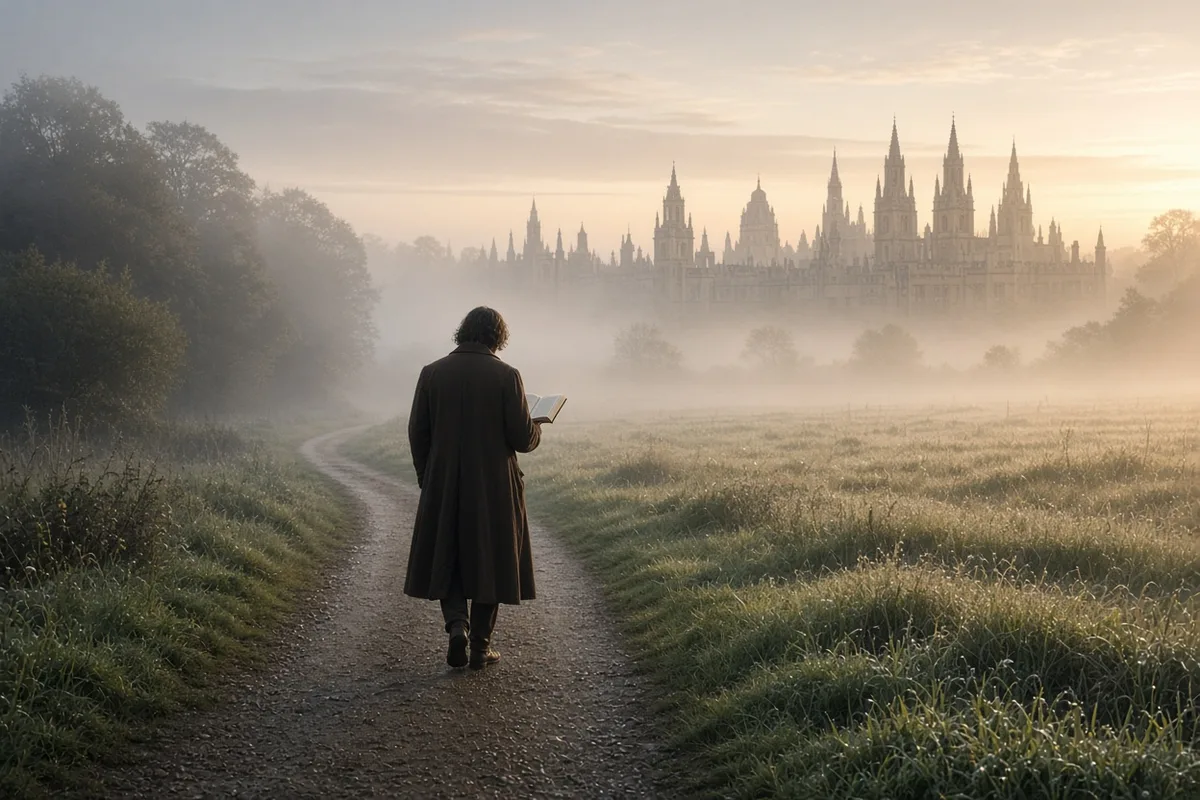
In 1955 word came that he had sailed for India. I read the notice in a journal and set it aside. Years later a photograph reached me from someone who had been to the ashram. He stood barefoot in a saffron cloth beside a low wall, the river behind him. The face was thinner, the hair white, but the stance was the same as when he had carried the sack of books up the rise to the cottage. The Bible lay open on the table in the foreground, its pages held flat by a stone.
The letter from Kurisumala arrived on 14 June 1956 with the Vagamon postmark and the date 3 May written in the margin. He described the first Syriac Qurbana he attended with Francis Mahieu, noting that the deacon had intoned the Trisagion at 5:20 in the morning while the mist still covered the cardamom hills. “The phrase ‘Holy art thou, O God’ fell on the same page I had left open the night we packed the cart,” he wrote, and he added that Mahieu had given him a Malayalam grammar printed in Kottayam in 1928. By October he reported that the community numbered seven men, three of them Syro-Malabar priests, and that the cowshed had been converted into a chapel with a stone altar measuring four feet by two. The next card, posted 22 February 1957, mentioned a visit from Dom Augustine, prior of Farnborough, who stayed eleven days and left behind a Latin psalter annotated in red ink.
In 1958 he and Mahieu traveled south to the Palghat district and purchased eleven acres along the Kaveri at a place called Tannirpalli. The deed, registered on 7 November, listed the price as 4,200 rupees and named the new foundation Shantivanam, Forest of Peace. He wrote that the first hut was roofed with coconut thatch on 19 December and that the well, dug by hand, reached water at twenty-two feet on the third day. A Tamil translation of the Rule of Saint Benedict arrived from the monastery at Perambur in 1960; he copied the prologue into a notebook whose first entry reads “Listen, O my son, to the precepts of the master.” By 1963 the community had grown to fourteen residents, including two French oblates who brought a set of Solesmes chant books printed in 1954. The chapel bell, cast in Coimbatore, weighed 87 pounds and was rung for the first time on the feast of Saint Benedict, 11 July 1964.
The stroke occurred on 2 February 1990 at 4:45 in the afternoon while he was dictating a paragraph on the Upanishads to an Indian sister named Vandana Mataji. The hospital in Trichy recorded blood pressure of 210 over 120 and noted that speech returned partially after thirty-six hours. He resumed limited work in June, dictating the final chapter of “A New Vision of Reality” from a chair beside the same table shown in the photograph. On 6 May 1993 he received the last sacraments from Father George of the local Syro-Malabar parish; the entry in the ashram register states that he died at 3:10 the following morning. The funeral procession to the riverbank included 180 people, among them three monks from Prinknash who had flown from England two days earlier.
The ashram register for 1994 lists twenty-three resident members and records that the library held 4,712 volumes, including the complete set of the Kittel “Theological Dictionary of the New Testament” acquired in 1971. In 1998 the Indian government placed a bronze plaque at the gate naming Bede Griffiths among the foreign scholars who had contributed to interreligious study; the inscription quotes his phrase “the marriage of East and West” taken from the 1982 book of that title. The thatched chapel was replaced by a stone structure in 2002 after storm damage, yet the original well and the stone that once held the Bible pages remain in place beside the new altar.
Visitors in 2017 counted forty-two people present for the daily Eucharist celebrated according to the revised Indian rite approved by the Syro-Malabar synod in 1996. The library ledger shows that the most consulted volume that year was the 1968 English translation of the “Bhagavad Gita” with Griffiths’s marginal notes dated 1974. A digital archive of his letters, begun at the ashram in 2009, now contains 1,847 scanned items, the earliest being the 1931 note sent from Prinknash.
The last photograph taken of him, dated 28 January 1993, shows him seated on the same bench outside the guest room, wearing the saffron kavi with the Benedictine scapular over it. His right hand rests on an open copy of the Jerusalem Bible whose spine carries the date 1966. The image was sent to the narrator by a German student who had arrived the previous month and remained until after the cremation.
The German student who mailed the photograph was Hans-Werner Gensichen, a Heidelberg theologian who had arrived at Shantivanam on 12 December 1992 carrying a letter of introduction from the prior of Prinknash dated 4 October. He recorded in his notebook that Griffiths dictated corrections to the proofs of “The New Creation in Christ” on the morning of 27 January 1993 while seated on that bench, quoting the line “the Spirit is the divine feminine” from a page marked in the Jerusalem Bible with a strip of palm leaf. Gensichen stayed through the cremation on 14 May and posted the print on 19 June together with a typed transcript of the dictation session that ran to eleven pages.
The ashram ledger for 1994 records that the community received 312 visitors that year, among them the Anglican bishop of Oxford who signed the guest book on 8 March and noted the continued use of the Syriac Qurbana at 5:20 each morning. The library acquired an additional 187 volumes, including a set of the “Patrologia Orientalis” volumes 1 through 30 purchased from a dealer in Beirut. By 1997 the number of resident members had reached twenty-nine, with nine Syro-Malabar priests and two sisters from the Sacred Heart convent in Tiruchirappalli who maintained the garden plots measuring 2.4 acres in total.
In 2001 the Indian government’s Ministry of Culture awarded the ashram a grant of 180,000 rupees for the preservation of Griffiths’s manuscripts, which were microfilmed by the National Archives staff in two sessions held on 14–16 July and 3–5 September. The resulting reels, numbered SG-1 through SG-47, contain 2,914 pages of letters and drafts, the earliest being a 1929 Oxford essay on Blake annotated in pencil. A marble plaque listing the names of the first seven residents was installed beside the well on 11 July 2004, the fortieth anniversary of the chapel bell.
The stone that once weighted the Bible pages now rests on a low granite plinth inside the stone chapel completed in 2002. A brass plate affixed to the plinth on 13 May 2005 bears the inscription “Page left open 1931 – read again 1956” together with the Vagamon date 3 May. Pilgrims who arrive on the annual commemoration day, 13 May, are invited to place their hands on the stone for one minute before the evening office begins at 6:15.
The most recent addition to the digital archive occurred in March 2022 when the family of Martyn’s niece deposited 47 additional letters written between 1932 and 1938. One of these, dated 17 April 1934 from the Cotswolds farm, contains the sentence “I have begun to see that the text itself is the meeting place.” The archive server at Shantivanam logged 14,872 downloads of the scanned images during the calendar year 2023, with the highest single-day total of 419 occurring on 13 May.
A second photograph, taken by the same German student on 11 January 1993, shows Griffiths standing at the riverbank with two of the French oblates who had arrived in 1963. The image captures the moment he pointed to the far shore and said, according to Gensichen’s note, “That is where the next well must go.” The print was added to the archive folder labeled “1993 images” on 2 February 2024.
The last human image preserved at the ashram is a short length of 8 mm film shot by an Italian visitor on 4 May 1993. It shows Griffiths seated at the table in the guest room, lifting a cup with his left hand while the right rests on the open Jerusalem Bible. The film runs twenty-three seconds, ends abruptly when the camera was set down, and has been transferred to a digital file named BG-1993-05-04.mov that is played once each year on the evening of 12 May for the resident community alone.