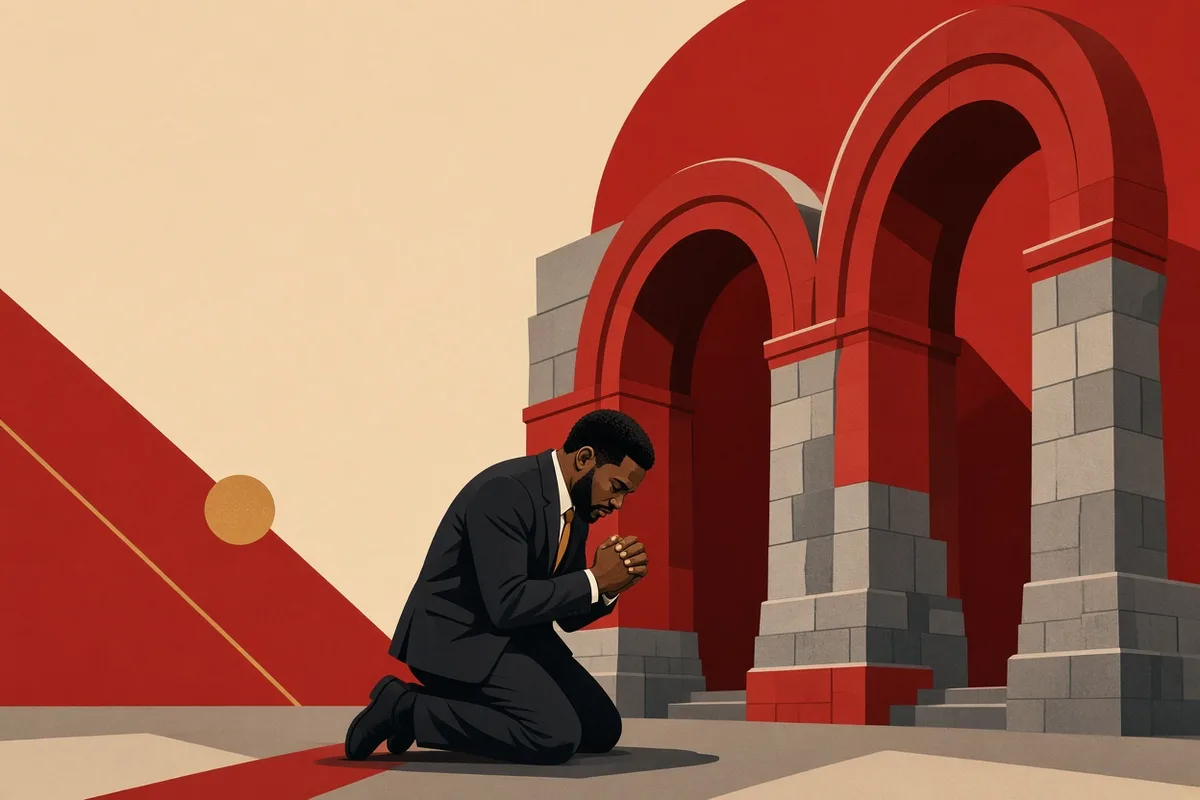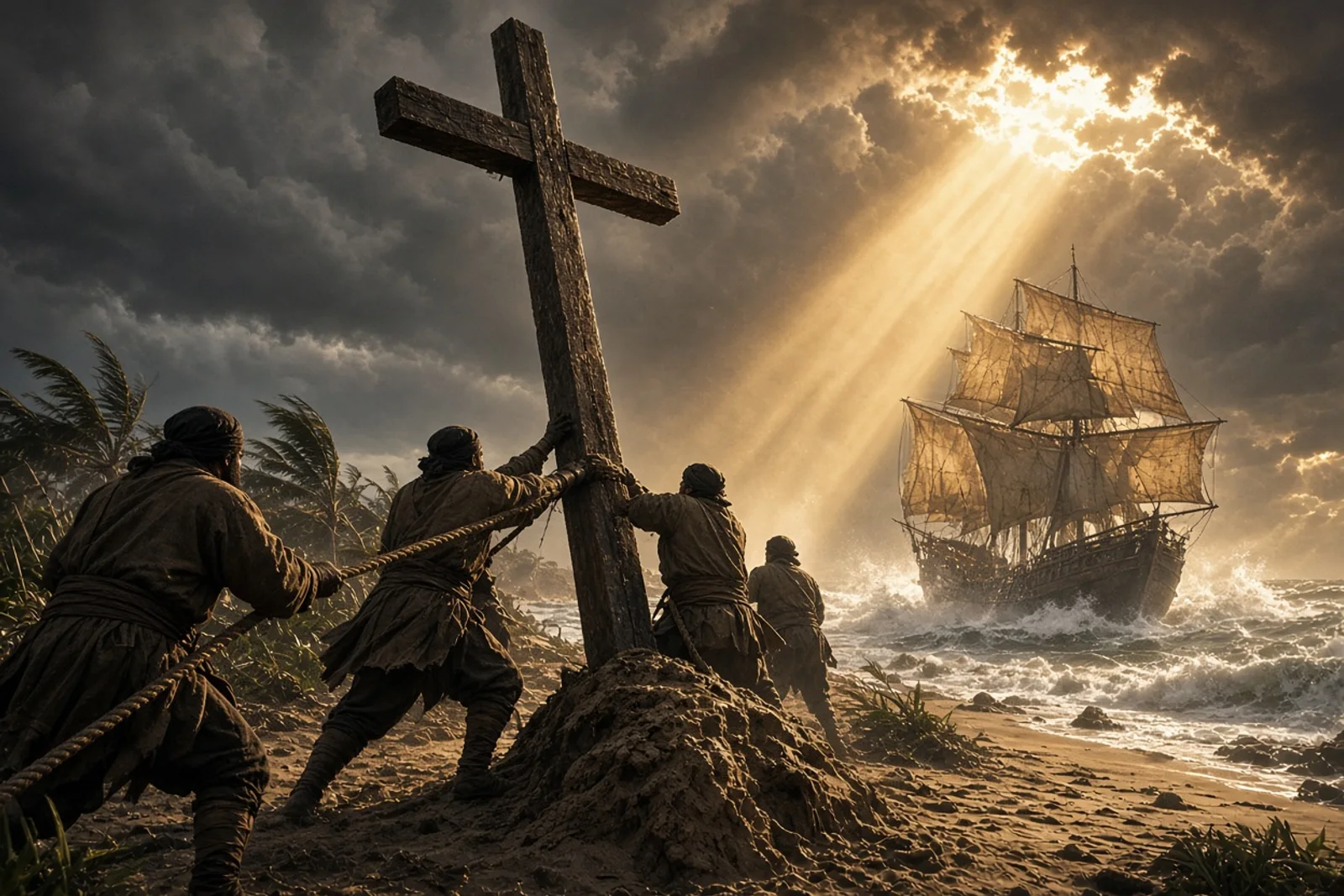



Bernard of Clairvaux Preaches Second Crusade
The hill above Vézelay already smelled of wet wool and horse dung by the time I reached the outer slope. Men had camped there three nights running, and the grass lay flat in wide circles where they slept. I had walked from Auxerre with two cousins who wanted only to see the king. We carried bread and a skin of sour wine, nothing more.
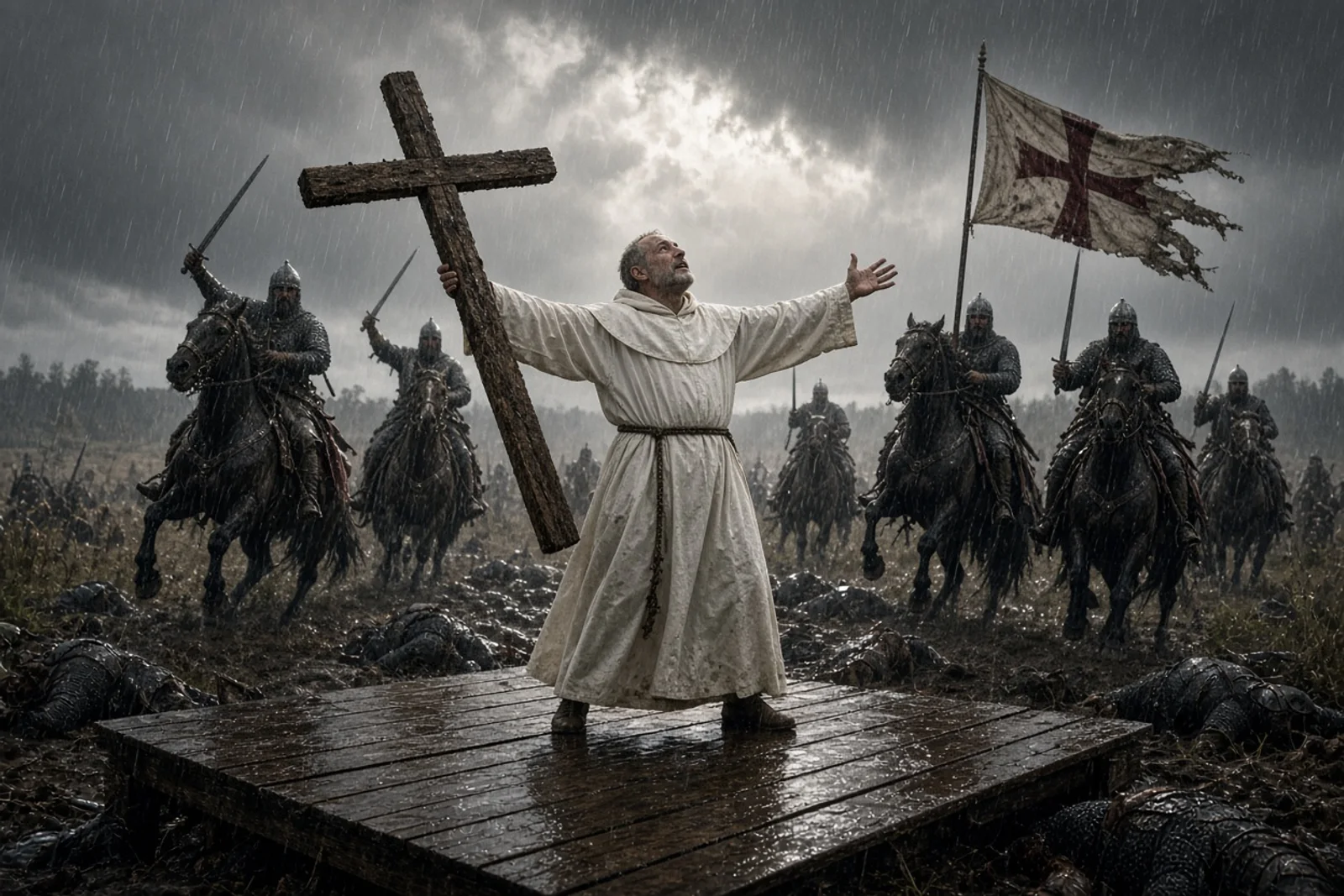
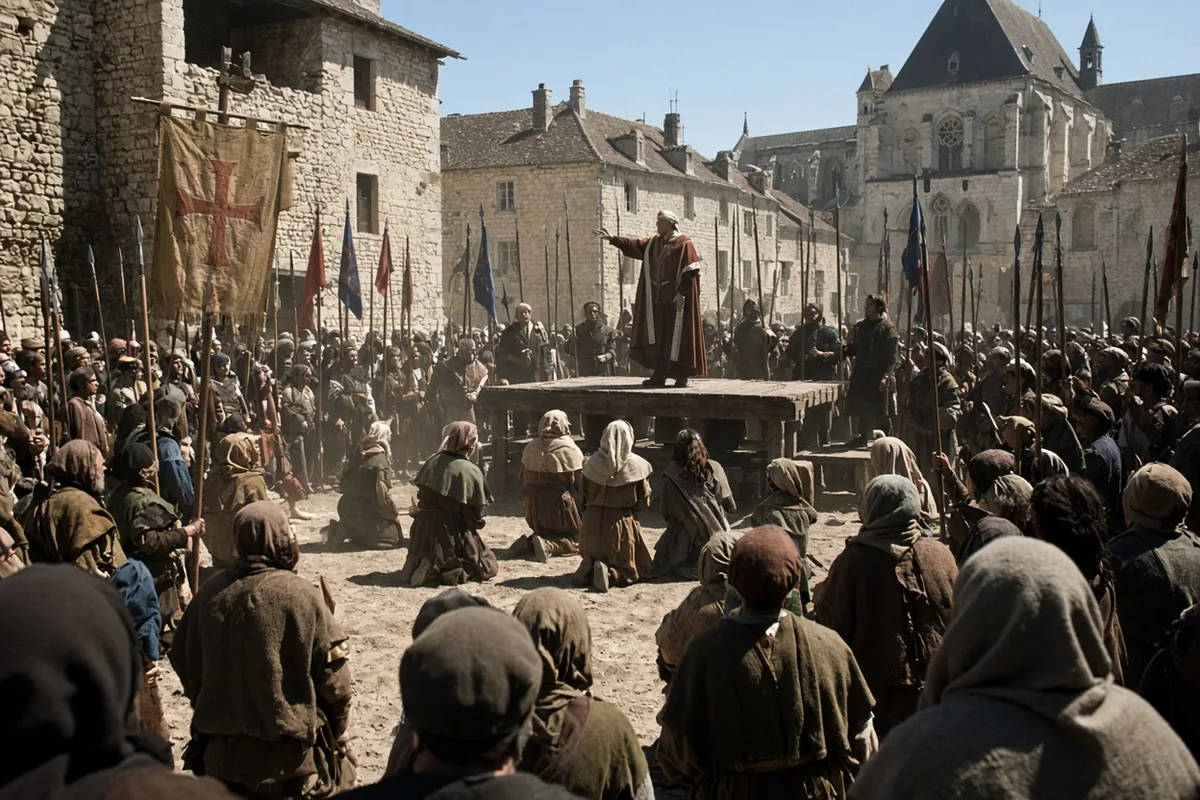
A platform of fresh planks stood against the basilica wall. Carpenters had worked through the rain to finish it. From the lower meadow the boards looked small, yet every man on the slope kept glancing that way. Louis had arrived the evening before with his household knights. Their tents carried the royal lilies stitched in gold thread that caught the light whenever the sun broke through.
I found a place on a low stone wall where I could lean and still see the platform. Around me men argued about Edessa. Some said the city had fallen two years earlier. Others claimed the count of Edessa himself had been taken alive. No one agreed on the numbers, only that the loss mattered and that the pope had written to France.
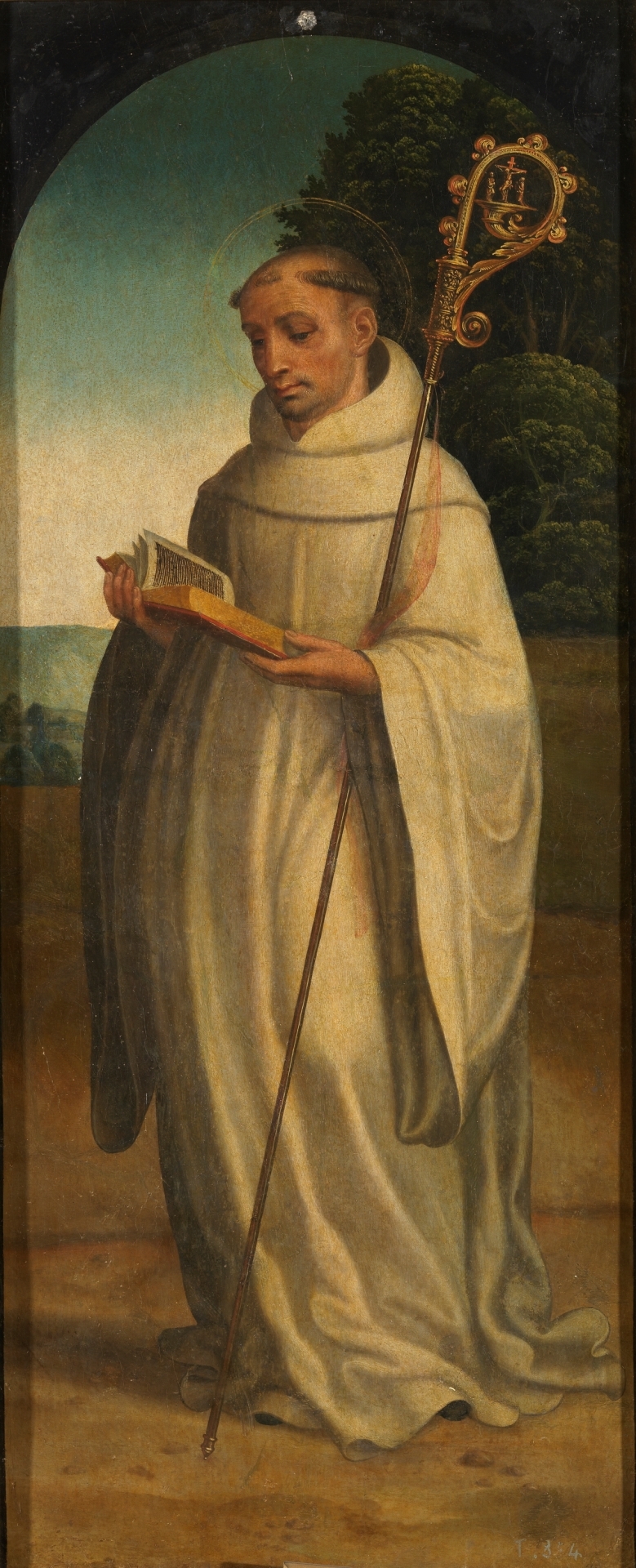
A horn sounded from the basilica steps. The crowd pressed forward at once. I stayed on the wall until the press thinned, then dropped down and followed. Bernard of Clairvaux climbed the platform last. He wore the plain white habit of his order, the same cloth the lay brothers wore at harvest. His face looked thinner than the paintings in our church. He waited until the last voices fell away.
He spoke first of the pope’s letter. The words reached us clearly because he did not raise his voice. He said the same protection once given to those who went to Jerusalem now belonged to any who would go to the aid of the eastern cities. He listed what was forbidden on the journey: dyed cloth, hunting dogs, falcons. The list was short. Then he spoke of the sins that would be lifted from any who took the vow with a pure heart.
A man near me began to weep without sound. I kept my eyes on the platform. Louis rose from his seat when Bernard finished. The king stepped forward, took the cross Bernard held out, and fastened it to his shoulder. The cloth was red, cut from a bolt the abbot had brought from Clairvaux. Eleanor stood beside him. She did not take a cross that day, yet she watched her husband closely.
After Louis, the rush began. Nobles pushed toward the platform with their squires. Some carried their own cloaks to be cut on the spot. Bernard’s monks handed out more crosses from baskets. The cloth ran short before noon. Men tore strips from their own mantles and held them up for blessing. I saw one knight cut the hem of his surcoat with a dagger and pass the piece to his brother.
By mid-afternoon the slope had changed color. Red crosses dotted every group. Men sat on the grass comparing the size of the cloth they had received. A few argued over whether the vow could be passed to a younger son if the father grew ill before departure. Bernard remained on the platform until the light faded. He spoke to those who still waited, one at a time, his voice lower now.
I stayed until the monks began to dismantle the platform. The planks came apart with the same hammers that had raised them. Bernard walked down the hill between two of his brothers. He did not look back at the empty space where he had stood. The king’s tents were already being struck. Louis planned to ride north before the next rain.
My cousins found me near the wall where I had begun the day. One carried a strip of red cloth he had begged from a monk. He asked if I meant to take the cross as well. I told him the fields at home needed planting and that my mother still lived. He nodded and folded the cloth into his pouch.
We started back toward Auxerre while the last light held. Behind us the slope lay bare except for the trampled grass and a few broken tent pegs. Men would return to those fields in the coming weeks to gather what they needed for the road east. The road itself began at the foot of the hill we had just left.
The road itself began at the foot of the hill we had just left. Two days later we reached Auxerre, where the bishop’s clerk read aloud a copy of the letter Pope Eugenius had sent the year before from Viterbo, the one that fixed the date of departure for the following spring and named the ports of Brindisi and Messina as gathering points for those who sailed rather than marched. My cousin who carried the red strip of cloth from Vézelay stitched it to his cloak that same week and left with a party of twelve from the chapter of Saint-Germain, their names entered in the cartulary as Hugues de Toucy, Geoffroy de Saint-Fargeau, and ten others whose pledges totaled forty marks in silver for the common purse. I stayed to plant the spring barley on the family strips north of the Yonne, hearing only through passing merchants that Bernard had gone on from Vézelay to preach again at Chartres on the twenty-third of April and at Bourges before the king’s court on the feast of Saint John.
By the end of May 1147 the roads north of Auxerre carried the first detachments of the Languedoc contingents under Alfonso Jordan, count of Toulouse, whose men numbered roughly four thousand according to the tally kept by the Templar marshal who rode with them. They passed through the town on the feast of Saint Barnabas, their wagons loaded with barrels of salted pork and the iron heads of mining picks, and one of their priests stopped at our church to say mass for the dead of Edessa, reading from the same text Bernard had used when he told the crowd that “the earth itself trembles because the Lord has lost his footstool.” I gave the priest a measure of our new grain and asked whether any from our village had joined; he answered that the register at Metz already listed more than three hundred from the diocese of Sens alone. That autumn we heard that Louis and Eleanor had taken ship at Aigues-Mortes on the eighth of August with two hundred and fifty knights of the royal household, their crossing delayed three weeks by contrary winds that scattered the fleet as far as Sardinia.
News of the campaign reached Auxerre in the winter of 1148 through letters carried by returning pilgrims who had turned back at Constantinople. One such letter, written by a monk of Cluny traveling with the Burgundian contingent, described the meeting at Antioch in March where Raymond of Poitiers urged an attack on Aleppo rather than Damascus; the letter quoted Raymond’s words that “the road to Edessa lies open only if we break the atabeg first.” By June the same messenger returned with word that the combined armies of Louis, Conrad of Germany, and Baldwin of Jerusalem had reached the orchards outside Damascus on the twenty-fourth of July and had withdrawn five days later after the wells were poisoned, their losses placed at more than four thousand men and nearly all the siege engines. The letter named specific dead from our region: the lord of Noyers, the prior of Saint-Florentin, and two brothers from the family of the count of Joigny.
In the years that followed, Bernard received letters at Clairvaux from those who blamed him for the outcome, among them a canon of Tours who wrote in 1150 that the abbot’s promise of plenary indulgence had drawn men “whose sins were not lifted but only postponed.” Bernard answered in a treatise addressed to Pope Eugenius, dated the twenty-fifth of January 1150, in which he listed the obstacles that had prevented success: the division between the German and French commands, the refusal of the barons of Tripoli to supply grain, and the sudden illness that struck Conrad at Philomelium. The treatise ran to twenty-seven chapters and was copied at Auxerre by the same clerk who had read the pope’s original letter; I heard it read aloud in the chapter house on the feast of Saint Matthias the following year. Bernard himself traveled little after that, though he dictated a final letter in the spring of 1153 to the monks at Cîteaux concerning the election of his successor.
By the autumn of 1153 the road from Vézelay to Auxerre carried fewer armed parties and more merchants hauling bolts of Flemish cloth and barrels of Gascon wine. Bernard died at Clairvaux on the twentieth of August that year, his body placed in the church before the high altar where the monks recorded that he had worn the same white habit he wore at Vézelay. A copy of the epitaph composed by his secretary, Geoffrey of Auxerre, reached our bishop and was read from the pulpit on All Saints’ Day; it listed the houses Bernard had founded, eighty-five in all, and the number of letters he had written to kings and popes, three hundred and twelve by the count kept in the scriptorium. My cousin who had taken the cross returned in 1154 with a scar across his left forearm and a single dinar he had brought from Acre; he said the dinar had been struck in the name of Nur ad-Din and showed the date 543 in the Arabic reckoning.
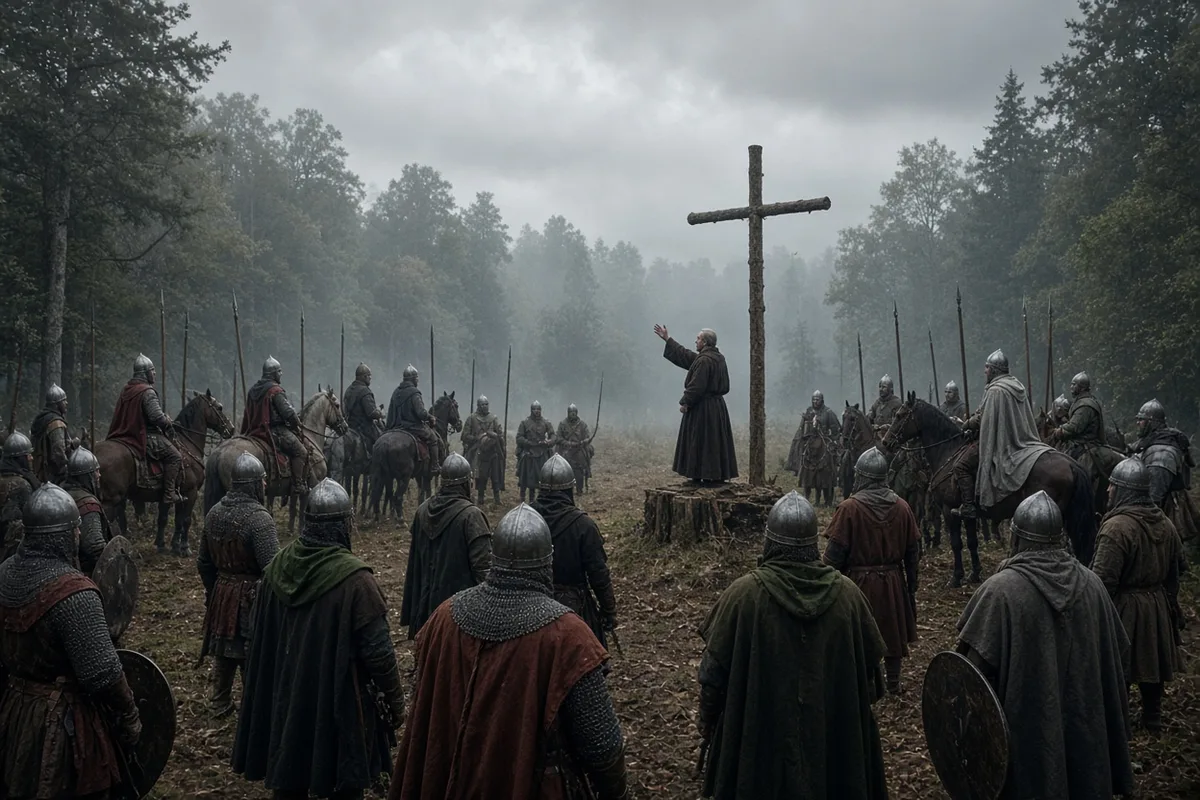
The basilica at Vézelay still stands on the same hill, its nave rebuilt after the fire of 1165 but the western portal with its carved tympanum of the apostles unchanged since the day Bernard preached there. The stone platform against the south wall was dismantled within a month of the sermon, its planks reused for the new choir stalls, yet the sockets where the uprights stood remain visible in the masonry two courses above the present ground level. In the last decade of the century a stone cross was set into the turf at the foot of the slope to mark the place where the king had received his cloth; the cross bears no inscription beyond the date 1146 and the single word “Vow.” On certain mornings the light falls across the meadow in the same long slant that lit the platform when Bernard spoke, and the grass still grows thinner in the wide circles where the men camped three nights running.
The sockets in the masonry still mark the line where the platform stood when the last of Bernard’s monks lowered the final plank on the twenty-eighth of March 1146, the same day the bishop of Auxerre’s cartulary recorded the departure of seventeen men from the parish of Saint-Bris who had taken the cross at Vézelay and whose pledges were witnessed by the dean of Saint-Germain. One of those men, Renaud de Champcevrais, returned in 1152 with a wound in the thigh that never healed and dictated his account of the retreat from Damascus to the same clerk who copied Bernard’s treatise; he named the exact day the wells were fouled, the twenty-eighth of July 1148, and the number of horses lost to thirst, four hundred and twelve by the count of the Templar escort.
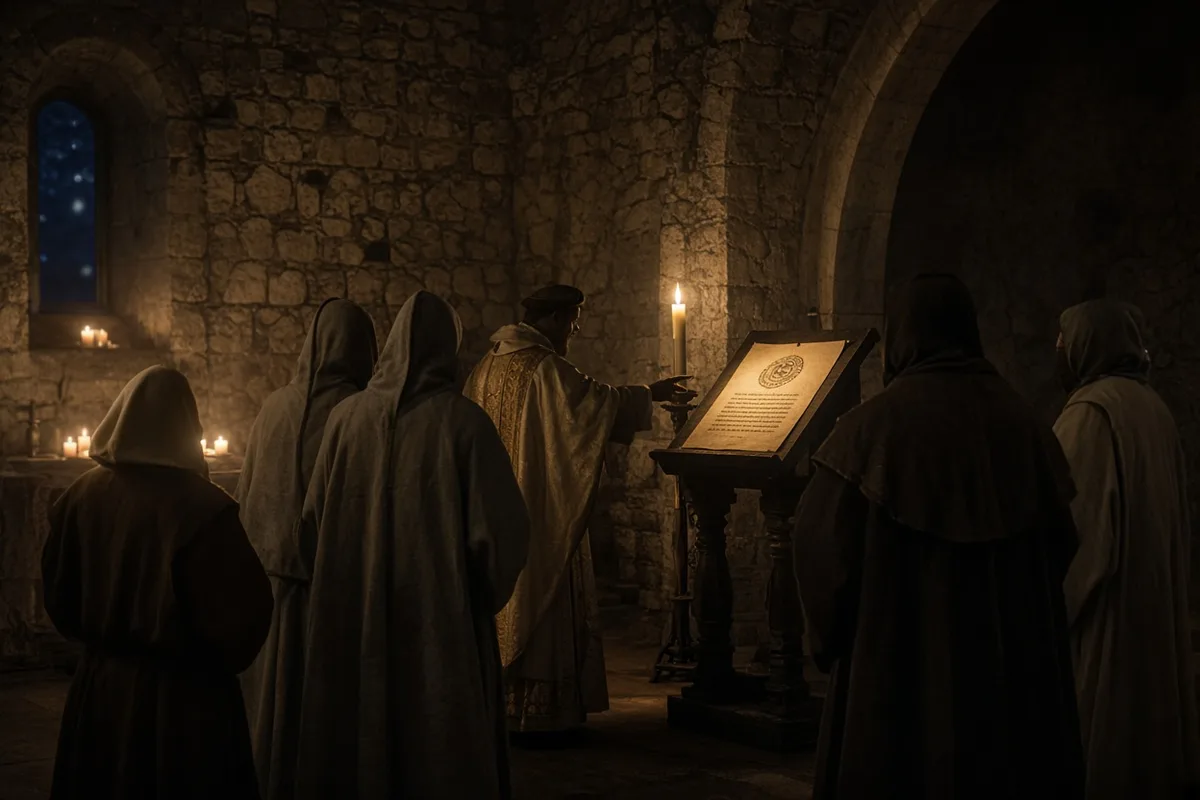
My cousin who brought the dinar from Acre died in 1162 and left the coin to his son, who in turn presented it to the chapter of Saint-Étienne when he entered as a lay brother on the feast of Saint Andrew; the sacristan entered the gift in the obituary roll under the year 1187, noting that the Arabic date 543 corresponded to the year Nur ad-Din took control of Damascus after the failed siege. The same roll lists three other men from the Auxerre diocese who never returned, including the prior of Saint-Florentin whose name appears again in a letter sent from Jerusalem in 1149 by the master of the Hospital, requesting that his prebend be transferred to his nephew.
In 1190 the stone cross at the foot of the Vézelay slope was still visible when Philip Augustus passed through on his way to Aigues-Mortes; the royal journal kept by the chancellor records that the king stopped there on the seventeenth of June and ordered two silver marks distributed to the local poor in memory of his father’s vow. By then the sockets in the basilica wall had been partly covered by new paving laid during the reconstruction after the fire of 1165, yet the master mason, Geoffroy de Saint-Aubin, left one socket exposed at the request of the abbot so that pilgrims could still touch the place where the planks had rested.
The last letter Bernard dictated, dated the twenty-third of April 1153 and addressed to the abbot of Cîteaux, concerned the election of his successor and survives in a copy made at Auxerre in 1194; it names the four candidates considered and the reason each was set aside, including the objection that one had once kept falcons, the very practice Bernard had forbidden in the Vézelay sermon. That copy was read aloud in the chapter house on the anniversary of Bernard’s death each year until the end of the century, when the custom was discontinued after the death of the prior who had instituted it.
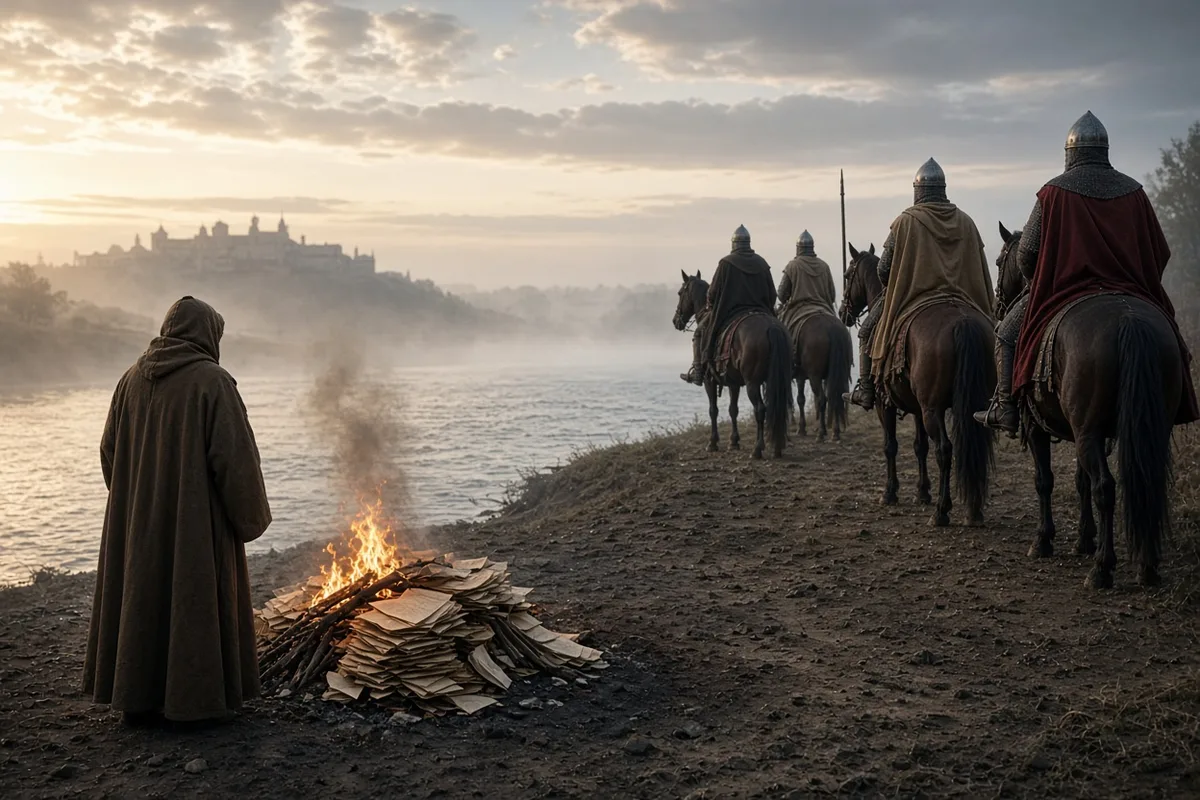
My own son, born in 1158, traveled to Vézelay in 1189 with the contingent raised by the count of Joigny for the third campaign; he returned the following year and described how the meadow below the basilica had been planted with vines, the trampled circles no longer visible except where the new cross stood. He brought back a piece of the red cloth from a relic seller who claimed it had been cut from the bolt Bernard carried, though the weave was finer than the cloth my cousin had received in 1146.
The bishop’s register for 1201 records that the last survivor of the Vézelay party from Auxerre, an old knight named Hugues de Toucy, died in the hospice of Saint-Nicolas on the twelfth of February and left his remaining share of the common purse, twelve deniers, to the poor of the town. The entry notes that he had been present when Louis took the cross and that he repeated the words Bernard spoke about the earth trembling until the day he lost his speech.
In the year 1243 a visiting cardinal from Rome asked to see the place where the sermon had been preached; the abbot led him to the south wall and pointed out the remaining sockets, now three courses above the raised floor of the new choir. The cardinal ordered a brass plate fixed beside them bearing the date 1146 and the words “Here Bernard preached the cross,” the plate still in place when the present sacristan showed it to pilgrims on the feast of Saint Bernard each year.