



Bill Campbell's habits that built Apple and Google's leaders

In 60 seconds
- Campbell's credibility came from losing football seasons, a failed startup, and boardroom fights—not unbroken wins—which let him tell founders hard truths without sounding like a theorist.
- A coach holds no operating title and never corrects a leader in public; feedback happens one-on-one, usually on a walk, while the coachee keeps the real business expertise.
- Trust is earned first through personal attention—spouses' names, school events, crisis calls—so hard feedback is received as care rather than attack.
- Executives must treat the CEO's staff as their first team ahead of their own departments, surface disagreement in the room, and support the group's decision outside it.
- Good decisions follow a funnel: broad input including junior people close to the work, then small-group debate of tradeoffs, then one clear owner.
- Leaders champion people publicly and pass trip reports of who did well, pair that with private critique, and use unhedged language—including the word love—backed by unmistakable care.
The big idea
Schmidt, Rosenberg, and Eagle argue that Campbell's influence on Apple, Google, and Intuit came from teachable habits—radical personal attention, private feedback paired with public credit, first-team loyalty, and blunt honesty backed by care—rather than mystique. They treat people's growth as inseparable from business results.
The book in brief
The book opens with Campbell's path from captaining Columbia football and head-coaching there from 1974 to 1979 with a losing record, through Kodak sales and marketing, Apple's original Macintosh marketing under John Sculley in 1983, the failed pen-computing startup GO Corporation, Claris, and finally CEO and chairman of Intuit beside Scott Cook in the 1990s. None of those roles made him famous. The authors contend his value came from already living through losing seasons, failed products, and board fights before he advised anyone else. When Eric Schmidt became Google's CEO in 2001, John Doerr and the board pushed Campbell on him over Schmidt's resistance; Campbell then sat in Google executive staff meetings for over a decade and helped smooth Steve Jobs's return to Apple in 1997.
From there the book separates coaching from managing. Campbell held no operating title at Google or Apple in later years. He listened in meetings, then pulled leaders aside privately and never contradicted them in front of their teams. He rarely told Larry Page or Sergey Brin what product decision to make; he asked whether the team trusted its leader, whether the leader was honest about weaknesses, and whether the right people were in the room.
Trust, the authors insist, had to precede advice. Campbell remembered spouses' names, asked about children's school events, and called during personal crises. He kept a running mental list of what mattered to each person and opened with life, not numbers, so later hard feedback landed as care.
The operational core is the first-team principle and the decision funnel. He pushed executives to give deepest loyalty to the peer staff around the CEO, not their own departments, and treated withholding information from peers as worse than a factual error. Staff meetings were to surface disagreement openly; anyone who lost an argument was expected to support the decision outside the room. Decisions were to move through a funnel: broad input from people doing the work, including engineers and product managers below VP level, then a small group to debate real tradeoffs, then one clear owner—not consensus paralysis and not lone calls.
Beside process sit the human habits: championing people publicly while keeping critique private, circulating informal trip reports so credit reached levels above, and speaking without corporate hedging, including using the word love for colleagues. In later years his daily volume of check-in calls built a cross-company network that let him introduce people who had solved similar problems without leaking details. When he died in 2016, the memorial drew founders and junior staff alike.
The book casts these habits as management doctrine. The lasting claim it leaves is simpler: people work harder and think more clearly for someone who has demonstrably invested in them, and most managers underinvest in that before asking for performance.
Context
Eric Schmidt, Jonathan Rosenberg, and Alan Eagle—three Google executives Campbell coached personally—published the book in 2019 to turn an intangible Silicon Valley reputation into a teachable management discipline. Campbell had advised Steve Jobs, Larry Page, Sergey Brin, Sheryl Sandberg, and Jeff Bezos, and the authors had watched his methods from inside the room.
The key ideas

1
Scars before credentials
Coaching effectiveness is built from accumulated operating failures, not formal training or a resume of unbroken wins.
The authors open with Campbell's path as the proof. He captained football at Columbia and returned as head coach from 1974 to 1979 with a losing record, then moved into Kodak sales and marketing, Apple Macintosh marketing under Sculley in 1983, the failed GO Corporation, Claris, and eventually CEO and chairman of Intuit beside Scott Cook.
None of those operating seats made him famous. What the book claims made him valuable was having already sat through losing seasons, failed products, and boardroom fights. When Schmidt became Google's CEO in 2001, Doerr and the board pressed Campbell on him over Schmidt's resistance to needing a coach; Campbell then sat in Google's executive staff meetings for more than a decade and helped smooth Jobs's 1997 return to Apple.
Founders trusted him, on this account, because he had nothing left to prove and no current stake in outshining them. He could deliver hard truths without sounding like a theorist precisely because his credibility was scar tissue rather than a pristine win list.
In practice: Schmidt accepted Campbell only after board pressure in 2001; the same advisor had already lived through GO's failure and Columbia's losing seasons.

2
Coaching is not managing
A coach has no formal authority and exists only to make the people who hold authority more effective—a different skill from directing work and owning outcomes.
Manager
Directs work, owns outcomes, holds formal authority, corrects inside the open hierarchy
Coach
No operating title, makes authority-holders more effective, gives feedback only in private
The authors draw a hard line between the roles. A manager directs work and owns results. A coach holds no operating title and is judged by whether the people who do have authority get better at their jobs.
Campbell attended meetings at Google and Apple, listened, then pulled leaders aside. He never publicly contradicted a leader in front of their team; feedback happened one-on-one, usually on a walk. The separation of forums mattered as much as the content: public correction damages standing with reports, while private correction lets a leader absorb the lesson without that cost.
He also assumed the person being coached held the real expertise about their business. He rarely told Page or Brin what product call to make. He asked whether the team trusted its leader, whether the leader was honest about weaknesses, and whether the right people were in the room. The model fits already-capable operators; the book says little about coaching someone who lacks the underlying judgment to act on good questions.
In practice: After Google staff meetings Campbell walked leaders aside for private feedback rather than challenging them in front of their teams.

3
Trust before advice
Hard feedback is accepted only from someone already proven to be unconditionally on your side through personal attention that does not depend on performance.
Campbell's trust-building, as the authors describe it, was not conventional strategy. He remembered spouses' names, asked about children's school events, and called during personal crises unrelated to work. He kept a running list in his head—not a system—of what mattered to each person and opened every conversation with life rather than numbers.
That habit had a functional purpose: it signaled that his interest in someone's success was not contingent on current performance. Years of that evidence meant an executive told that their meeting behavior had embarrassed the team did not treat the remark as an attack.
Transfer is the thin spot. Campbell had no quarterly targets tied to the people he coached and sat outside any reporting line, which freed him to be generous in ways a direct manager evaluated on the same numbers cannot easily match. The authors treat that asymmetry more as a detail than as a structural limit on how far the lesson travels.
In practice: Campbell opened with family and school questions before business numbers, then could later say a meeting performance had embarrassed the team without it landing as an assault.

4
The first team principle
A leader's deepest loyalty should go to the peer executive team around the CEO, not the department that reports up, because protecting turf at the company's expense is a leadership failure.
Department-first
Protect headcount, timelines, and credit for your own function; lobby through backchannels
First team
Prioritize the peer executive staff and company interest; disagree in the room, support the decision outside it
Campbell repeatedly pushed executives to treat the CEO's staff as their first team, ahead of the people reporting to them. The book shows recurring Google fights between product and engineering leaders who protected headcount, timelines, or credit in ways that slowed the whole company.
His private move was to ask whether someone was representing their function's interest or the company's in the room, and to call out hoarding of information or resources to win internal arguments. Withholding information from peers counted as a serious offense—worse than a factual error—because it corroded the trust the team depended on.
The mechanism is plain. Staff meetings should surface disagreement openly rather than let it run through backchannel lobbying. A leader who loses an argument in the room is expected to support the group's decision outside it. The principle only has teeth when the CEO runs the room that way and rewards company-first behavior; without that top reinforcement it is mostly an appeal to conscience.
In practice: Campbell asked Google product and engineering leaders in private whether they were protecting departmental headcount and credit or solving the shared company problem.

5
The decision funnel
Sound decisions narrow from wide input to a small debating group to one accountable owner; skipping a stage yields consensus paralysis or decisions without buy-in.
- 1Wide inputPull knowledge from anyone close to the problem, including people below executive level
- 2Small debateNarrow to a tight group that argues the real tradeoffs
- 3One ownerAssign a single person to make the call and be accountable for it
The authors present Campbell's preferred process as a funnel. First, gather input broadly from anyone with relevant knowledge, including people well below executive level. Second, narrow to a small group that will debate the real tradeoffs. Third, assign clear ownership so one person—not a committee—makes the final call and owns it.
He pushed back on both extremes common in tech: leaders who chased total consensus before deciding anything, and leaders who decided alone without testing their thinking against people closer to the problem. At Google he insisted engineers and product managers, not just vice presidents, sit in early technical debates, because the people doing the work usually saw problems executives missed.
The book ties this partly to football, where the best in-game adjustments often came from players on the field rather than coordinators in the box. The underplayed limit is scale: a funnel that depends on knowing which junior people to invite works when leaders still know those names; in organizations of hundreds of thousands, informal access collapses and formal escalation paths replace the relationships the funnel assumes.
In practice: At Google, Campbell pressed to have engineers and product managers in the room for early technical debates rather than leaving those talks to vice presidents alone.

6
Champion people in public
Leaders must actively advocate for their team's credit in rooms the team never enters; failing to do so erodes loyalty even when private feedback is excellent.
Private respect only
Manager values the work quietly; credit never travels to rooms above or beside the team
Public championing
Leader passes specific credit upward through trip reports and speaks for the team in rooms they cannot enter
The book separates coaching someone's skills from championing their standing. Campbell held that leaders were obligated to make sure contributions reached people above and beside the team, even when the leader could have taken the credit instead.
He modeled generous public credit and reserved critical feedback for private conversations—a pattern the authors flag as intentional. A concrete practice was asking executives after significant meetings or trips for a short account of what happened and who did well, a trip report then passed along so good work several levels down still reached a CEO.
Recognition, on this argument, compounds. People who feel seen take more ownership of future work; people whose contributions vanish upward disengage even if their manager privately respects them. The evidence offered is anecdotal testimony from Google and Apple executives, not retention or performance measures.
In practice: Campbell asked for informal trip reports after meetings so specific praise for people several levels down still reached the CEO's attention.

7
Say the hard word love
Direct, unhedged talk about both performance problems and personal regard produces stronger teams than diplomatic corporate vagueness.
Corporate vagueness
Hedged criticism and assumed goodwill left unspoken
Unhedged speech
Blunt performance truth paired with plainly stated personal care, including the word love
The authors describe Campbell using the word love without embarrassment about colleagues and treat it as a deliberate communication choice, not sentimentality. Their version of his logic is that people perform better when they know unambiguously someone cares about them as a person, and euphemism weakens that message.
The same directness covered criticism. He told people bluntly when they had done something wrong, without the hedging many executives use to avoid discomfort. The book pairs the two forms of directness as inseparable: harsh feedback lands only when goodwill is beyond doubt, and goodwill means something only when stated plainly rather than assumed.
The claim is culturally specific. It reflects a Silicon Valley register among people who had often worked together for decades. The authors do not test whether blunt affection translates across gender, seniority gaps, or cultures where the same directness from someone with influence could read as inappropriate. Campbell's outside-advisor status, with no formal authority over the founders he coached, made the power balance more symmetric than most managers enjoy.
In practice: Campbell said love out loud about colleagues and, in the same unhedged register, told executives flatly when their behavior had been wrong.
8
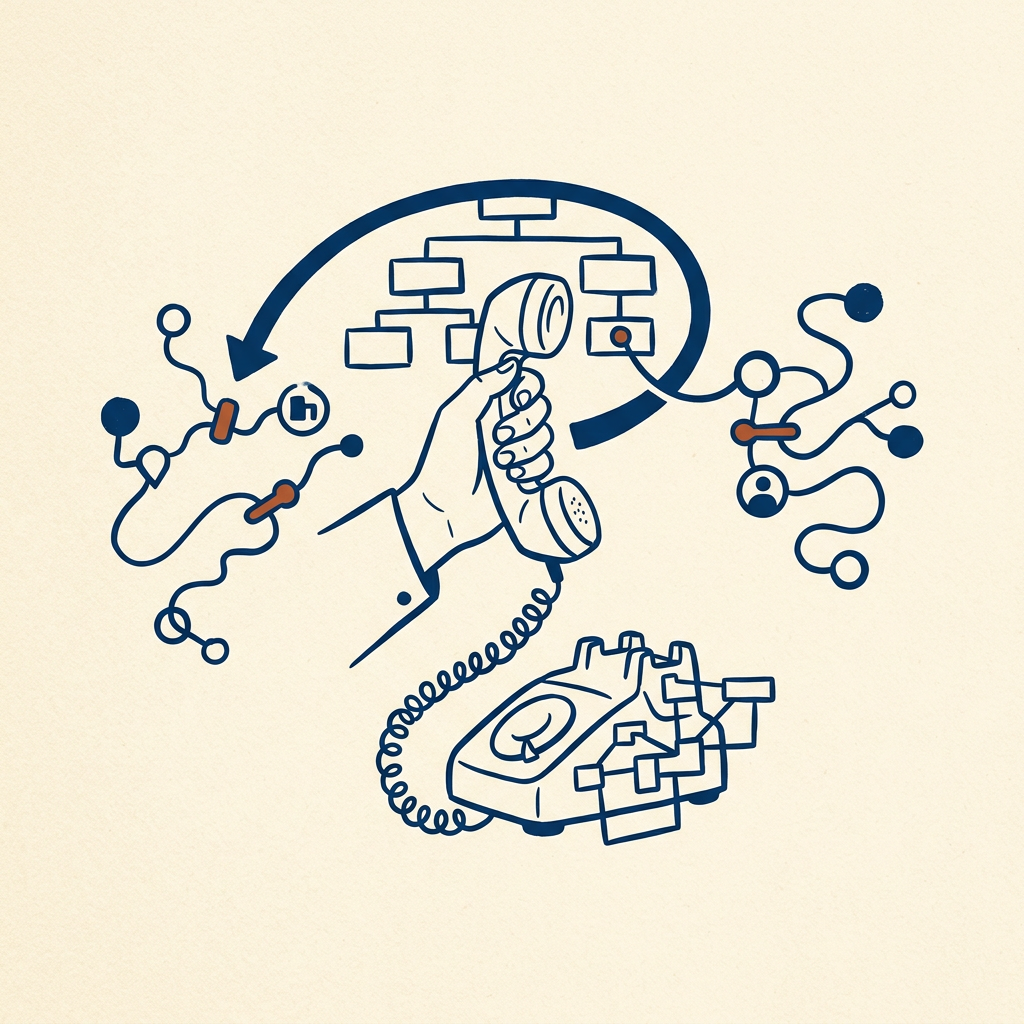
Reach past the org chart
Treating relationship-building as an end in itself let Campbell move knowledge and trust across competing companies that would otherwise never share it.
- 1Check-in callsLarge daily volume of personal calls with no immediate business agenda
- 2Cross-firm trustRelationships span competing and unrelated companies and junior ranks
- 3Quiet introductionsConnect people who have solved parallel problems without leaking specifics
- 4Wider reachNetwork compounds; influence extends beyond any one org chart
↻ and round again
In later years Campbell advised executives at Google, Apple, Intuit, and numerous startups while also keeping friendships with assistants, junior staff, and people far outside the executive ranks he was hired to help. His daily habit was a large volume of phone calls simply to check in, unconnected to any specific business problem, sustained over many years.
That produced a network effect. Because he held relationships across competing and unrelated companies, he could quietly connect people who needed help with a problem someone else had already solved, without violating confidentiality—he never disclosed specifics, only made the introduction.
The authors argue this cross-company connective role is undervalued in cultures that treat outside relationships as irrelevant or as a security risk. When Campbell died in 2016, the memorial drew founders through assistants he had mentored, which the book reads as proof his influence was not limited to the powerful. The weaker claim is that any leader could build the same reach simply by caring more; the book does not grapple with how much of his freedom came from sitting outside any single company's chain of command.
In practice: Campbell's check-in calls across Google, Apple, Intuit, and startups let him introduce people facing similar problems without ever sharing confidential details.
Key terms
- First team The peer executive staff around the CEO; the group a leader should prioritize over their own department
- Decision funnel Three-stage process: broad input, small-group debate of tradeoffs, then one accountable owner
- Trip report Short informal account after a meeting or trip of what happened and who did well, passed upward so credit reaches senior leaders
- Coach vs. manager A coach has no formal authority and exists to make authority-holders more effective; a manager directs work and owns outcomes
- Public championing Actively advocating for a person's credit and reputation in rooms they are not in
- Private feedback Correcting a leader one-on-one, often on a walk, never in front of their own team
What to do
- Spend the first two minutes of your next difficult conversation asking about something in their life unrelated to work, and mean it.
- In your next staff meeting, notice when you are defending your department rather than the company and say so out loud.
- Within 24 hours after a meeting where a junior teammate did well, tell their manager or your peers specifically what you saw.
- When you disagree with a peer-group decision, voice it in the room, then support the decision outside rather than relitigating in side conversations.
Questions to think with
- Where does your loyalty actually sit in the next executive debate—your function or the peer team?
- Who on your team has done good work that has not yet been named in a room above them?
- Can the people you manage already prove you are on their side before you deliver hard feedback?
- Which stage of the decision funnel do you most often skip—broad input, small debate, or single ownership?
- If you sat outside your company's reporting line, what relationships would you build that your current role discourages?
The other side
The book is written by three people who benefited from Campbell's coaching and loved him; nearly every account comes from the same circle, with no interview of anyone harmed by his bluntness, no failed coaching relationship, and no moment his judgment was wrong. Survivorship bias runs through it: readers only meet people he helped at companies that already had structural advantages, such as Google's search economics or Apple's product run under Jobs, so cause and coincidence cannot be separated. It glosses his seat on Apple's board and compensation committee during the mid-2000s stock-option backdating matter that drew SEC scrutiny. Almost every example comes from venture-backed Northern California tech staffed by highly paid, already-capable executives; the book never tests first-team loyalty, blunt love, or the funnel in unionized workplaces, family firms, government, or lower-margin companies. Later commentary noted the absence of counterfactuals and measurement. It is strongest as an intimate biography of one advisor's habits, not as validated evidence those habits generalize.
Who it's for
Managers told to develop people without ever being shown how, startup founders assembling an executive team and unsure how to build trust across it, and readers curious about the hidden operators behind Apple, Google, and Intuit will get the most from the full book.