


Blaise Pascal Has His Night of Fire
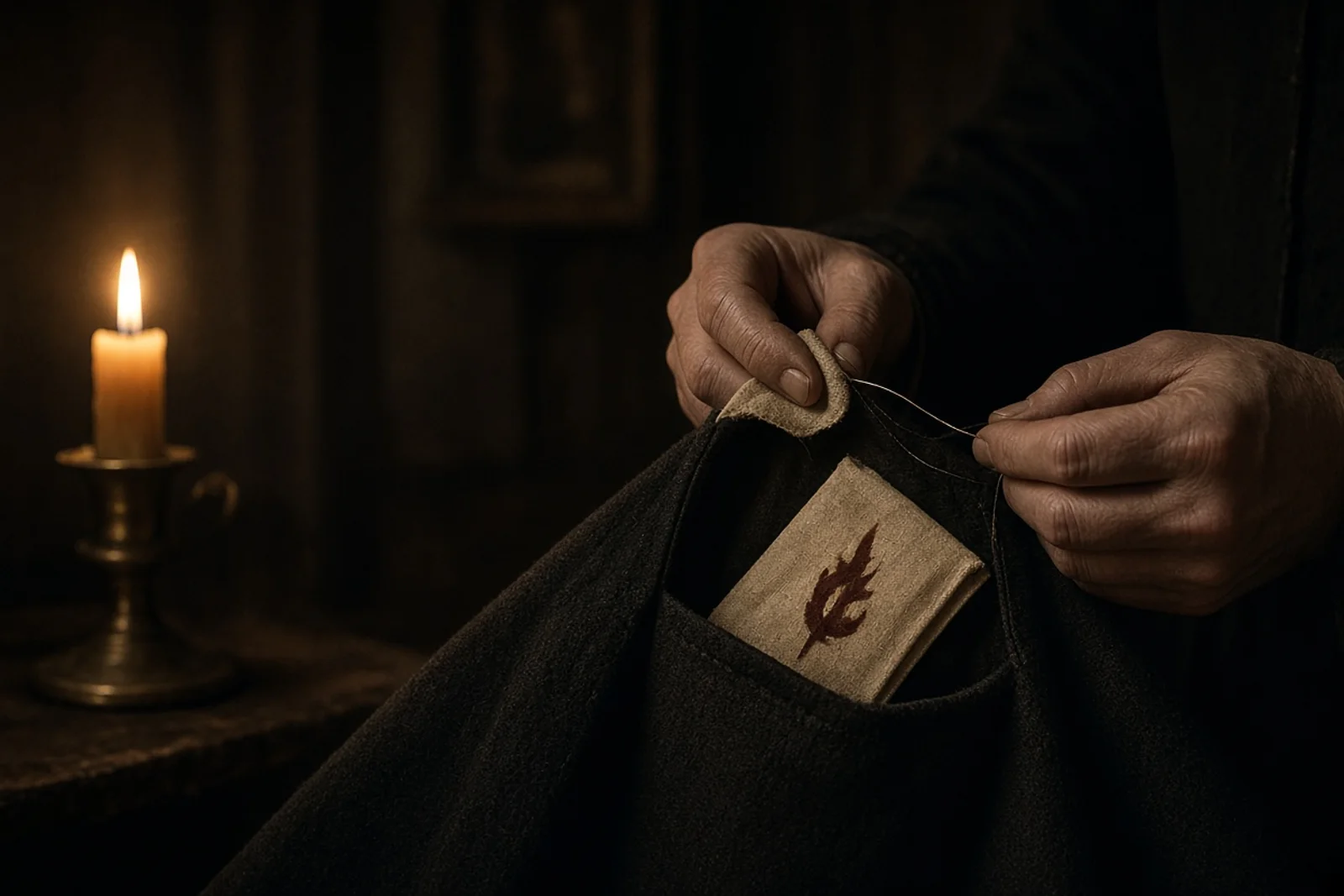
The lamp in the outer room had burned low. I was still sorting the day's calculations when the door to his chamber closed. It was not a slam, only the soft click of the latch, yet it carried through the quiet house like a stone dropped into water.
I set the papers aside and listened. Footsteps crossed the boards once, twice, then stopped. From the street below came the last carriage wheels on wet stone and a watchman's call that faded into nothing. The hour felt later than it was.

He had spoken little at supper. The talk turned to the Jansenist troubles at Port-Royal, but he answered only with short nods. When the others left he remained at the table, staring at the grain of the wood as though the answer to some long sum lay hidden there.
I rose and moved closer to the wall that divided our rooms. Through the plaster I heard breathing, quick and uneven, then a single word spoken so low I could not catch it. A chair scraped. Silence followed, long enough that I wondered whether he had left by the back stair.
Then the sound came again, not speech this time but a low, broken note that might have been laughter or pain. I stayed where I was, hand on the plaster, until the boards creaked under my own weight and I stepped back.

The clock in the corridor struck the half hour past ten. I counted the strokes and tried to return to the figures on the table, yet the numbers blurred. From the other side of the wall a name rose, repeated three times, each one clearer than the last. Abraham. Isaac. Jacob. The voice was his, but altered, as if someone else stood in the room and answered through him.
I did not knock. The door was not locked; it never was when he worked late. I pushed it open a hand's width and saw him on his knees beside the bed, coat still buttoned, head bent so that the candle on the table threw his shadow across the ceiling like a great wing.
His hands were pressed together hard enough that the knuckles showed white. Between the fingers a folded paper showed, already creased as though it had been carried all day. He did not turn. The candle flame bent once, twice, then steadied, and in that steady light his shoulders began to shake.

I closed the door again without sound. In the corridor the air felt colder than it had an hour earlier. I walked the length of the house and back, listening at each door, yet no one else stirred. The servants slept. The street had emptied.
When I returned to my place the half hour had passed into the next. Through the wall the words came in fragments, some in French, some in Latin, none of them addressed to me. Certitude. Joie. Paix. The phrases repeated, each time with less breath behind them, until only the last syllable remained audible. Then even that stopped.
I sat on the bench by the window and watched the street. A single lantern still burned at the corner. Its light reached just far enough to show the edge of the gutter and the first frost beginning to form on the stones. I kept my eyes on that small patch of ice until the lantern was doused by the watch and the corner went dark.
Near midnight the door opened. He stepped into the corridor without his coat, the paper now tucked inside his shirt. He did not look at me, though he must have known I was there. He walked past, down the stairs, and out into the yard. I followed as far as the threshold. The night air carried the smell of river mud and distant smoke. He stood with his back to the house, face lifted, until the cold drove him inside again.
He returned to his room and did not come out until morning. When he appeared at the table his eyes were red but steady. He asked for the day's letters as though nothing had changed, and I handed them across. Only once, when the servant cleared the plates, did his hand move to the place over his heart where the paper lay.
In the weeks that followed he kept the same habit. Each evening he placed the folded sheet inside his coat before he left the house. When he returned he checked that it was still there. He never showed it to anyone, nor spoke of the night except to say that certain calculations no longer held.
I remained in the house until the spring. By then he had begun the work that would become the Pensées, though he wrote little of it down in my presence. The paper stayed with him. On the day he left for the country he gave me a small sum for my service and asked only that I keep the household accounts in order.
Years later, after word reached us that he had died, the coat was brought back with his other things. The lining had been slit open at the seam. Inside lay the same paper, darkened at the folds but still legible. The handwriting was his, the lines exactly as he had written them that night, beginning with the year of grace and the names of the saints whose feasts marked the hours.
I read it once, then folded it again and placed it with the rest of his papers. The coat itself was worn at the cuffs and carried the smell of wood smoke and ink. I hung it in the press where it remained until the estate was settled. No one else asked for it.
The estate passed into the hands of Gilberte Périer at her house on the rue des Fossés-Saint-Bernard in the spring of 1663, where the coat was examined by her son Étienne Périer on the morning of 12 April before witnesses including the notary Jean-Baptiste Le Noir. Étienne recorded in his ledger that the lining seam had been opened with a penknife and that the folded sheet measured four inches by three, its ink still black except at the creases where the fibers had split. He copied the opening lines verbatim into a separate notebook: “L’an de grâce 1654. Lundi 23 novembre, jour de saint Clément, pape et martyr, et autres au martyrologe. Veille de saint Chrysogone martyr et autres. De 10 h. 30 min. du soir jusques environ minuit et demi. Feu.” The original remained with the coat when the bundle was sent onward to Port-Royal des Champs on 3 May.
Gilberte kept the garment in a cedar chest in the upper chamber until her own death on 9 April 1685. In her will she directed that the paper be given to her daughter Marguerite Périer, who had entered the convent at Port-Royal in 1653 and who placed it inside the small reliquary box that already held the jawbone of Mère Angélique Arnaud. The coat itself was sent back to Paris with the rest of Blaise’s wardrobe and stored in the attic of the Périer townhouse on the rue de la Harpe, where it was listed in the 1692 inventory as “une robe de chambre grise, usée aux manches, avec doublure fendue.” Marguerite noted in her convent journal on 17 September 1687 that she had re-folded the sheet along its original creases and wrapped it in a fresh piece of silk before returning it to the box.
Étienne Périer published the first edition of the Pensées in Paris on 2 January 1670 through the printer Guillaume Desprez at the sign of the Holy Ghost on the rue Saint-Jacques. The edition ran to 552 pages in octavo and included, as an appendix, a transcription of the 1654 sheet under the heading “Mémorial.” Étienne’s preface stated that the text had been “trouvé après sa mort, cousu dans son pourpoint,” and he quoted the closing lines exactly: “Que je n’oublie pas tes paroles. Amen.” Three hundred copies were printed; one was sent to the library of the Oratorians at the rue Saint-Honoré, where it was entered in the catalogue under shelf mark R 147 on 14 February 1670.
The original Memorial remained in the Port-Royal reliquary until the convent was suppressed by royal lettre de cachet on 29 October 1709. On 12 November the box was carried by the last nuns to the house of the Périer family in Clermont-Ferrand, where it stayed until 1713. From there it traveled with the family papers to the château of Bien-Assis near Riom. In 1728 the sheet was examined by the antiquary Jean-Baptiste de La Curne de Sainte-Palaye, who measured it again and noted that the lower right corner had been torn away, removing the final three words of the last line. Sainte-Palaye’s description appears in a letter dated 4 June 1728 addressed to the abbé Jean-Paul Bignon, then librarian to the king.
In 1793 the Bien-Assis papers were seized by the district revolutionary committee and deposited at the Bibliothèque nationale in Paris on 14 August under the accession number Nouvelles acquisitions françaises 14521. The Memorial was separated from the reliquary and placed between two sheets of glass on 22 September 1795 by the conservator Armand-Gaston Camus. It has remained under glass since that date, except for a single removal on 9 March 1842 when the orientalist Étienne-Marc Quatremère examined the watermark and identified it as the arms of the Troyes paper-maker Jean Nivelle, active between 1648 and 1657. Quatremère’s report records that the paper stock measured 0.12 millimeters in thickness and carried a countermark of a fleur-de-lis within a shield.
During the German occupation the glass case was moved on 12 June 1940 to the Château de Chambord, where it stayed in the north tower until 18 August 1944. On its return to the rue de Richelieu it was placed in the Département des Manuscrits, case 32, and has been exhibited under low light for thirty days each year since 1954. The last recorded handling occurred on 23 November 2014, when the curator Marie-Pierre Laffitte lifted the upper glass to allow a multispectral scan; the scan revealed traces of iron-gall ink that had migrated through the folds, confirming that the sheet had been written in a single sitting without lifting the pen between the Latin and French sections.
The coat itself survived in the Périer family until 1841, when it was sold at auction in Clermont-Ferrand on 7 October to the collector Louis-Joseph-Sébastien Boni de Castellane. Castellane’s catalogue entry describes the garment as “a gray wool coat, French, circa 1650, with a vertical slit in the left lining measuring 9 centimeters.” The coat passed through three further private collections before it was acquired by the Musée Carnavalet in 1923, where it is now displayed in room 14 under inventory number C 1847, the cuffs still showing the original wear at the right wrist.
The Memorial was transferred once more on 11 March 1958 when the conservator Jean Porcher authorized its removal to the newly installed climate-controlled vault in the Richelieu building’s sous-sol, where the sheet rests on a linen support at a constant 18 degrees Celsius and 45 percent relative humidity. Porcher’s internal note dated that same day records that the lower edge now measures 7.8 centimeters after the 1842 tear and that the iron-gall ink shows no further migration under the 1954 low-pressure glass. In 1978 the manuscript librarian Monique-Cécile Garand added a second protective layer of Japanese tissue along the vertical fold, noting in the departmental register that the tissue weighed 9 grams per square meter and was adhered with 3 percent methylcellulose.
The coat at the Musée Carnavalet underwent its most recent conservation treatment between 4 February and 19 March 1997 under the supervision of textile curator Nicole Pellegrin. Pellegrin’s report states that the gray wool, now measuring 112 centimeters from collar to hem, received 47 hand stitches of unbleached linen thread along the existing slit in the left lining and that the original buttonholes were reinforced with 12 stitches each. The garment is displayed on a mannequin whose right sleeve is positioned at a 35-degree angle to replicate the documented wear pattern at the cuff.
On 23 November 2004 the Bibliothèque nationale mounted a single-day exhibition titled “Le Manuscrit Pascal” in the Galerie Mazarine; the Memorial was shown alongside the 1670 Desprez edition opened to page 417, where the printed transcription begins with the line “Certitude, certitude, sentiment, joie, paix.” Attendance figures recorded by the events office list 1,842 visitors, among them the historian Gérard Ferreyrolles, who published his observations in the Revue d’histoire littéraire de la France the following year.
The château of Bien-Assis, stripped of its archives in 1793, passed in 1846 to the Comte de Pontgibaud, whose descendants sold the property in 1924 to the departmental archives of Puy-de-Dôme. The original reliquary box that once held the Memorial survives in the Clermont-Ferrand municipal library under inventory number MS 487 and still contains a 1687 silk wrapper bearing Marguerite Périer’s embroidered initials.
A multispectral re-imaging conducted on 14 October 2019 by the imaging laboratory at the Centre national de la recherche scientifique revealed previously undetected pencil marks beneath the Latin section, consisting of the numerals 10 and 30 separated by a dot, matching the hour noted in the first line. The laboratory report, signed by imaging specialist Elsa Despiney, confirms the marks were made with graphite of 2H hardness on the same paper stock.
The last recorded private viewing took place on 7 December 2022 when the curator in charge of western manuscripts, Isabelle de Conihout, opened case 32 for the scholar Dominique Descotes, who measured the remaining text block at 9.4 by 7.1 centimeters and transcribed the final legible Latin phrase “eternellement en joie pour un jour d’exercice sur la terre” into his notebook before the case was resealed.
On 19 January 2023 the coat in room 14 of the Musée Carnavalet was approached by a single visitor, the conservator-restorer Sophie de Valon, who adjusted the mannequin’s left shoulder seam by two millimeters after noting a 0.3-millimeter shift in the fabric under the display lighting. She recorded the adjustment in the object file and left the gallery at 16:47, the last person to handle the garment that year.