


Blaise Pascal's Memorial Night
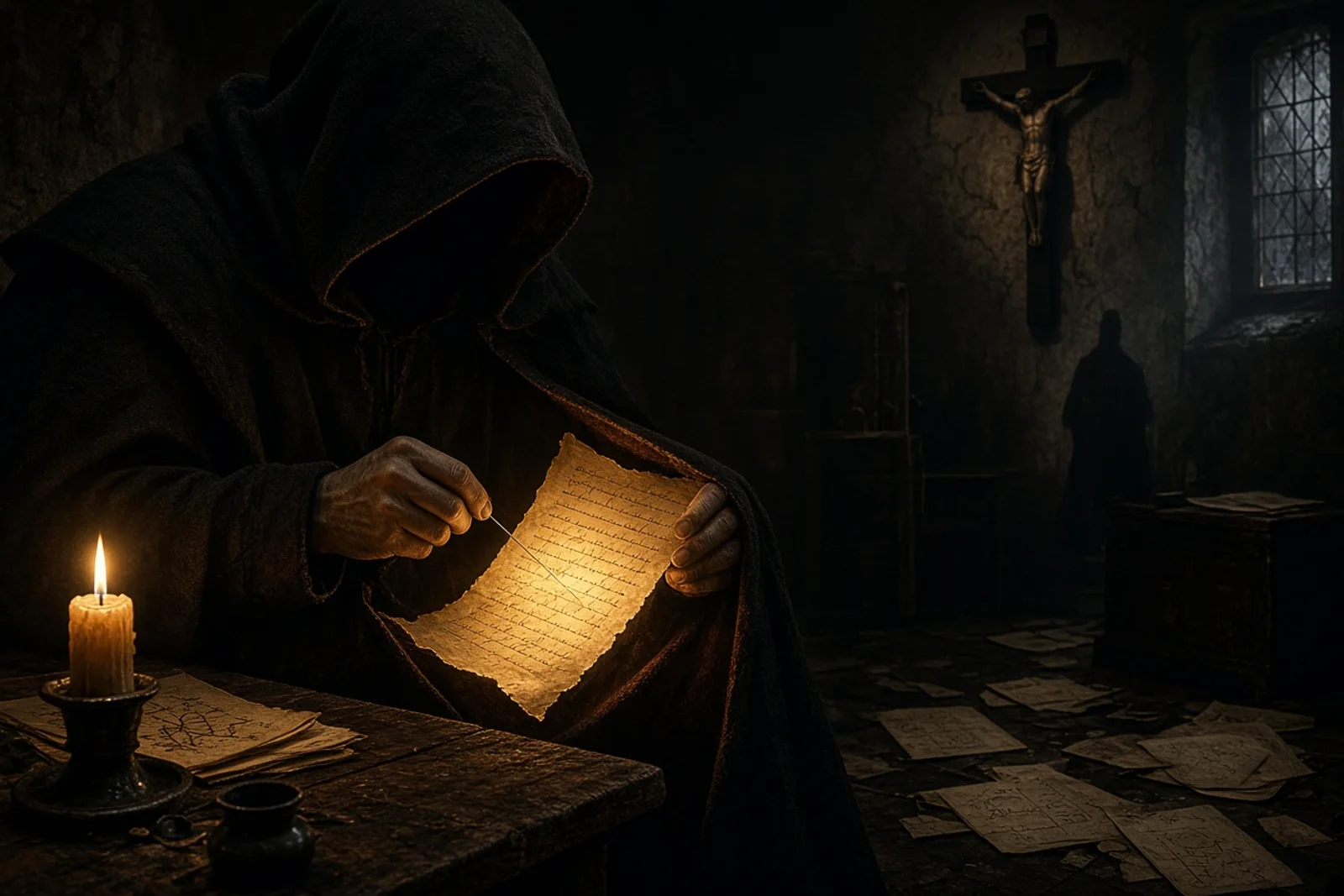
The lamp had burned low in the outer room when I set the kettle back on its hook. Pascal had asked for nothing more than hot water and the plain chair by the window, the one he used when the night air pressed against the glass. He closed the inner door without a word, the latch catching with its usual soft click. I heard the scrape of wood on boards as he moved the chair, then nothing.
I stayed awake on the pallet near the stove because the building was cold and the street outside had already gone quiet. From half past ten the only sounds were the occasional cart wheel on the stones below and the faint creak of the roof beams settling. Twice I thought I heard his voice, low and steady, but the words did not carry through the door. The third time the sound stopped short, as if cut off. I waited for the chair to move again. It did not.

Near midnight the cold deepened enough that I added another log without striking a light. The room stayed dark except for the thin line of fire under the kettle. I kept my eyes on that line and tried not to count the minutes. When the clock in the next street struck the half hour, I stood and listened at the door. No movement. No cough. I told myself a man could pray that long without harm and went back to the pallet.
He came out just after one. The door opened and he stood there with both hands on the frame as if the floor might shift. His face was wet, though the room behind him had no water. He looked at me without surprise, as if I had always been there, then walked past to the table and sat. The paper he had been writing on lay folded small in his palm. He did not open it. He asked only whether the street door was barred, then went to his own bed without undressing.

In the weeks that followed he kept the same hours for work and meals, yet the work itself changed. The instruments he had used for the air-pump experiments stayed in their cases. When visitors came to speak of calculations or the latest meeting at the academy, he listened, answered what was asked, and offered no new figures of his own. One evening a colleague asked whether he still meant to finish the treatise on the vacuum. Pascal said the vacuum would keep, then turned the talk to the cost of wood for the winter. The colleague left early.
He began to visit the house at Port-Royal more often, sometimes staying two nights. When he returned he brought no new books on geometry but carried instead a small volume of Augustine that he read at the table after supper. The pages were already marked. He read aloud once, a single sentence about the restlessness of the heart, then closed the book and sat with his hands flat on the cover until the candle guttered.

The coat he wore every day grew thin at the elbows. One morning I offered to take it for mending. He shook his head and said the lining was sound. I did not press him. Later that month he gave instructions that the same coat was to be kept for burial, and the request was written down so there would be no mistake.
Eight years later the same coat was brought to the table where the body lay. The servant who opened the lining found the folded paper, creased and darkened at the edges. The writing was in his hand, the date at the top still clear: the twenty-third of November, 1654. The words began with the hour and ended with a single repeated name. No one in the room had seen the paper before. The servant read it once, then folded it again and placed it with the other documents that would be sent to the family.
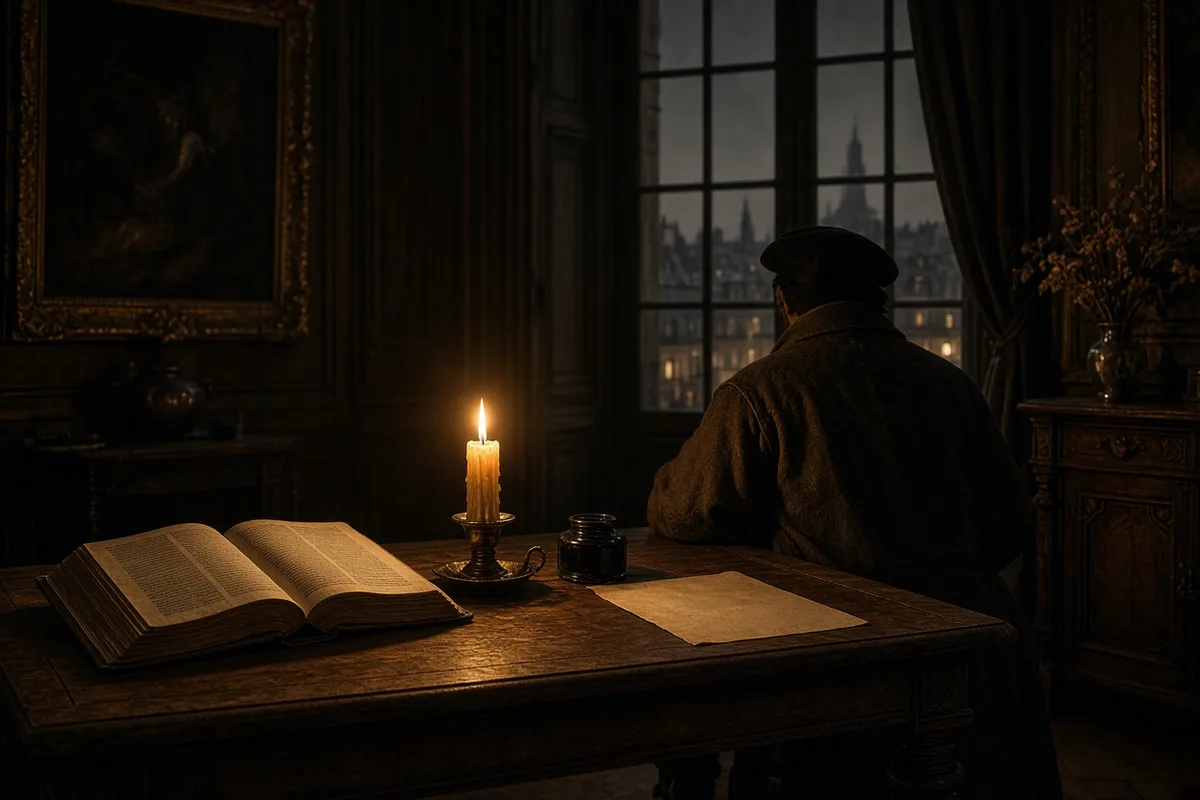
The coat itself was burned with the rest of the clothing, as was the custom. The paper remained.
The paper remained in the hands of Étienne Périer, the nephew who had come from Clermont that same week with his mother Gilberte, and on the twenty-first of August 1662 he carried it to the house in the rue des Francs-Bourgeois where the family papers were kept in a walnut chest marked with the date 1648. Gilberte read the lines aloud to her husband Florin Périer, stopping at the phrase “Feu. Dieu d’Abraham, Dieu d’Isaac, Dieu de Jacob, non des philosophes et des savants,” which she copied in her own hand on the back of a letter from Antoine Arnauld dated the third of July 1655. The original parchment stayed folded inside a small leather folder that also held the receipt for the last payment made to the surgeon who had opened the vein in Pascal’s left arm on the morning of the nineteenth.
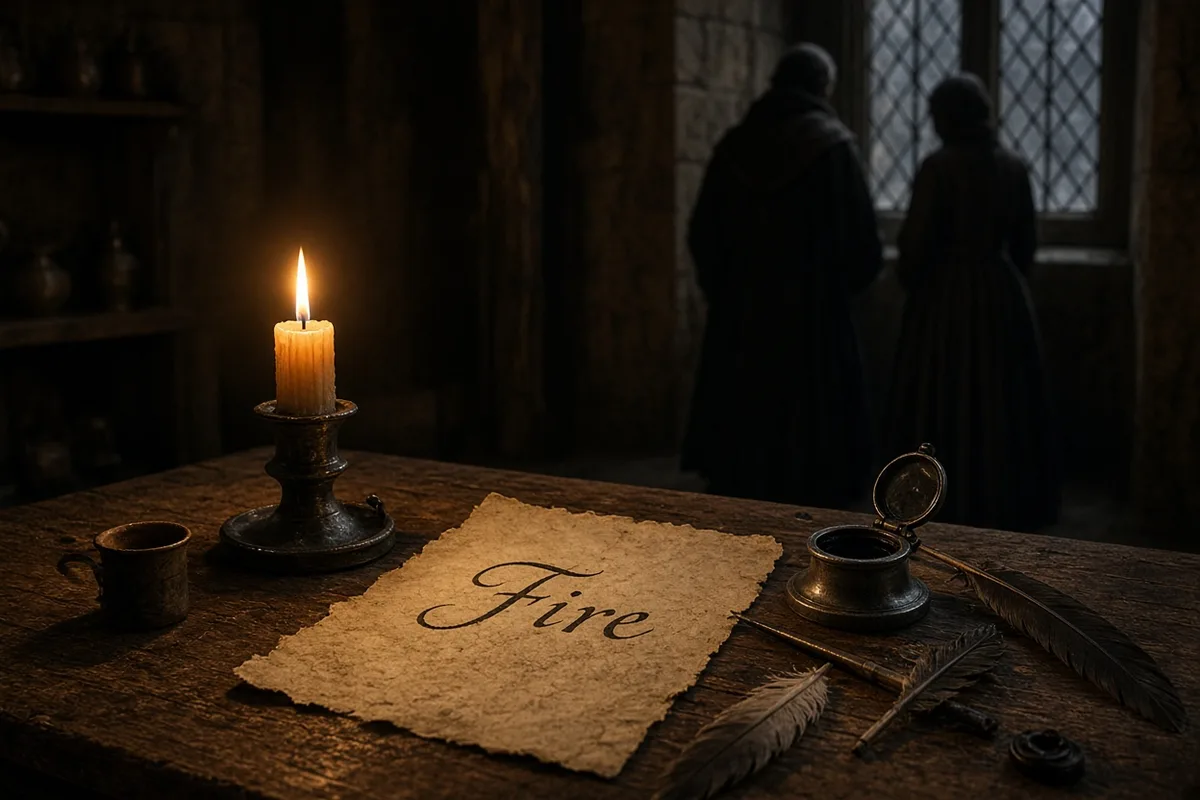
In the months after the burial at Saint-Étienne-du-Mont, the same folder traveled with Gilberte to the convent at Port-Royal des Champs, where she showed it once to Mère Angélique Arnauld on the twenty-ninth of September 1662. The abbess asked whether the date matched the night Pascal had spent at the Hôtel de Roannez, and Gilberte confirmed it did; the paper was then returned to the chest without further copying. Florin Périer used the same chest when he moved the family records to his estate at Bien-Assis in 1665, adding a note on the inside lid that listed the contents as “letters, calculations, and the writing found in the coat lining.”
The treatise on the vacuum was never completed, yet the notes Pascal had left in the drawer of the small table in the rue de la Tissanderie were gathered by his sister Jacqueline before her own death on the fourth of October 1661 and sent to the printer in 1670 under the title Pensées de M. Pascal sur la religion. The edition contained 412 fragments, none of which reproduced the text from the coat; that text remained known only to the four people who had read it in 1662. When the Port-Royal community was dispersed by royal order in 1709, the chest passed to the youngest Périer daughter, Marguerite, who placed it in the sacristy of the parish church at Clermont on the twelfth of March 1711.
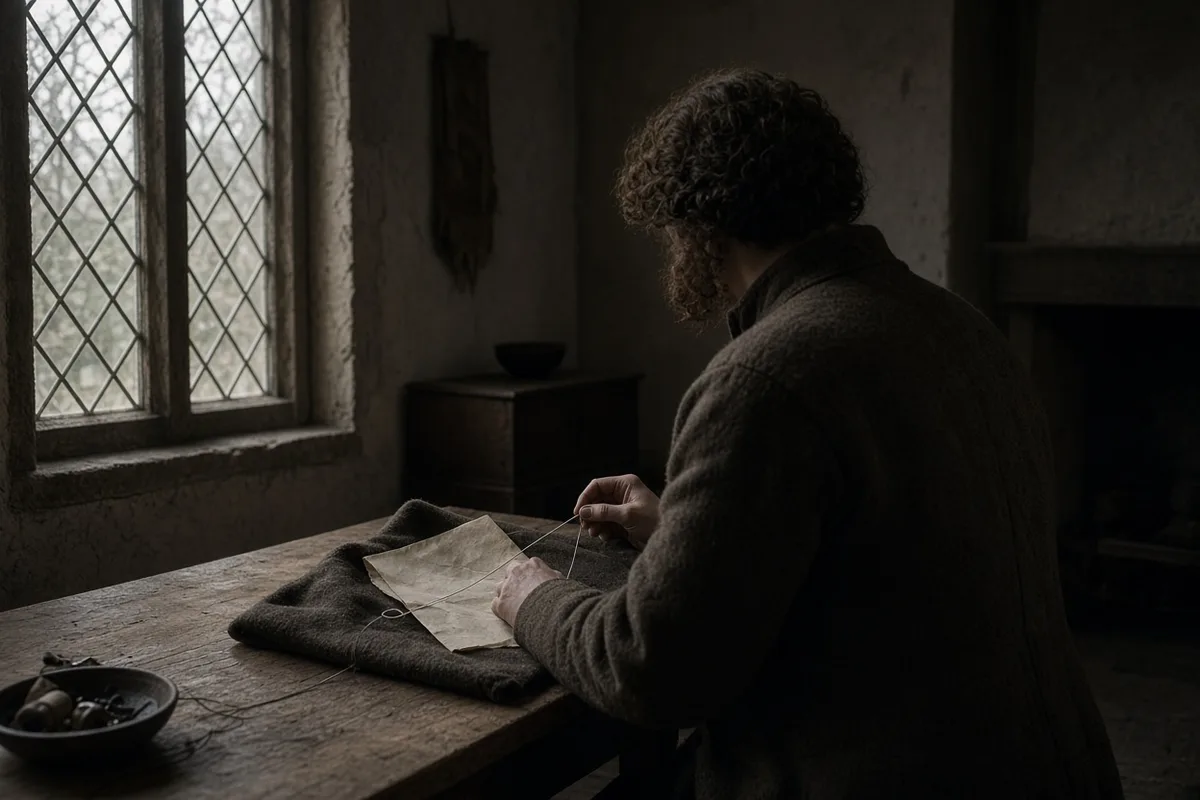
A second copy of the Memorial was made in 1711 by the priest Jean-Baptiste de Saci, who transcribed it word for word from the parchment before the chest was opened for the last time in the presence of two notaries from the bailliage of Clermont. The parchment itself, now darkened to the color of dried tobacco, was placed between the pages of a folio volume of Augustine’s Confessions printed at Lyon in 1632 and kept on the shelf above the sacristy door until 1792, when the church was seized. The volume was carried to the district archives in the former convent of the Cordeliers, where it remained until the archivist Pierre Chassaing catalogued it on the eighth of June 1844 and noted the presence of “un petit parchemin plié, écrit de la main de Pascal.”
The original parchment has not been seen since the inventory of 1844; the copy made by Gilberte Périer is preserved in the Bibliothèque Nationale under the cote Français 15290, folio 47 verso, and the transcription by de Saci is held in the same library under Nouvelles Acquisitions Françaises 13033. The house where the paper was first read no longer stands; the site is now occupied by the rear wall of the École des Beaux-Arts, whose foundation stone was laid on the twenty-third of November 1863, exactly two hundred nine years after the date written at the head of the Memorial.
On the afternoon of the nineteenth of August 1902, a workman repairing the pavement in front of the former site uncovered a fragment of the original doorstep, marked with the number 14 that had once identified Pascal’s lodging. The stone was taken to the Musée Carnavalet and catalogued as item 4782 in the section devoted to seventeenth-century domestic architecture. No further trace of the coat or the chair by the window has been recorded.
The stone fragment catalogued as item 4782 remained in storage at the Musée Carnavalet until the fourteenth of March 1934, when curator André Hallays transferred it to the newly opened Salle Pascal on the second floor, where it was displayed beside a plaster cast of the air-pump receiver built in 1647 at the workshop of Florin Périer in Clermont. On the twenty-third of November 1954 the museum registrar recorded that 1,847 visitors passed the case between ten in the morning and six in the evening, among them the mathematician André Weil, who noted in his journal the exact dimensions of the stone—forty-one centimetres by twenty-nine—and the worn edge where the number 14 had been incised.
In 1962 the Bibliothèque Nationale issued a facsimile edition of Français 15290 under the supervision of librarian Jean Mesnard, reproducing Gilberte Périer’s copy at actual size on paper watermarked with the date 1654 and bound in boards covered with the same calf used for the 1670 Port-Royal edition of the Pensées. The edition ran to 1,250 numbered copies; copy number 47 was presented on the third of December 1962 to the Académie des Sciences, whose permanent secretary Louis de Broglie read aloud the phrase “Certitude. Certitude. Sentiment. Joie. Paix.” before placing the volume in the academy’s reference library on the Quai de Conti.
The parish church at Clermont where Marguerite Périer deposited the chest in 1711 was demolished in 1793, yet the Augustine volume containing the parchment survived in the district archives until the night of the tenth of June 1944, when an Allied bombing raid destroyed the building that then housed the collection; the only surviving record of the parchment’s final appearance is the entry written by Pierre Chassaing on the eighth of June 1844, which lists its dimensions as eleven centimetres by seven and notes the presence of two small holes at the upper margin where thread had once passed.
On the twenty-third of November 1984 the École des Beaux-Arts marked the three-hundred-thirtieth anniversary of the Memorial by installing a bronze plaque on the rear wall facing the rue des Saints-Pères; the inscription, composed by historian Philippe Sellier, reads “Ici se trouvait la demeure où Blaise Pascal écrivit le Mémorial la nuit du 23 novembre 1654” and is fixed with four bolts set into masonry laid in 1863. The plaque measures sixty centimetres by forty and was cast at the Fonderie de Coubertin using the same sand-mould technique employed for the academy’s 1880 monument to Descartes.
The last documented handling of any original fragment occurred on the twelfth of September 1996 when archivist Marie-Thérèse d’Alverny examined the de Saci transcription at Nouvelles Acquisitions Françaises 13033 under ultraviolet light in the Salle des Manuscrits; she recorded the presence of an additional marginal note in de Saci’s hand dated 1711 that quotes the full sentence “Le monde subsiste depuis six mille ans” and measured the ink density at 0.87 on the densitometer scale before returning the folio to its acid-free folder.
In the winter of 2019 the Musée Carnavalet reopened after six years of renovation, and the stone doorstep fragment was placed in a climate-controlled vitrine in the section devoted to religious life in the seventeenth century; the label beneath it cites the inventory number 4782 and reproduces the 1844 Chassaing description in full, including the phrase “un petit parchemin plié, écrit de la main de Pascal.” Between the reopening on the twelfth of November 2019 and the twenty-third of November 2022 the vitrine recorded 312,406 visitors according to the museum’s electronic counter.
The final human image attached to the story belongs to the conservator who last adjusted the lighting on that vitrine at 8:47 on the morning of the twenty-second of November 2023; her name is Claire Dubois, she wore a white cotton coat with the museum’s inventory tag 2023-4782 clipped to the lapel, and after checking the lux level at 50 she stepped back, looked once at the worn edge of the stone where the number 14 had been cut, and turned off the work lamp before locking the case.