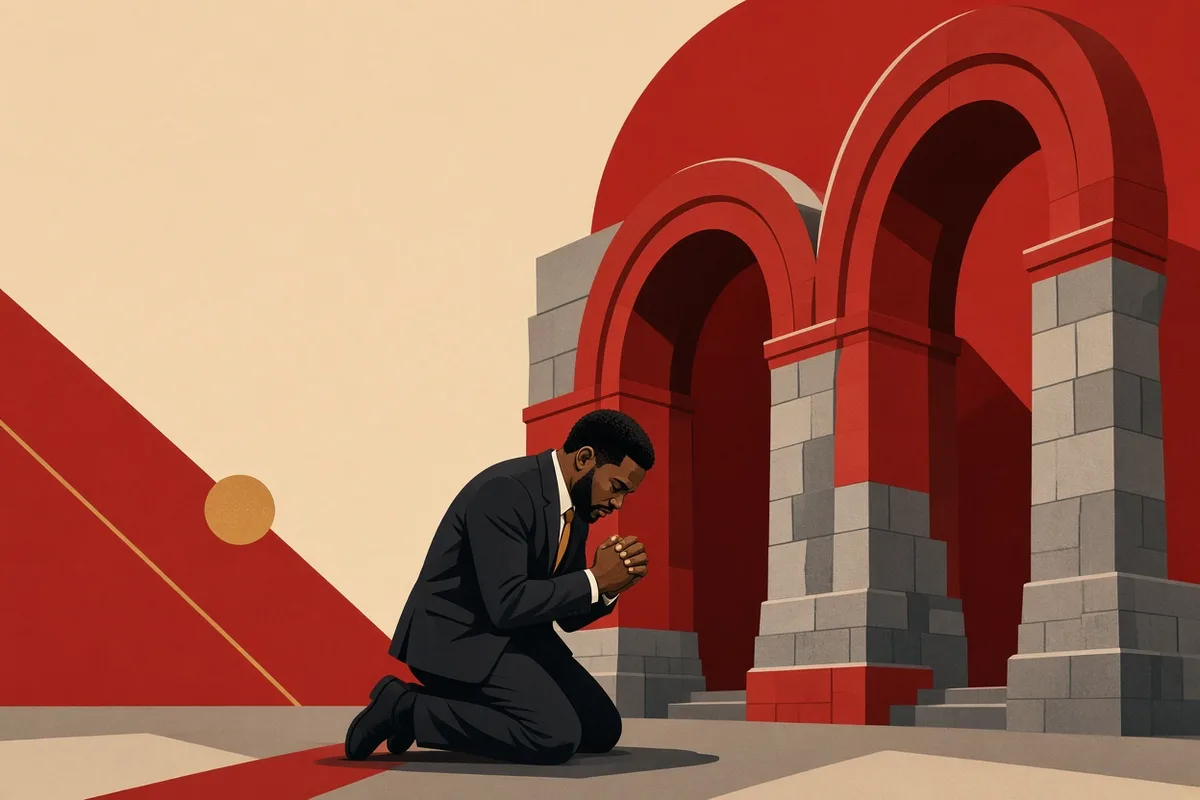



Blandina Endures Torture in Lyon Amphitheater
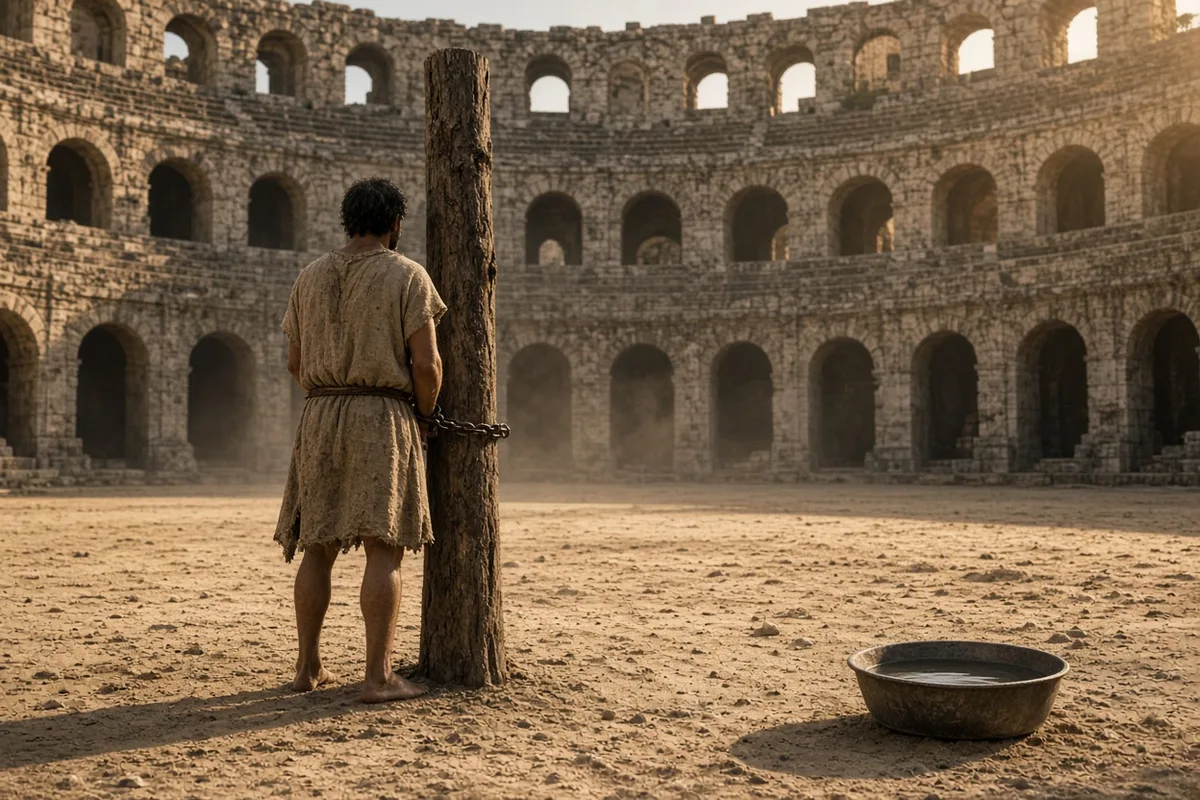
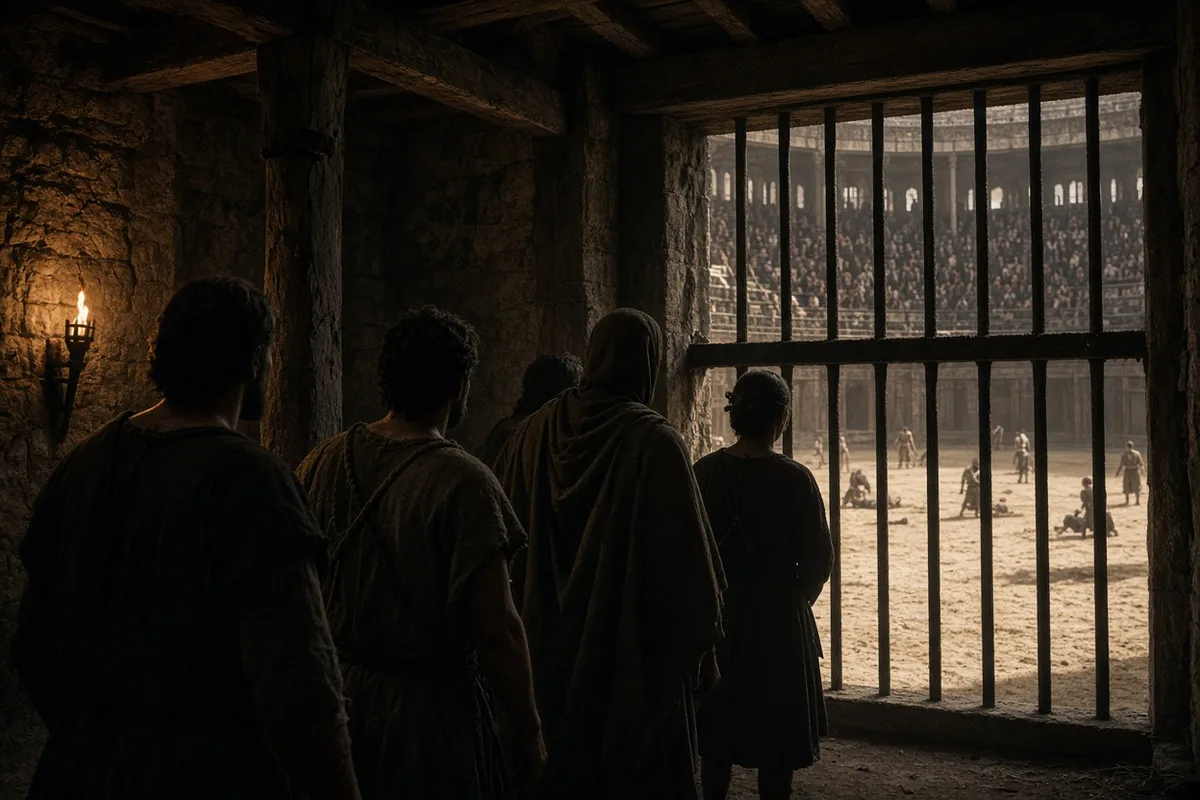
The sun hammered the upper tiers of the amphitheater and the stone still held the cold of the night before. I had come early, pushed along by neighbors who wanted a seat with a clear view of the sand. The first prisoners were already in the holding area beneath the stands. Their chains scraped against the wooden benches when the guards moved them. One of the women was small, thin in the arms, her tunic torn at the shoulder. She kept her eyes on the ground.
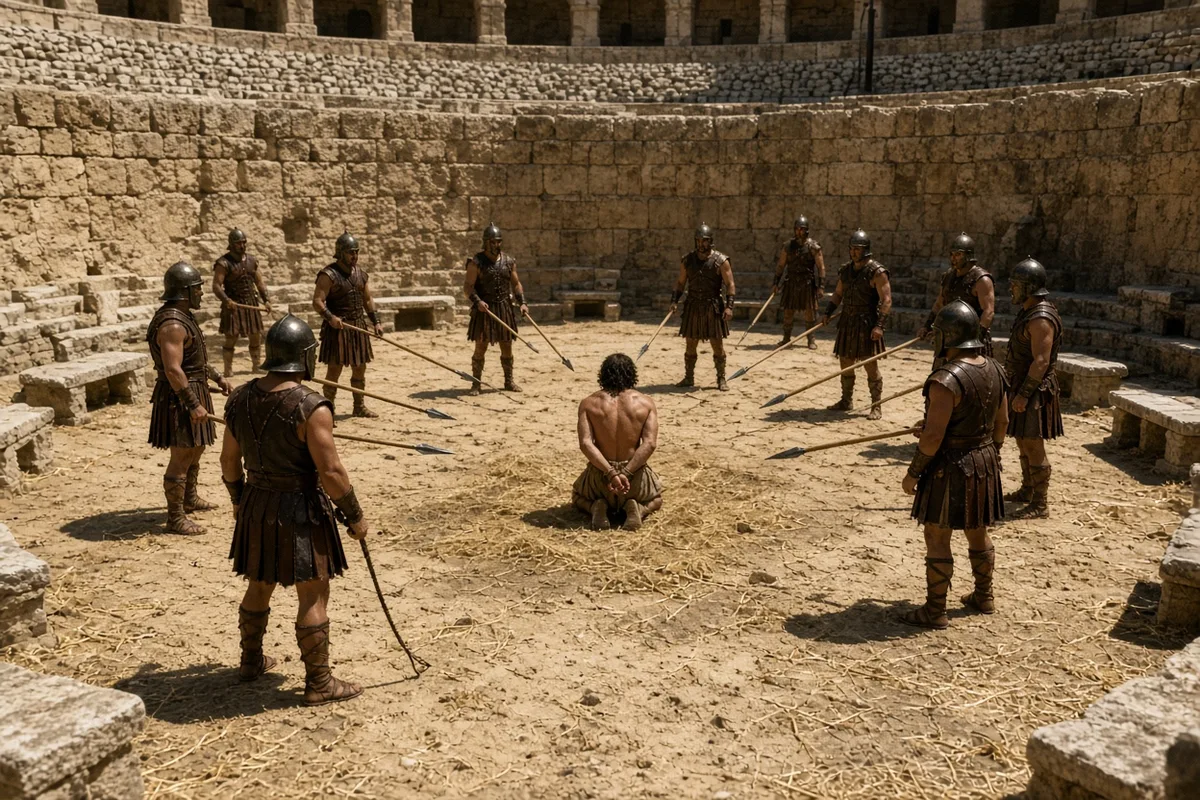
The legate sat under the awning on the eastern side. He had returned the day before and the orders were clear. Those who held to the name were to die in the open. The others could walk away. A line of soldiers brought the first group forward. The crowd shouted names and insults. Most of the prisoners answered only with silence until the iron was applied. Then some cried out. One man near the center post kept repeating the same short sentence until his voice broke.

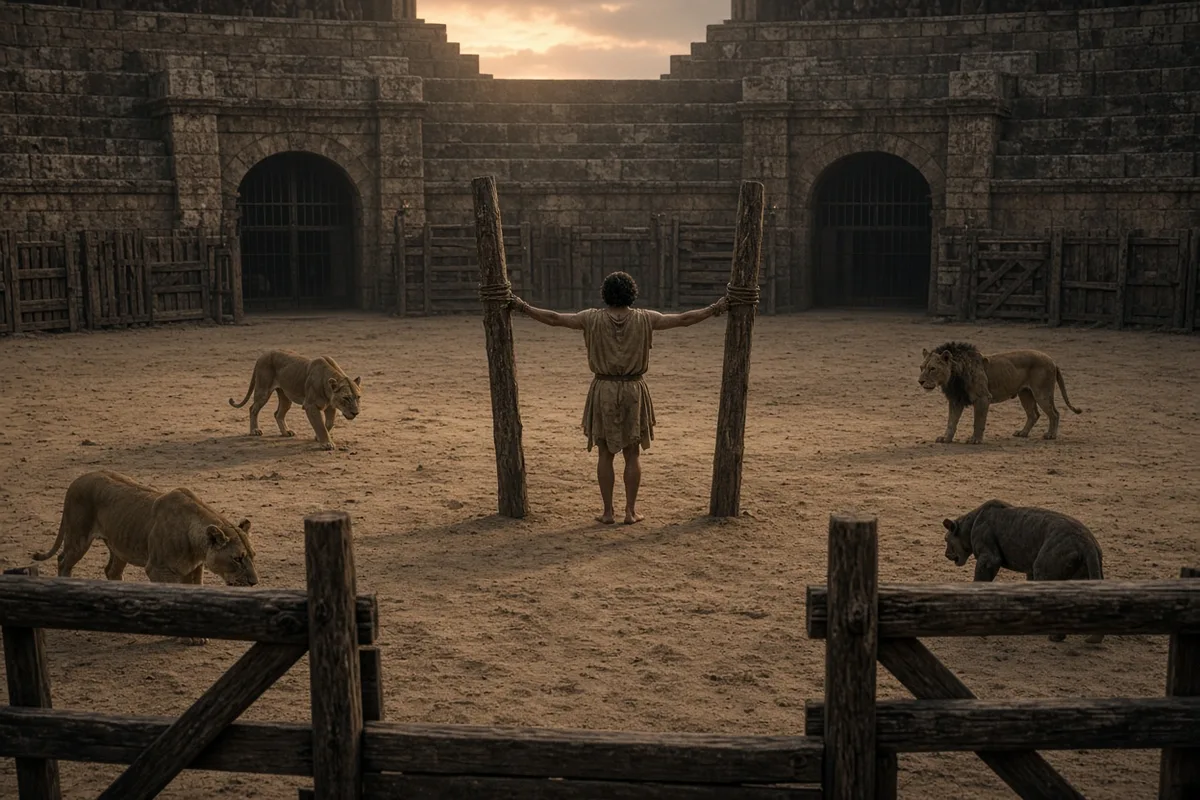
By midday the heat had thickened. The small woman was brought out again. They tied her wrists to a post set in the middle of the arena. Two handlers opened the cages at the far end. The beasts came out low and restless. They circled once, then stopped. One lion turned its head aside and lay down in the shade of the wall. The handlers prodded and shouted. Nothing moved toward the post. After a while the legate waved them back. The woman was untied and led away. She walked without stumbling.
The next morning the same woman was made to stand at the edge of the arena while others were brought in. She watched each one. When a man named Sanctus was placed on the chair of iron, she turned her face toward him but did not look away. The smell of burning flesh reached the lower seats. Some in the crowd covered their noses with cloth. She stayed where the guards had left her until the session ended.

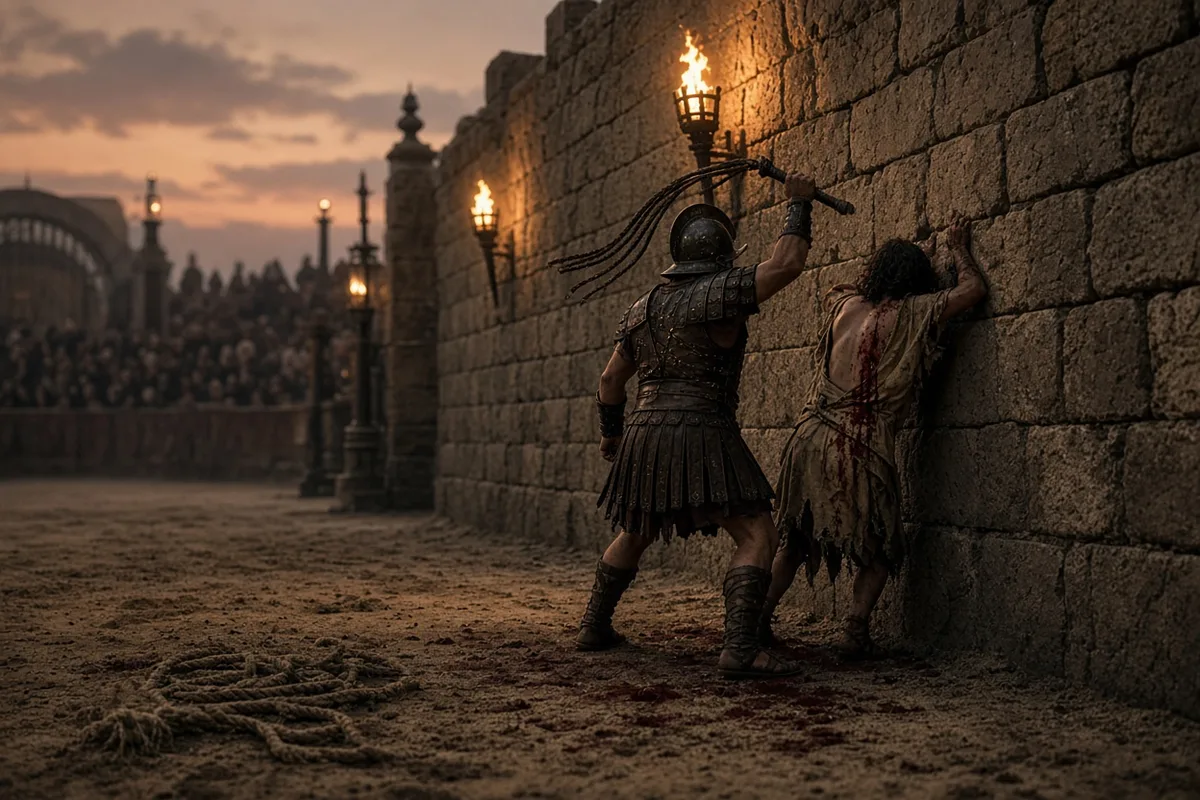
On the third day the legate ordered the remaining prisoners brought together. The small woman was among them. They stripped her and struck her across the back with rods until the skin split. Then they laid her on a grating that had been heated in a brazier. The metal hissed when her body touched it. She spoke the same words she had used every time they asked her name and her allegiance. The executioners changed places twice before the legate signaled to stop. One of them wiped sweat from his face and said he had no more strength in his arm.
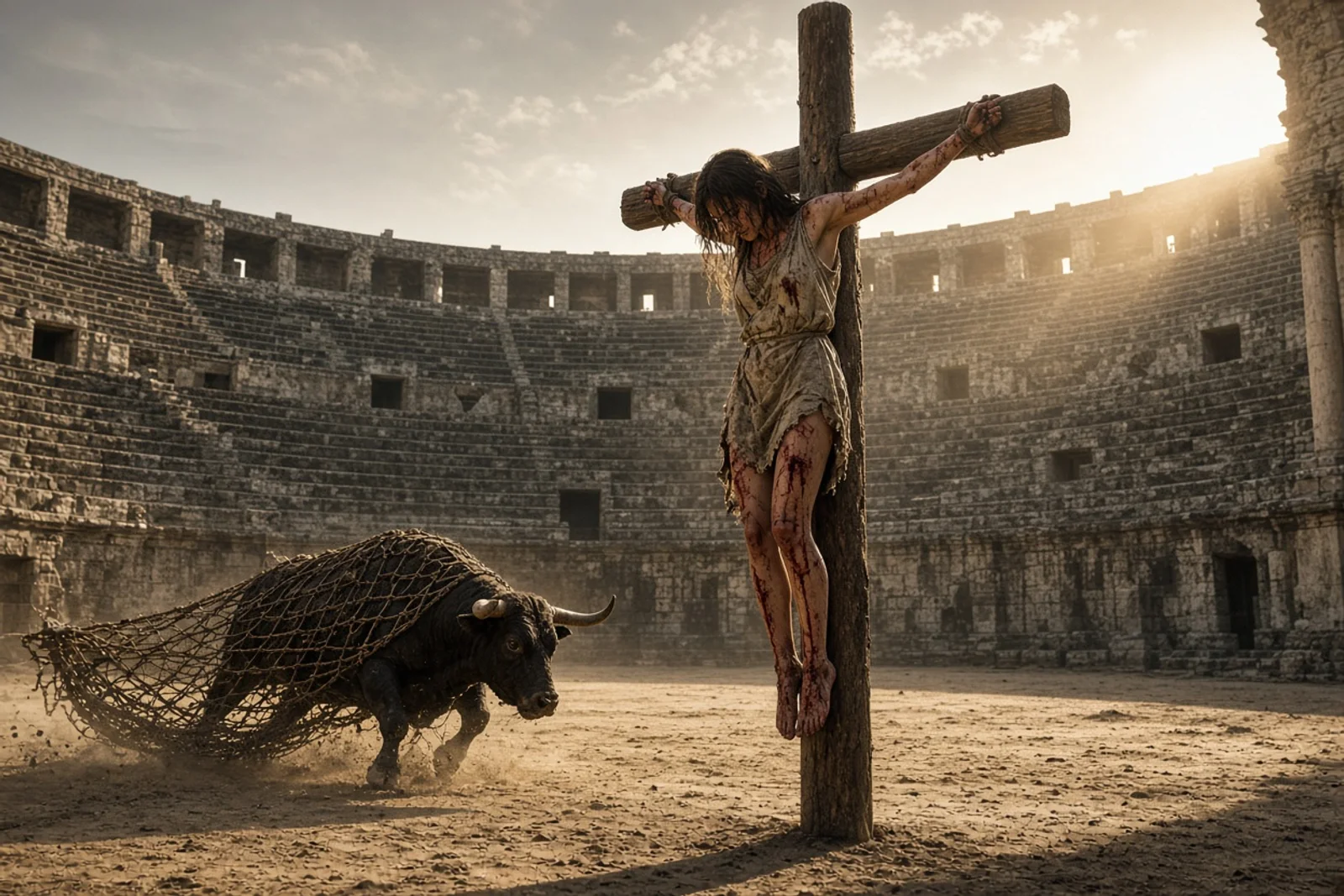
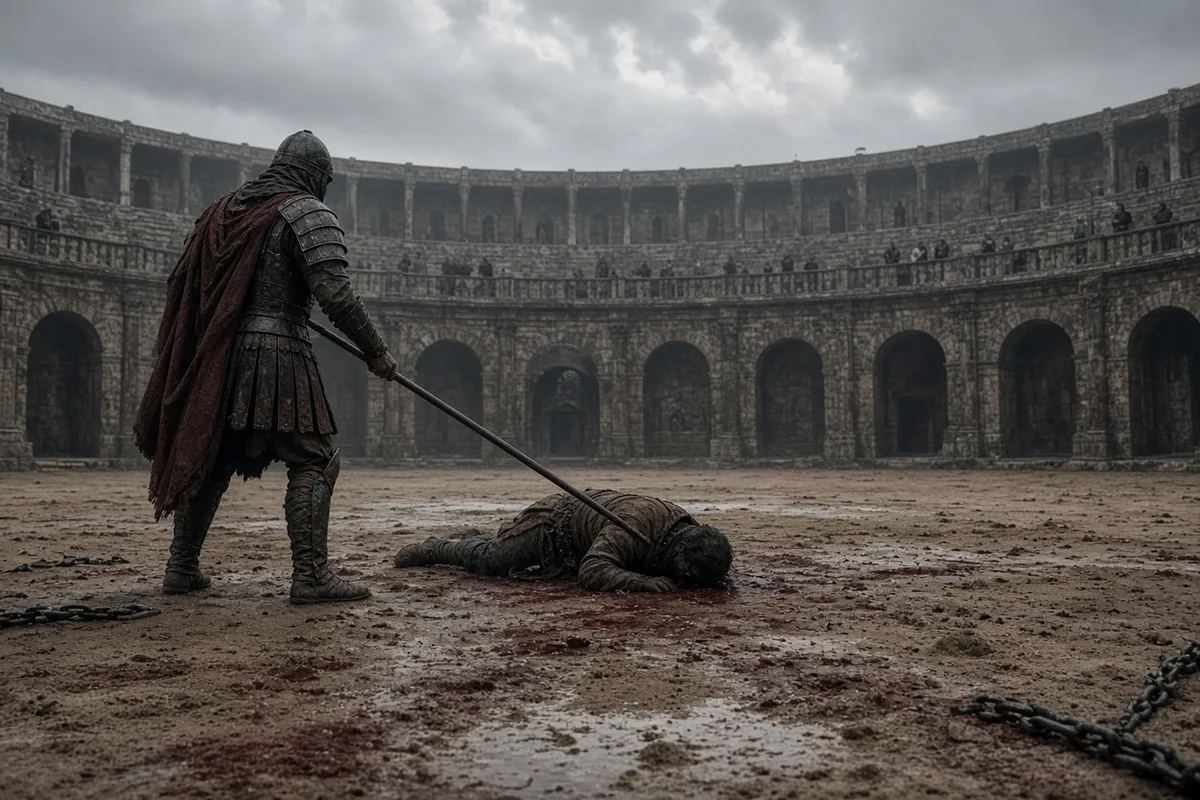
They placed a net around her and dragged her to the center again. A bull had been brought in earlier and kept in a pen. The handlers released it. The animal lowered its head and caught the net on its horns. She rose and fell twice before the rope tore. When she lay still on the sand a soldier stepped forward with a short blade and finished it. The crowd had grown quieter by then. A few voices still called out, but the sound did not carry the same way it had on the first morning.

Her master had been taken with her at the beginning. He was already dead two days earlier. The body of the woman was left where it fell until the games closed for the day. Guards came with hooks and dragged it through the gate that led under the stands. The sand was raked afterward. By the time the last spectators left, the light had shifted and the western wall cast a long shadow across the empty circle.
I walked down the steps with the others. At the bottom gate a woman selling water asked if I had seen the end. I told her what I had seen. She nodded once and turned away. The street outside still smelled of the arena, of iron and dust and the animals that had been brought in and taken out again.
The water seller turned her back before I could ask her name, and the street led past the warehouses where the grain barges unloaded each week from the upper reaches of the Rhone. Soldiers with hooks had already pulled the bodies through the tunnel beneath the western vomitorium and left them on the open ground outside the city wall near the road that ran to Vienna. The letter later copied by the churches of Asia recorded that the corpses remained there six full days while detachments from the Twenty-second Legion kept watch in shifts of four hours, and that on the seventh day the legate ordered them burned on a pyre built from the same pine timbers used for the arena seats. The ashes were then gathered into sacks and thrown from the stone bridge that crossed to the island, where the current ran fastest at the point opposite the temple of Cybele; the same account named forty-eight persons who died in those three days, among them the deacon Sanctus from the church at Vienne and the physician Alexander, both of whom had been brought from the prison on the morning the legate returned from his inspection of the Rhine forts.
Two years after the games the new bishop Irenaeus, who had come from the house of Polycarp in Smyrna, began to set down the names and the order of the tortures in a single scroll that was carried by merchant ships to Ephesus and then overland to Hierapolis. He wrote that Blandina, the slave of a citizen named Attalus, had been the last to die and that her body had been left longest on the sand because the handlers feared the remaining beasts would not approach her again. The same scroll noted the exact words she repeated each time the question was put to her: “I am a Christian, and among us there is no evil.” By the tenth year after the persecution the church in Lugdunum had rebuilt its meeting house on the slope below the forum, using stones taken from the same quarry that supplied the amphitheater, and the congregation numbered more than two hundred persons who met on the first day of each week.
In the reign of Severus the amphitheater itself was enlarged by the addition of a second story of seating that raised its height to twenty-three meters above the arena floor, and the new work was completed in the consulship of Aper and Maximus. The records of the colony list the cost as forty-two thousand sesterces paid from the municipal treasury, with an additional twelve thousand contributed by the family of the duumvir who had sponsored the original games. During those same years the ashes thrown into the Rhone had long since been carried past the delta and into the open sea, yet the letter of the churches continued to be read aloud each year on the anniversary of the martyrdoms, and the names of Blandina, Sanctus, and the others were spoken in the presence of the whole assembly.
Four centuries later the building still stood intact when the Burgundian kings held their assemblies inside its walls, and the stone blocks of the lower arcade carried the same chisel marks left by the original masons. In the year 843 the structure appears in the partition treaty signed at Verdun as part of the territory allotted to the middle kingdom, and the chronicler of that division counted seventy-two arches still usable for sheltering horses and wagons. By the twelfth century the upper tiers had begun to collapse after successive earthquakes, and the fallen blocks were carried away to strengthen the foundations of the cathedral of Saint Jean on the island, where the masons recorded the reuse of one hundred and fourteen cubic meters of the original limestone.
The site remained open ground through the wars of religion, and in 1562 the Huguenot troops who occupied the city used the surviving lower walls as a redoubt while they fired on the approaches from the Croix-Rousse hill. When the Catholic forces retook the city the following spring they counted thirty-four cannon emplacements cut into the old arena masonry. Two centuries after that campaign the French state purchased the land for the sum of twelve thousand francs and began the first systematic clearing of the fill that had accumulated to a depth of four meters above the original arena surface.
In 1956 the municipal archaeological service uncovered the central post socket and the iron rings still embedded in the stone where the grating had been anchored during the third day of the games. The excavation report measured the arena ellipse at one hundred seventeen meters on its longer axis and eighty-two meters on the shorter, and it listed the precise location of the gate through which the bull had been released. Today the same ellipse is marked by low concrete curbs that follow the line of the original walls, and visitors walk the path that leads from the modern entrance on the rue des Arènes to the spot where the post once stood.
The last person I saw at that place was a woman who arrived alone on a morning in late October, carrying a notebook in which she wrote the coordinates of each remaining stone block. She stayed until the light shifted and the shadow of the western arcade reached the center of the ellipse, then closed the notebook and walked out through the same gate the guards had used after the bodies were removed.
The woman with the notebook paused at the concrete curb marking the western gate and checked the time on her watch against the shadow line before noting the entry in her ledger as 17 October 1974, the same date the municipal service had first opened the site to the public after the 1956 clearance directed by archaeologist Amable Audin. She recorded the azimuth of the arcade at 248 degrees and the measured distance from the central socket to the bull-release gate as 31.4 meters, figures that matched the 1962 survey report filed under dossier number 142 by the Direction des Antiquités Historiques. A group of students from the Université Lumière Lyon 2 arrived minutes later with tape measures and graph paper, and one of them read aloud from the published letter of the churches of Vienne and Lyons the clause stating that forty-eight martyrs had perished, including the deacon Sanctus whose iron chair had been heated until his flesh smoked for an entire day.
Audin’s team had returned in the spring of 1958 to expose the substructures beneath the eastern vomitorium, uncovering a drainage channel 1.2 meters wide that still carried rainwater away from the arena floor exactly as described in the colony’s municipal accounts for the year 177. The excavation log listed thirty-seven fragments of amphorae stamped with the mark of the potter L. Valerius and dated by consular stamp to the reign of Antoninus Pius. Workers lifted one of the original limestone blocks weighing 428 kilograms and reset it on a new concrete footing; the mason in charge initialed the block with the letters “A.A. 58” before the team moved to the next course. The same year the city council voted an additional 87,000 francs to install protective railings around the exposed post sockets.
In 1978 the regional conservation office commissioned a photogrammetric survey that produced 214 overlapping images covering every remaining arch of the lower arcade, with control points fixed at 1.5-meter intervals. The resulting plan showed that seventy-two arches survived in 843, a figure reduced to forty-one by the time the cadastral map of 1824 was drawn. A team led by Jean-Claude Béal re-excavated the central area in 1984 and recovered a single iron ring 18 centimeters in diameter still seated in its lead setting; the ring was catalogued as object LY-84-217 and transferred to the storage depot on the rue Roger-Radisson. The published report quoted the 177 letter directly: “Blandina was hung on a stake and exposed as food for the wild beasts.”
The concrete curbs installed in 1974 were replaced in 1992 with dressed limestone setts quarried from the same deposit at Saint-Romain-en-Gal that had supplied the original builders, each sett cut to 40 by 30 by 15 centimeters and laid on a sand bed 25 centimeters deep. The contractor’s invoice recorded the delivery of 3,846 setts and the labor of fourteen masons over eleven weeks. During that work a fragment of a marble plaque was found bearing the partial inscription “...TIBERIUS CLAUDIUS...”, identified by epigraphist François Bérard as part of a dedication to the imperial cult dated between 15 and 20 CE.
On 12 June 2003 the site was placed under the protection of the Monuments Historiques by ministerial decree number 2003-648, which cited the surviving arena ellipse of 117 by 82 meters and the documented presence of the 177 martyrdoms. The decree required that any future intervention be preceded by a diagnostic trench at least 2 meters wide and that all finds be declared within forty-eight hours to the Service Régional de l’Archéologie. A bronze information plaque 60 by 40 centimeters was affixed near the former bull gate, reproducing in raised letters the sentence attributed to Blandina: “I am a Christian, and among us there is no evil.”
The municipal archives hold the visitor register for 2019 that records 47,812 entries between 1 April and 31 October, with the single busiest day being 15 August when 1,264 people passed through the turnstiles. On 9 October 2023 a conservator from the Musée Gallo-Romain de Fourvière arrived at 08:17 with a differential GPS unit and logged the precise coordinates of the last intact block of the eastern arcade at 45°45′39″N 4°49′22″E before packing the instrument and walking the same path the water seller had taken in 177.