



Braiding Sweetgrass argues land is kin owed gratitude and care

In 60 seconds
- Origin stories act as ethical code: Skywoman's gift-and-gratitude tale trains reciprocity; expulsion-and-dominion trains extraction.
- Potawatomi grammar makes bays, hills, and berries into verbs and beings; English nouns quietly turn them into inert property.
- A wild strawberry received as gift creates ongoing obligation; a purchased berry ends the relationship when money changes hands.
- Pecan masting and the Honorable Harvest show cooperation and teachable restraint as real ecological and ethical strategies.
- The Windigo names unlimited consumer growth as a recognized pathology, not a natural economic default.
- Restoration labor lets anyone earn reciprocal belonging; gratitude practiced as discipline can reorient taking into exchange.
The big idea
Kimmerer argues that ecological crisis is partly a crisis of relationship: Western science treats nature as object and resource, while Indigenous traditions treat it as kin owed gratitude and reciprocity. She holds these two ways of knowing can be braided into a more complete and more sustainable practice.
The book in brief
Braiding Sweetgrass opens by pairing creation stories to show that origin myths function as ethical operating systems. A tale of animals helping a falling woman who gifts seeds back trains reciprocity; a tale of expulsion and dominion trains ownership and extraction. That frame—guests receiving gifts versus owners collecting dues—runs under everything that follows.
Language and economy come next as carriers of the same split. Potawatomi grammar renders bays and berries as verbs, beings doing something, while English nouns freeze them as things. Wild strawberries arriving unbidden model gift versus commodity: a purchase finishes the deal, a gift starts a chain of obligation. Pecan trees fruiting in sync across regions, and families sharing harvest in hard years, show cooperation as a survival strategy plants and people already use.
Practice then gets rules. The Honorable Harvest supplies teachable limits—ask permission, take only what you need, never more than half, give something back—while corn, beans, and squash grown together prove companion design can beat monoculture logic on agronomic terms. Against that ethic she sets the Windigo, the cannibal whose hunger grows with every meal, as a name for consumer growth that never resolves its own appetite.
Late chapters make method and invitation explicit. A graduate student's sweetgrass trial found harvested stands regrowing more vigorously than untouched ones, a proof of concept that traditional practice and experiment can test each other. Restoration on damaged land, she argues, lets anyone earn reciprocal belonging through care rather than ancestry alone. The close treats gratitude not as a mood but as a discipline that could reorient households, farms, and institutions from one-way taking toward exchange, without offering a full policy blueprint.
Context
Kimmerer is a research botanist and Potawatomi citizen. The 2013 essay collection became an unlikely bestseller and reshaped popular environmental writing by pairing scientific attention with Indigenous teachings of gratitude and reciprocity.
The key ideas
1
Stories that program ethics
A culture's origin story functions as an operating ethical code, and the Skywoman tale of gift and gratitude produces a different land relationship than expulsion and dominion.
Skywoman story
Animals help a falling stranger; she repays with seeds and gratitude, training reciprocal exchange with land.
Genesis frame
Expulsion into scarcity and toil, with humans told to take dominion over the world.
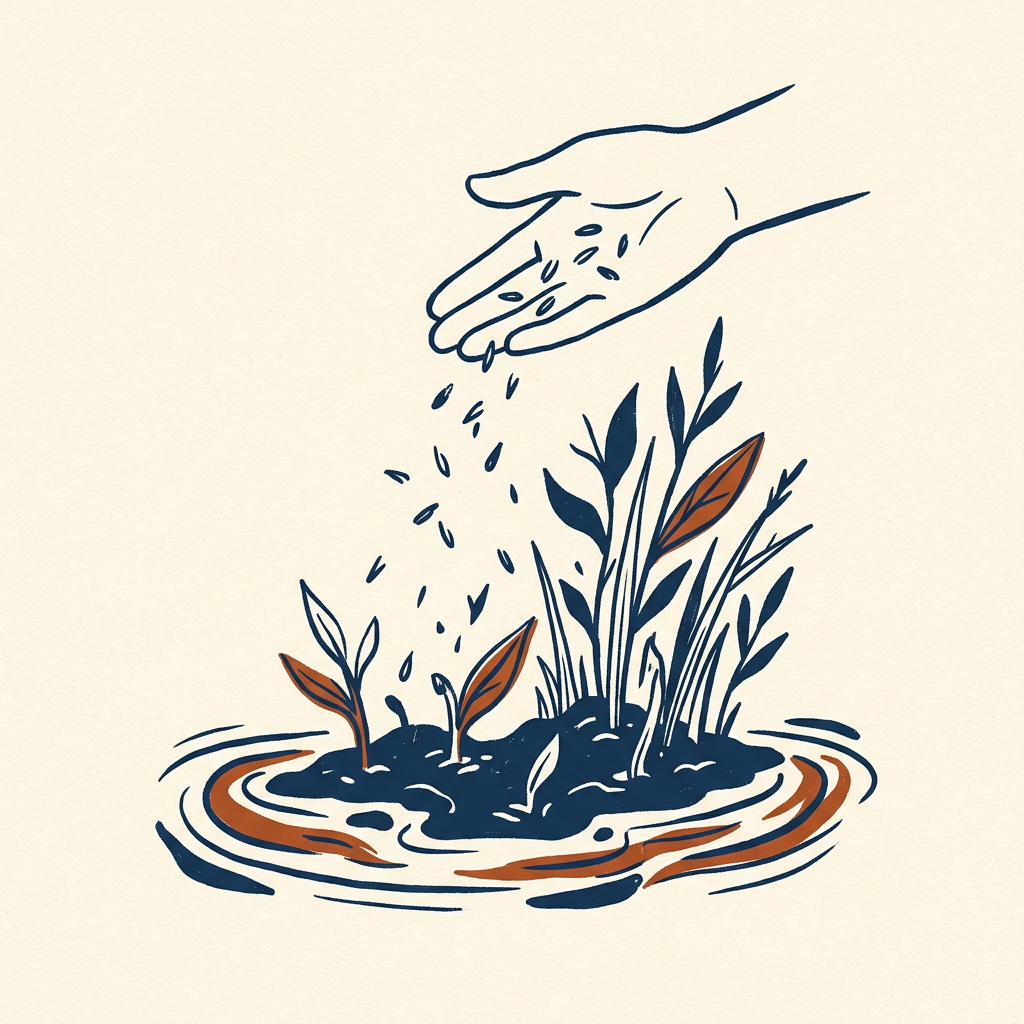
Kimmerer sets two creation stories side by side. In the Haudenosaunee and Anishinaabe telling, a woman falls from the sky world onto water-covered earth; animals dive up mud so she can land, and she scatters seeds carried from the sky, dancing gratitude into the ground until plants grow.
In the Genesis story more familiar to many Western readers, a woman is blamed for loss and humans are expelled into scarcity and toil, told to have dominion. Kimmerer's aim is not theological one-upmanship. She treats origin stories as instructions that tell a people what the world owes them and what they owe the world.
A story that begins with animals helping a stranger who repays them with seeds and dance sets up reciprocal exchange. A story that begins with expulsion and dominion sets up ownership and extraction. She traces that split into practice: land as a partner to thank versus land as property to use up.
She does not claim to prove myth causes behavior. She offers the pairing as a frame the rest of the book tests against real plants, harvests, and damaged ground. Later chapters keep returning to one question: are we guests receiving a gift, or owners collecting a due.
In practice: Skywoman scatters seeds in thanks after animals bring mud; the Genesis frame sends humans out to exercise dominion over a world of toil.
2
Words that make kin
The grammar of a language shapes ecological perception, so Potawatomi's verb-based animacy toward bays, hills, and berries produces kinship where English's noun grammar produces property.
Language becomes her next carrier of worldview. In Potawatomi, a dying language she works to relearn as an adult, many things English treats as nouns are verbs. A bay is not a static object but an ongoing action performed by water, shore, and season together.
The same grammatical move applies to hills, fires, and Saturdays. English, she argues, is overwhelmingly a language of nouns, and that grammar quietly teaches speakers to treat rivers, mountains, and animals as inert things rather than beings doing something in the world.
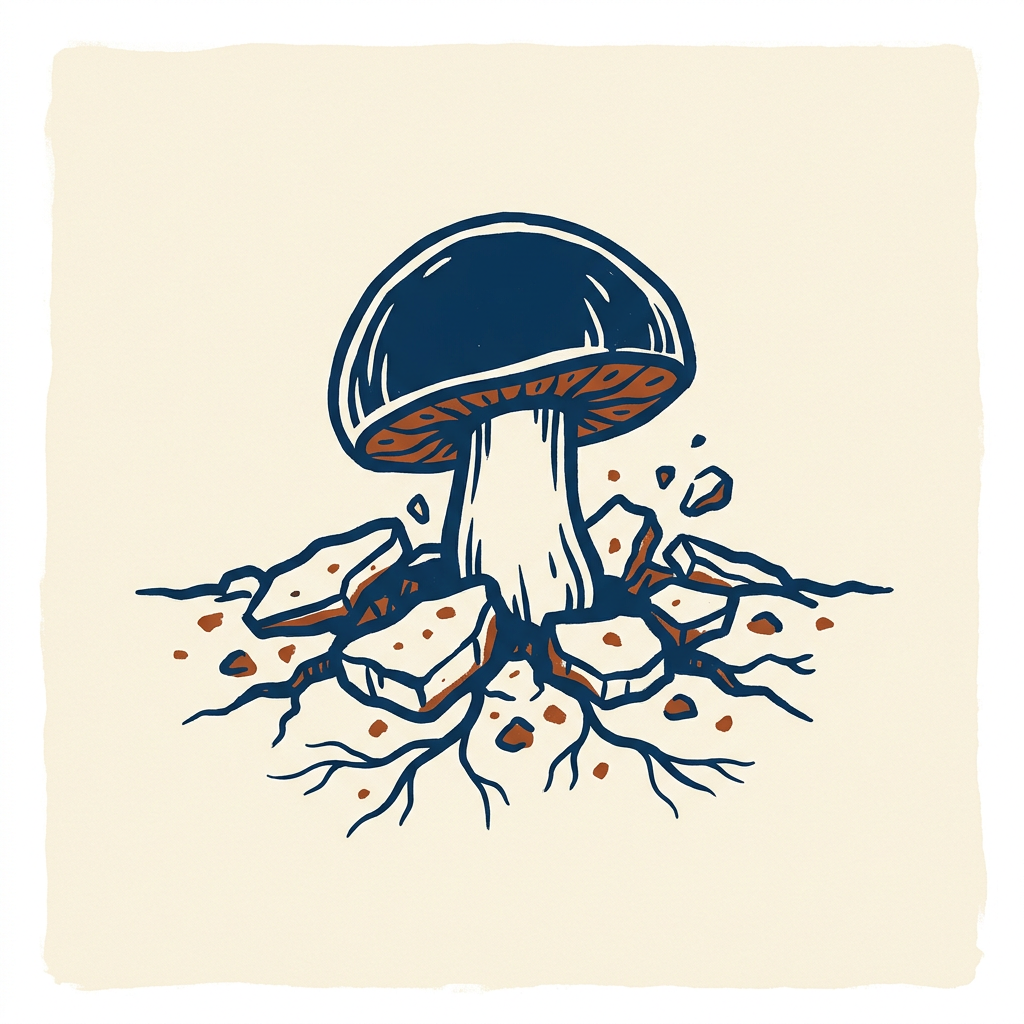
She points to puhpowee, an Anishinaabe term her botany training had no equivalent for: the force that causes a mushroom to push up through the ground overnight. English science could describe mycelium chemistry but had no single word for the animating force, because its grammar does not expect the ground to hold that kind of agency.
She is not asking readers to learn Potawatomi. She wants them to notice that the words on hand shape what they can even think to notice, and that a grammar of animacy is available as an alternative to a grammar of objects.
In practice: Puhpowee names the force that pushes a mushroom up overnight—a single word her scientific English could not match.
3
The strawberry obligation
Treating the natural world as a gift rather than a commodity changes behavior toward it, because gifts create ongoing gratitude and obligation that purchases end.
Commodity berry
Money ends the deal; neither side owes anything afterward.
Gift berry
Receiving starts a debt of thanks that calls for tending, restraint, or return.
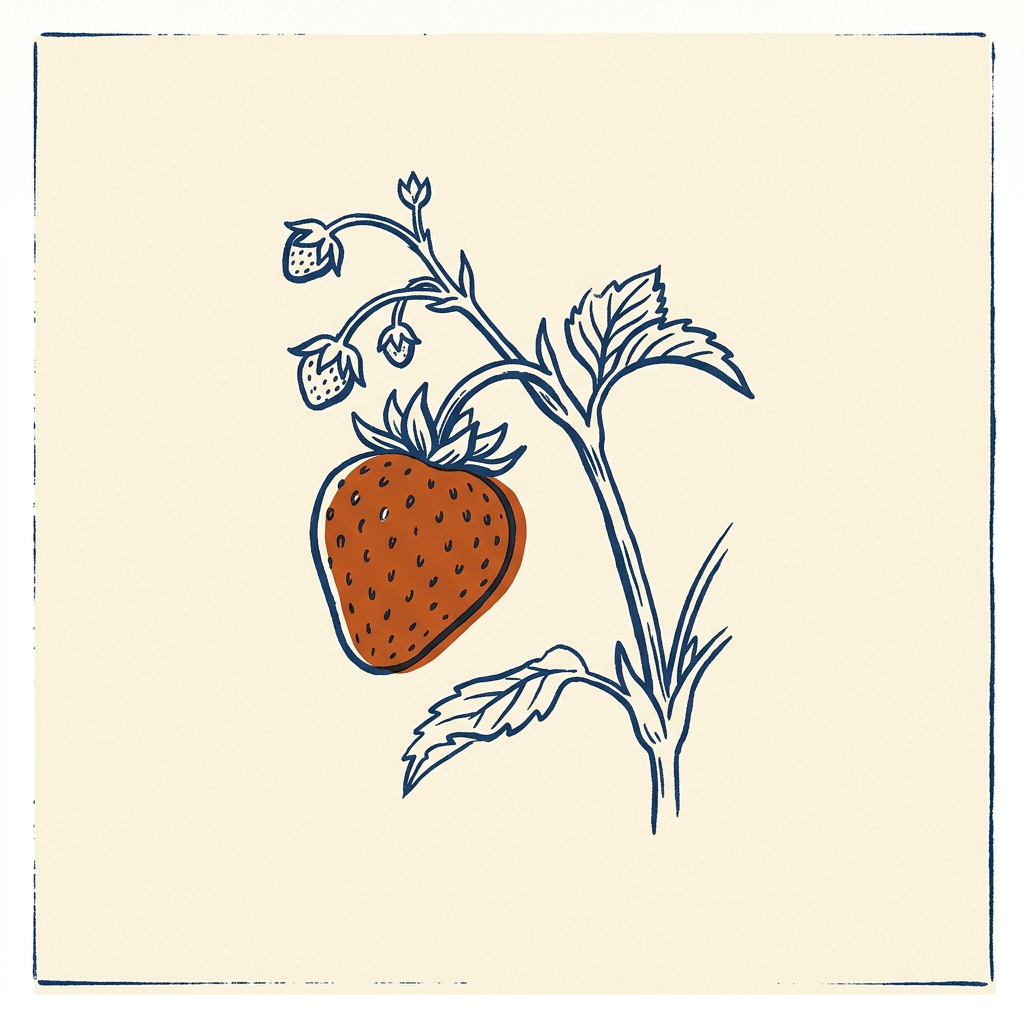
Wild strawberries, appearing unbidden each June, carry the economic argument. Kimmerer holds that a gift differs from a commodity not in its physical stuff but in the social relationship it creates.
Buying a strawberry at a supermarket ends the transaction the moment money changes hands; no obligation remains. Receiving a strawberry as a gift from the earth creates an ongoing debt of gratitude that calls for a return—tending the patch, planting more, or simply not taking more than needed.
She recalls being taught as a child to leave the first berries found for the plant and for other creatures, a small ritual that trains restraint into habit rather than leaving it to willpower alone. She extends the logic outward: a society organized entirely around commodity exchange has no built-in mechanism for gratitude or reciprocity, because the deal is designed to be complete and forgettable.
A gift economy, by contrast, keeps circulating obligation and care. She is careful not to claim gift economies can simply replace markets at industrial scale; the standard is normative and personal first. The rest of the book measures practices against it: does this way of taking create ongoing care, or does it end when the resource is extracted.
In practice: As a child she was taught to leave the first berries for the plant and other creatures, turning restraint into habit.

4
Trees that wait together
Synchronized mast-fruiting of pecan trees shows that cooperation, not only competition, is a viable and observable survival strategy in nature.
Looking to the trees themselves, Kimmerer seeks evidence that reciprocity is not only a human ideal projected onto nature. Pecan trees across a region, sometimes hundreds of miles apart, produce bumper nut crops in the same years and lean years between—a pattern called masting.
No single tree benefits from restraining its own seed production in an off year if neighbors do not also restrain theirs, yet the synchrony holds across huge populations, likely through weather cues and possibly chemical signaling science has not fully mapped. The ecological payoff is predator satiation: in a mast year, squirrels and other eaters cannot consume every nut, so enough survive to become trees, while lean years keep predator numbers in check.
She pairs this with families in her region during the Depression who gathered pecans together in hard years, sharing labor and harvest rather than competing for scarcity. Both trees and families, she argues, show coordinated restraint and sharing outperforming individual maximizing when survival is at stake.
The chapter moves the book's claim from ethics into ecology. Reciprocity is not only a nicer way to relate to nature; it is a strategy nature itself uses. That sets up the explicit harvest code that follows.
In practice: Depression-era families in her region gathered pecans together, sharing labor and harvest instead of competing over a scarce crop.
5
Rules for taking
Sustainable use requires an explicit, teachable code of restraint rather than general reverence, and Three Sisters companion planting shows such codes can be agronomically strong.
Values still need operational rules to survive real hunger and real markets. Kimmerer lays out the Honorable Harvest, practices passed across many Indigenous nations: ask permission before taking, listen for a signal that permission is granted, take only what you need, never take more than half of what is available, use everything you take, minimize waste, and give a gift of reciprocity in return—tending the population or offering thanks.
These are not vague sentiments but rules a community can teach children and enforce socially, which is why she treats them as a technology of sustainability rather than a mood.
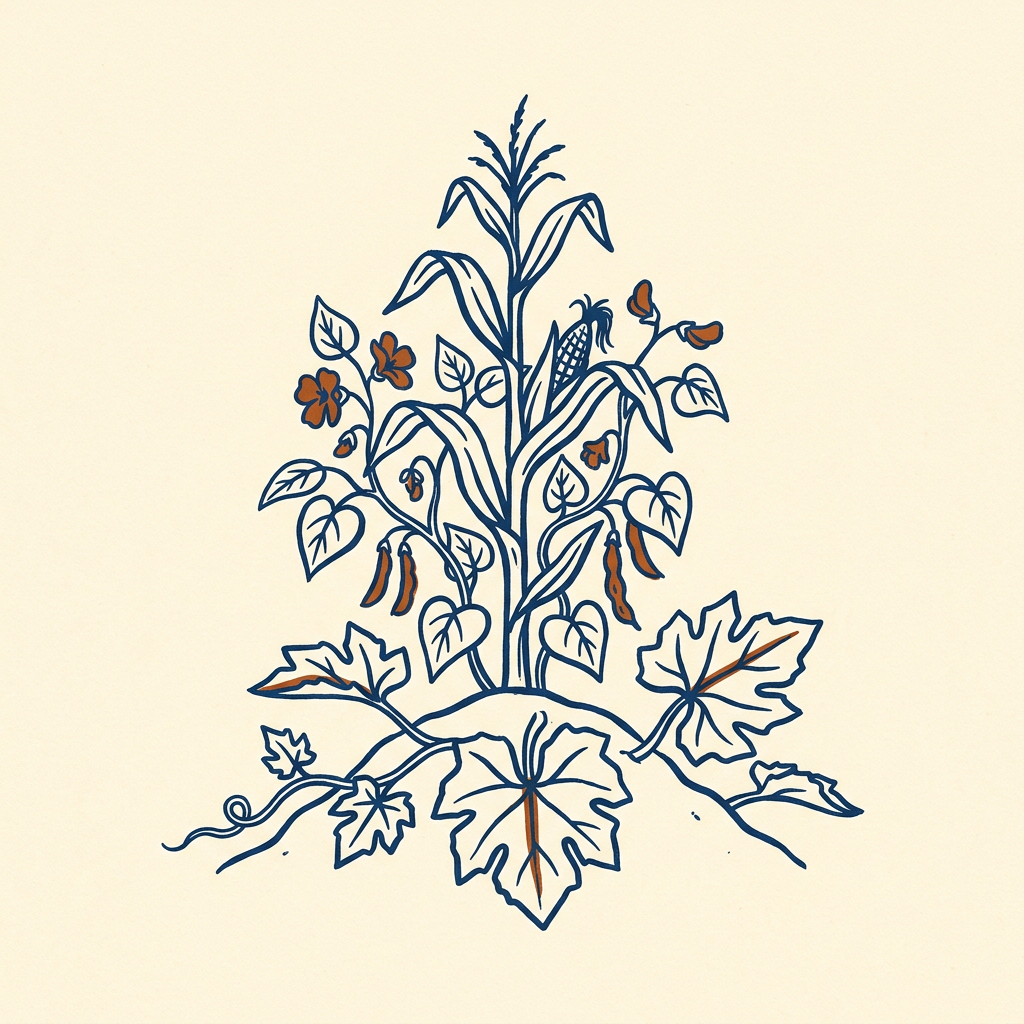
She pairs the code with the Three Sisters garden of corn, beans, and squash grown together, a practice found across many Indigenous farming traditions in the Americas. Corn offers a stalk for beans to climb; beans fix nitrogen that feeds heavy-feeding corn and squash; squash's broad leaves shade ground, suppress weeds, and hold moisture.
Agronomic study, she notes, confirms the mutual benefit is real: soil nitrogen levels and yields in polyculture compare favorably to monoculture corn under many conditions. The system was arrived at through generations of observation organized around plants helping each other, not maximizing a single crop. Codified restraint plus companion design, not goodwill alone, is what makes long-term harvest sustainable.
In practice: Corn, beans, and squash grown together feed and shelter each other—stalk, nitrogen, shade, and moisture in one planting.
6
The hunger that grows
The Windigo myth of the insatiable cannibal monster names unlimited consumer growth as a recognized pathology rather than a natural or inevitable economic default.
Default story
Unlimited growth is natural, inevitable, and the ordinary aim of an economy.
Windigo diagnosis
Hunger that grows with every meal is a recognized sickness once named and feared.
Naming the opposite comes after the positive account of reciprocity. The Windigo, from Anishinaabe and related traditions, is a monster born of a human who turned to cannibalism in extremity and whose hunger only grows the more it eats, so it can never be satisfied.
Traditionally the figure named the terror of starvation-driven violence in hard winters, and stories about it worked as a warning system to contain a real danger before it consumed a community. Kimmerer repurposes it as a diagnosis of consumer capitalism: a system whose defining feature is that growth must continue indefinitely, that having more never resolves the appetite for more, is structurally identical to the Windigo's curse.
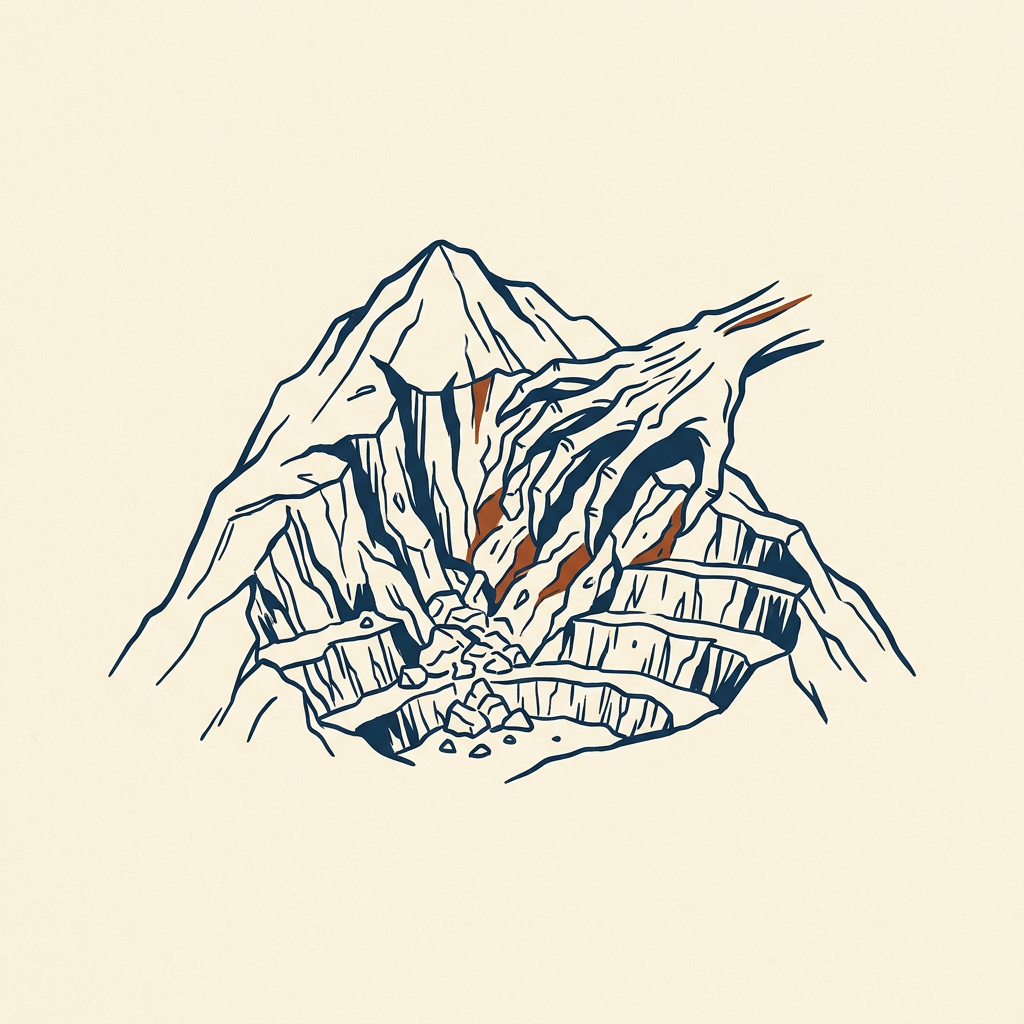
She points to strip-mined mountains, monocultured land, and disposable consumer goods as visible footprints of the same pathological logic at industrial scale. Naming the pattern as a sickness, with inherited vocabulary, does something neutral economic language does not: it makes clear that unlimited consumption is not the natural default of human behavior but a specific, traditionally feared failure mode.
Earlier chapters on gift economies and honorable harvest then read as inoculations against a known danger, not only pleasant alternatives. The Windigo chapter is the hinge where description of Indigenous practice turns into explicit criticism of the dominant economic order.
In practice: Strip-mined mountains, monocultured fields, and disposable goods stand as industrial-scale footprints of the same never-satisfied hunger.
7
Two-eyed seeing
Indigenous traditional knowledge and Western empirical science are not rivals but complementary strands that, braided together, produce better ecological understanding than either alone.
Her own double training makes the method plain. Trained as a research botanist, she has alternated scientific explanation and inherited teaching without treating them as opposed; here she states the case directly.
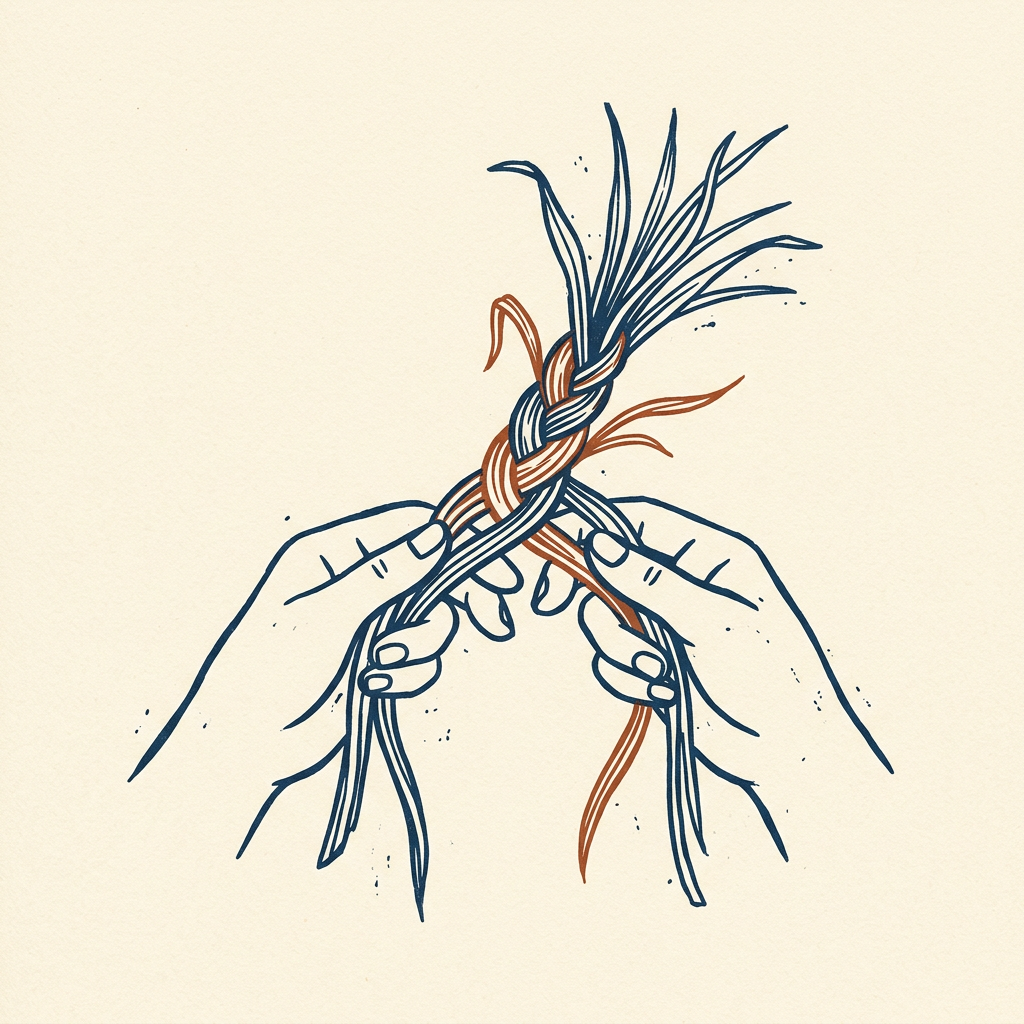
She recounts guiding a graduate student's research that tested a traditional claim: harvesting sweetgrass under Honorable Harvest rules—taking only some of a stand and leaving the rest—actually causes stronger regrowth than leaving it completely unharvested. That ran against a conservation instinct that untouched nature is always healthiest.
The field experiment compared harvested and unharvested plots and found harvested plots did show stronger regrowth, plausibly because removing some shoots reduces self-shading and stimulates the plant, much like pruning. Kimmerer is careful that this is one study on one species, not a universal law, yet she treats it as proof of concept: traditional practices can encode real ecological mechanisms formal science has not yet tested, and experiment can validate, refine, or correct traditional claims rather than dismiss them.
She calls the stance two-eyed seeing, borrowing the term from Mi'kmaw elder Albert Marshall—seeing through the strengths of both Indigenous and scientific ways of knowing without collapsing one into the other. Earlier material on animacy and harvest rules then reads not as poetry added onto science but as a parallel research tradition worth taking seriously on evidentiary terms.
In practice: A graduate student's plots showed sweetgrass harvested with restraint regrowing more vigorously than stands left untouched.
8
Belonging through repair
Anyone, regardless of ancestry, can become indigenous to a place through sustained reciprocal labor restoring damaged land; belonging is earned through care rather than granted only by birth.
Preservation
Protect untouched land chiefly by keeping people out.
Restoration
Enter damaged ground—plant willow, return natives, watch water for years.
Settler-descended readers get a direct invitation. The book has centered Indigenous practice as ecological wisdom largely inaccessible by birthright; here Kimmerer turns to what those readers can actually do.
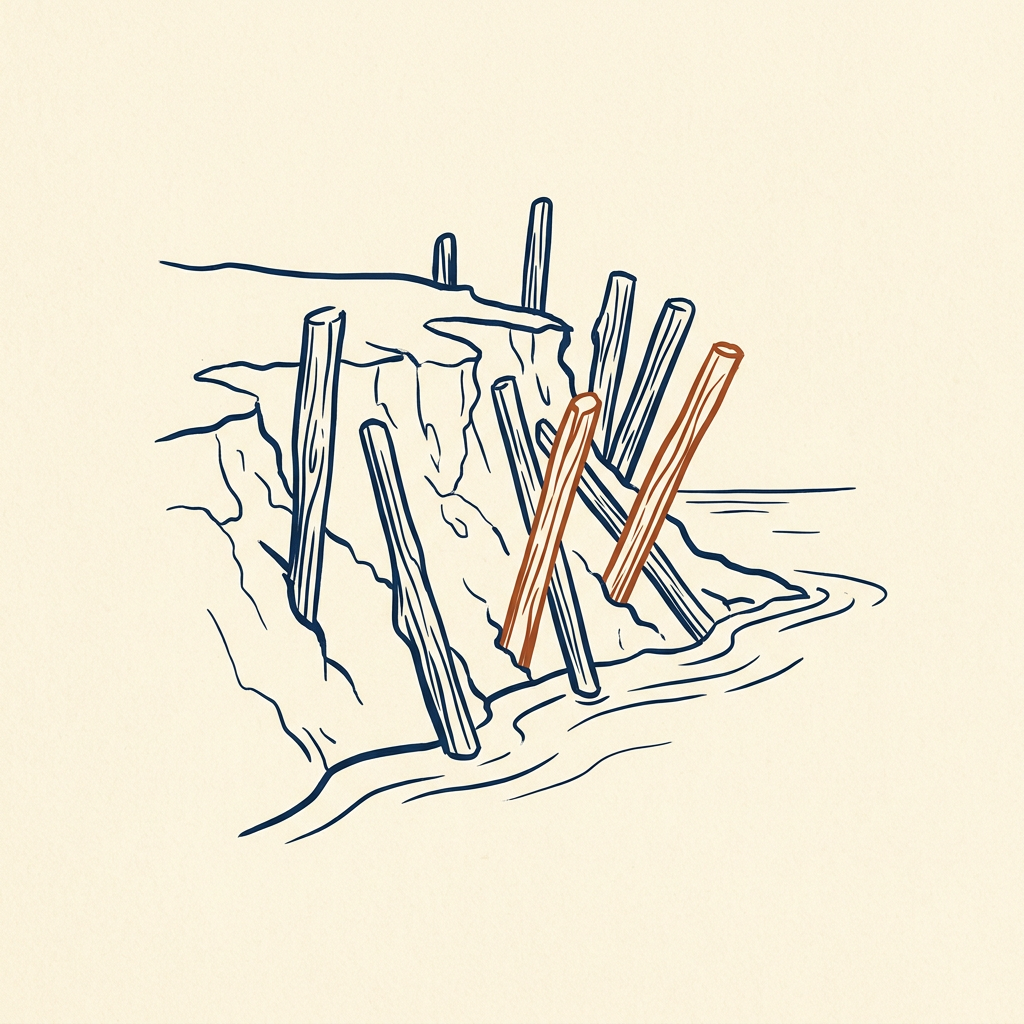
She argues restoration ecology—the active healing of degraded land such as former mine sites, polluted waterways, or exhausted farmland—is available to anyone as a path toward the reciprocal relationship the rest of the book describes. She distinguishes restoration from mere preservation. Preservation protects untouched land mainly by keeping humans out; restoration requires hands in damaged ground: planting willow along eroded banks, reintroducing natives crowded out by invasives, monitoring water quality over years.
She describes reclaiming a polluted industrial site into a functioning wetland, work done by scientists and volunteers with no ancestral claim to that specific land but with sustained commitment to its recovery. Indigeneity in the relational sense the book builds is not solely ancestry; it can be earned by showing up for a place over time, tending it, and being changed by it.
This does not erase specific historical and legal claims of Indigenous nations to their homelands, which remain a separate political matter. It does offer settler readers a concrete practice rather than only an admiring outside view of someone else's tradition.
In practice: Scientists and volunteers with no ancestral claim reclaimed a polluted industrial site into a functioning wetland through sustained work.
9
Gratitude that restructures
Gratitude, practiced consistently rather than felt occasionally, becomes the seed of a different political economy built on reciprocity instead of extraction.
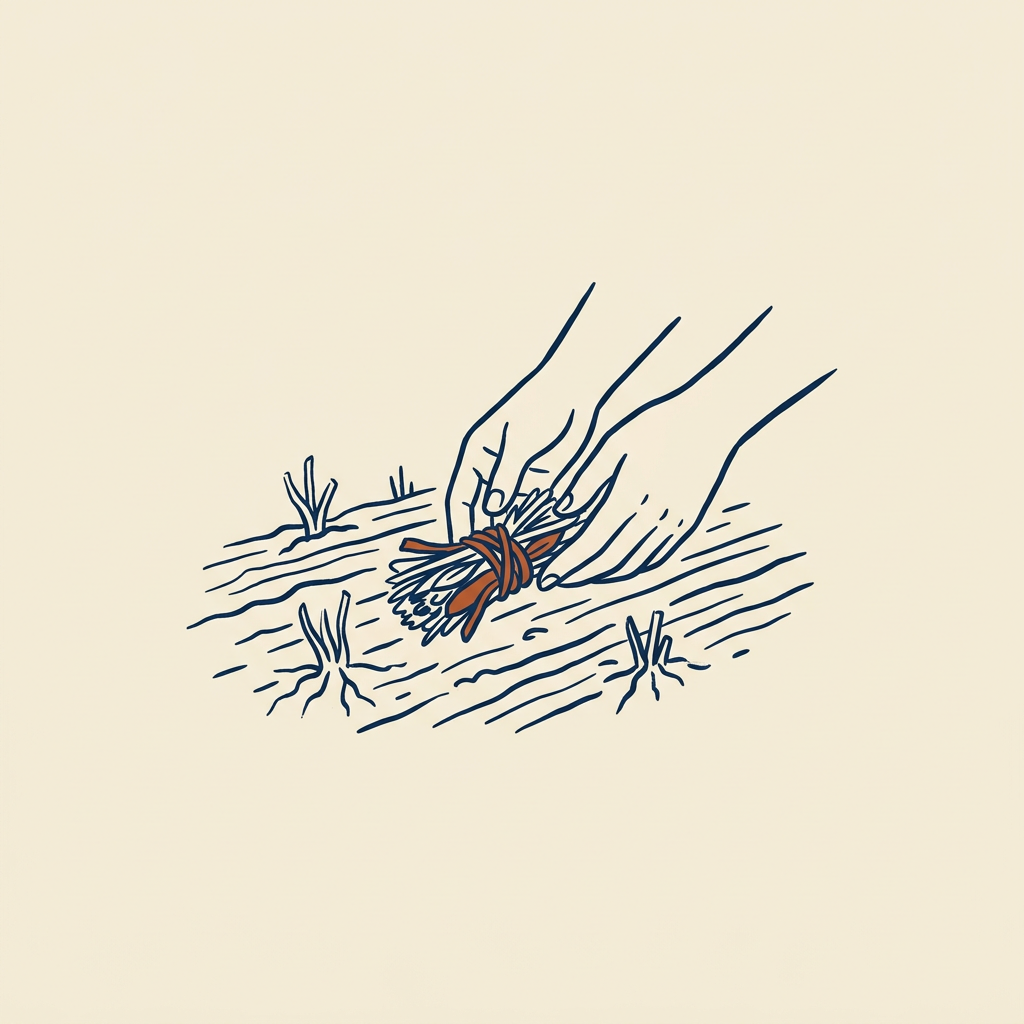
The closing move draws the threads into one practical claim. Skywoman, animacy, strawberries, the Honorable Harvest, the Windigo warning, and restoration work have all pointed the same way: gratitude is not a private feeling to visit occasionally but a discipline that, practiced steadily, restructures how a person or society behaves economically.
Kimmerer describes humans, in ecological terms, as one of the newest and in some ways least mature species on earth, still learning to live well among older forms of life—an image from Indigenous teaching that positions humans as younger siblings rather than masters of creation. Being a good younger sibling means attending to what older species and older knowledge systems have already learned, and returning something for what is received rather than only consuming it.
She is explicit this is not a call to return to a pre-industrial past, which is neither possible nor, for most people, desirable. It is a call to build modern institutions—a university, a farm, a household—around reciprocal obligation rather than one-way extraction.
The final chapters resist a tidy policy program, a real limit of the book. The closing argument is that changing the underlying orientation from taking to exchanging is the necessary first step any specific policy would have to rest on.
In practice: She pictures humans as younger siblings among older forms of life, still learning to return something for what they receive.
Key terms
- grammar of animacy Speech that treats bays, hills, berries, and other beings as verbs in action rather than inert nouns and objects.
- gift economy Exchange that creates ongoing gratitude and obligation instead of ending when payment finishes the deal.
- Honorable Harvest A teachable code: ask permission, take only what you need, never more than half, use it all, cut waste, and give something back.
- masting When trees across a wide region bear bumper nut crops in the same years and lean crops in the years between.
- predator satiation A mast-year effect in which so many seeds fall that eaters cannot finish them, leaving some to grow.
- Three Sisters Corn, beans, and squash grown together so stalk, nitrogen, shade, and moisture support the whole planting.
- Windigo A cannibal monster whose hunger grows the more it eats; used here to name unlimited consumer growth as a sickness.
- two-eyed seeing Holding Indigenous and scientific ways of knowing by their strengths without collapsing one into the other.
What to do
- Pick one plant, animal, or piece of land near you and observe it on a fixed weekly schedule for a season before taking from it or judging it.
- Before you next harvest, buy, or use something from the natural world, ask whether you are taking only what you need and what you can give back.
- Name gratitude out loud for one thing you receive from the living world instead of letting the thanks stay silent.
- Find one degraded place within reach—a vacant lot, polluted creek edge, or depleted bed—and do actual restoration labor on it this month.
- Leave the first part of a wild harvest for the plant and other creatures rather than taking the whole find.
Questions to think with
- Does your default story of the land cast you as guest receiving a gift or as owner collecting a due?
- Where in a normal week does a purchase end the relationship, and where could a return gift begin one?
- What would Honorable Harvest rules change about how you garden, shop, or walk a trail?
- Can sustained restoration labor where you live stand in for belonging you were not born into?
- Where does Windigo logic—hunger that grows with every meal—show up in your own appetite for more?
The other side
The book persuades through narrative and metaphor more than systematic evidence, so a single graduate sweetgrass study on one species in one region is easy to over-generalize. It also risks the flattened “Ecological Indian” portrait Shepard Krech criticized—understating historical variation, depletion, and conflict among Indigenous nations—even though Kimmerer’s own tradition is handled with more care. It names colonialism and dispossession but stops short of land rights, treaty enforcement, or land-back as concrete politics, which can leave settler readers with a comforting disposition and little accountability to living political claims. The gift-economy model is never tested against feeding and housing eight billion people, so reciprocity may remain a personal ethic inside an industrial economy the book does not seriously propose to replace.
Who it's for
Gardeners and naturalists who want a scientific eye paired with wonder; readers drawn to Indigenous knowledge presented by a practicing scientist rather than a tourist; and anyone questioning consumer culture who wants an alternative built from stories rather than slogans.