



Carney defends Erdoğan trade pact amid Turkey rights crackdown
By The Conservative Desk (/journals/conservative-desk)
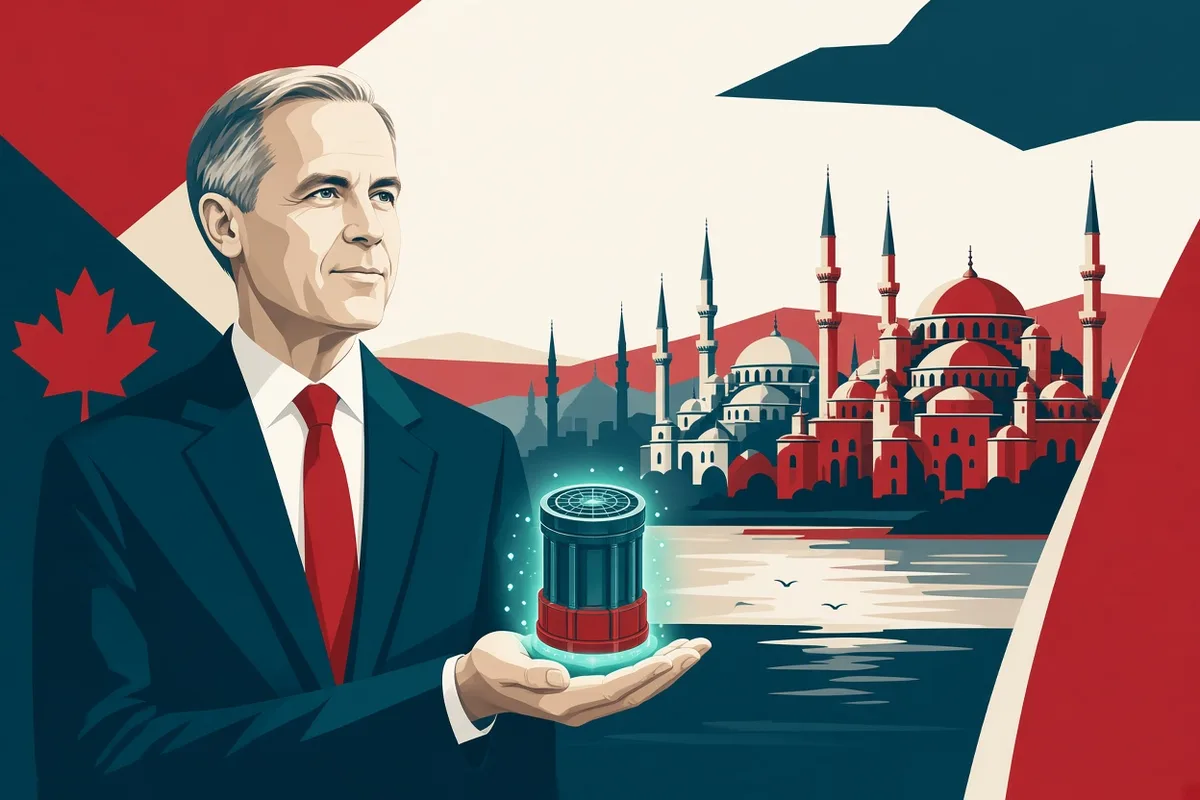
Prime Minister Mark Carney stood before reporters in Istanbul on Friday and reduced the argument to four words. “Engagement is not approval.”
The line closed the first bilateral visit to Turkey by a Canadian prime minister. Over three days, Carney and President Recep Tayyip Erdoğan moved from a signing ceremony in Ankara to business meetings on the Bosphorus, wrapping a strategic partnership around energy, defense and trade and putting Canadian exporters in the room with Turkish capital.
On Thursday in Ankara the two leaders signed a three-year action plan. Erdoğan said, “We are now starting a new era between Türkiye and Canada.” Current bilateral trade sits at $3 billion a year. The Turkish president wants that figure at $10 billion, with a short-term target of $5 billion. Negotiations toward a Canada-Turkey free-trade deal are expected to begin in November.
Nuclear power sat at the center of the commercial pitch. Turkey plans to add 20 gigawatts of nuclear capacity by 2050. Canada wants to sell AtkinsRéalis CANDU reactors into that build-out. On Friday, AtkinsRéalis chief executive Ian Edwards announced a feasibility study for a potential new CANDU build at Sinop, a Turkish port city. Carney told reporters the chances of a sale, very low a year ago, are now good. That is a concrete stake for a Canadian engineering firm and for the taxpayers who have carried a nuclear sector that needs foreign orders to stay alive.
The Istanbul schedule matched the ambition. Carney held private meetings with Sabanci Holding and Calik Holding, then with Baykar, the military drone maker, and Aselsan, the arms manufacturer. Defense cooperation with a formal NATO partner is not a side errand. “Turkey is a formal partner of Canada in NATO and one of the most important geostrategic countries, not just in this region but in this world. So we need to engage, and we do engage,” Carney said. For a government trying to widen Canada’s options beyond a strained relationship with the United States, a market of tens of millions at the hinge of Europe and Asia is the kind of partner free enterprise actually uses.
Sovereignty, in the sense Carney invoked it, runs through export contracts and alliance management, not press-conference sentiment. “Part of the way we discharge that is to be a truly sovereign nation. Part of the way we become a truly sovereign nation and reinforce our sovereignty is to have a broad range of partnerships around the world,” he said. Canadian workers who build reactors, mine critical minerals, or ship liquefied gas do not clock in on the basis of another capital’s domestic politics. They clock in when Ottawa opens doors and keeps them open.
The rights record traveled with the delegation anyway. Freedom House scores Turkey 32 out of 100 on its civil liberties index and rates the country “not free.” Turkish authorities have recently taken over a pro-opposition media outlet, raided LGBTQ groups, and convicted a stand-up comic of insulting the president. Critics argue that closer ties risk legitimizing Erdoğan’s government amid those conditions and the country’s treatment of LGBTQ people. Carney’s government has also pursued deeper ties with Saudi Arabia, another state whose human-rights record is sharply disputed. The pattern is commercial first.
Carney did not claim Turkey mirrors Canada. “There are very few countries in this world that have the standards of Canada, the rights of Canada, the conviction of Canada, the constant reinforcement of those rights, so that all Canadians can live their lives as they choose,” he said. He put the domestic duty ahead of foreign lecture. “Our first and foremost job is protecting, not just protecting LGBTQI rights and two-spirited rights in Canada, but promoting those rights and ensuring that all Canadians can live their full selves in Canada. So first and foremost, that’s our responsibility.”
Asked whether the Ankara meeting legitimized Erdoğan and his actions, Carney said, “No.” Breitbart framed the week without softening: “Mark Carney Insists Bringing Canada Closer to Islamist, Anti-LGBTQA2+ Turkey Fits ‘Values-Based Realism’.” The progressive vocabulary of rights at home sat directly beside outreach to a government that has been silencing opposition media and raiding the communities named in the prime minister’s own remarks. Foreign Affairs Minister Anita Anand raised human rights issues with her Turkish counterpart on Thursday. Carney said his government raised LGBTQ rights during the visit and declined to build a public case file out of the exchanges.
A conservative reading does not require naivete about the counterpart. A NATO flag does not cancel a 32-out-of-100 civil-liberties score, and private sessions with drone and arms manufacturers are facts on the calendar, not atmospherics. Engagement can serve Canadian industry and still carry a cost in the appearance of endorsement while opposition voices inside Turkey absorb pressure. The rule of law that limited government is supposed to defend at home is harder to reconcile with partners who jail comics for insulting the president. The honest position is that trade, nuclear exports, and alliance management are national interests, and that a signing ceremony does not rewrite the other government’s habits.
What it does rewrite is Canada’s order book if the CANDU path and the November trade talks produce contracts. Diversifying away from over-concentration on a single large neighbor is a sovereignty argument older than any one ministry’s branding. The taxpayer who funds nuclear expertise, and the firm that has to sell it, gain nothing from a foreign policy that confuses moral performance with leverage. They gain when a prime minister treats a NATO ally as a market and a strategic hinge and measures success in gigawatts and shipment volumes.
The same trip produced a separate collision with Washington. The U.S. Embassy in Ottawa released a fact sheet on Thursday accusing Canadian leaders of election meddling ahead of the Nov. 3 U.S. midterms. Carney pushed back, rejecting the charge while he was still on Turkish soil. The episode supplied its own reason for Ottawa’s hunt for additional partners. Whether Turkey is the right weight on the other side of the scale is the question the action plan and the Sinop study do not close.
The sequence the record does close is simpler. The partnership was signed. Trade targets were named. A Canadian nuclear feasibility study was announced. Rights concerns were acknowledged in general terms and kept out of the transcript. When reporters pressed Carney on whether he personally challenged Erdoğan over the crackdown, he would not be pinned down.
“I find those conversations are more effective when they’re direct and open and not then reported out in detail.”