



Hayek warns central planning erodes freedom and rule of law
In 60 seconds
- Hayek warns that comprehensive central planning, however well-meant, destroys individual freedom and the rule of law and slides societies toward totalitarian control.
- Markets coordinate millions of private plans through prices; no board can gather the same scattered, shifting local knowledge.
- Legislatures can pass general rules, but a full plan multiplies zero-sum specifics until power drifts to unelected experts.
- Whoever controls jobs, materials, and wages controls the practical means to speak, dissent, travel, or live unconventionally.
- A basic safety net can fit a market order; guaranteeing each fixed job or relative position freezes adaptation and choice.
- Holding one plan together favors ruthless enforcers and requires control of opinion as well as resources.
The big idea
Hayek contends that economic planning and political freedom are not separate domains: control over production and distribution is control over every practical goal people pursue. Comprehensive planning needs discretionary, case-by-case allocation that breaks the rule of law, hollows democracy, elevates unscrupulous leaders, and finally demands propaganda to hide favoritism and failure.
The book in brief
Hayek opens on a wartime observation. Intellectuals across parties treated central planning as the mature next stage after liberal markets. He frames that drift as abandonment of the institutions—secure property, free contract, government bound by general law—that had coincided with Europe’s rise in welfare and liberty. He dedicates the work to socialists of all parties, targeting a shared habit of mind rather than one faction.
He splits freedom into two senses. Classical liberty means freedom from coercion. The socialist promise means freedom from want and insecurity. Collapsing them into one utopia fails, he argues, because guaranteeing outcomes requires someone to assign jobs, wages, and shares in advance. That assignment is itself coercion. Wartime rationing already replaced voluntary exchange with administrative permission; extending the logic to peacetime multiplies every point where choice vanishes.
The middle stretch builds the mechanism. Markets are not chaos but decentralized coordination: prices transmit scarcity and preference without any center knowing the whole. Democracy thrives on general rules a legislature can debate. A comprehensive plan multiplies specific, zero-sum decisions until gridlock pushes power onto insulated experts. The rule of law—fixed general rules known ahead—cannot survive that discretion. Officials weighing who gets steel or which town gets a factory exercise arbitrary power, not blind application of law.
From there he tightens the political stakes. In a market, money and property act as a general license for any legal purpose. Under sole state allocation, a critic can be silenced by denial of livelihood or materials without a censorship statute. Once priorities are set by plan, economic life becomes a personalized struggle over who captures the apparatus. Absolute security for particular jobs freezes the reallocation markets need; limited minimum security need not. He presses a contested historical claim that German National Socialism absorbed earlier collectivist, anti-market habits of mind. Leadership under a single enforced plan favors those willing to suppress dissent and manufacture common enemies. Sustaining the plan finally requires controlling education, press, and statistics so that truth serves legitimacy.
He lands on a structural warning, not a story about malice. The tools of full planning carry a logic that erodes institutional limits on power. Whether that path is inevitable or only a serious risk is the fight the book still leaves open.
Context
Written during World War II by an Austrian economist living in Britain, the book addressed Western intellectuals who admired Soviet-style planning. It became a foundational text of postwar classical liberalism and later influenced Thatcher- and Reagan-era politics.
The key ideas

1
The abandoned liberal road
The 1930s–40s turn to planning abandoned the liberal institutions that had raised European freedom and living standards, rather than progressing beyond them.
Liberal institutions
Secure property, free contract, government bound by general law
Planning habit of mind
Central direction treated as the mature, rational next stage
Hayek treats the generation debating wartime planning as one that had forgotten the hardship preceding nineteenth-century liberal order. Secure property, freedom of contract, and government bound by general law were imperfect, yet they coincided with an unprecedented rise in material welfare and personal liberty across Europe.
By the 1930s, intellectuals across the spectrum treated planning as the inevitable next stage—a rational correction to market chaos. He aims not at one party but at a habit of mind shared by moderate reformers and revolutionaries: the belief that conscious central direction is simply more rational than impersonal price coordination.
His own observation of interwar Germany and Austria supplies the opening stake. Heavy state direction of the economy preceded, and in his view helped enable, totalitarian rule. Freedom is lost less through malice than through the slow surrender of institutional limits on power in exchange for promised efficiency and fairness.
In practice: Hayek watched heavy state economic direction in interwar Germany and Austria come before totalitarian rule and treated that sequence as a warning, not a coincidence.

2
Two meanings of freedom
Socialism’s promise of freedom from want cannot be delivered without destroying the older freedom to choose one’s own economic path.
Classical freedom
Freedom from external coercion; choose your own path
Planned freedom
Freedom from want; outcomes assigned in advance
Hayek distinguishes freedom from external coercion—the classical sense—from freedom from the compulsion of circumstance, the sense planners invoke when they promise liberation from poverty, insecurity, and market pressure. The utopian appeal rests on collapsing the two, as if one plan could deliver both.
He insists that is impossible. Guaranteeing outcomes for everyone requires someone to decide in advance who gets which job, wage, and share of goods. That power is coercion exercised by whoever controls the plan, not by impersonal exchange.
Modern societies are too complex and morally diverse for a single uncontested common good to exist before the plan. Someone’s preferences must be chosen over others’. That act of choosing is exactly the loss of freedom the utopia claims to prevent.
In practice: Wartime rationing and allocation boards turned goods once obtained by voluntary exchange into goods distributed only by administrative permission.
3
Prices versus the planning board
The real choice is not planning versus chaos but decentralized coordination through prices versus a small group deciding for everyone.
Price system
Scattered signals prompt substitution across unrelated industries
Planning board
Conscious investigation and mandates, slower and cruder
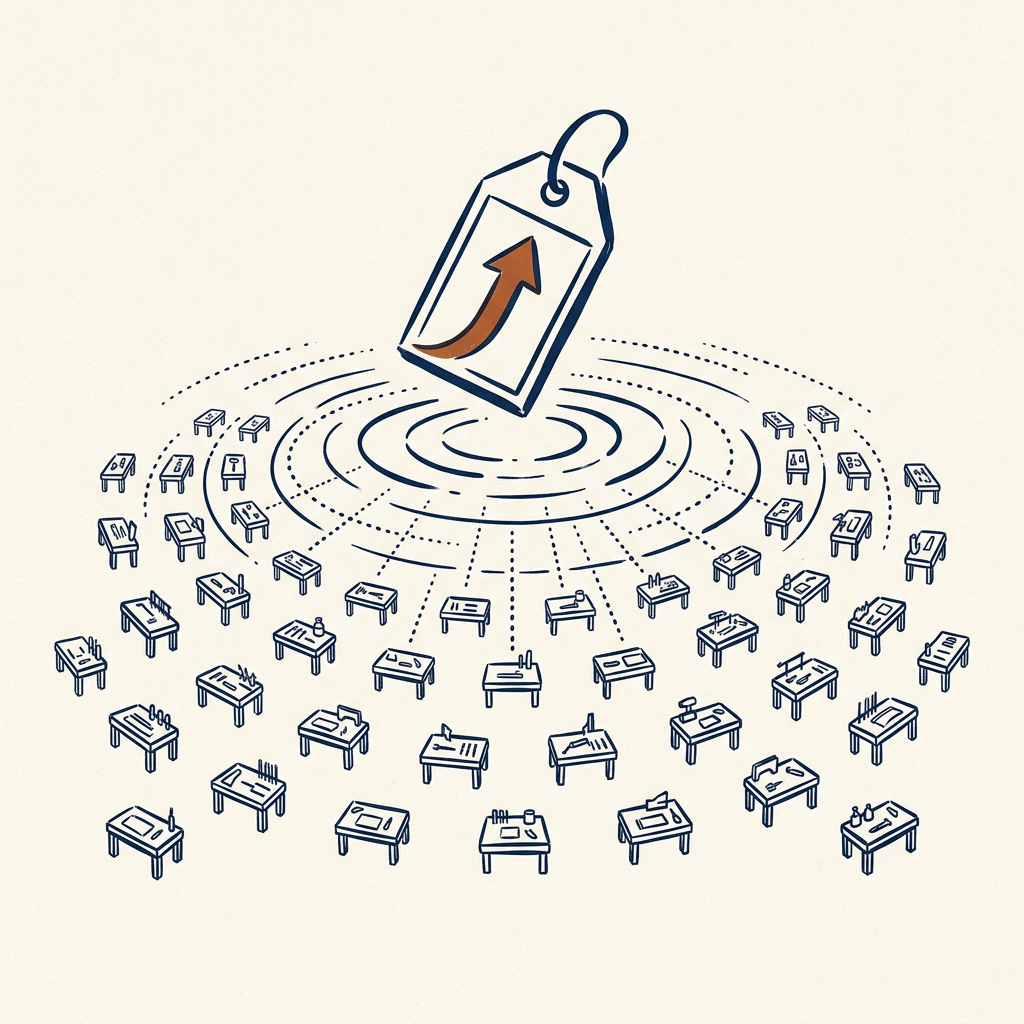
Hayek rejects the framing that markets are the absence of planning while socialism is its presence. Markets are a coordinating mechanism: prices transmit scattered information about scarcity, preference, and opportunity so millions can adjust private plans without any center knowing the whole.
Central planning concentrates decisions about production and distribution in one body that must substitute its judgment for everyone else’s. The practical problem is not only that planners may be unwise. No single body can gather and process the volume of localized, constantly shifting information a price system aggregates automatically.
Individualism, in his usage, does not mean selfishness. It means a social order that respects individuals’ local knowledge and judgment instead of subordinating it to a central design. Every later claim rests on this: to work at all, planning must override the mechanism that makes decentralized economies adaptive.
In practice: A tin shortage in a market triggers price signals that prompt substitution and conservation across thousands of unrelated industries; a board must investigate, decide, and mandate responses industry by industry.

4
Planning shrinks democracy
Comprehensive planning is incompatible with sustained democratic control because no legislature can agree on the detailed tradeoffs a full plan requires.
Democratic bodies can agree on general rules—a tax rate, a minimum wage, a safety standard—because such rules leave individuals room to apply them to their own circumstances. A comprehensive plan for the whole economy must answer far more specific questions: which factory expands, whose wage rises, which region gets investment.
As planning grows more comprehensive, those specific decisions multiply, and so does disagreement among elected representatives, since each decision favors some groups and hurts others. Faced with gridlock, governments delegate discretionary power to technical experts or planning boards insulated from ordinary scrutiny, on the theory that only specialists can make the detailed calls.
Democracy may survive formally through elections while the terrain of decisions actually open to contest steadily shrinks. The public lacks the information or channels to reverse particular allocations that shape daily life.
In practice: Wartime Britain’s emergency powers and planning agencies already allocated materials and labor with limited debate—a pattern Hayek warned could harden under postwar reconstruction.

5
Discretion versus the rule of law
The rule of law—general rules known in advance and applied equally—cannot coexist with comprehensive planning, which needs case-by-case judgment about who receives what.
Rule of law
Fixed general rules known ahead; applied without regard to person
Planning discretion
Case-by-case awards of steel, sites, wages to named claimants
Hayek’s touchstone for a free society is government constrained by fixed, general rules announced beforehand. Individuals can then predict how the state will act and plan their own affairs, regardless of who holds office. Ordinary commercial law fits: it states the conditions under which contracts bind without knowing in advance who will use them.
Central planning cannot operate that way. Deciding how much steel a factory receives, which town gets a new industry, or what wage an occupation deserves requires weighing specific persons and circumstances. That is inherently discretionary rather than general.
Once officials make substantive allocative choices, they acquire arbitrary power resembling older privilege—deciding outcomes for named individuals rather than applying rules blindly. Pushing the problem to higher target-setters only relocates the same discretion. When such choices become routine across the economy, the predictability the rule of law exists to secure disappears in substance even if legal forms remain.
In practice: Raw-material allocation boards must choose among competing claimants with no impartial rule able to resolve the conflict, because the conflict is over resources too scarce to satisfy every claim.

6
Economic control is political control
Economic and political freedom cannot be cleanly separated, because whoever controls production and distribution controls the practical ability to pursue any goal.
A common defense held that the state could run the economy while leaving personal and political freedoms untouched. Hayek treats this as a category error. In a market economy, money and property function as a general license: income can support a newspaper, a campaign, travel, education, or an unconventional life without anyone approving that particular purpose.
Once the state is sole employer, sole allocator of materials, and sole arbiter of prices and wages, it decides not only how much a person receives but effectively what purposes that person can pursue. Every purpose needs material means the state now controls.
Political rights on paper mean little if the same state that must respect them also controls every material condition of exercising them. The danger is structural, not a matter of which party happens to hold power.
In practice: A dissenting scholar under a planned economy can be silenced without a censorship law—simply by denial of an independent employer, paper, premises, or funds.

7
Who decides becomes everything
Once planning replaces price-driven allocation, the decisive question becomes who benefits and who decides, turning economic life into a struggle for the planning apparatus.
Under markets, outcomes—which industries grow or shrink, who profits—are the depersonalized result of countless transactions. No single actor is responsible for any individual’s disappointment, which softens the felt injustice of loss.
Comprehensive planning cannot replicate that depersonalization. A single plan must set explicit priorities, and any priority list favors certain regions, industries, or groups over others. Resources are finite; choices among uses are zero-sum. There is no national plan that treats every claimant equally.
Political life then reorganizes around capturing the apparatus itself. Interest groups compete less to produce and trade better than to influence whoever holds allocation power, since that influence now determines fortunes more directly than market performance. Planning does not eliminate conflict over resources; it concentrates and personalizes it.
In practice: Agricultural subsidy and quota fights of Hayek’s era already played out as contests between organized farm blocs and other groups—a preview of the wider pattern under full planning.

8
Limited security, not absolute
Planning cannot deliver full economic security without cost to freedom, because guaranteeing fixed positions requires freezing the flexibility markets use to adapt.
Limited security
Minimum standard and common-risk insurance; markets still adjust
Absolute security
Fixed job, wage, relative place; entry and exit blocked
Hayek separates two kinds of security. Limited security—a guaranteed minimum standard, insurance against illness or old age—he explicitly treats as compatible with a market economy. He is not arguing against a basic safety net.
Absolute security—guaranteeing each person’s particular job, wage, or relative position against change—is different, and this is what many planning schemes implicitly promise. Delivering it means blocking new competitors, forbidding contraction of declining sectors, and fixing wages independent of shifting demand.
The cost is lost capacity to reallocate labor and capital toward new opportunities, because any such move disturbs someone’s guaranteed place. The public is often offered security as if it were free, when it is purchased by sacrificing the flexibility and risk-taking that generate future prosperity—and by limiting individuals’ freedom to change their own circumstances.
In practice: In a declining-demand industry, markets let wages and employment fall so workers retrain or move; a job guarantee forces indefinite subsidy or protection, locking structure in place and diverting resources from better uses.

9
Why the worst rise
Totalitarian systems elevate ruthless leaders because imposing one plan on a diverse population requires suppressing dissent and sacrificing some groups—tasks for which moral restraint is a liability.
Leadership selection under a fully planned, single-party system follows a logic distinct from ordinary political competition. A comprehensive plan cannot satisfy every group. Maintaining it requires overriding objections, punishing resistance, and justifying sacrifices imposed on some for the supposed whole.
People willing to carry out those tasks without hesitation rise faster than those constrained by scruples about fairness or rights. The system rewards decisive enforcement over moral deliberation. Building mass support for one unifying plan also favors leaders who can manufacture a simple common enemy or destiny, since genuine intellectual consensus on complex tradeoffs is unattainable while shared hatred or myth is easier to sustain.
Hayek treats this filtering as structural, not an accident of who seized power in any one year. Pluralism and disagreement, normal in democratic societies, become obstacles a planned society must actively suppress to function.
In practice: Roles in the Nazi apparatus that suppressed opponents and persecuted minorities attracted people selected for obedience and willingness to act against conscience—a filter built into enforcing one plan on a divided population.

10
Truth becomes an instrument
Sustaining a comprehensive plan requires control of opinion, because open debate would expose failures and favoritism and turn truth-seeking into propaganda.
Hayek argues that propaganda under totalitarian planning is not an unfortunate byproduct of dictatorship but a structural necessity of the planning project. A single plan cannot satisfy every interest. Honest public accounting of costs and failures would undermine support. The state therefore has strong reason to control education, the press, and discourse to manufacture the appearance of consensus and success.
Truth is redefined in practice as whatever statement currently serves the plan’s legitimacy, rather than a claim tested against independent evidence. Rewriting statistics, suppressing unfavorable findings, and reshaping historical narrative in Nazi Germany and the Soviet Union illustrate the process. He treats them as predictable consequences of subordinating universities and media to one official purpose, not incidental abuses.
He extends the warning to wartime Britain: even democratic governments under comprehensive economic mobilization had begun suppressing unfavorable information and discouraging dissent for unified morale—a habit he feared could harden once planning became permanent peacetime policy. Surrendering decentralized price coordination risks surrendering the decentralized, adversarial pursuit of truth that independent science and journalism need.
In practice: Hayek cites rewritten economic statistics, suppressed scientific findings, and reshaped historical narratives in both Nazi Germany and the Soviet Union as instances of truth subordinated to the plan.
Key terms
- Rule of law Government limited to fixed, general rules announced in advance and applied equally, so people can predict state action and plan their own lives.
- Central planning Concentrating decisions about production, labor, and distribution in one authority that substitutes its judgment for millions of private plans.
- Price mechanism Decentralized coordination in which prices transmit scattered facts about scarcity and preference so individuals can adjust without a center knowing the whole.
- Freedom from coercion The classical sense of liberty: not being forced by others; the opposite of administrative assignment of one’s path.
- Freedom from want The socialist sense of liberty: release from poverty, insecurity, and market pressure through guaranteed outcomes.
- Limited security A guaranteed minimum standard and insurance against common risks; Hayek treats this as compatible with markets.
- Absolute security A guarantee of each person’s particular job, wage, or relative position against change; requires freezing adaptation.
- Discretionary power Officials deciding case by case who gets what, rather than applying known general rules blindly.
- Who, whom Hayek’s shorthand for the personalized struggle over who benefits and who decides once a plan replaces depersonalized markets.
What to do
- Ask whether each new program sets a general rule applied equally or grants officials case-by-case power to pick winners and losers.
- Before backing a policy sold as security, name whose flexibility to change jobs, prices, or plans it must restrict to deliver the guarantee.
- In any organization you help run, mark which high-stakes decisions follow known public rules and which rest on unaccountable discretion, then push toward the former.
Questions to think with
- Where does a general safety rule end and discretionary allocation begin in the policies you already support?
- Once the state is sole employer and allocator, what keeps economic control from deciding who may speak, publish, or live unconventionally?
- Is the security on offer limited minimum protection, or a freeze of particular jobs and relative positions?
- If a single plan cannot please every group, what stops politics from becoming a fight to capture the planners?
- How much of the warning depends on full replacement of prices, and how much still applies inside a mixed economy?
The other side
Hayek’s strongest claims land against comprehensive Soviet-style planning that replaces the price mechanism entirely; they weaken when stretched to any state economic action. He explicitly allows a basic safety net, health and unemployment insurance, and regulation of working conditions, yet the book’s momentum and later reception treated it as a blanket brief against the welfare state—a reading he later tried to correct without fully escaping it. The slippery-slope claim rests mainly on logical inference about planning’s internal needs rather than systematic historical comparison. Postwar Britain nationalized major industries and built the National Health Service without producing Gestapo rule; Sweden’s expansive welfare state has coexisted with democratic institutions for decades. The chapter tracing Nazi roots to socialist and collectivist intellectual traditions draws the sharpest scholarly fire: historians argue fascism’s core energies came from nationalism, militarism, and violent anti-Marxist reaction, and that Hayek’s lineage is selective in service of his thesis. Read as a warning about the internal tendencies of comprehensive planning, the book stays sharp; read as a predictive law about any expansion of the state, it claims more than its evidence supports.
Who it's for
Readers who want the classical liberal case against comprehensive planning stated at full strength, policy-minded people weighing security programs against individual discretion, and students of twentieth-century political thought tracing how economic and political freedom become entangled.