



Mlodinow book argues chance outweighs skill in many outcomes

In 60 seconds
- Human intuition fails at probability because minds evolved to invent causal stories rather than compute odds.
- Right answers demand disciplined counting of outcomes, which people botch on dice, coincidences, and the Monty Hall door switch that doubles winning odds from one third to two thirds.
- A 99 percent accurate test for a one-in-ten-thousand disease still leaves most positives as false alarms once base rates are counted.
- Basketball hot hands, fund streaks, and studio hits often match pure noise and regression to the mean rather than lasting skill.
- Success stories erase survivorship bias and the cascading chance events that separate similar hard workers.
- Judge decisions by process quality before results arrive, because randomness routinely rewards bad choices and punishes good ones.
The big idea
Mlodinow argues that chance shapes human affairs far more than we admit, while brains are wired to see patterns, skill, and intention where only luck operates. Without a feel for randomness mathematics, people keep building false causal stories that drive bad decisions in medicine, business, and everyday life.
The book in brief
The book starts from a simple failure: people treat coin-flip streaks as signals that the next side is due, and they credit Hollywood hits to proven talent when a single success is weak evidence in a high-variance business. Mlodinow uses that miscalibration to introduce the drunkard's walk itself—an unpredictable sequence of independent steps that models pollen, stocks, and many careers.
He then supplies the missing toolkit. Combinatorics shows why outcomes that look symmetrical are not equally likely, and why the Monty Hall switch works only after the sample space is recounted. Conditional probability and Bayes’s rule follow, exposing how independence and base rates are confused in medical testing and risk perception.
Those tools are applied next to performance. Shooting logs, executive promotions, and fund returns that look like skill often collapse into expected noise and regression to the mean once small samples are treated honestly.
A historical detour explains why the math feels alien: rigorous probability arrived late, after Cardano, Pascal, Fermat, Bernoulli, and Gauss, and it still collides with older cause-seeking instincts. Cognitive research then shows the brain’s aggressive pattern detector manufacturing structure from noise, from fabricated coin sequences to financial chart lore.
The same lens turns on individual lives. Survivorship bias and retrospective storytelling hide how cascading small chance events separate people of similar talent. The close urges calibrated humility: score the decision process before the outcome is known, accept short-run feedback as often uninformative, and stop inventing purposeful journeys from drunkard paths.
Context
Leonard Mlodinow published the book in 2008. It mattered because it translated technical probability concepts into a case against the illusion of control.
The key ideas
1
Minds reject pure chance
After five heads in a row people feel tails is due, yet each flip stays an independent fifty-fifty event—the gambler’s fallacy that shows brains demand causal stories.
Mlodinow opens with the claim that human intuition is fundamentally miscalibrated for probability. Randomness feels like an affront that must be explained away rather than accepted. This is presented as a structural feature of cognition, not a minor quirk.
The title image is the mathematical random walk: each step independent and unpredictable, used to model everything from pollen grains in water to stock prices. Many outcomes credited to skill or intention, he argues, are better treated as such walks, where any single step tells almost nothing about the underlying process.
Practical stakes appear immediately. Doctors reading tests, employers judging performance, and investors picking funds all underestimate how much of the observed record is noise. Without a feel for the mathematics, false narratives about causation keep producing costly decisions.
In practice: Studio executives green-light films on the assumption that a director’s last hit proves talent, even though one success is weak evidence amid huge variance in film outcomes.
2
Count every arrangement
Two dice make seven six different ways and two only one way, so the sums are not equally likely—yet untrained instincts systematically miscount the possibilities.
Once intuition is shown to fail, Mlodinow turns to combinatorics, the disciplined counting of outcomes. He traces the practice to Gerolamo Cardano, the sixteenth-century physician-gambler who wrote early systematic treatments of dice partly to improve his own play.
Simple dice examples reveal the trap: outcomes that look symmetrical rarely are. People still fail to enumerate correctly when estimating coincidences or judging diagnostic reliability. The same counting failure later infects medical and legal judgments.
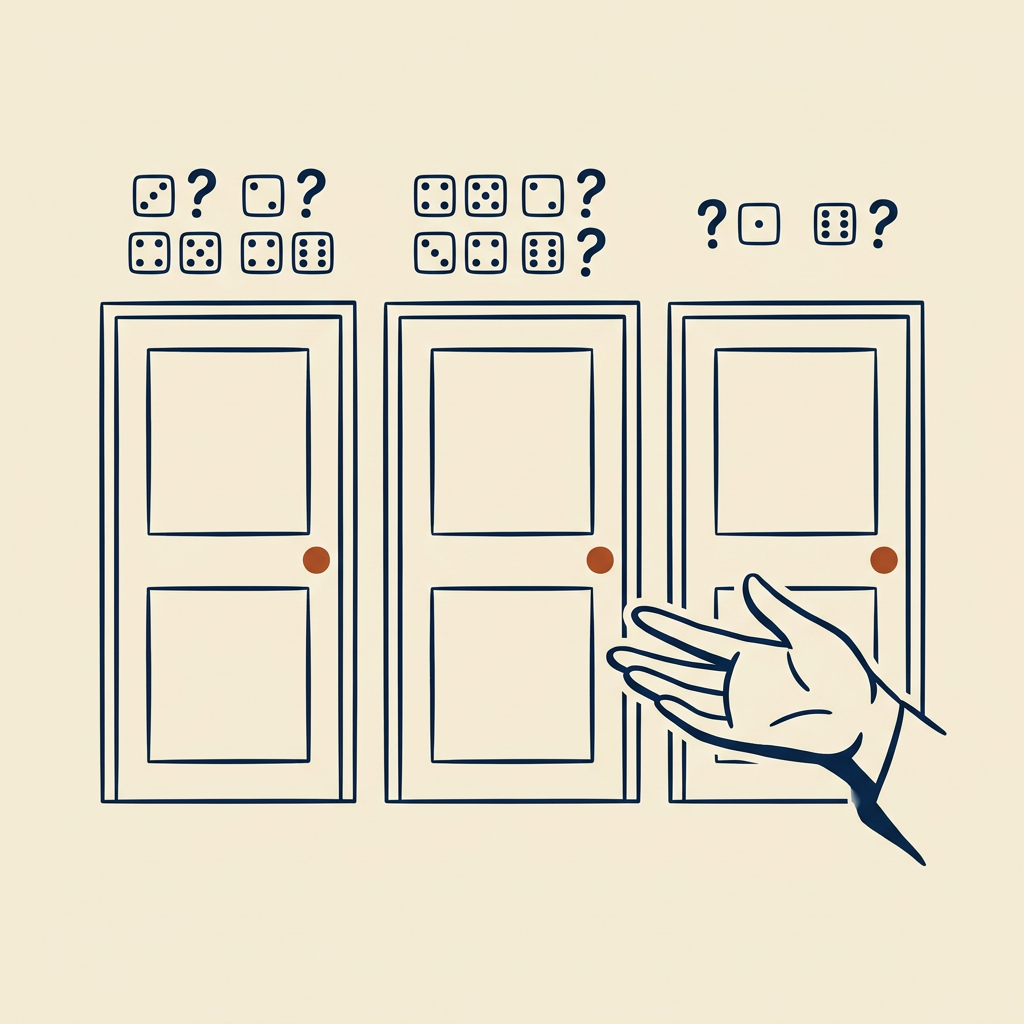
The Monty Hall problem drives the point home. A contestant picks one of three doors; the host reveals a goat behind another; switching then doubles the chance of winning from one third to two thirds. Even professional mathematicians balked when the result was publicized, because the sample space must be fully recounted after new information arrives.
In practice: Switching doors after the host reveals a goat raises winning odds from one third to two thirds, a result that contradicts the intuition that the two remaining doors are equally likely.

3
Base rates rewrite accuracy
A test that is 99 percent accurate for a disease found in only one in ten thousand people still leaves a positive result more likely false than true, because the healthy majority generates far more false alarms.
Accuracy intuition
99 percent accurate test means disease is nearly certain
Base-rate reality
One-in-ten-thousand prevalence makes false positives dominate
Mlodinow next isolates independence—the property that one event does not alter another—and the mathematics of conditional probability formalized by Thomas Bayes. Bayes’s rule updates a hypothesis only when the prior base rate is tracked correctly.
The medical-testing example is the signature illustration. Accuracy of the test is not the same as the probability of disease given a positive result. When prevalence is tiny, false positives from the large healthy pool overwhelm true positives.
Studies Mlodinow cites show many physicians reverse the probabilities and overestimate the chance that a positive means illness. The error is the same mental shortcut that produces the gambler’s fallacy: ignoring the actual dependence structure and substituting an intuitive but wrong story. Consequences reach juries weighing DNA, patients reading screening results, and public fears that track vividness instead of frequency.
In practice: Physicians given the 99-percent-accurate, one-in-ten-thousand scenario routinely overstate the probability that a positive result means the patient has the disease.

4
Streaks look like skill
Philadelphia 76ers shooting logs examined by Gilovich, Vallone, and Tversky showed makes and misses clustering no more than chance predicts, matching random binary sequences rather than momentum.
Mathematics already developed is now aimed at performance evaluation. The widespread hot-hand belief holds that several made shots raise the odds of the next one. The 76ers data supplied no supporting pattern.
Mlodinow extends the finding to studio executives and mutual-fund managers. With enough people placing enough bets, some records will look brilliant purely by chance, exactly as someone must win a large lottery. A short run of outcomes is nowhere near enough data to separate skill from luck in high-variance systems, yet firms and audiences draw the distinction anyway.
Regression to the mean supplies the companion mechanism: extreme results are partly luck-driven, so they tend to be followed by more moderate ones. A hit film’s weaker sequel or a rookie-of-the-year’s quieter second season is often this statistical pull, misread as decline or a sophomore slump.
In practice: An executive who green-lights several successful films is promoted even when the selection process is largely luck, because someone had to end up with the hot streak.
5
Probability came late
Rigorous probability theory emerged only after centuries of resistance, crystallizing in the mid-seventeenth-century Pascal–Fermat letters on how to divide stakes in an interrupted game.
Mlodinow steps back to argue that the late arrival of the field itself explains why everyday intuitions remain poor. Humanity lacked good conceptual tools for most of its history.
The line runs from Cardano’s gambling manuals through Blaise Pascal and Pierre de Fermat, prompted by the Chevalier de Méré’s question about fair division of stakes. Their solution laid groundwork for formal theory. Understanding still spread slowly because probabilistic thinking clashes with the desire for definite causes.
Jacob Bernoulli’s law of large numbers later showed why repeated trials converge on true probabilities; Carl Friedrich Gauss described the normal distribution that clusters measurement errors and many natural phenomena around an average. The history underscores that probability is a difficult intellectual achievement, not common sense in formula clothing—so ordinary decision-makers without training keep misjudging chance.
In practice: The Chevalier de Méré’s practical gambling question about interrupted games pushed Pascal and Fermat to the correspondence that founded formal probability.
6
Patterns appear in noise
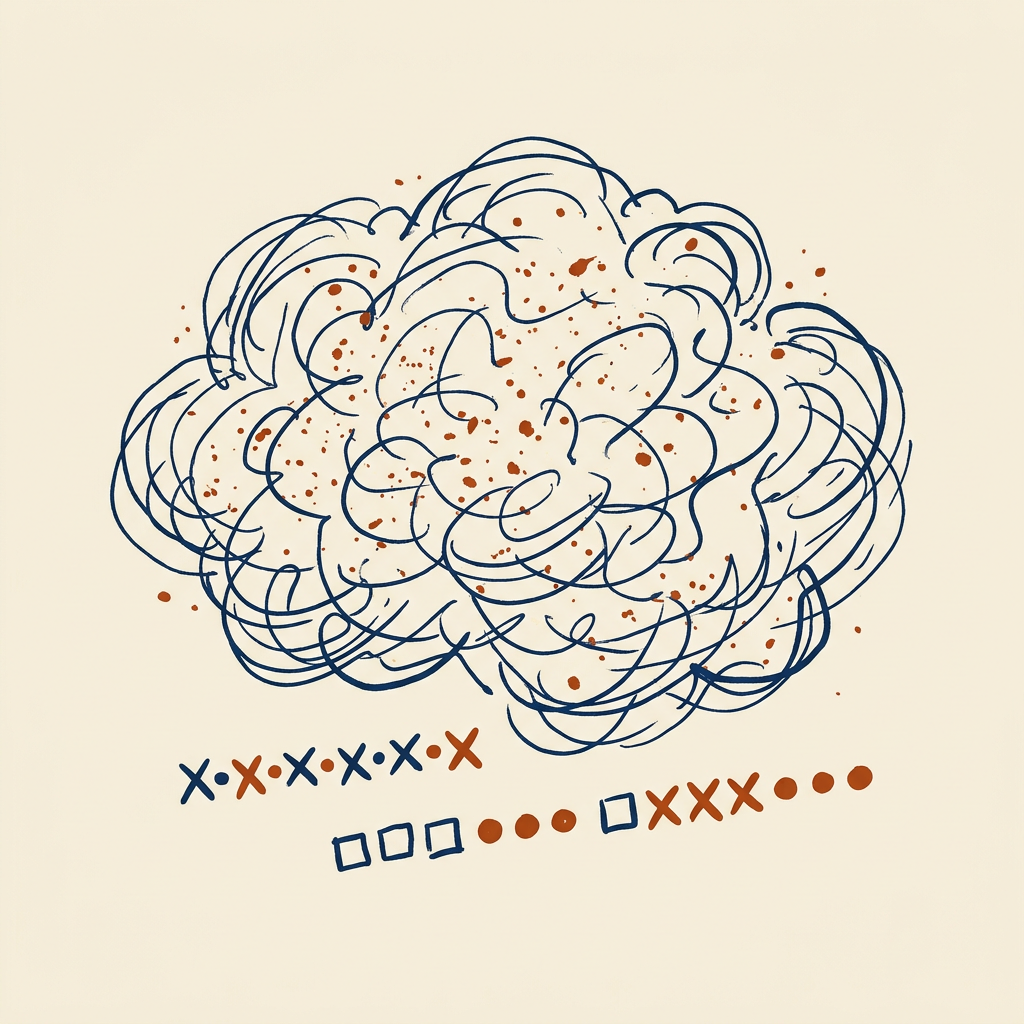
When people invent ‘random’ coin-flip strings by hand they insert too few long runs, yet they reject genuine random strings as rigged because real chance looks clumpier than expected.
Cognitive psychology now explains the persistence of the errors even after the formulas are known. Experiments associated with Daniel Kahneman and Amos Tversky show the mismatch between imagined and actual randomness.
The same low threshold for declaring signal appears in pareidolia—seeing faces in visual noise. Mlodinow ties it to evolutionary logic: missing a real predator cue was costlier than falsely detecting one, so over-detection became adaptive even though it wrecks statistical judgment.
The mechanism feeds superstition, conspiracy thinking, and financial chart reading that discovers head-and-shoulders patterns in largely random price moves. Once a pattern such as a manager’s genius is believed, confirmation bias and the halo effect keep disconfirming evidence from landing.
In practice: Analysts draw trend lines and formations on price charts that are statistically indistinguishable from random walks.

7
Lives follow random walks
Outliers in wealth and fame often arise from cascading small chance events plus survivorship bias, so the celebrated winners’ stories systematically omit the larger invisible pool who took similar risks and failed.
Everything built so far is applied to biography and careers. Movie studios, publishers, and labels reject projects that later become hits and green-light flops, despite coherent internal reasoning at the time—evidence that expert judgment in high-variance creative fields has limited predictive power.
Mlodinow draws on his own television and screenwriting years to note how chance encounters and timing repeatedly mattered alongside effort. In a long enough sequence of small random steps some paths drift dramatically upward purely by chance; those walkers then get asked for their secret.
Retrospective determinism seals the distortion: looking backward, each step of a successful life is treated as inevitable, when other equally plausible outcomes were live at every juncture. Skill and work still matter; they multiply with luck, so equally capable people finish in wildly different places.
In practice: Projects turned down by multiple studios or labels later become massive hits, while internally favored projects flop, showing the limits of predictive judgment.

8
Score process before results
Randomness can produce good outcomes from bad decisions and bad outcomes from good ones, so judging any single choice solely by its result is itself a statistical mistake.
The closing chapter gathers the threads into guidance. A gambler who wins after playing terribly should not be praised; an investor whose sound diversified approach has one poor year should not be fired. Both misjudgments remain common.
Mlodinow notes that professional fund managers rarely beat index funds consistently over long periods once luck is accounted for. The practical response is to focus on decision quality and long-run process, treat short-term feedback as often uninformative noise, and resist immediate causal stories after any win or loss.
He returns to the title image: observers who see only where the drunkard ended up invent a story about where he meant to go. Clear thinking, he argues, means recognizing when a career, market, or life is closer to that walk than to a directed journey, then lowering confidence and softening judgments of others accordingly.
In practice: An investor is fired after one bad year even though the underlying diversified strategy was sound, while a lucky but reckless win elsewhere is rewarded.
Key terms
- drunkard's walk A random path of independent, unpredictable steps that can model stocks, careers, or particles
- gambler's fallacy The pull to believe a streak makes the opposite outcome 'due' even when events stay independent
- combinatorics The disciplined counting of all possible arrangements so probabilities can be calculated correctly
- base rate The prior frequency of a condition in the population before any new test evidence arrives
- Bayes's theorem The rule for updating a hypothesis probability only after correctly combining new evidence with the base rate
- hot hand The belief that a run of successes raises the chance of the next success beyond what chance predicts
- regression to the mean The tendency for extreme results, partly driven by luck, to be followed by more ordinary ones
- survivorship bias Studying only the visible winners of a noisy process while ignoring the larger group who failed
- law of large numbers The formal reason repeated trials converge toward the true underlying probabilities
What to do
- Ask how many similar trials would be needed before treating any single sale, return, or break as proof of skill.
- Write down the decision process before the outcome is known and review that process later regardless of the result.
- Check whether a noticed streak in sales, sports, or habits falls inside the range a random process would produce.
- When admiring someone’s success, examine the base rate of success for everyone who tried the same approach.
- Separate short-run noise from long-run process when praising or blaming colleagues and managers.
Questions to think with
- In which parts of your work is a short streak most likely just noise rather than emerging skill?
- How would your last major decision look if scored only on the process you used before results arrived?
- Where do you still treat a vivid single story as stronger evidence than a base rate?
- Which success narrative in your field most clearly erases the people who followed the same steps and failed?
- What would change if you waited for a larger sample before promoting or firing on performance?
The other side
The thesis that randomness dominates is asserted more strongly than the data support once the book leaves well-studied domains such as basketball streaks and fund returns; Hollywood and biography sections rely heavily on anecdote. The argument can overcorrect by understating domains where skill is persistent and measurable, and it supplies no clear test for separating luck-dominated from skill-dominated fields. Some cited psychology findings later faced replication problems, and a purely statistical frame can obscure structural forces such as inherited advantage or discrimination that are not independent random draws.
Who it's for
Investors and managers who routinely mistake short winning streaks for durable skill, along with readers of psychology who want to see how cognitive biases distort everyday judgments about chance. General readers tired of sports announcers, critics, and pundits turning noise into destiny will also get the full corrective.