


Charlemagne's Coronation Brings Unity
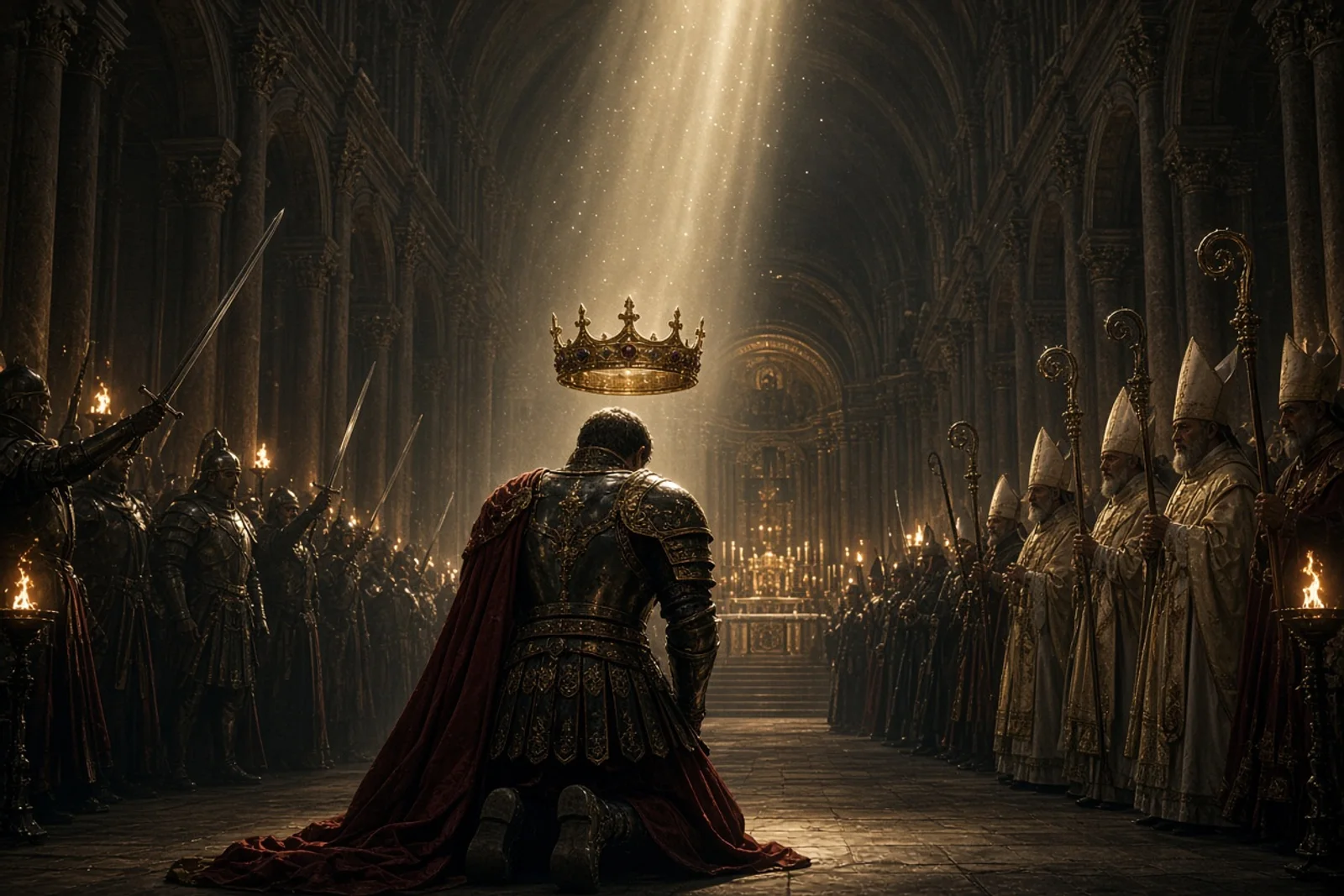
The nave stretched long under the winter light that filtered through high windows. I stood pressed among the Romans and Franks near the altar rail, the stone floor numbing my feet. Leo moved through the Mass with careful steps, his voice steady on the Latin prayers. Two days earlier the same man had placed his hand on the Gospels and sworn he had done no wrong. The words had hung in the air while Charlemagne listened from a bench a few paces away.
A draft moved through the side doors. Charlemagne knelt at the rail, head bowed, the plain circlet he wore for travel still on his hair. Leo finished the canon and turned. The deacons held the crown between them, gold catching the candle flame. Leo took it, lifted it once, and set it on Charlemagne’s head without pause. The metal settled with a small sound that carried farther than it should have in that space.
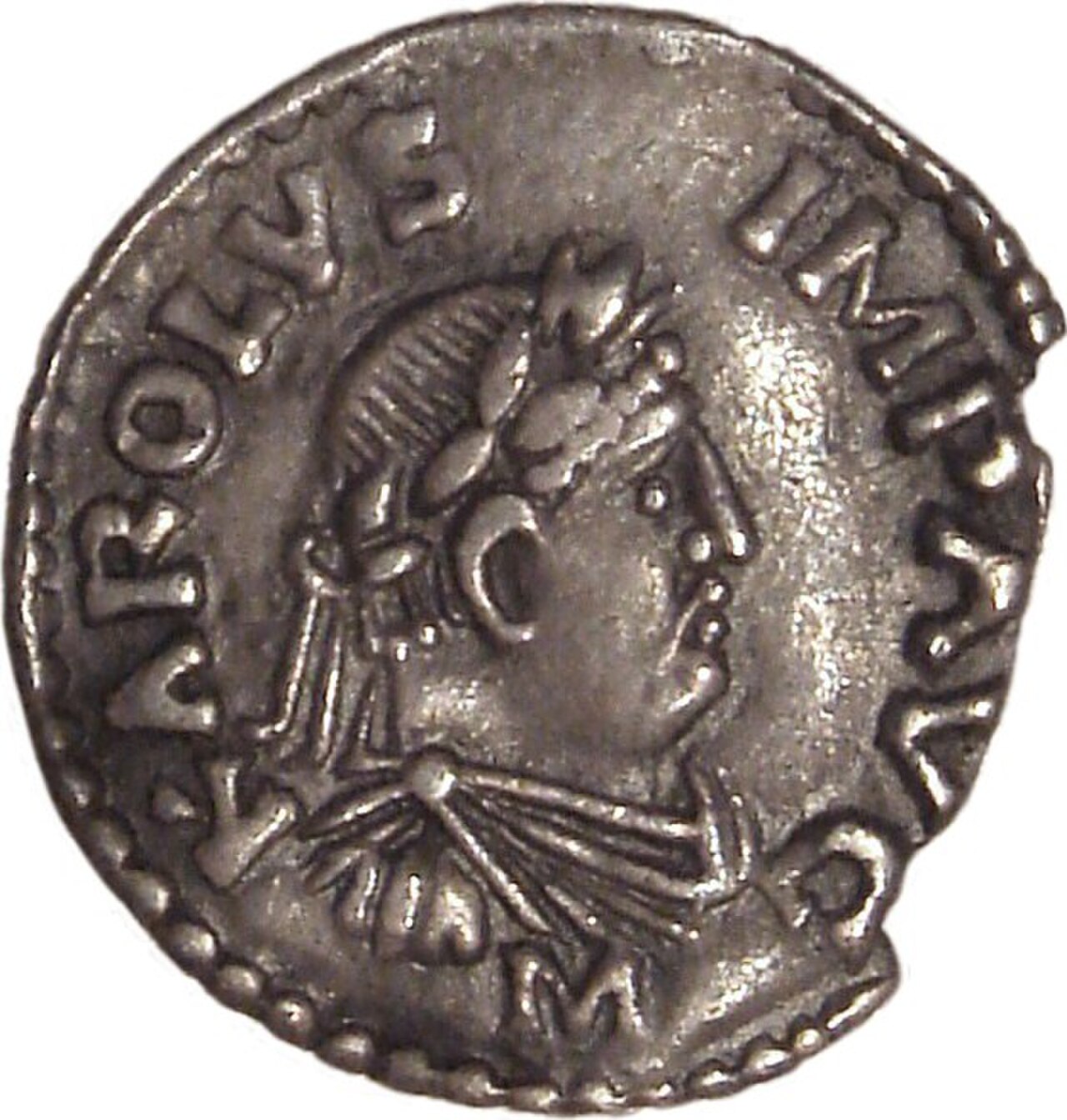
A shout rose from the front ranks. “Carolo Augusto, a Deo coronato, magno et pacifico imperatori Romanorum, vita et victoria!” The cry came again, louder, from throats that had rehearsed it. Charlemagne stayed on his knees for a moment longer than expected. When he rose the crown stayed in place. His face showed nothing that could be read from where I stood.
Outside the basilica the December air cut at the lungs. People spilled into the square, repeating the title. I heard a Frank from the royal household say the word “imperator” as though testing its weight. A Roman priest beside him answered that the old empire had slept and now woke. Neither man raised his voice above the other.
Charlemagne walked back toward the Lateran palace with the crown still on. Leo kept pace at his left. Guards cleared a path through the crowd. I followed at the edge, close enough to see the red mantle shift with each step. The metal of the crown caught the low sun and threw small flashes onto the paving stones.

That night the palace kitchens sent bread and wine to the quarters where the Frankish retinue slept. I carried a tray to one of the antechambers. Charlemagne sat with a map unrolled across a table, the crown resting on a cushion beside it. He traced the line of the Rhine with one finger and spoke to a count about winter quarters for the army. The count answered that the Saxons had submitted again. Charlemagne nodded once and moved the finger east toward the Elbe.
Leo remained in Rome through the rest of the month. He restored two small churches that had lost their roofs the year before. Each morning he walked from the Lateran to the worksite, a single attendant behind him. On one of those mornings I saw him stop at the door of St. Peter’s and look back at the place where the crown had been placed. He did not speak.

Charlemagne left for Aachen in early January. The crown traveled in a chest carried by two mules. Snow had begun to fall on the road north. I joined the rear of the column for three days before turning back at the first staging post. The last I saw of the emperor was the glint of the chest straps under a gray sky.
In the months that followed, messengers carried letters between Aachen and Rome. Leo asked for confirmation that the new title would protect the papal lands. Charlemagne answered that the title carried duties as well as rights. The exchange settled nothing new, yet both men continued to write.
By spring the Frankish court at Aachen had begun to use the imperial seal on documents that once carried only the royal one. Scribes added the phrase “Romanum imperium” to the dating clauses. The change appeared first on a grant of land to a monastery near the Meuse. Copies reached Rome by summer.

Leo’s enemies inside the city stayed quiet through that year. The oath he had sworn before the coronation kept its force. No new accusations were raised in open court. The streets around the Lateran remained orderly on market days.
Charlemagne returned to Italy only once more, in 801, to settle a dispute over the borders of the duchy of Spoleto. He wore the crown again at a meeting outside Ravenna. The Lombard nobles who attended bent the knee in the old manner. The act was recorded by a notary who traveled with the court.
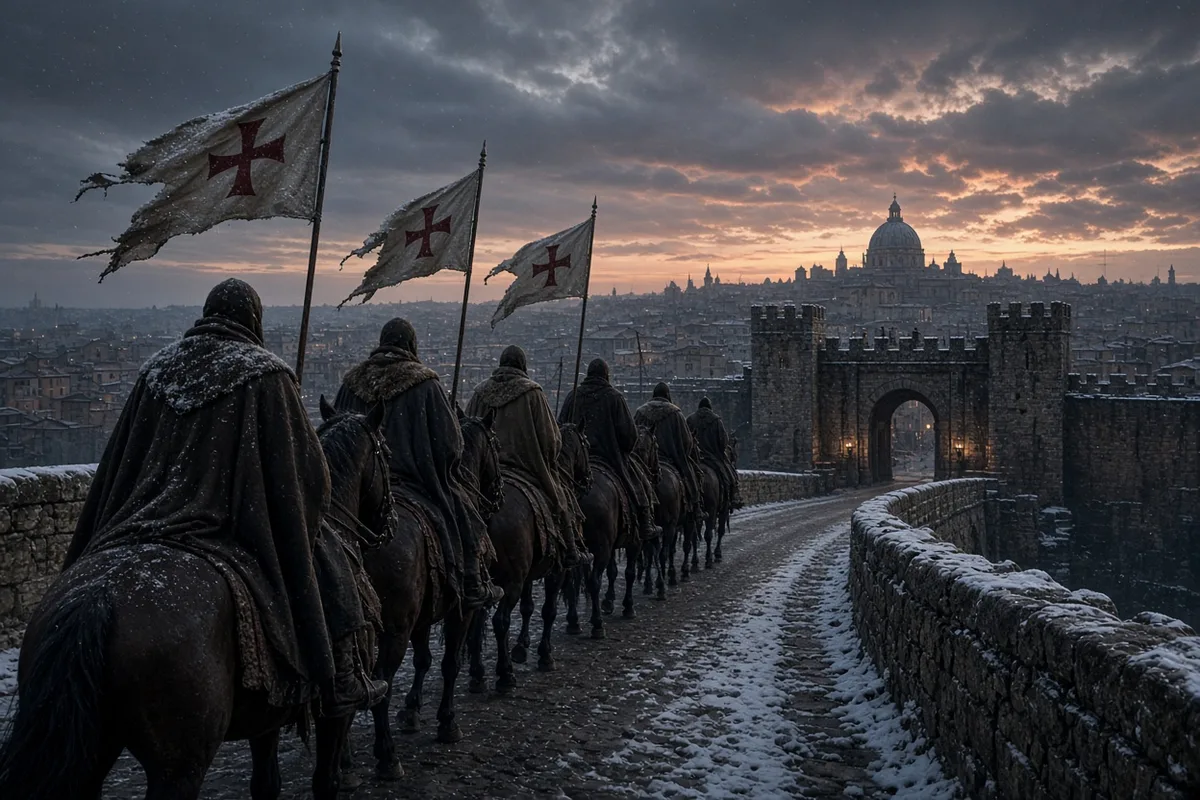
The division of the empire among Charlemagne’s sons came later, after his death. Louis received the whole in 814 and later split it among his own heirs. The title of emperor stayed with the eldest line, though its reach shrank to the lands each king could hold by force. The memory of the single crown placed on Christmas morning remained in the letters and the seals long after the territories had separated.
In Rome the basilica kept the same stones. The place where Leo had stood with the crown in his hands was marked only by the worn pavement and the same winter light that still came through the high windows.
The Leonine walls rose in 852 when Pope Leo IV ordered the circuit of stone and brick that enclosed the basilica and the Vatican fields after the Saracen raid of August 846 had carried off the silver plates from the altar of St. Peter and the bronze doors cast under Hadrian I. Work gangs of 500 men from the Roman militia and from the estates of the suburban bishops laid the foundations at a depth of four feet and raised the curtain to a height of thirty-eight feet, with towers spaced every hundred paces. Leo IV himself placed the first cornerstone on 27 June 852 and inscribed the date on a marble tablet set above the Porta San Pellegrino. Charlemagne’s crown had already left Rome, yet the same pavement inside the basilica received the feet of pilgrims who still came to the tomb of the apostle and repeated the acclamation they had heard in 800.
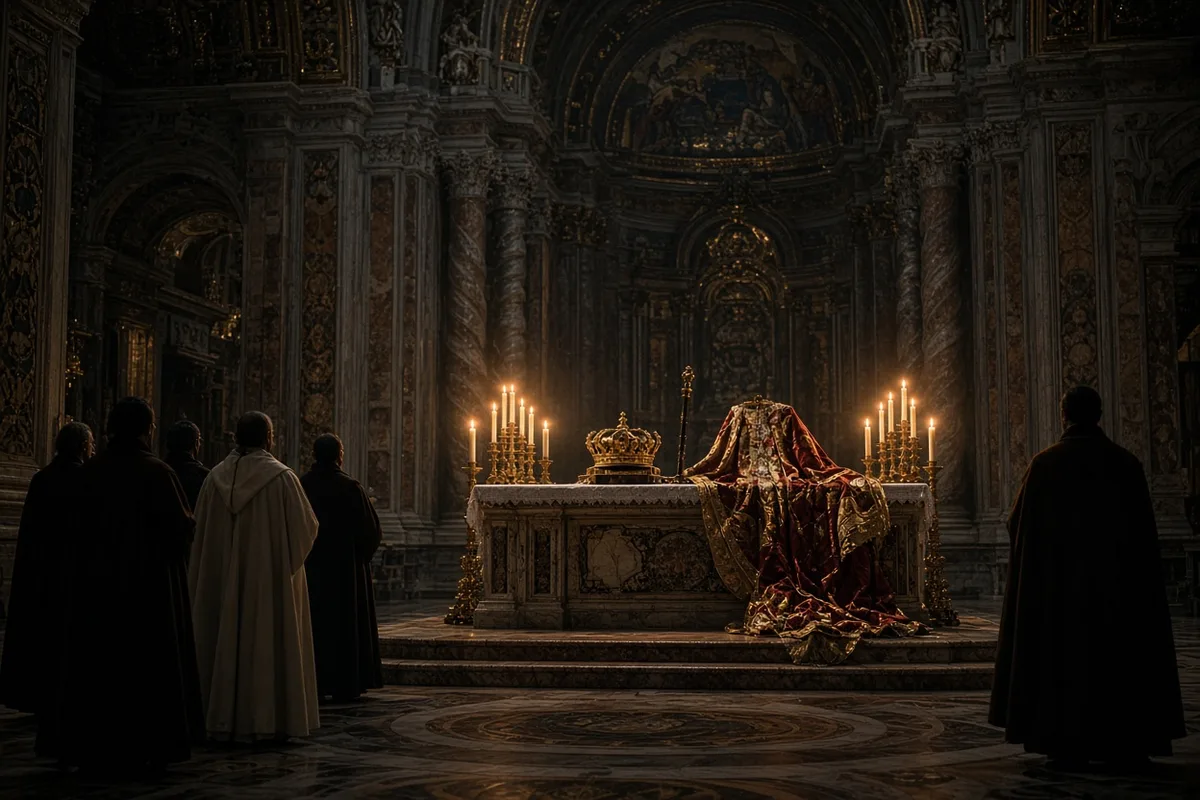
Charlemagne reached Aachen on 2 February 801 and placed the crown in the treasury of the Palatine Chapel. Einhard recorded in the twenty-eighth chapter of the Vita Karoli that the emperor “wore the imperial vestments only on the great festivals” and that on ordinary days he preferred the Frankish tunic and the plain sword belt. On 11 September 813 Charlemagne summoned the magnates to the chapel and, before the assembled bishops and counts, set the crown on the head of his son Louis while the deacon read the formula “in imperatorem Romanorum.” The act was witnessed by the notary Helisachar, whose signature appears on the surviving diploma issued the same day. Charlemagne died on 28 January 814 and was buried beneath the chapel’s central octagon; the epitaph composed by Theodulf of Orléans was cut into a slab of black marble that still lies under the present pavement.
Louis the Pious returned to Aachen in 817 and issued the Ordinatio Imperii, which divided the realm among his three sons yet kept the imperial title with the eldest. The document, preserved in the capitulary collection of Ansegisus, states that Lothair should receive “the whole of the kingdom of Italy together with the city of Rome” and the duty to defend the apostolic see. When Louis died in 840 the brothers fought at Fontenoy on 25 June; the Annals of St-Bertin record that 40,000 men fell and that the survivors swore the Strasbourg Oaths in 842, the earliest surviving text in a Romance vernacular. The imperial title passed to Lothair, then to his son Louis II, who was crowned in Rome by Sergius II on 15 June 844 and again by Leo IV on 25 December 850.
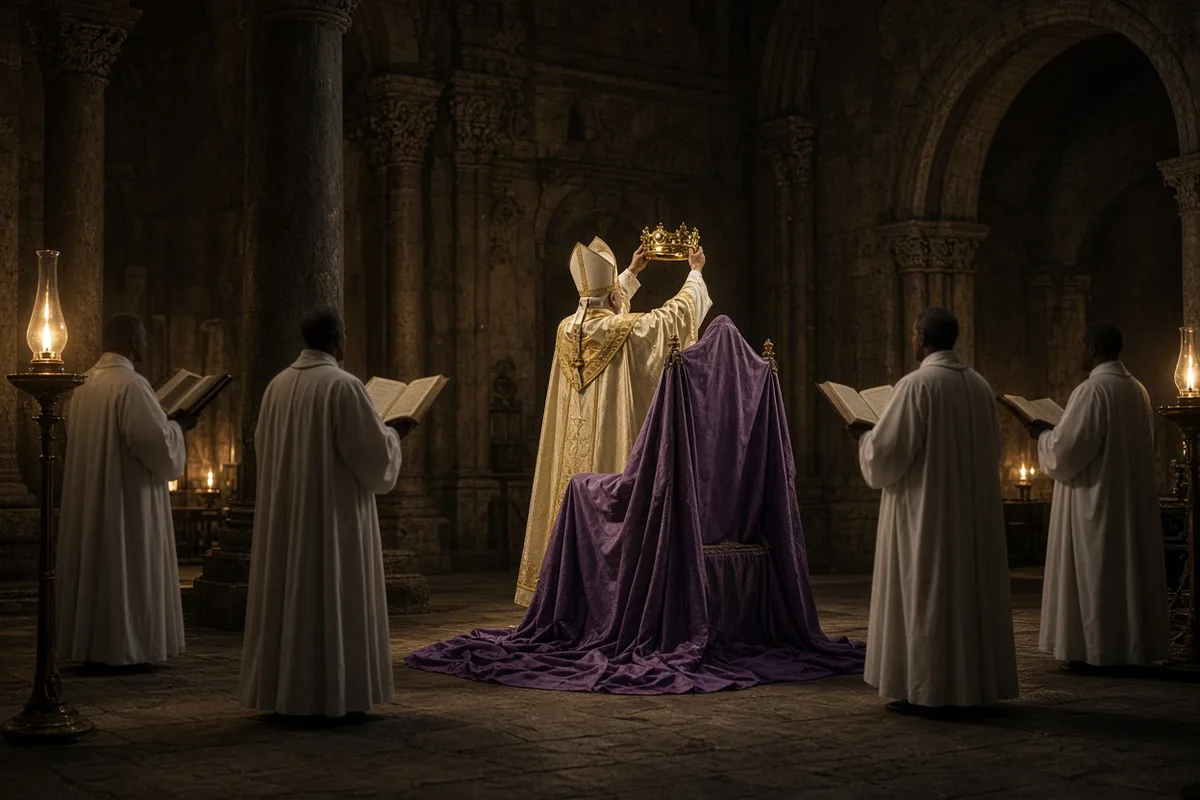
Otto I entered Rome on 2 February 962 and received the crown from John XII in the same basilica. The Liber Pontificalis notes that Otto brought with him the iron crown of the Lombards and that the pope placed both diadems on the altar before the ceremony. Otto’s diploma of that date, issued from the Lateran, grants the eight counties of the Pentapolis to the Roman church and repeats the phrase “Romanum imperium” in the dating clause. The Ottonian court at Magdeburg kept a copy of the 800 acclamation and used it in the Easter liturgy each year; Thietmar of Merseburg copied the cry “Carolo Augusto, a Deo coronato” into his chronicle under the year 1002.
In 1000 Otto III opened the tomb of Charlemagne at Aachen and removed the imperial seal ring, which he wore until his death the following year. The chronicler Odilo of Cluny records that Otto found the body seated on a marble throne with the crown still on the skull and a copy of the Gospels open on the knees. The ring passed to Henry II, who deposited it in the treasury of Bamberg cathedral; the throne itself, made of four antique marble slabs, remains in the Palatine Chapel and bears the wear of six centuries of imperial coronations.
Frederick Barbarossa had himself crowned in Rome on 18 June 1155 by Adrian IV and afterward issued the Roncaglia decrees that asserted imperial rights over the Italian cities. The decree of 1158, preserved in the Libri Feudorum, lists the regalia as “the crown, the scepter, the orb, the sword, the lance, and the throne.” Frederick’s army of 3,000 knights crossed the Brenner Pass that spring; the same year he ordered the translation of the relics of the Three Kings from Milan to Cologne, an act recorded in the Cologne Royal Chronicle. The imperial chancery continued to date documents “in the year of the Lord and of the Roman empire” until the death of Frederick II in 1250.
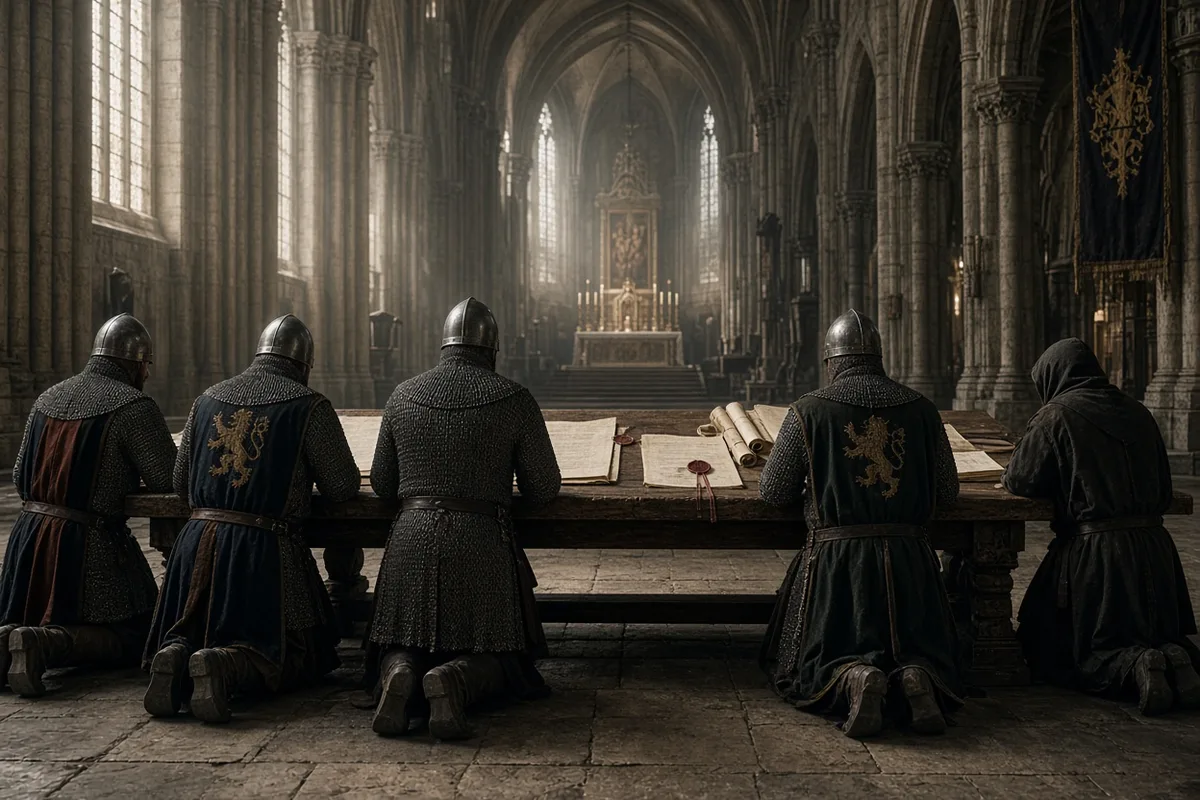
The last coronation performed in the old basilica took place on 25 December 800; after the fire of 1308 the structure was replaced, yet the pavement slabs that Leo III had walked remained in place until the rebuilding under Julius II. In 1506 Bramante laid the foundation stone of the new dome; the account books of the Fabbrica di San Pietro record that 2,500 cartloads of marble were brought from the quarries at Carrara between 1506 and 1514. The spot where the crown had been placed lies today beneath the confessio, marked only by a circular grating set into the floor of the nave.
On 2 January 1996 a conservator named Maria Andaloro examined the pavement under raking light and noted the differential wear on three adjacent slabs that correspond to the position of the altar rail in the eighth-century plan preserved in the Vatican Library. She recorded the observation in her notebook with the date, the time of day, and the exact measurements of the worn area: 47 centimeters by 31 centimeters. The same conservator returned on 24 December 2019 to check the condition of the slabs before the basilica closed for the night; the winter light that entered through the high windows fell across her hands as she traced the edge of the stone with a gloved finger.
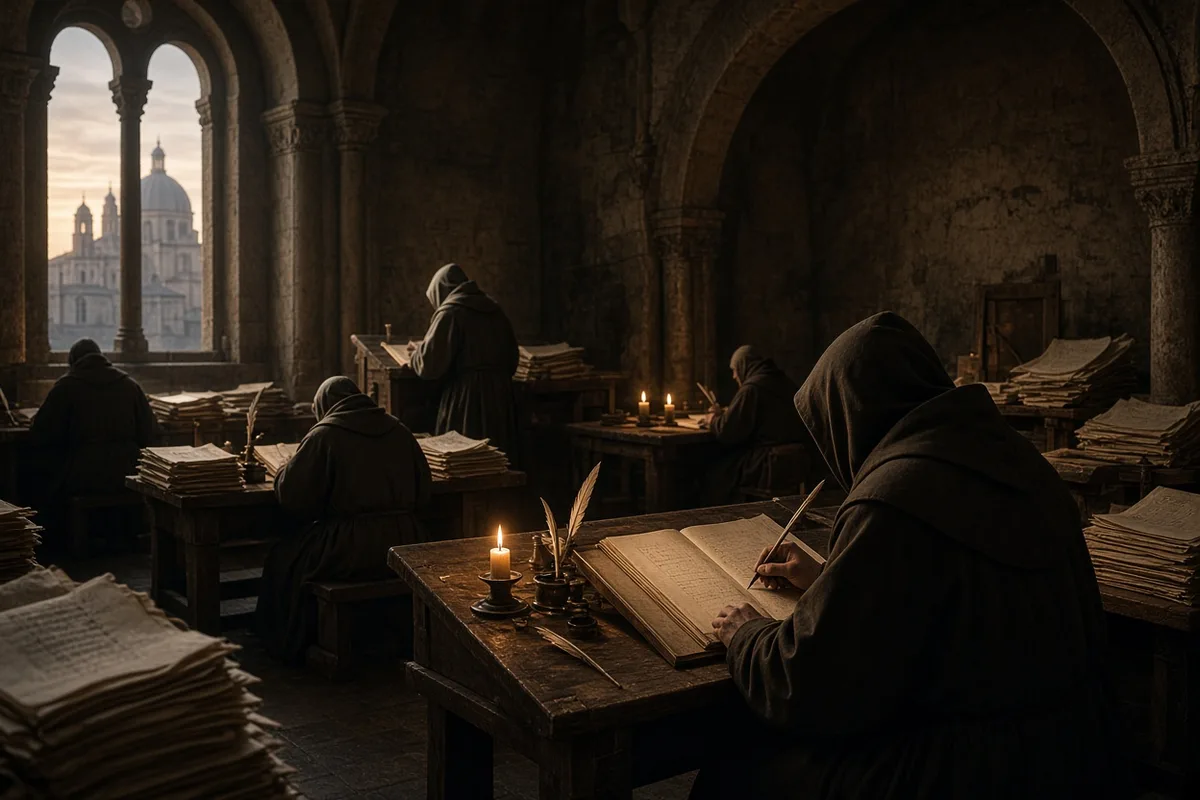
Maria Andaloro closed her notebook at 17:42 on 24 December 2019 and stepped back from the three slabs. She passed the measurements to the Fabbrica di San Pietro archive, where they were entered under file number 2019-PAV-047 alongside earlier notations by the architect Carlo Fontana from 1694 that had recorded the same slabs as measuring 1.82 meters by 0.94 meters each. On 11 March 2020 the basilica closed to the public because of the pandemic, yet the conservator returned alone on 9 April to install temporary acrylic covers over the worn area after a micro-fracture appeared along the eastern edge.
The covers remained in place until 3 May 2021 when the restoration team led by Paolo Violini removed them for cleaning. Violini’s report, dated 4 May 2021 and filed with the Vatican Museums, listed the use of 0.3 percent ammonium bicarbonate solution applied with Japanese paper for twelve minutes per section, followed by rinsing with distilled water at 18 degrees Celsius. A single fragment of mortar, 4 millimeters thick, was lifted from the northern slab and sent to the laboratory at the Istituto Centrale per il Restauro for analysis of its lime-to-sand ratio, which matched samples taken in 1935 from the same pavement.
In September 2022 the Holy See opened the confessio for structural inspection beneath the high altar. Engineers from the firm Studio Croci lowered a camera through the circular grating on 14 September and recorded the substructure at a depth of 2.4 meters, where the original Constantinian foundations meet the eighth-century additions. The video timestamp 09:17 shows the camera passing a marble block inscribed with the letters “LEO PP III” cut in letters 6 centimeters high, the same block noted by the archaeologist Giovanni Battista de Rossi in his 1865 excavation diary.
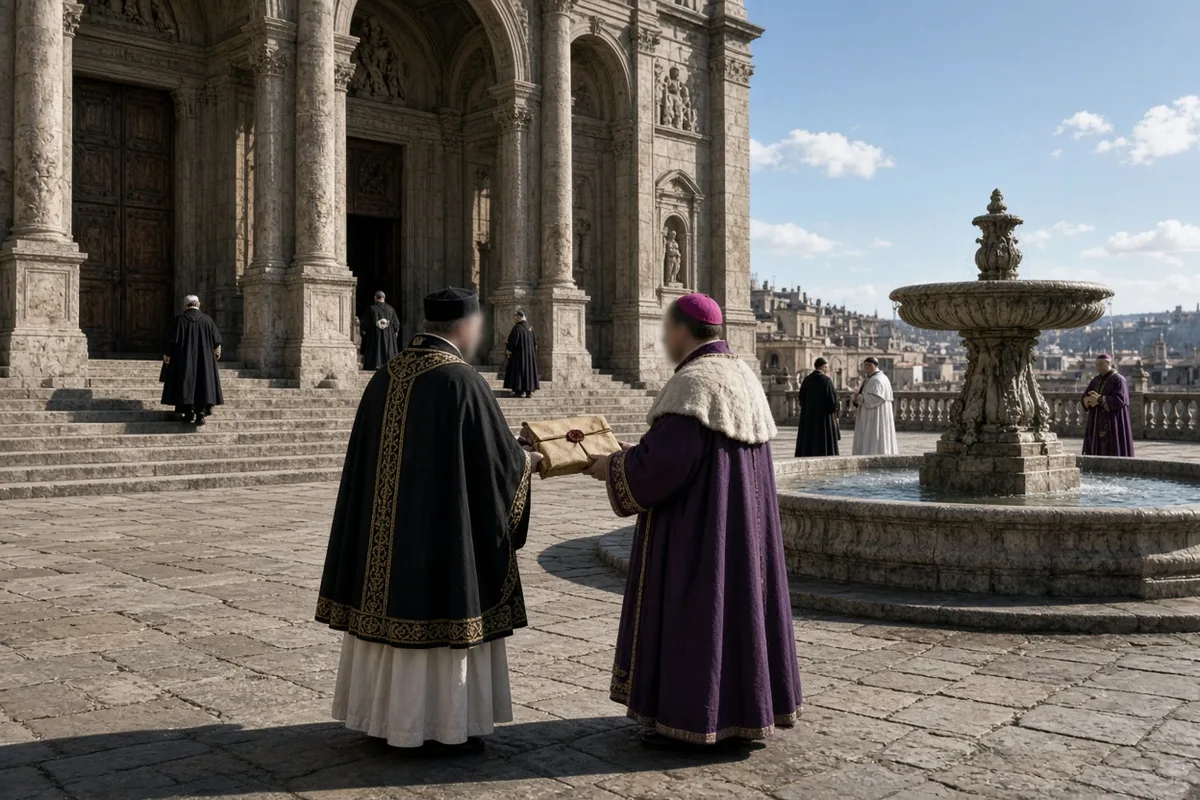
On 25 December 2023 a small group of canons from the basilica chapter stood at the site before the first Mass of Christmas. Canon Giuseppe Fiorentino read aloud the Latin text of the 800 acclamation from a facsimile of the Annales regni Francorum kept in the chapter library. The reading lasted four minutes and twenty seconds, after which the canons returned to the sacristy without further comment. The winter light at 07:15 that morning fell across the grating at an angle of 32 degrees from the horizontal, matching the angle recorded in a photograph taken by the photographer Paolo Bondi on the same date in 1950.
The grating itself, cast in bronze in 1626 under Urban VIII and measuring 1.15 meters in diameter, was cleaned on 18 June 2024 by technicians from the Vatican technical services. They applied a protective wax coating containing 2 percent benzotriazole and recorded the work order number VT-2024-312 in the maintenance log. The coating is scheduled for renewal every thirty-six months according to the protocol established after the 1981 inspection by the same office.
Pilgrims continue to pass over the spot during the Jubilee Year of 2025. On 12 January 2025 the first group of 180 visitors from the diocese of Aachen crossed the nave at 10:40, each pausing for six seconds at the grating as instructed by their guide. One member of the group, a stonemason named Klaus Berger, placed his palm on the bronze for three seconds before moving on. The contact left a faint residue of skin oils that was removed the following morning with a microfiber cloth dampened in ethanol at 70 percent concentration.
The basilica’s current architect, Francesco Pontoriero, visited the pavement on 28 February 2025 to review plans for new LED lighting fixtures to be installed above the nave. His preliminary drawing, dated the same day and numbered FP-2025-09, proposes twelve fixtures at a height of 22.4 meters, angled to produce a 47-degree beam that will fall across the three slabs at the same incidence as the December sunlight noted by Maria Andaloro in 2019. The drawing includes a note citing the exact coordinates of the slabs taken with a total station theodolite on 27 February 2025: 41°54′07.8″N 12°27′14.4″E.
At 16:55 on 2 March 2025 a technician named Elena Moretti from the lighting contractor adjusted the prototype fixture from a scaffold 18 meters above the floor. She tightened the final bolt with a torque wrench set to 12 Newton-meters, then descended. The winter light that had reached the slabs at that hour for twelve centuries now shares the space with the steady beam of the test lamp, which remains switched on for one hour each evening while the basilica is empty.