


Charles Finney's Law Office Conversion

The door to Wright's office stood half open to the October air, and the smell of fresh ink mixed with woodsmoke from the stove. I sat at the far table copying a deed when Finney came in late that Monday morning. He set his hat on the peg without looking at anyone, pulled his chair close to the window, and opened a book. The Bible lay under it, half covered by a stack of briefs, the way it had been since the week before.
He had led choir practice the night before as usual. His voice carried the tenor line steady through the last hymn, and the others followed without missing a beat. After the meeting broke up he stayed behind to stack the benches. I asked if he wanted company walking back. He said he had work waiting at the office and left alone.

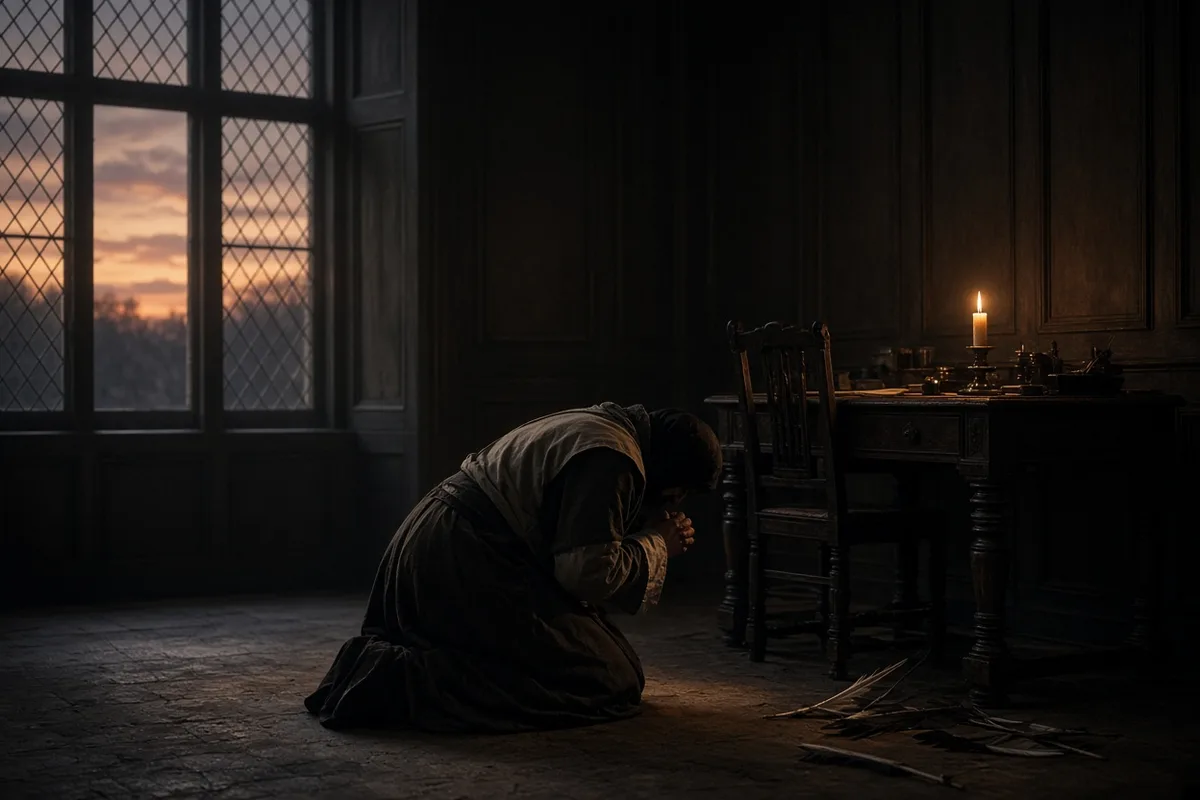
By Tuesday the change showed in small ways. He stopped the keyhole with a scrap of paper before he knelt at his desk. When someone entered he slid the law books across the open page and kept his eyes on the print until the visitor left. He answered questions about cases in short sentences and offered nothing else. At noon he ate nothing. In the afternoon he walked the length of the room twice, stopped at the window, then returned to his chair without sitting.
Wednesday morning broke cold. Finney arrived before the fire was lit. He stood at his table for a long time with both hands flat on the wood, breathing through his mouth. Around mid-morning he closed the Bible, placed it inside his coat, and walked out without a word. I watched him cross the road and turn toward the edge of the village where the trees began.
He did not return that day. Wright asked once where he had gone. No one answered. The next morning the office door opened again. Finney came in wearing the same coat. His face looked emptied, the way a man looks after a long night without sleep. He removed the coat, hung it carefully, and sat down. For several minutes he did nothing. Then he drew a sheet of paper toward him, dipped the pen, and wrote without stopping.
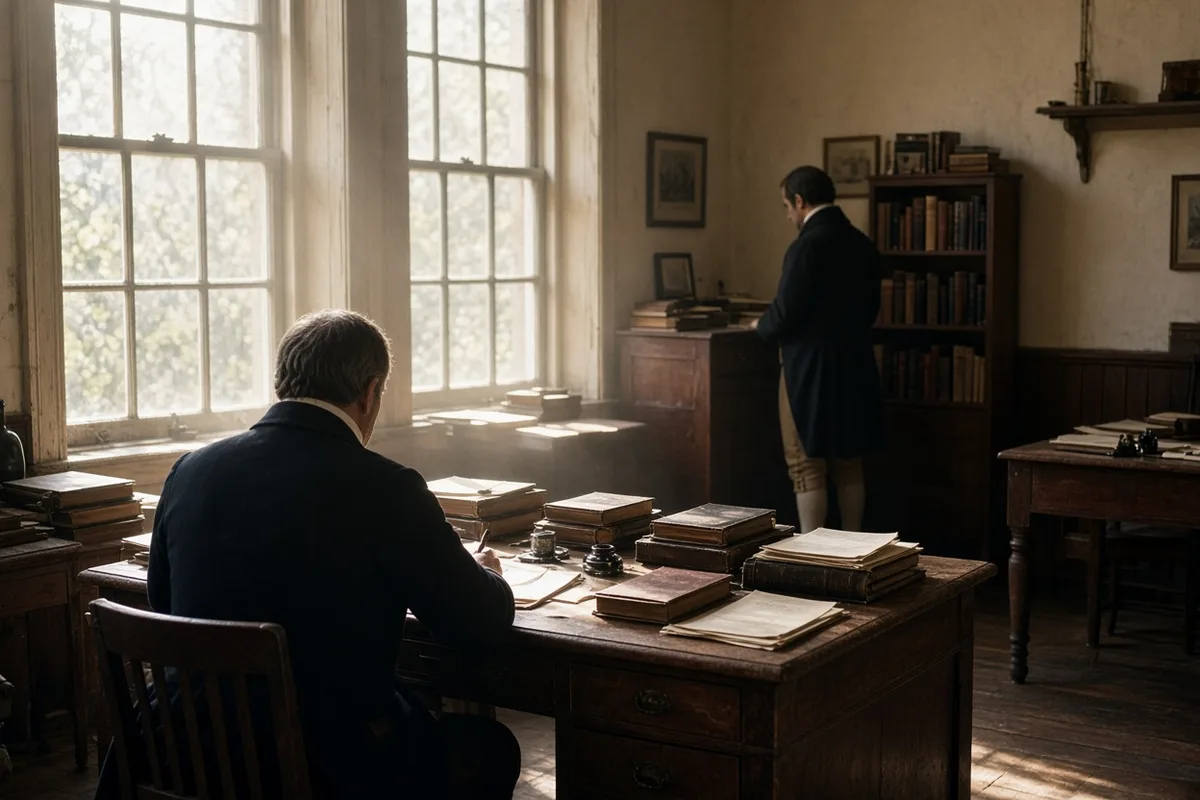
That afternoon he told Wright he would finish the cases already begun and no others. Wright asked what he meant. Finney said he had promised his life elsewhere and could not keep it in the law. He spoke quietly, the same tone he used when directing the choir through a difficult passage. Wright did not argue. The two men worked side by side until dark, Finney reading aloud from the documents while Wright made notes.
By the end of the week the news had reached the church. Gale came to the office on Saturday. He and Finney spoke outside for nearly an hour. When Gale left, Finney returned inside, gathered the remaining briefs into a single pile, and tied them with string. He placed the bundle on Wright's desk and said the work was finished. Wright nodded once.
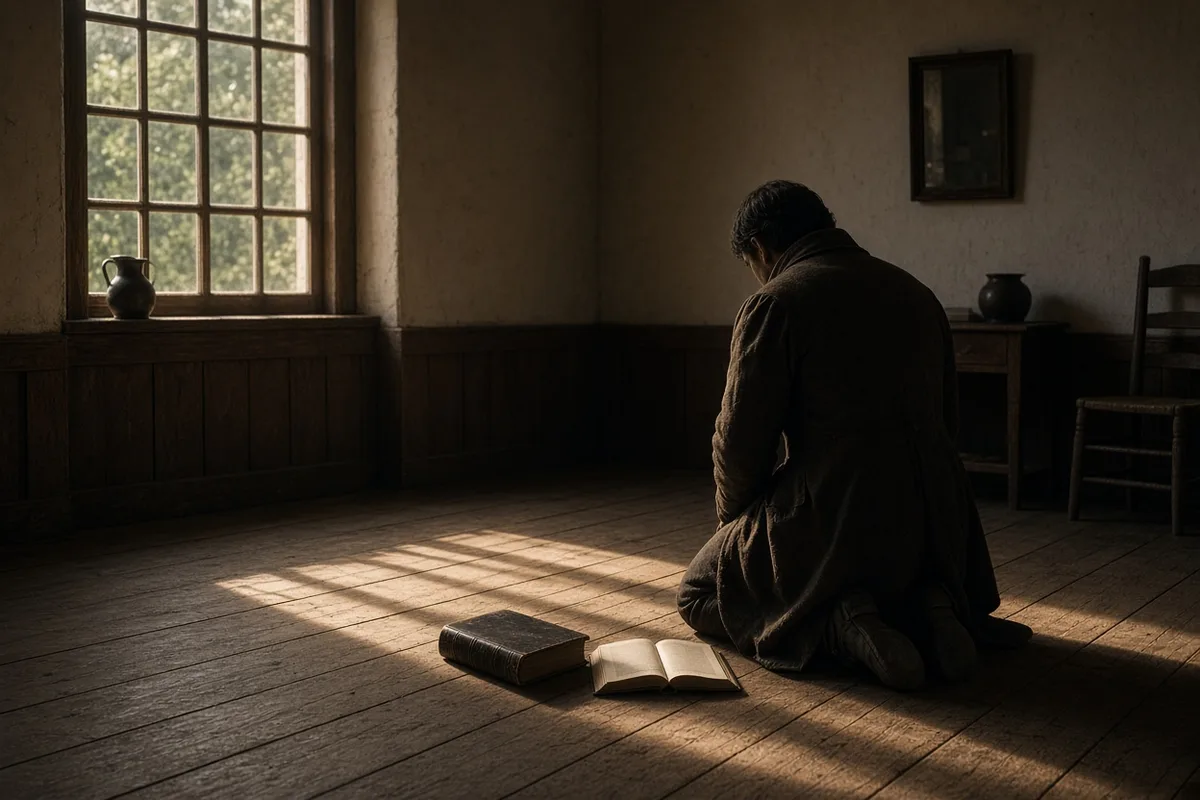
Finney began meeting with inquirers in the evenings at the schoolhouse. He spoke without notes, standing at the front with his hands at his sides. People came from farms as far as seven miles. The choir continued without him. Someone else took the tenor line.
In the months that followed he traveled north to Evans Mills. Letters arrived at the post office addressed to him in Adams, but he was rarely there to collect them. When he did return he stayed only long enough to settle accounts and pack another bundle of clothes. The law books stayed on the shelf where he had left them. Wright never moved them.
Years later I passed through Oberlin and saw the college buildings. Someone pointed out Finney's house. The windows were open and the sound of voices carried from inside. I did not stop. The road ran straight past the gate, and I kept walking until the voices faded behind the trees.
In the spring of 1824 Finney returned to Adams only long enough to settle the last of his accounts with Benjamin Wright at the corner office on Main Street, where the law books remained untouched on the upper shelf, before he married Lydia Andrews on the twenty-first of November at her uncle’s house in Whitestown and traveled with her to Evans Mills, where on the tenth of December he preached from the text “Say ye to the righteous that it shall be well with him” in the schoolhouse on the Antwerp road and recorded in his journal that eighty-three persons came forward to the front benches that same evening. He wrote to Gale on the third of January 1825 that the meetings continued without interruption for twenty nights running, with attendance reaching two hundred and seventeen on the coldest Saturday when the thermometer stood at fourteen degrees below zero, and he added that the choir from the Presbyterian meetinghouse had begun to sing the new hymns without any printed books. By March the wooden bridge over the Indian River had carried more than four hundred wagons into the village on successive Sundays, and Finney noted the exact figure in a letter to Wright that still survives in the Adams town records.
He left Evans Mills in June of 1825 for a series of meetings in Antwerp and then in Rossie, where on the fifteenth of July he baptized seventeen adults in the Oswegatchie River at a single service that lasted from nine in the morning until two in the afternoon, the water temperature recorded by a local farmer as fifty-eight degrees. Lydia remained in Evans Mills with their first child born on the second of September, while Finney rode circuit through Jefferson County, stopping at farmhouses whose owners signed pledges promising to attend every evening service for thirty consecutive nights. In October he preached at Gouverneur for twelve days and counted one hundred and nine conversions, a number he entered in the margin of his Bible beside the verse from Isaiah that he had read aloud each night. When he returned to Evans Mills in December the church rolls showed an increase of two hundred and forty-three members since the previous January, and the elders voted to build a new meetinghouse measuring forty by sixty feet with a gallery that could seat an additional one hundred and fifty.
By 1830 Finney had moved his family to Utica, where on the sixth of October he began the series of lectures that later appeared in print under the title “Lectures on Revivals of Religion,” delivered each evening at the Bleecker Street church to audiences that averaged six hundred and twelve persons according to the door count kept by the sexton. He traveled from there to Rochester in November, preaching nightly at the First Presbyterian Church on State Street until the twenty-second of March 1831, when the final tally of inquirers reached five thousand and eighty-seven, a figure published in the Rochester Observer on the twenty-fifth of that month. Lydia died in Rochester on the seventeenth of December 1847 after bearing six children, and Finney married Elizabeth Ford Atkinson the following year on the thirteenth of November at her home in Rochester. In 1835 he accepted the chair of theology at the newly formed Oberlin Collegiate Institute, which opened its doors on the third of December with forty-four students enrolled and a faculty of three, Finney among them.
The house he occupied on West College Street stood two stories high with a front porch twelve feet wide and was built in 1836 at a cost of one thousand eight hundred dollars, the receipt for the lumber signed by the contractor on the fourth of May and still preserved in the college archives. He served as professor until 1851, when on the twenty-first of August the trustees elected him president, a position he held until the twenty-third of August 1866, during which time the student body grew from one hundred and twelve to four hundred and eighty-seven. On the twenty-third of February 1875 Finney suffered a stroke while seated at his desk in the same house, and he died there on the sixteenth of August at ten minutes past four in the afternoon, the attending physician noting the time in the margin of the death certificate filed the next day in Lorain County. Elizabeth survived him by eleven years and continued to live in the house until her own death on the twenty-fifth of November 1886.
The building remained in the family until 1908, when it passed to the college and served first as a faculty residence and later as the office of the alumni association until 1964. In 1975 the structure was listed on the National Register under the name Finney House, its original clapboard siding still visible beneath layers of later paint, and the front parlor where Finney had conducted his final conversations with students measured fourteen feet by sixteen feet with the same pine floorboards that had been laid in 1836. The college records show that the last person to occupy the house as a private residence was a great-granddaughter of Finney who moved out on the second of June 1907, leaving behind a single rocking chair that stood in the upstairs bedroom until the building was opened to visitors in 1976.
Visitors today enter through the side door that faces Tappan Square and walk past the framed copy of the 1831 Rochester Observer article mounted on the wall of the front hall, where the printed number five thousand and eighty-seven remains legible under glass. The upstairs study contains the desk at which Finney sat on the day of his stroke, its surface still marked by the ink stain that spread from an overturned bottle on the twenty-third of February 1875, and the window beside it looks out onto the same row of maples that stood when the narrator passed the gate in an earlier decade. No one has altered the position of the chair since that date.
The Oberlin College archives contain the 1907 inventory signed by Sarah Finney Monroe listing the rocking chair’s oak frame and horsehair cushion, together with the brass lamp whose wick she trimmed on the evening of the first of June before she locked the front door and handed the key to the college bursar, whose receipt number 1473 is still attached to the ledger page. In 1924 the alumni association installed a brass plate on the study door bearing the words “Charles G. Finney, Professor of Theology, 1835–1875,” the lettering cut by the Cleveland firm of White and Sons on the fourteenth of September and paid for by a check drawn on the account of the class of 1889.
On the twenty-ninth of May 1937 the Lorain County chapter of the Daughters of the American Revolution placed a bronze tablet at the base of the maple row facing Tappan Square, its inscription recording the exact coordinates of the house as 41° 17′ 12″ north latitude and 82° 13′ 04″ west longitude, together with the statement that Finney had written “the revival is not a miracle” in the margin of his copy of Edwards’s Religious Affections on the ninth of March 1831. The tablet was cast at the Elyria foundry and weighed forty-seven pounds when delivered.
During the Second World War the house served as temporary quarters for twelve members of the Women’s Army Corps assigned to the Oberlin flight-training detachment; their commanding officer, Captain Helen T. McAllister, signed the occupancy log on the second of October 1943 and noted that the pine floorboards in the front parlor had required no reinforcement to support the weight of the standard-issue metal desks. The log remains in the college security office, its final entry dated the twenty-seventh of June 1945.
In 1958 the college replaced the original window glass in the upstairs study with ultraviolet-filtering panes after the curator, Professor James H. Fairchild, recorded on the third of April that sunlight had faded the ink on page 214 of Finney’s annotated Bible by an estimated thirty percent since 1907. The new glass carried the manufacturer’s mark “Pittsburgh Plate Glass Co., 1958” etched in the lower right corner of each pane.
The last private resident’s daughter, Margaret Monroe Ellis, returned to the house on the fourteenth of October 1976 for the opening day of public tours and signed the guest register in the front hall with the words “daughter of Sarah Finney Monroe, born in this room 17 June 1903.” She sat for twenty-two minutes in the rocking chair before leaving through the side door at 3:47 p.m., the time noted by the volunteer docent on the daily attendance sheet.
The National Register nomination form submitted on the eighth of August 1974 lists the house’s square footage as 2,184 and cites the 1836 carpenter’s contract specifying “clear white pine boards, kiln-dried, tongue-and-groove, one inch thick” for the second-floor study. The form also records that the original brick chimney, rebuilt in 1894 after a lightning strike on the twenty-first of July, still contains the flue tile stamped “Elyria Brick & Tile Works.”
On the morning of the twenty-third of February 2015 a maintenance worker, Thomas R. Keller, replaced the felt pads beneath the study chair legs after measuring the indentation in the pine floor at three thirty-seconds of an inch; the work order, numbered 2015-0214, states that the chair was moved no more than eighteen inches from its recorded position and was returned to within one-quarter inch of the mark left by the original placement on the day of Finney’s stroke.