



China's AI edge is speed and data, not labs

In 60 seconds
- AlphaGo's 2016 win over Lee Sedol hit China like Sputnik and triggered a national plan for AI leadership by 2030.
- Chinese founders learned innovation by surviving a brutal copycat era that treated ideas as disposable and execution as sacred.
- AI arrives in four waves—internet, business, perception, autonomous—and China leads where data volume and market scale decide outcomes.
- WeChat and Alipay concentrate denser behavioral data than America's fragmented apps, aided by lighter privacy norms at the time.
- AI will hollow routine pattern-recognition tasks inside most jobs rather than erase whole professions overnight.
- After stage IV lymphoma, Lee rejects UBI for idle consumption and proposes a stipend that pays people for care, teaching, and community work.
The big idea
Lee argues AI has entered an age of implementation where data, execution speed, and entrepreneurial hustle outweigh research breakthroughs, giving China real advantages over the United States on that terrain. His cancer diagnosis convinced him human worth rests on love and connection, so societies should meet job loss with stipends for care work rather than blank payments for idleness.
The book in brief
Lee opens with AlphaGo's 2016 match against Lee Sedol. In the US it registered as a curiosity; in China it landed as a national wake-up call. Within months Beijing issued a plan targeting global AI leadership by 2030 and capital flooded startups. That contrast frames his hinge claim: the age of discovery rewarded rare theoretical insight at places like DeepMind and Google Brain, while the age of implementation rewards whoever applies known techniques fastest across the most data and markets.
He traces China's edge to a decade of Darwinian copying that Western firms never fought at home. Founders cycled through failed clones until they could solve local problems no foreign playbook contained. The same intensity shows up in 996 schedules, feature cloning overnight, and price wars fought to the edge of ruin. Silicon Valley still optimizes for elegant, defensible technology and global mission; Chinese firms optimize for whatever wins the local market first.
Lee then splits AI's economic impact into four waves with different timelines and different winners. Internet AI personalizes feeds from clickstreams. Business AI scores credit and catches fraud on structured enterprise data. Perception AI digitizes faces, objects, and speech through sensors. Autonomous AI embeds decisions in cars and robots and remains furthest out. America still leads where deep novelty and enterprise trust matter; China's advantages cluster where data volume and dense retail infrastructure decide outcomes.
The social half of the book turns on what happens to work. AI will not mainly delete whole professions; it will absorb the routine, pattern-based portions of jobs from loan officers to radiologists, leaving a thinner residue of judgment and empathy. Lee's own stage IV lymphoma diagnosis interrupts the industry tour. He reevaluates a life built on competitive intensity and concludes that human value was never about optimizing output. That personal turn underwrites his policy close: reject universal basic income as payment for idleness, and instead pay a social investment stipend for care, teaching, and community work markets undervalue. He ends by warning that framing US-China AI as a winner-take-all race is more dangerous than the technology, because the real race is between the pace of automation and the pace at which societies invent new sources of income and meaning.
Context
Kai-Fu Lee writes as a former Google executive and venture investor who funded automation startups, pairing competitive analysis of US and Chinese tech with a memoir of his 2013 lymphoma diagnosis. Published in 2018, the book caught a moment when Chinese AI ambition was surging and offered Western readers a granular map of why Beijing's data and hustle advantages might outweigh Silicon Valley's research lead.
The key ideas

1
The Sputnik signal
AlphaGo's 2016 defeat of Lee Sedol did more to mobilize Chinese AI money and policy than years of technical papers.
- March 2016AlphaGo defeats Lee Sedol; China treats it as Sputnik
- Months laterNational AI plan targets global leadership by 2030
- 2018 bookLee frames the shift as discovery era to implementation era
Lee opens on the March 2016 match. American audiences treated it as a curiosity. Chinese audiences treated it as a national emergency comparable to the Soviet Sputnik launch for America in 1957.
Within months the government issued a national AI development plan aimed at global leadership by 2030, and venture capital poured into startups. The country did not need to invent deep learning; it needed a visible signal that deep learning mattered.
That contrast lets Lee draw the book's central line between eras. The age of discovery rewarded rare theoretical insight at a handful of labs. The age of implementation rewards speed, capital, data volume, and tolerance for brutal competition. If the framing is wrong and research breakthroughs still dominate, China's advantages shrink.
In practice: AlphaGo versus Lee Sedol in March 2016 produced a Chinese policy and capital surge that years of papers never triggered.

2
Copying as training ground
China's internet giants did not skip the copycat phase; they were built by surviving it.
Western commentary long dismissed Baidu as China's Google and Taobao as China's eBay. Lee reframes the copying years as a forced training regimen that put thousands of founders through market tests faster and harsher than Silicon Valley ever demanded.
Product ideas became disposable. Execution became sacred. Each failed clone taught specific lessons about Chinese user behavior, payments, and logistics that no foreign playbook contained.
By the time survivors pivoted into original problems, they already carried hardened habits about iterating in public and treating a rival's popular feature as fair game. That decade of combat, not state planning alone, produced the implementation-era advantage.
In practice: Wang Xing ran at least five copycat startups, including Facebook and Twitter clones, before Meituan succeeded by solving group buying and food delivery with algorithmic dispatch of motorbike couriers.
3
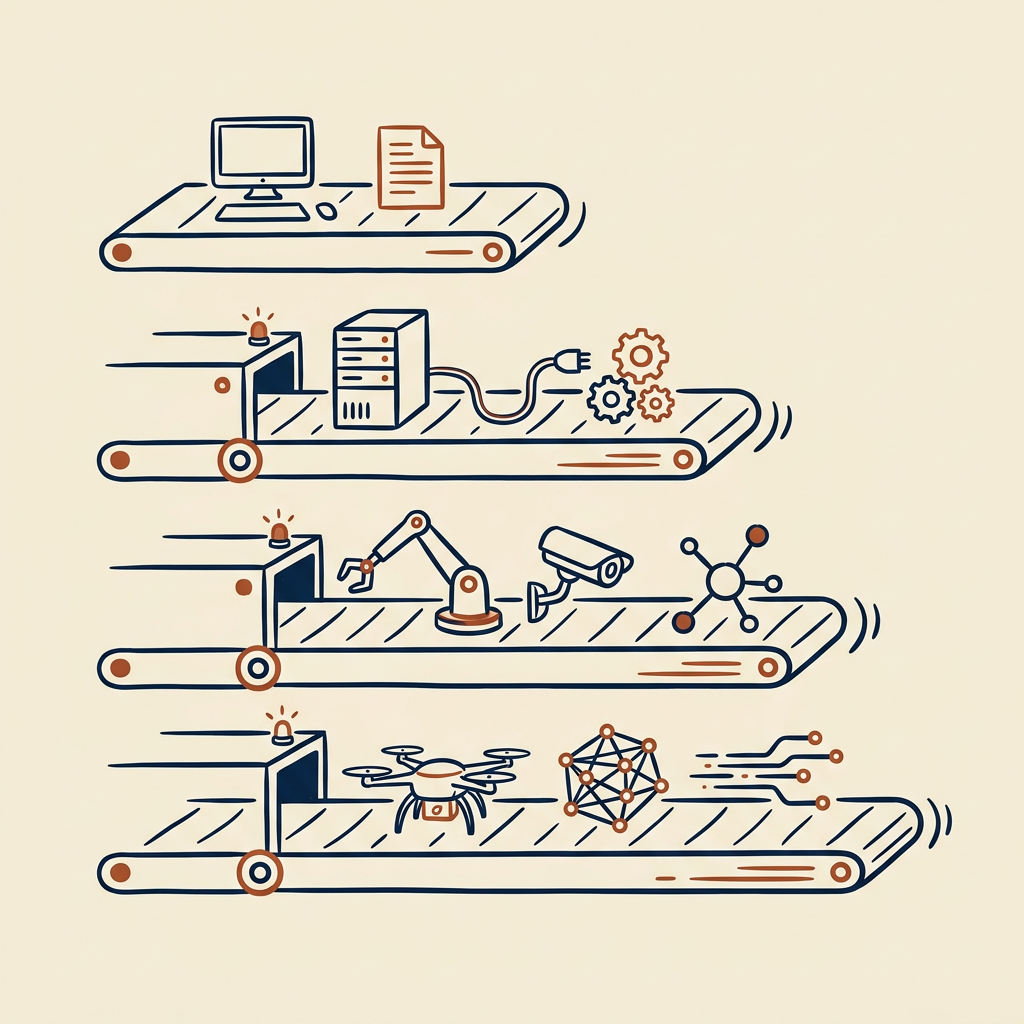
Four separate AI waves
AI's economic impact arrives as four waves with different timelines and different winners, not one monolithic race.
- Internet AIRecommendation engines from clickstream data; China strong
- Business AICredit, fraud, enterprise data; US still leads
- Perception AIFaces, objects, speech via sensors; China edge in dense infrastructure
- Autonomous AICars and robots deciding in the physical world; furthest out
Internet AI turns clickstream and app behavior into recommendation engines that can displace human editors. Business AI applies machine learning to structured data companies already hold—credit scoring, fraud detection—where American enterprise-software maturity still leads.
Perception AI digitizes the physical world through cameras, sensors, and voice so software can recognize faces, objects, and speech. China's dense retail and surveillance infrastructure gives it an edge, already visible in facial-recognition payment tests at supermarkets when Lee wrote.
Autonomous AI embeds decisions inside physical machines such as self-driving cars and robots and remains furthest from full deployment. Separating the waves stops readers from declaring a single national winner. A country can lead one wave and lag badly in another.
In practice: Toutiao used machine learning to personalize news feeds so effectively it displaced traditional editors, illustrating internet AI's early Chinese strength.

4
Dense data advantage
In the implementation era, messy real-world usage data matters more than algorithmic elegance, and Chinese consumers generate more of it.
China data trail
Payments, rides, food, messaging inside WeChat and Alipay ecosystems
US data trail
Activity split across single-purpose apps and separate credit systems
Lee's empirical claim is specific: so much of Chinese commerce, payment, and social life runs inside a few app ecosystems that the resulting behavioral trail is denser and more integrated than anything American firms can assemble.
Hundreds of millions of users handle payments, ride-hailing, food orders, and messaging inside WeChat and Alipay. American consumers spread the same activity across many single-purpose apps and separate credit systems.
Mobile payment volume in China already dwarfed the US by orders of magnitude by the mid-2010s, partly because underdeveloped card banking let consumers leapfrog straight to mobile. Combined with comparatively permissive data-collection norms at the time of writing, that scale let Chinese companies train on datasets American firms could not match. Lee treats lighter privacy norms as a competitive advantage inside his framework, not only an ethical cost.
In practice: WeChat and Alipay concentrate payments, rides, food orders, and social messaging into single apps, producing integrated trails Western multi-app habits do not.

5
Gladiator startup culture
China's 996 schedules, overnight cloning, and unprofitable price wars produce faster iteration than Silicon Valley's mission-driven norms allow.
Chinese gladiator norms
996 hours, overnight feature clones, price wars to the edge of ruin
Silicon Valley norms
Mission framing, original ideas prized, less appetite for below-cost wars
Founders work 9 a.m. to 9 p.m., six days a week. Companies fight price wars so aggressive they burn hundreds of millions of dollars in subsidies to win share, as Didi and Kuaidi did before merging in 2015.
Lee contrasts this with Silicon Valley's more idealistic culture, where founders frame work as changing the world and hesitate to copy a rival overnight or price below cost. Having worked inside Google, he does not dismiss mission-driven culture; he argues it is poorly matched to markets where execution speed decides outcomes before anyone finishes a mission statement.
Survivors of the Chinese arena have typically fought dozens of near-identical competitors and predatory investors. The brutality itself trained the pragmatism about copying, pivoting, and undercutting that stronger IP norms and gentler customs rarely force on Western founders. Lee stops short of calling the culture sustainable or humane for the workers inside it.
In practice: Didi and Kuaidi burned hundreds of millions in ride-hailing subsidies fighting each other before their 2015 merger.
6
Mission versus market OS
Silicon Valley optimizes for elegant defensible technology; Chinese tech optimizes for whatever wins the market fastest, and the latter fits implementation-era economics better.
Lee synthesizes culture into two operating systems. Valley firms inherited a research-lab ethos from places like Xerox PARC and Stanford, often deferring monetization until a product feels complete. Chinese firms, shaped by copycat combat, launch imperfect products, iterate in public, and treat a rival's proven feature as fair game.
The claim is not that Chinese execution is superior in the abstract. It is better matched to implementation-era rules: localized speed beats global elegance when known techniques must be applied across messy markets.
That hinge sets up the rest of the book. Neither model wins every contest, but waves that reward data volume and rapid localization tilted toward the Chinese model more than 2018 observers typically assumed.
In practice: Uber entered China in 2013 with a globally consistent product; Didi integrated WeChat payments and local address conventions and forced Uber to sell its China operations for equity in 2016.

7
Hollowing jobs, not erasing them
AI will absorb routine pattern-based tasks inside almost every profession, a quieter displacement harder to see and compensate than mass unemployment.
More exposed
Loan officers, radiologists, paralegals—routine pattern recognition
More insulated
Home health aides and roles needing unstructured dexterity or real empathy
Drawing on his venture work funding automation startups, Lee estimates a large share of existing jobs contain tasks vulnerable within fifteen to twenty years of his writing. Whole jobs do not vanish overnight; AI takes the data-pattern portions and leaves humans a shrinking residue of judgment and interpersonal work.
He separates work that needs physical dexterity in unstructured settings or genuine empathy from work built on pattern recognition. The latter is exposed regardless of pay or credentials. A radiologist reading scans is more automatable than a home health aide, because perception AI already rivals human accuracy on certain images while caregiving still needs presence and emotional attunement.
Lee flags his numbers as estimates, not precise forecasts. Pace depends on regulation, labor markets, and public acceptance as much as technical capability. The chapter converts the US-China industrial contest into stakes for ordinary workers in both countries.
In practice: Lee argues a radiologist reading scans faces more automation risk than a home health aide whose work requires physical presence and emotional attunement.

8
Love over output
Stage IV lymphoma forced Lee to conclude human value is rooted in love and connection, not productivity, reframing what a post-automation economy should optimize.
In 2013 Lee received a lymphoma diagnosis that interrupted the industry narrative with a personal reckoning. A career built on competitive achievement and workaholic intensity—the same qualities he praises in Chinese entrepreneurs—felt insufficient once mortality became concrete.
Sitting with family, he decided human worth was never actually about optimizing output. Coming automation of cognitive labor could be read as a chance to redirect effort toward care, connection, and craft rather than a pure economic loss.
The pivot is deliberate and uneasy. After chapters treating speed and ruthless competition as strengths, he now treats those same qualities, taken as life philosophy, as costs to health and relationships. He still credits the intensity with building China's AI industry even after concluding it nearly cost him his life. Critics note he never fully reconciles the tension.
In practice: Lee's 2013 stage IV lymphoma diagnosis led him to reevaluate workaholic intensity and locate human worth in family connection rather than output.

9
Stipend for care work
UBI pays people to be idle; Lee's social investment stipend would pay specifically for care, community service, and education that markets undervalue.
Universal basic income
Unconditional cash; risk of paying for consumption without contribution
Social investment stipend
Pay tied to care, teaching, volunteering, and community work
Building on the meaning chapter, Lee rejects universal basic income as the main response to AI job loss. Unconditional cash, in his view, risks corroding the sense of purpose he just argued is central to dignity.
His alternative compensates people for socially valuable work AI cannot easily perform and markets under-reward: elder care, childcare, community organizing, teaching, volunteering. Funding would likely come from taxing AI-driven productivity gains at large tech firms.
He presents the idea as a starting point for debate, not a fully costed plan, and notes that neither the US nor China had shown urgency about the required political will when he wrote. The proposal answers the displacement chapter with something more specific than generic retraining while staying consistent with his personal conclusion that meaning, not income alone, is what the safety net must protect.
In practice: Instead of blank UBI checks, Lee would pay people for elder care, childcare, teaching, and community organizing that AI and markets both undervalue.
10
Coexistence over cold war
Treating US-China AI as a winner-take-all race is more dangerous than the technology, because it risks policies neither science nor citizens need.
Lee closes by stepping back from the competitive framing that organized most of the book. The more consequential outcome is how each society manages job displacement and value distribution internally, not which labs publish more papers or which GDP share of AI is larger.
American and Chinese AI ecosystems are already intertwined through academic collaboration, shared publications, and cross-border startup investment he personally funds. Decoupling them for nationalist competition would slow beneficial applications such as AI-assisted medical diagnosis that citizens in both countries need.
He calls for recognizing the US and China as two complementary centers of commercial and research AI even while political tension persists. The final note is softer than the middle chapters and corrects any reader who mistook the earlier 'who's winning' scorekeeping for the book's real message. The urgent race is between automation's pace and society's pace at designing new income and meaning.
In practice: Lee notes the ecosystems already share research, publications, and cross-border startup investment, so nationalist decoupling would slow medical-diagnosis tools both publics need.
Key terms
- Age of discovery The earlier AI phase when a few researchers made foundational breakthroughs; rare theoretical insight mattered most.
- Age of implementation The current phase when value shifts to whoever applies known techniques fastest across the most data and markets.
- Four waves of AI Lee's sequence of internet, business, perception, and autonomous AI, each with different timelines and winners.
- 996 Chinese startup schedule of 9 a.m. to 9 p.m., six days a week, treated as a competitive norm.
- Gladiator entrepreneurs Founders hardened by copycat wars, price wars, and ruthless iteration until execution outruns idealism.
- Social investment stipend Lee's alternative to UBI: pay people for care, teaching, and community work markets undervalue rather than for idleness.
- Data as the new oil In implementation-era AI, sheer volume and messiness of real-world usage data outweigh algorithmic elegance.
What to do
- Localize one product obsessively for a single target market instead of shipping a globally uniform version.
- Audit your job for pattern-recognition tasks versus work that needs physical presence or judgment under ambiguity, and shift training toward the latter.
- Treat any management policy modeled on 996-style intensity with suspicion; Lee himself abandoned that model after his diagnosis.
- Map which of the four AI waves most touches your industry and which country or firm currently holds the data or trust advantage there.
- Sketch what care, teaching, or community work in your area would look like if it were paid as socially valuable labor rather than left to unpaid leftovers.
Questions to think with
- If implementation really outweighs discovery, which parts of your own work still depend on original research versus fast deployment of known tools?
- Does Lee's praise of gladiator intensity survive his later claim that the same intensity nearly cost him his life and relationships?
- Would a stipend tied to care work protect dignity better than UBI, or would it just create a new bureaucracy of approved virtue?
- How much of China's data advantage was regulatory permissiveness that later crackdowns could erase?
- What would US-China AI coexistence look like in practice while political rivalry continues?
The other side
Published in 2018, the book overrated China's durable regulatory permissiveness—later crushed by the Ant Group IPO halt, data-security laws, and antitrust hits on Alibaba and Tencent—and said almost nothing about chip supply chains that US export controls later choked. Job-displacement figures are estimates often received as harder forecasts than the method supports; labor costs of 996 culture and surveillance harms of the data-rich environment are underweighted; the social investment stipend is sketched without funding mechanics, administration, or comparison to real income pilots.
Who it's for
Tech workers and founders who need a clear map of where AI investment and US-China competition actually tilt, plus policy readers and general audiences who want the job-displacement stakes and Lee's care-stipend alternative without wading through pure hype or pure panic.