


Christopher Columbus Names Island After the Savior
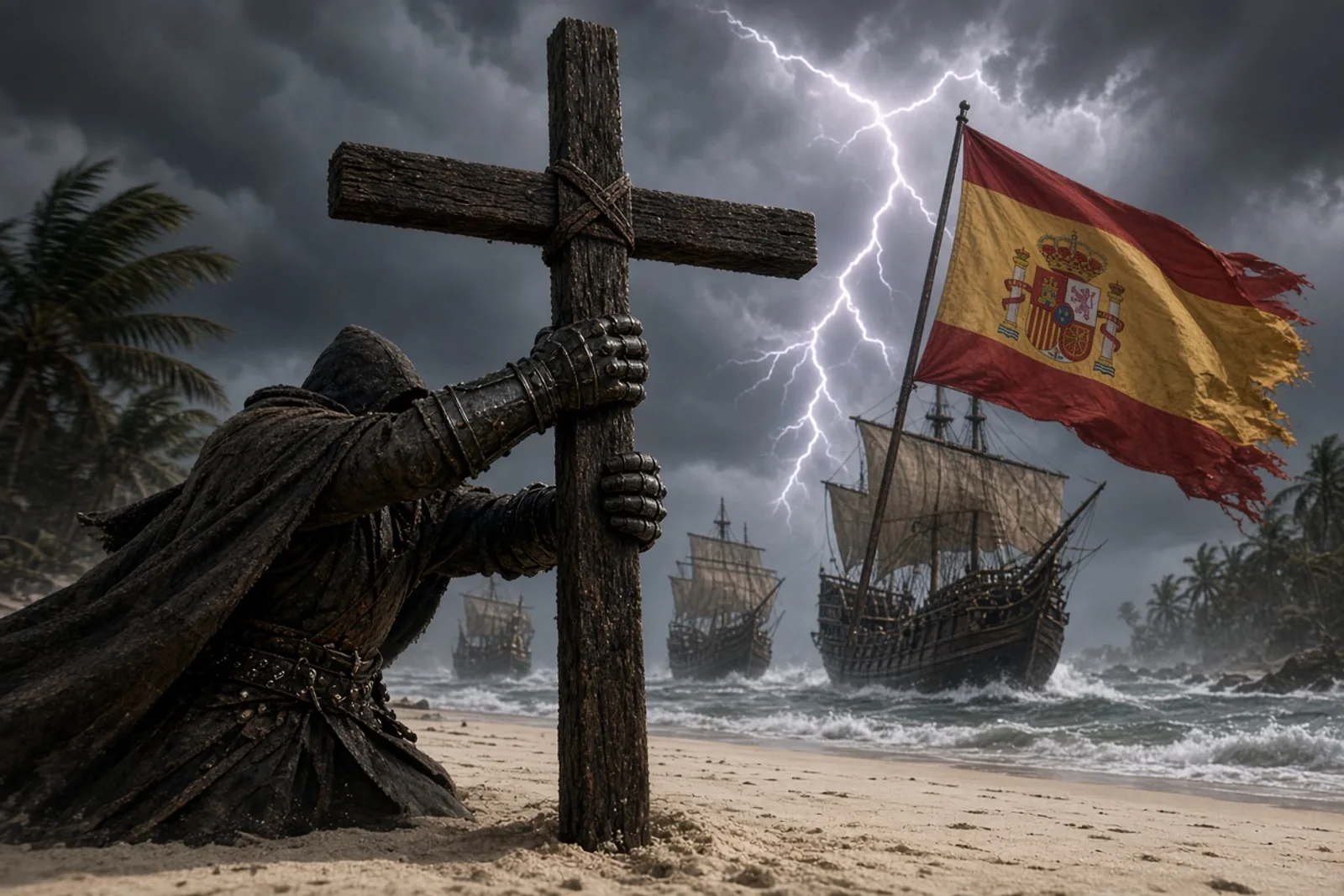
The cry from the Pinta reached us first, thin and ragged across the water. I dropped the coil of line I was mending and climbed the rail. Land lay low on the horizon, a streak of white sand under a hard blue sky. We had been at sea thirty-three days out of Cadiz. The wind had held steady from the east for most of them.
Columbus stood on the Santa Maria’s deck with his charts spread on a cask. He did not smile. He ordered the ships to shorten sail and sent word to the other two vessels by flag. By midmorning we lay off the island, the surf breaking white along its shore. A boat was lowered. Columbus stepped into it with the royal standard and several officers. I followed with four other men from the watch, oars in hand.

The water was clear to the bottom. Small fish darted under the keel. When the bow grated on sand, Columbus was the first to step out. He walked up the beach until the dry ground took his weight, then turned and faced the sea. The standard was planted in the sand. He spoke the proclamation in a clear voice that carried back across the water to the ships. The island was claimed for Ferdinand and Isabella. He named it San Salvador, after the Savior whose protection had brought us here.
Native people had already gathered at the edge of the trees. They carried no weapons that I could see. Some held out pieces of fruit. One man stepped forward and touched the cloth of the standard, then stepped back. Columbus gave orders that each of the other islands we had sighted should receive a name as well. He spoke them aloud: Santa Maria de la Concepcion, Fernandina, Isabella, Juana.

We stayed on the beach until the sun stood overhead. The natives brought roasted roots and fish wrapped in leaves. They showed no fear once the first minutes passed. Their canoes were narrow and fast. Two of them circled our boat as we rowed back to the ships.
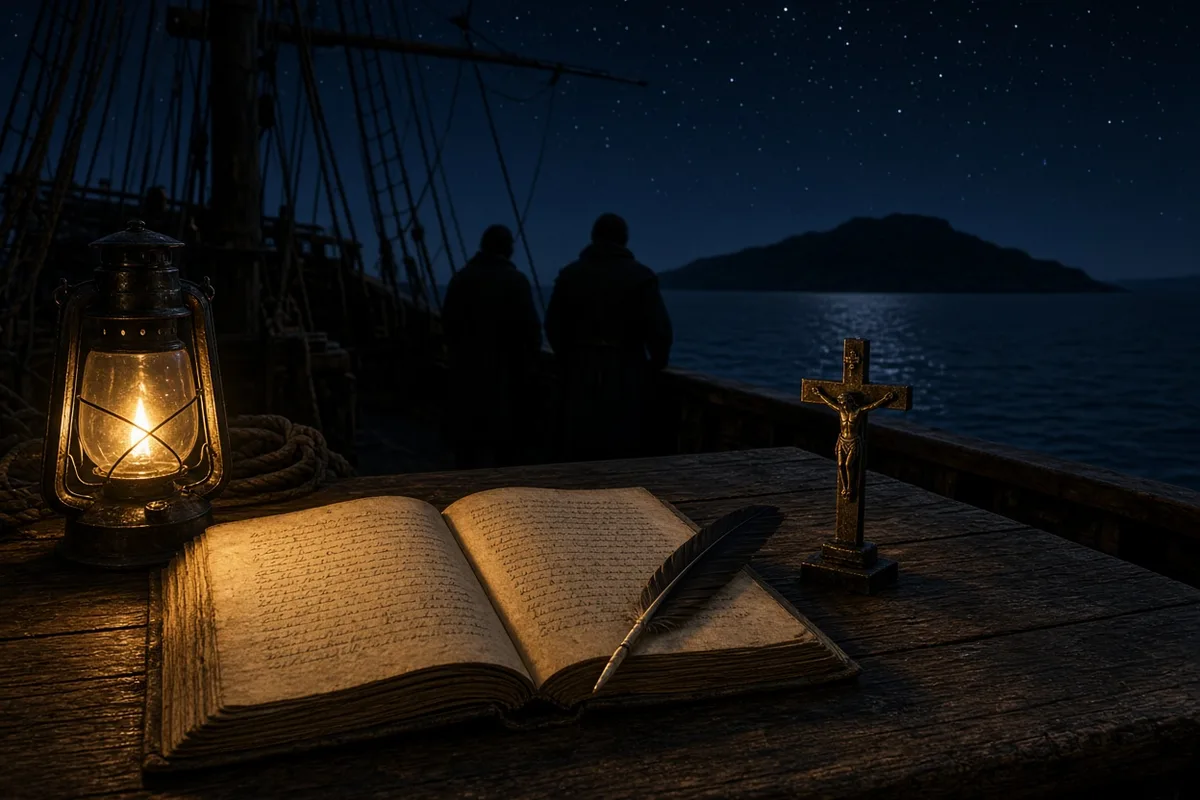
That evening Columbus wrote in his journal by lantern light. He noted the harbors, the height of the trees, the absence of iron. He also recorded that the people appeared ready to accept instruction in the faith. I heard him say the same words to the officers at supper.

Over the next days we moved from island to island. At each landing the same ceremony was repeated. The standard was raised, the names spoken, the claim made. The natives followed us from one beach to the next in their canoes. They learned a few of our words quickly and repeated them back. Columbus selected ten of them to come aboard. They were taken without resistance. Their faces showed confusion rather than anger when the ships weighed anchor and left the last island behind.
We continued west. Juana proved larger than we expected. Its coast ran for many leagues. We found good harbors and rivers that emptied into the sea with clean water. Hispaniola was sighted later. Its mountains rose higher than any we had seen since leaving Spain. Columbus ordered a settlement built near a sheltered bay. Thirty-nine men remained there with tools, seed, and instructions to trade for gold.
The return voyage began in January. The winds turned against us for weeks. One ship was lost. We reached Spain on the fifteenth of March. Columbus went at once to the court with his samples: small quantities of gold dust, brightly colored birds, and plants none of us could name. The ten natives traveled with him. Eight survived the crossing.
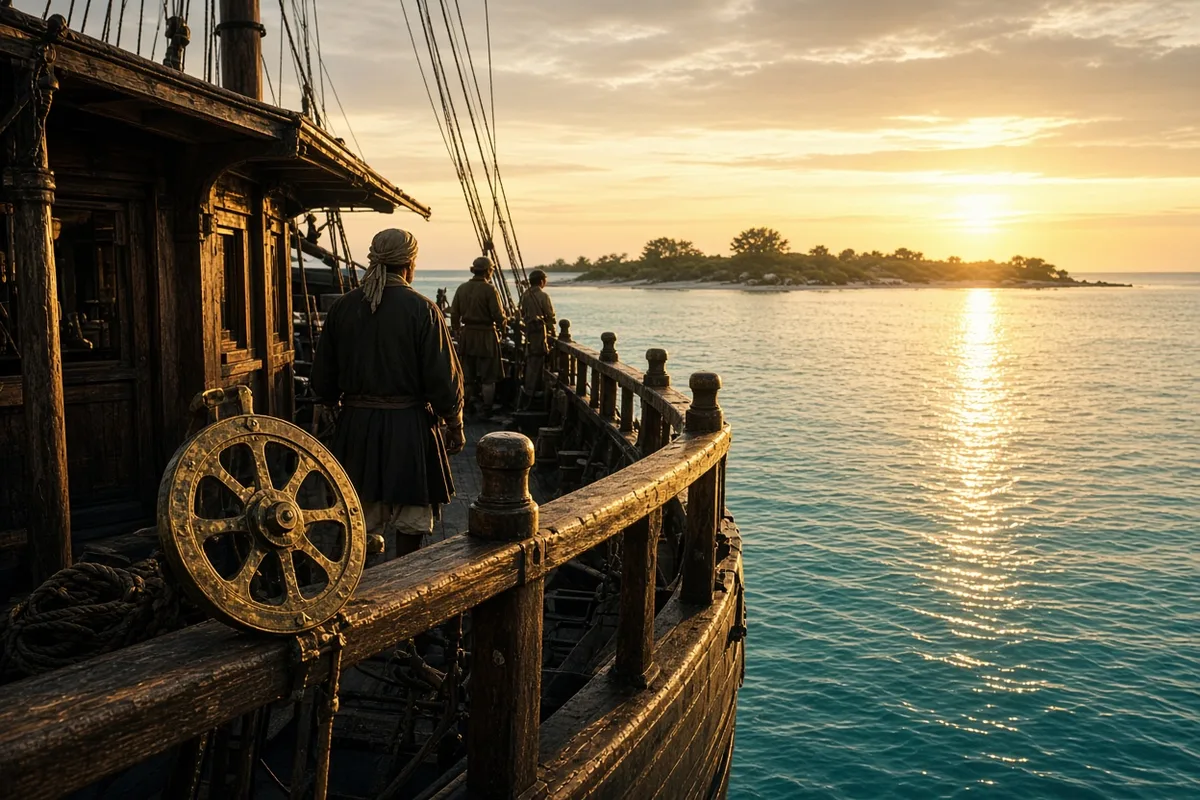
In Barcelona the letter he had written was copied and carried to Rome. It described the islands, the people, and the ease with which the land could be held. The first printing left out the Queen’s name. A second printing corrected the error within days. Copies spread through the ports of Europe before summer.
I remained with the ships through the fitting out of the second voyage. Some of the men taken from Guanahani asked to be returned. They were told the journey would continue. One of them died in Seville before the fleet sailed again. The others stayed aboard.
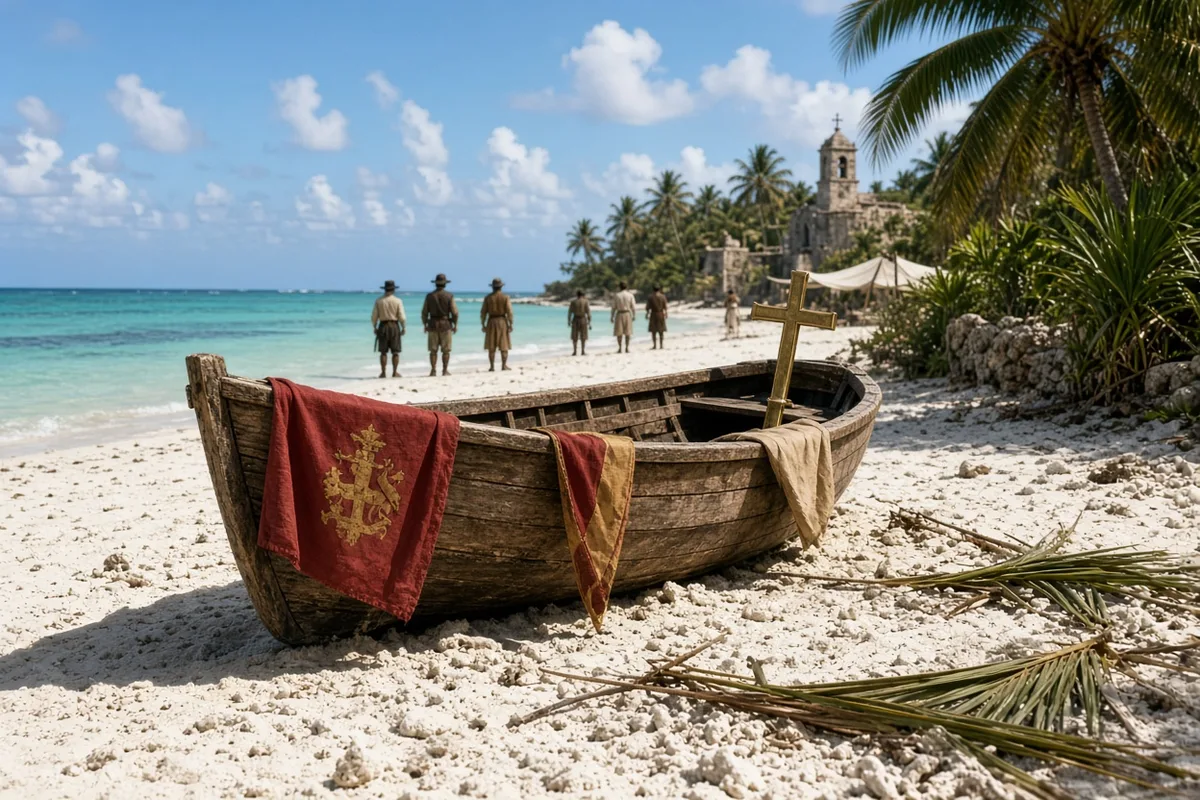
The standard that had been planted on the first beach was never brought back. Its cloth had rotted in the salt air. A new one was made for the next departure.
The new standard flew from the maintop of the flagship Marigalante when the second fleet cleared Cadiz on the twenty-fifth of September 1493. Seventeen vessels carried twelve hundred men, including the five hundred settlers who had signed on after reading the printed letter Columbus addressed to Luis de Santangel. In that letter he wrote that the people of the islands “are very simple and ready to receive our faith,” and the Crown had granted him the title of Admiral and Viceroy for the voyage that followed. I shipped again as able seaman under the same master who had steered the Santa Maria. We anchored first at La Gomera to take on water and goats, then raised the islands on the third of November. Columbus named the first landfall Dominica because it was Sunday. He sent a boat ashore at Guadeloupe and noted the Carib villages built on poles above the ground.
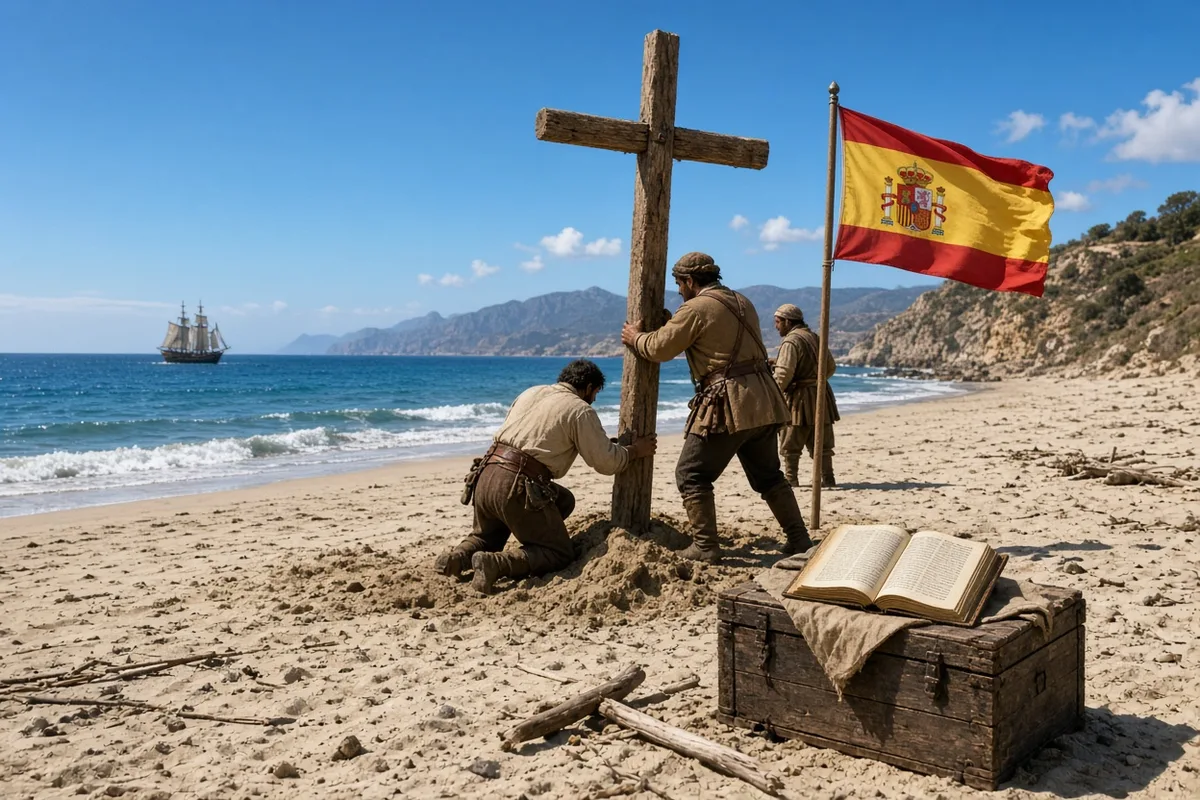
At La Navidad we found the fort burned and the thirty-nine men dead. The Taíno cacique Guacanagari told Columbus through interpreters that the Spaniards had quarreled among themselves, seized women, and been killed when they tried to take gold from another village. Columbus ordered a new settlement founded farther east on the north coast of Hispaniola and named it La Isabela after the Queen. On the sixth of January 1494 he laid the first stone of the church with his own hands while the notary Rodrigo de Escobedo recorded the act in the presence of the royal treasurer. By April the settlement held two hundred and fifty houses of thatch and timber, a storehouse for the wheat and barley seed brought from Castile, and a forge that produced nails from the iron cargo. I remained there three months cutting mahogany for the ships before the Admiral sailed back to Spain with the news that no passage to Cathay had yet been found.
The third voyage left Sanlúcar de Barrameda on the thirtieth of May 1498 with six vessels. Columbus took three south to the Cape Verde Islands and then west until, on the thirty-first of July, he sighted the mainland he called Trinidad because of its three hills. From the deck of the flagship he noted the strong current that set the ships northward through the Gulf of Paria and wrote in the journal that the water was fresh and must come from a great river. On the fifth of August he landed at the mouth of the Orinoco and claimed the territory for the Crown, naming it Isla de Gracia. The following year he was arrested at Santo Domingo by Francisco de Bobadilla, placed in irons, and sent to Spain on the ship La Gorda. The irons were removed only after the monarchs ordered his release at Granada in December 1500.
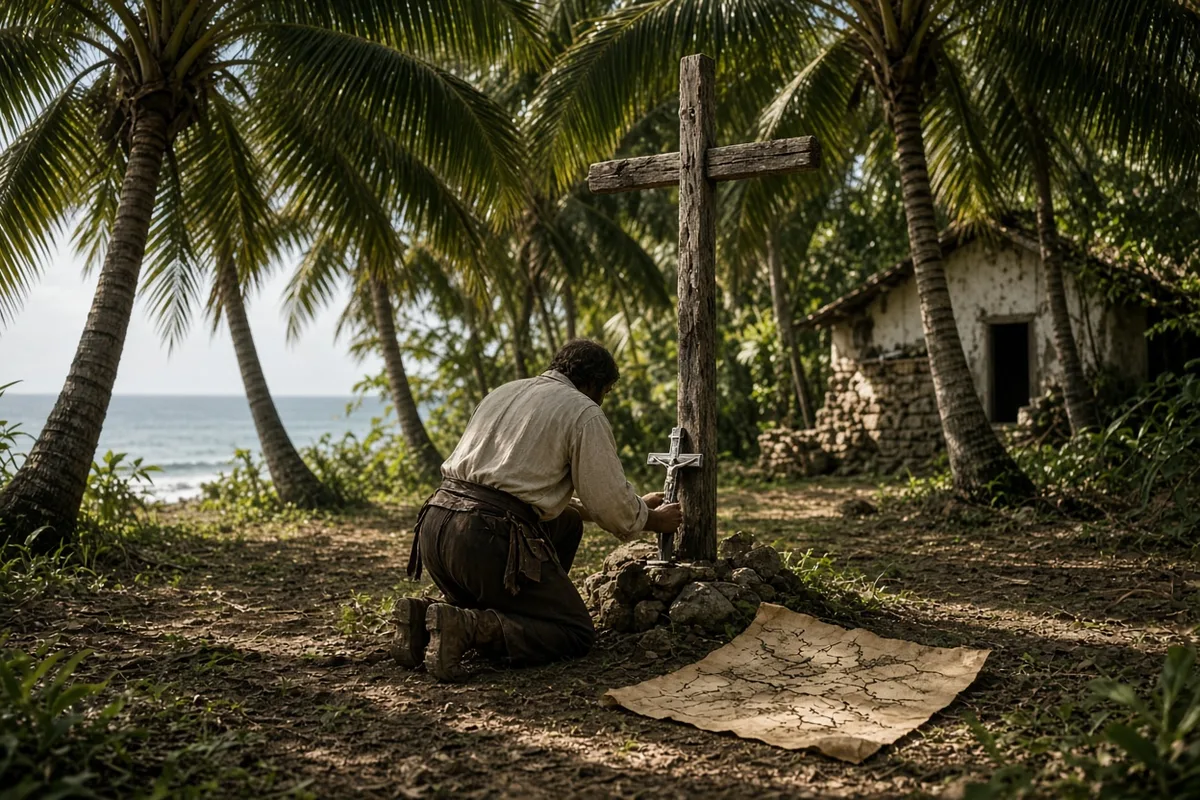
On the eleventh of May 1502 the fourth fleet of four caravels sailed from Cadiz. I was not aboard, having taken service on the Indio trade route between Seville and the Canaries, but letters from the pilot Pedro de Ledesma reached me two years later. Columbus had reached Martinique on the fifteenth of June, then turned to Hispaniola where Governor Ovando refused him shelter in the harbor of Santo Domingo. The fleet rode out a hurricane that sank twenty ships of the returning gold convoy, including the vessel carrying Bobadilla. Columbus continued to the coast of Honduras, sailed south to Panama, and spent the winter of 1503–1504 marooned at St. Ann’s Bay, Jamaica, after the ships were declared unseaworthy. The local cacique supplied cassava and fish until the caravel built from the wrecks reached Hispaniola in June 1504. Columbus returned to Spain on the seventh of November and took lodging at Seville.
He spent his last months in Valladolid petitioning the Crown for the restoration of his titles and the tenth part of all gold and pearls taken from the islands. On the twentieth of May 1506 he dictated a codicil to his will leaving one tenth of his income to the poor of Genoa and naming his son Diego as successor to the admiralty. He died two days later. The body was placed in the monastery of San Francisco and later moved to the Carthusian monastery of Las Cuevas in Seville. In 1537 the remains were taken to Santo Domingo and interred in the cathedral there beside those of his son Diego.
The island first called San Salvador appears on the 1507 Waldseemüller map as Guanahani, the name the Taíno had given it before the landing. By 1511 the settlement at Santo Domingo had grown to six hundred Spanish households and held the first royal audiencia in the Indies. The original La Isabela was abandoned after an earthquake and epidemic in 1496. Its stone foundations were quarried for the new city of Puerto Plata. The ten natives taken in 1492 had been baptized in Barcelona; only one, named Diego Colón, returned with the second voyage and served as interpreter until his death near Santo Domingo in 1514.
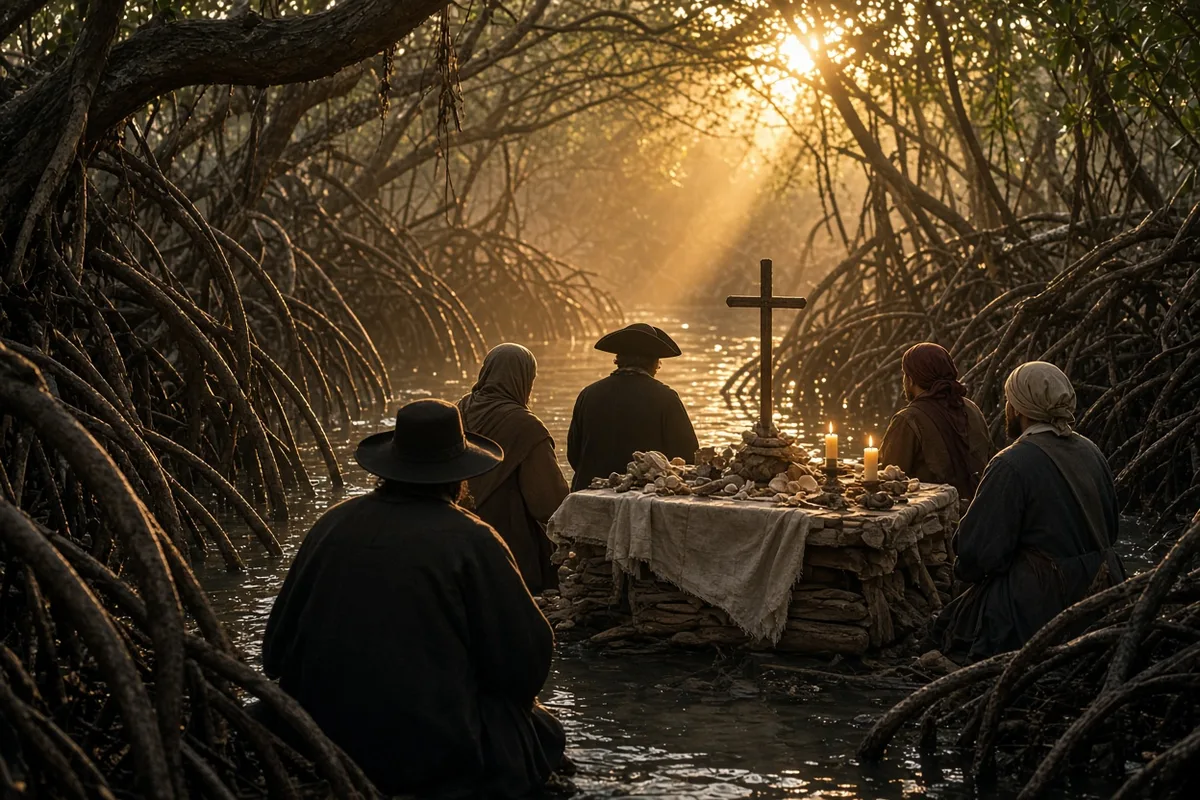
In 1796 the Spanish government ordered the remains removed from Santo Domingo to Havana. They were placed in the cathedral there until 1898, when they were transferred to Seville and deposited in the cathedral’s Capilla de San Antonio. A marble slab marks the site with the inscription “Here lie the bones of Cristóbal Colón.” In 1992 a monument of concrete and steel was completed on the site of the first landing at what is now called San Salvador in the Bahamas; its base holds a time capsule containing copies of the 1493 letter to Santangel and soil from the beach where the standard was planted. The last recorded image of any participant from the first voyage is a 1513 woodcut portrait of the interpreter Diego Colón printed in the Seville edition of Peter Martyr’s Decades.
The 1513 woodcut shows Diego Colón standing before a table of open folios in the Seville printing house of Jacobo Cromberger, his right hand resting on a copy of the Decades opened to the page describing the first landing. The block was cut by an unnamed artisan whose initials appear as a small “F” in the lower margin, and the edition numbered four hundred copies, of which twenty-seven are recorded in the 1523 inventory of the Colegio de Santa Cruz in Valladolid.
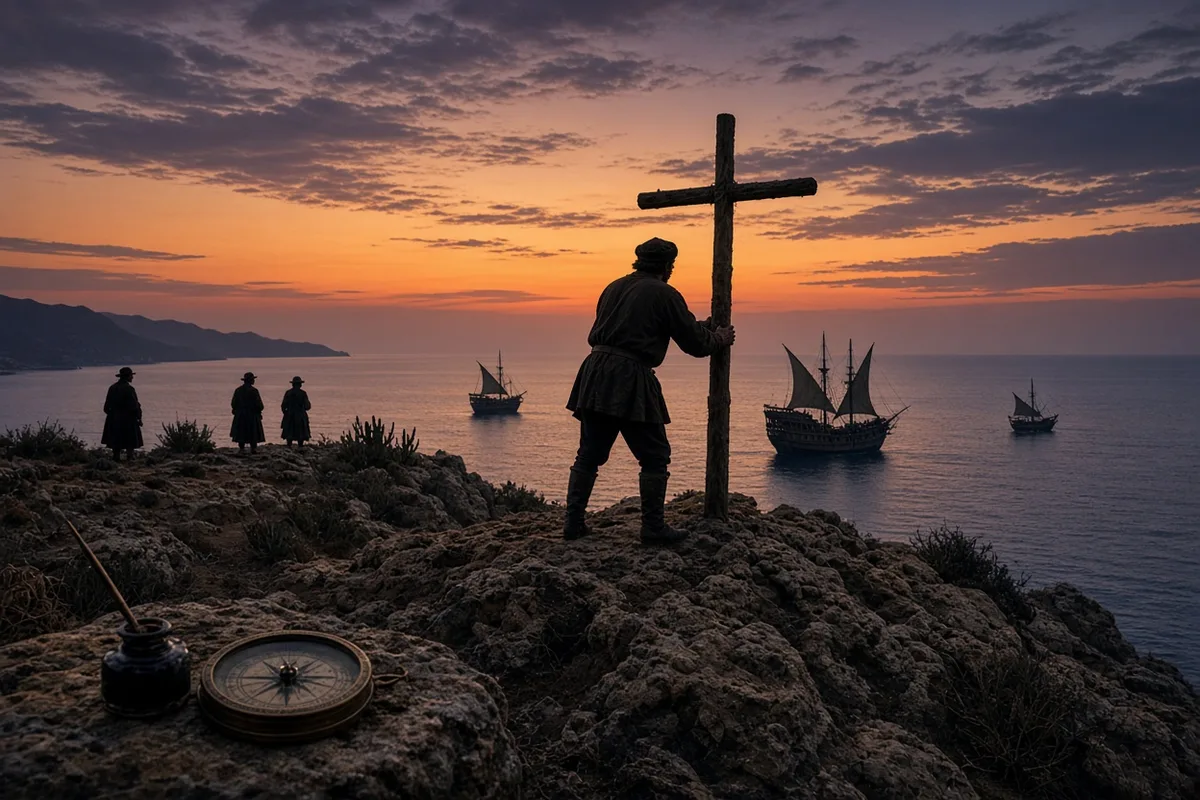
After 1514 the remaining nine men taken from Guanahani in 1492 disappear from the ledgers of the Casa de Contratación except for a single entry dated 9 March 1518 noting that one, called Pedro, received four reales for guiding a caravel to the harbor of San Juan de Puerto Rico. In the same year the Audiencia of Santo Domingo ordered the construction of a stone church on the site of the original La Navidad, its foundations measured at seventy-two feet by thirty-four feet and paid for with twenty-three marcos of gold taken from the mines at Concepción de la Vega.
By 1536 the island of Guanahani had been granted in encomienda to the heirs of the pilot Juan de la Cosa, who had sailed on the first voyage; the grant lists forty-two Taíno tributaries still living in two villages and required each to deliver one arroba of cassava flour every quarter to the factor in Santo Domingo. The Waldseemüller map of 1507 was reprinted in 1513 with the name corrected to “Isla de San Salvador,” and a copy reached the library of the Colegio Mayor de San Bartolomé in Salamanca, where it is annotated in the hand of the cosmographer Martín Fernández de Enciso with the latitude 24° 30′ north.
In 1629 the English ship Warwick, captained by Daniel Elfrith, anchored off the same beach and recorded in its log that the island was “low and sandy with a great lake in the middle,” after which the name Guanahani was replaced on English charts by “Watling’s Island.” The Spanish cathedral in Santo Domingo was damaged by earthquake on 2 December 1562; its records note that the lead coffin containing Columbus’s remains was opened and the bones examined by the dean, who counted eight ribs and a fragment of the right femur before resealing the casket.
When the remains were moved from Havana to Seville in 1898, the transfer document signed by the captain-general listed three sealed tin boxes weighing 47 kilograms in total, accompanied by a 1796 certificate from the bishop of Santo Domingo attesting to their identity. The 1992 monument on San Salvador consists of a 64-meter concrete cross whose base contains a stainless-steel capsule holding a facsimile of the 1493 Santangel letter printed by Pedro Posa in Barcelona and a sample of beach sand collected on 12 October 1991 by the Bahamas Department of Archives.
The last known image of any member of the 1492 crews is a 1584 engraving by Crispijn van de Passe the Elder, published in Antwerp as part of the series “Portraits of Famous Navigators,” which depicts the pilot Peralonso Niño, who had steered the Niña on the return voyage; the plate is inscribed “Peralonso Niño, piloto de la Niña, 1502” and was struck from a copper plate measuring 18 by 12 centimeters, of which 312 impressions were recorded in the publisher’s stock book before 1600.