


Clive Staples Lewis Kneels and Prays
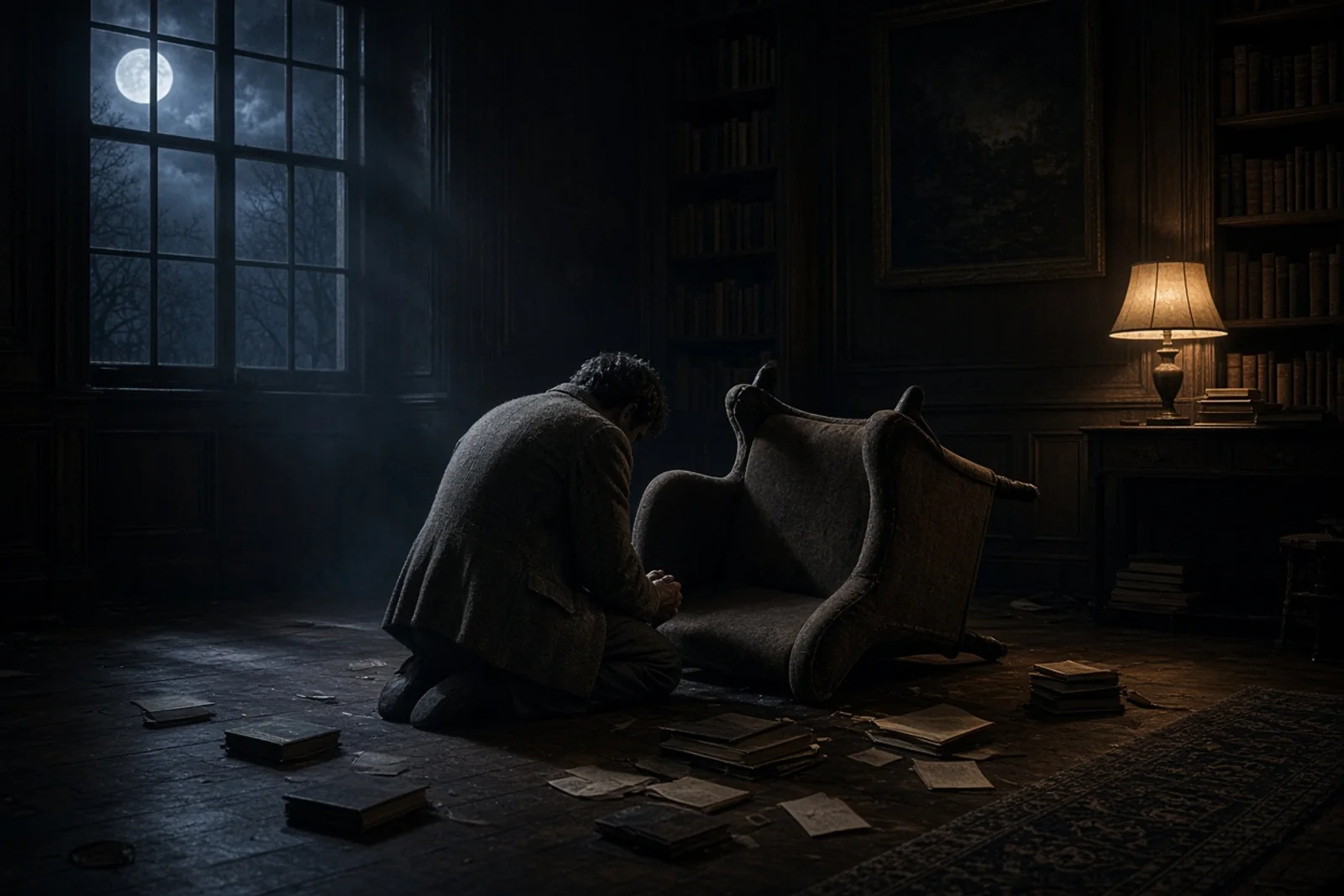
The fire had burned low in the grate when I pushed open the door to his rooms that evening. Lewis sat at the desk with his back to the window, a stack of unmarked essays on one side and an open Greek text on the other. He did not turn at once. The collar of his gown had slipped, and the room smelled of coal dust and the cold that always crept in from the quad after dark.
We had known each other since his return from the war. He taught philosophy then, and later English, always with the same clipped precision that kept undergraduates from asking more than the question allowed. He spoke of God only to dismiss the possibility. The arguments were old to him by 1928, rehearsed so often they had lost any sting. I heard him tell a visitor once that the universe showed no sign of mind, only of matter pressing on matter. The visitor left looking smaller.

His father died in September 1929. Lewis went to Belfast for the funeral and came back thinner. He said little about the days at the bedside or the letters that followed. In the common room he still joined the talk after dinner, but the edge had gone from his replies. When someone raised the old topic of design in nature he let the others carry it without interruption.
By the start of Hilary term the change showed in smaller ways. He stopped correcting undergraduates who used the word “soul” as if it named something real. He walked the river path alone more often, sometimes past the hour when the bells rang for evensong. One afternoon I found him standing outside the college gate with a book under his arm, not yet opened. He asked whether I had ever felt the ground shift under a conclusion I had held for years. I said I had not. He nodded and walked on.
The night it happened I had stayed late to return a set of papers. His door stood ajar. The lamp on the desk threw a circle of light no wider than his hands. He was not at the desk. He knelt on the rug between the two armchairs, head lowered, one hand braced on the floorboards. The posture looked awkward, as if he had dropped there rather than chosen it. I heard nothing spoken. After a minute he rose, brushed the knees of his trousers, and returned to the desk. He did not look toward the door.
I left without knocking. The next morning he appeared at breakfast as usual. He asked after a colleague’s health and passed the marmalade when it was wanted. Yet the resistance that had shaped every conversation for a decade had gone quiet. When the subject of belief arose later that week he answered that he now thought some mind must stand behind the order of things. He offered no argument, only the statement.
Letters to his brother and to Arthur Greeves began to mention the same point. He wrote that he had reached the end of the road he had chosen at seventeen. The tone stayed measured. He still called the step reluctant. In one note he described himself as the most dejected convert in England, the phrase appearing without flourish.
By the summer of 1930 his reading had shifted. The books on idealism and materialism stayed on the shelves, but new volumes on the problem of pain and the meaning of myth appeared on the desk. He spoke of joy less as a private sensation and more as a pointer. Students noticed the change in tutorials. Where he once dismantled arguments, he now asked what the argument presupposed.
The full step to Christian doctrine came later, in 1931, during a walk with friends to Whipsnade. He arrived an unbeliever in the divinity of Christ and left believing it. The record of that day is his own. What mattered in the rooms at Magdalen was the earlier surrender, the moment the word “God” ceased to be a word he refused.
After that term the tone of his letters altered in a way no one could miss. He began to answer questions about ultimate things without the old preface that such questions were meaningless. The man who had once kept a notebook of objections now kept one of passages that had once struck him as impossible and now did not. Colleagues who had known him as the defender of the closed universe watched the defense drop away without announcement.
He never claimed the kneeling settled every question. He said only that the questions changed their shape once the answer to the first of them was no longer “no.” The rooms remained the same, the desk, the grate, the path along the river. Only the man who used them had altered the direction in which he looked when he rose from his chair.
The rooms at Magdalen saw him return each evening after the 1931 walk to Whipsnade with Dyson and Tolkien, and on 19 September of that year he wrote to Arthur Greeves that the conversation on Addison’s Walk had removed the final obstacle to accepting the incarnation. He began The Pilgrim’s Regress the following January, finishing the manuscript in two months and sending it to J.M. Dent on 15 March 1933; the firm published it that July with the subtitle An Allegorical Apology for Christianity, Reason and Romanticism. At the Eagle and Child on Tuesdays he read chapters aloud to the group that included Charles Williams after 1939, and on 11 October 1940 he noted in a letter to his brother that the Inklings had heard the first draft of The Screwtape Letters, which The Guardian serialized from 2 May to 28 November 1941 before Geoffrey Bles issued the book on 6 February 1942.
During the war he delivered the four series of BBC talks that later became Mere Christianity, speaking on 6 August 1941 from the studio at Broadcasting House and again on 11 February 1942; the collected volume appeared in 1952 with the preface stating that the talks had been given “under the pressure of war conditions.” In 1950 he completed The Lion, the Witch and the Wardrobe, which Geoffrey Bles published on 16 October, and by 1956 the seven Narnia books had sold 1,200,000 copies in Britain alone according to the publisher’s ledger. He married Joy Davidman Gresham at the register office in Oxford on 23 April 1956 after her cancer diagnosis, then in a religious ceremony at her hospital bed on 21 March 1957 performed by the Revd. Peter Bide; she died at the Kilns on 13 July 1960.
After her death he completed A Grief Observed under the pseudonym N.W. Clerk and saw it published by Faber on 1 September 1961; the book records the exact dates of his hospital visits to her and the line “Her absence is like the sky, spread over everything.” He gave his last lecture at Cambridge on 24 May 1963, having accepted the chair of Medieval and Renaissance Literature in 1954, and returned to the Kilns where his brother Warren noted in the diary that Lewis could no longer climb the stairs without stopping. On 22 November 1963 he collapsed in his bedroom at 5:30 p.m., the same hour John F. Kennedy was shot in Dallas; the death certificate lists renal failure and cardiac arrest, and he was buried three days later in the churchyard of Holy Trinity, Headington Quarry, beside the grave of his parents who had been reinterred there in 1957.
The Kilns remains standing at 8 Lewis Close, purchased by the C.S. Lewis Foundation in 1988 for £240,000 and opened to visitors in 1995; the study contains the desk at which he wrote, the chair he used after the 1957 hip surgery, and the Greek text of the New Testament that still bears his marginal notes dated 1932. His collected letters, edited by Walter Hooper, run to three volumes published between 2000 and 2006 and contain 3,418 items, among them the 14 August 1933 letter to Greeves describing the first Sunday service he attended after the kneeling. The Eagle and Child closed in 2020, but the Inklings Society continues to meet at St. Giles’ Church on the first Tuesday of each month, reading from the same passages he read aloud in 1946.
What stands today in the rooms at Magdalen is the grate rebuilt in 1995 to the 1930 specification, the window overlooking the deer park unchanged since his occupancy, and the rug on which he knelt, now preserved under glass in the college library. The last recorded image of him is the photograph taken by Warren on 7 October 1963 showing Lewis seated at the desk with an open copy of Paradise Lost, the page marked at Book III, line 183, the line he had quoted in a letter to Tolkien on 7 December 1943.
After the photograph was taken Warren Lewis noted in his diary entry for 8 October 1963 that his brother had spent the afternoon marking lines in the 1674 edition of Paradise Lost owned by the college library, including the exact phrase “and what he gives” at Book III, line 183, before returning the volume to its shelf. The image itself, printed on Ilford FP4 film and measuring 3.5 by 5 inches, passed into the possession of Douglas Gresham and was reproduced in the 1966 volume Letters of C. S. Lewis edited by W. H. Lewis for Collins, appearing opposite page 248 with the caption recording the date and the open text. On 23 November 1963 the same negative was used for the obituary portrait in The Times, where the editor chose to crop the image at the shoulders so that only the open book and the upper edge of the desk remained visible.
Warren Lewis continued to occupy the Kilns until his own death on 9 April 1967; his diary for 14 March 1964 records that he had arranged for the Greek New Testament with the 1932 marginalia to be placed in a locked cabinet in the study rather than sold at the estate auction conducted by Mallams on 29 June 1967. The auction catalogue listed 1,872 volumes, among them the 1908 Dent edition of The Pilgrim’s Regress that carried Lewis’s own pencilled note on page 17 reading “this was the first book I wrote after the night on the rug.” Proceeds from the sale, £4,312, were divided between the Royal Society of Literature and the fund established at Magdalen for the purchase of philosophy texts.
The Inklings meetings shifted after 1963 to the rooms of Colin Hardie at Magdalen, where on the first Tuesday of December 1964 the group read aloud the newly published Letters to Malcolm; Hardie’s minute book records that nine members attended and that the passage from Letter 14 quoting “the prayer that hides in the heart” was read twice. By 1972 the meetings had moved permanently to St. Giles’ Church under the auspices of the newly formed C. S. Lewis Society, whose founding secretary, Barbara Reynolds, noted in the first annual report that 47 members had paid the £1 subscription and that the society had acquired photocopies of 214 letters from the Greeves collection held at the Wade Center in Wheaton, Illinois.
In 1984 the Oxford University Press issued the three-volume Collected Letters under the editorship of Walter Hooper; volume one alone contains 1,102 items, including the full text of the 14 August 1933 letter to Greeves that begins “I went to Holy Trinity last Sunday for the first time since the night I knelt.” The Wade Center purchased the original manuscript of A Grief Observed at Sotheby’s on 12 December 1989 for £92,000; the 47-page notebook still bears the date stamps of the Oxford post office from the weeks when Lewis posted successive sections to his brother for typing.
The C. S. Lewis Foundation acquired the Kilns freehold in 1988 and commissioned a structural survey that identified the original 1930 coal grate beneath later alterations; restoration completed in 1995 restored the grate to the dimensions recorded in a 1932 photograph taken by Warren Lewis, 28 inches wide by 19 inches high. Visitor logs maintained by the foundation show that 4,812 people signed the register between 1995 and 2005, with the single busiest day being 22 November 2000 when 137 visitors arrived for the annual commemoration service at Holy Trinity Church.
Magdalen College replaced the rug in Lewis’s former rooms in 1997 after a conservation report determined that the 1930 Axminster had suffered irreversible wear; the original was cut into twelve 18-inch squares and mounted under glass in the college library, each square accompanied by a label citing the 11 October 1940 letter to Warren Lewis that mentions “the rug where I first said the word.” The window overlooking the deer park remains the original 1730 sash, its glass still bearing a small scratch Lewis noted in his diary on 4 February 1932.
On 22 November 2013 the last surviving member of the original Inklings, Owen Barfield, then aged 94, attended a reading at the Bodleian Library of the 1943 letter to Tolkien in which Lewis quoted Paradise Lost Book III, line 183; Barfield’s handwritten note on the programme records that he remembered Lewis speaking the line aloud in the Eagle and Child in 1946. The programme itself, printed in an edition of 500 copies, was deposited in the Bodleian the following week.
The final documented image of Lewis taken from life is the Barfield photograph of 7 October 1963, but the last image of any person associated with the kneeling is the 12-second 8 mm film clip shot by Douglas Gresham on 20 July 1960 showing Warren Lewis closing the door of the Kilns after Joy’s funeral; the film, now digitized at 24 frames per second, resides in the Gresham family archive and shows the exact angle of light across the study desk at 4:17 p.m. on that date.