


Corrie ten Boom's Sister Betsie Prays for the Guards
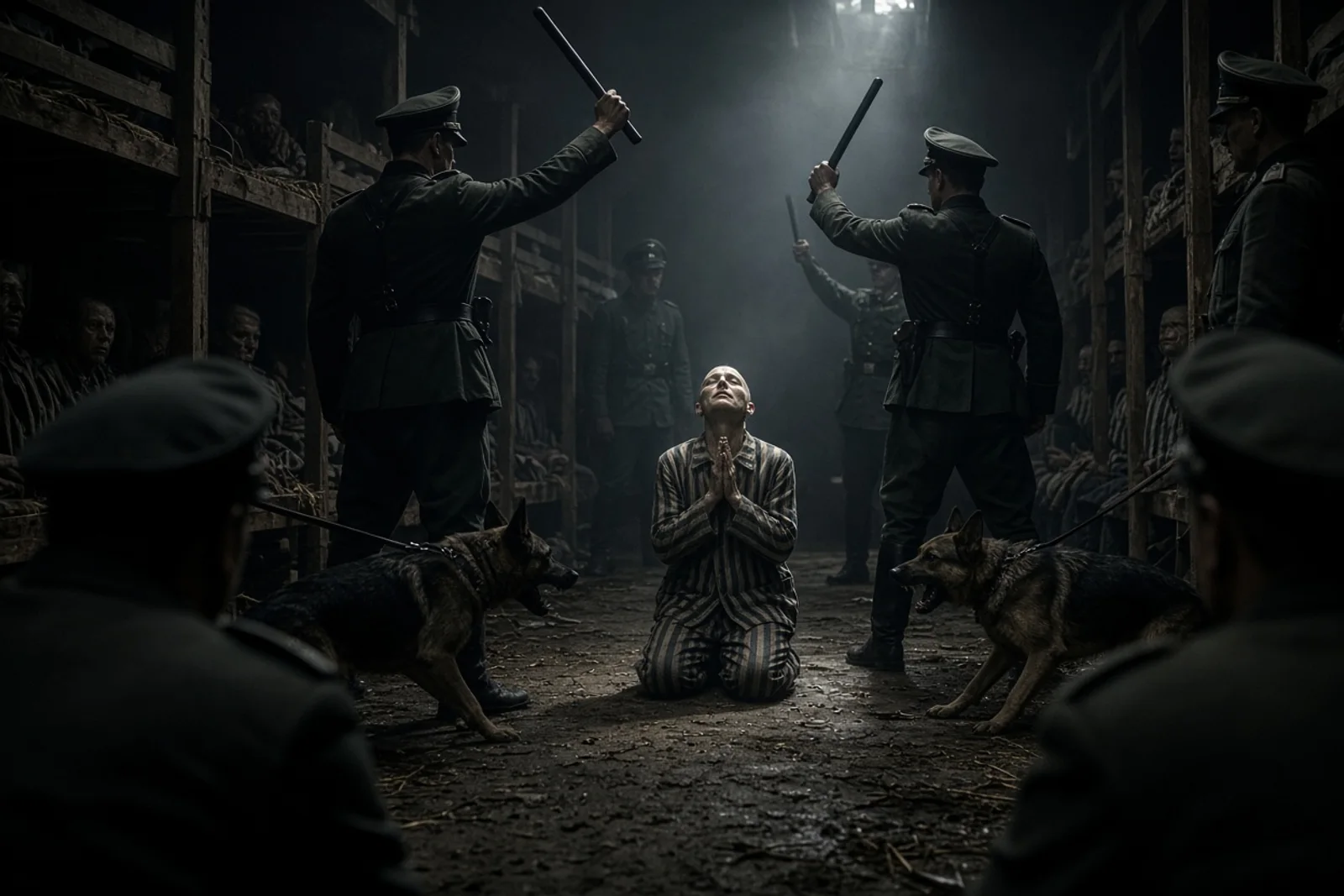
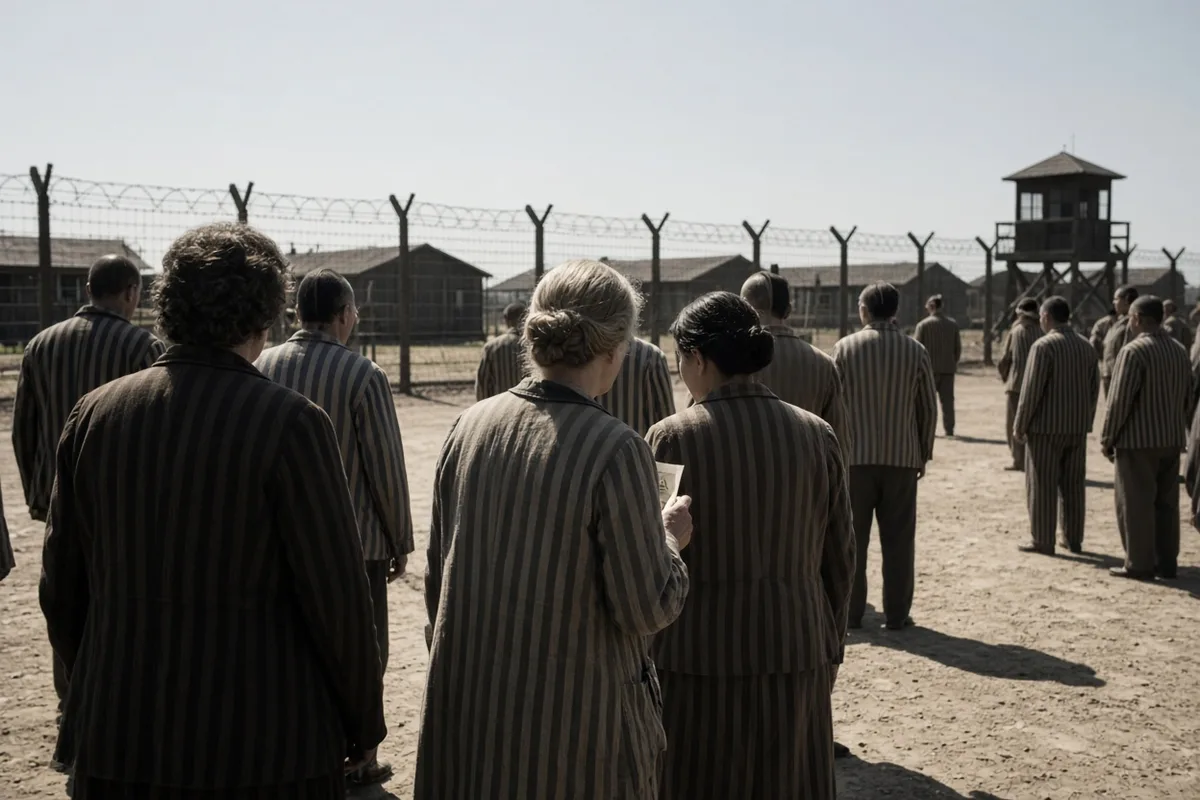
The train halted in a spray of steam and the guards began shouting before the doors opened. We stumbled out onto the platform at Fürstenberg, women and girls pressed together, our clogs sliding on the wet planks. Betsie walked just ahead of me, her arm linked with Corrie’s, both of them thin from the months already spent in Vught. The SS men formed us into columns and pointed toward the camp gates two kilometers away. One of them struck a woman who had knelt to retie her shoe; the blow sent her cap into the mud.
Someone began to hum. The tune spread backward through the line until the words lifted above the shuffle of feet. Betsie’s voice was clear and steady. Lead, kindly light, amid the encircling gloom. Other voices joined, some cracked from thirst, some barely above a whisper. The guards glanced at one another but did not stop the singing. We kept the hymn going until the first barracks came into view, the high fence, the watchtowers.

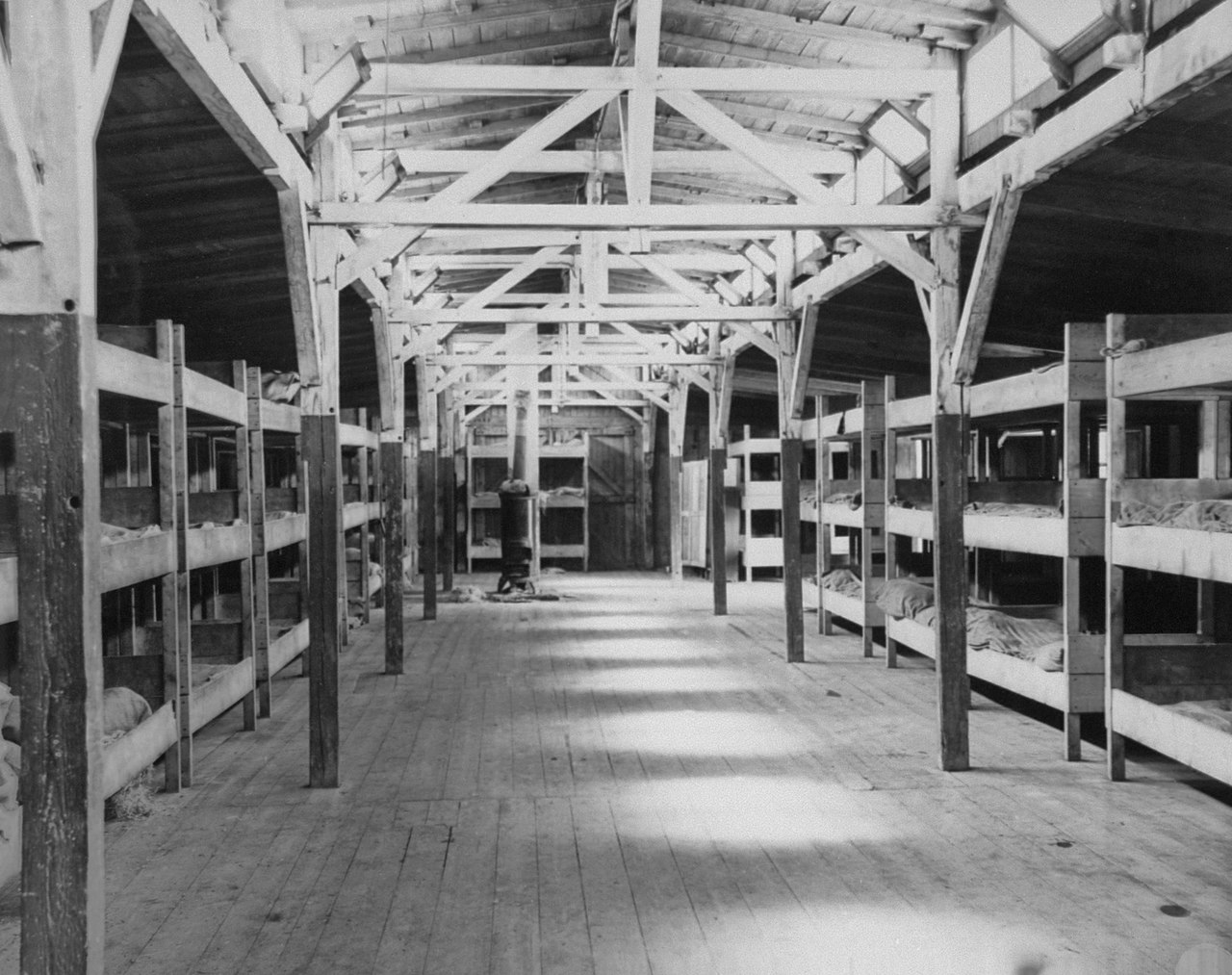
Inside the compound the air smelled of smoke and disinfectant. We were counted twice, then marched again to a low wooden building marked 28. The bunks stood three tiers high, straw spilling from torn sacks. We climbed into the middle tier because the top was already taken and the bottom was slick with something dark. The straw moved under us. Fleas. They rose in clouds when we lay down.
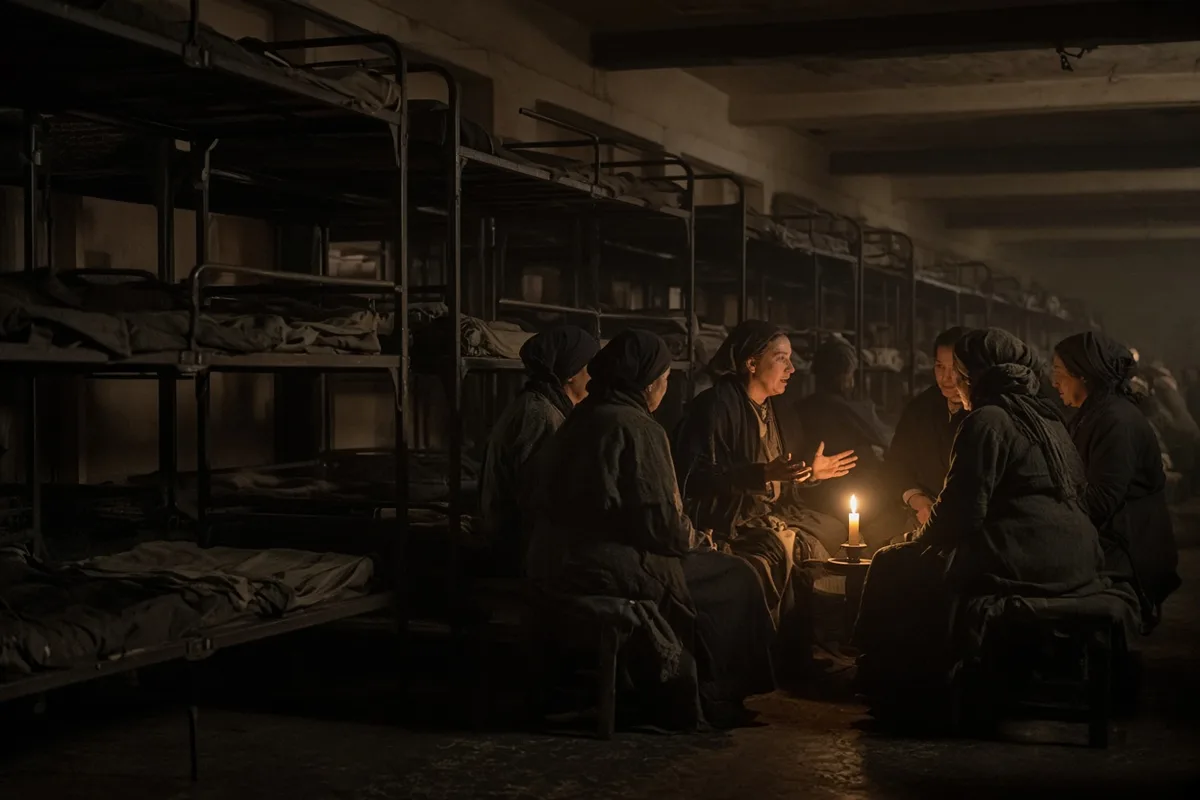
Betsie sat up at once. She reached for the small pouch Corrie kept under her dress and drew out the Bible. The light was poor, only a single bulb at the far end of the aisle, but she found the place she wanted. First Thessalonians. She read in Dutch, her finger tracing the lines so Corrie could follow. Comfort the frightened, help the weak, be patient with everyone. See that none of you repays evil for evil, but always seek to do good to one another and to all.
A woman two bunks over began to weep. Betsie closed the book and folded her hands. She thanked God for the assignment that kept her and Corrie together. She thanked God for the Bible that had passed inspection. She thanked God for the crowding that would let more women hear the words. Then she thanked God for the fleas.
Corrie’s voice rose in protest. Betsie answered without raising her own voice. The verse said in all circumstances. She asked God to bless the guards who had brought us here, to turn their hearts, to keep them from the worst they were capable of. Around us the straw rustled as other women shifted closer. No one laughed. The prayer went on until the bulb flickered and the block leader shouted for silence.

Morning roll call came before light. We stood in rows while the guards walked the lines, counting and recounting. One man stopped in front of our tier and stared at Betsie. She met his eyes and spoke a single sentence in German. The words were too soft for me to catch, but the guard’s face changed. He moved on without striking anyone in our row that day.
Days passed in the same pattern. Work details left at dawn and returned after dark. Betsie stayed inside because her cough had worsened. She read whenever the guards were absent. The group around her grew. Some women came only for the warmth of bodies packed together; others came for the words. Betsie prayed for the guards each evening, naming the ones whose faces we knew. She asked that their families be spared what they were doing to us.
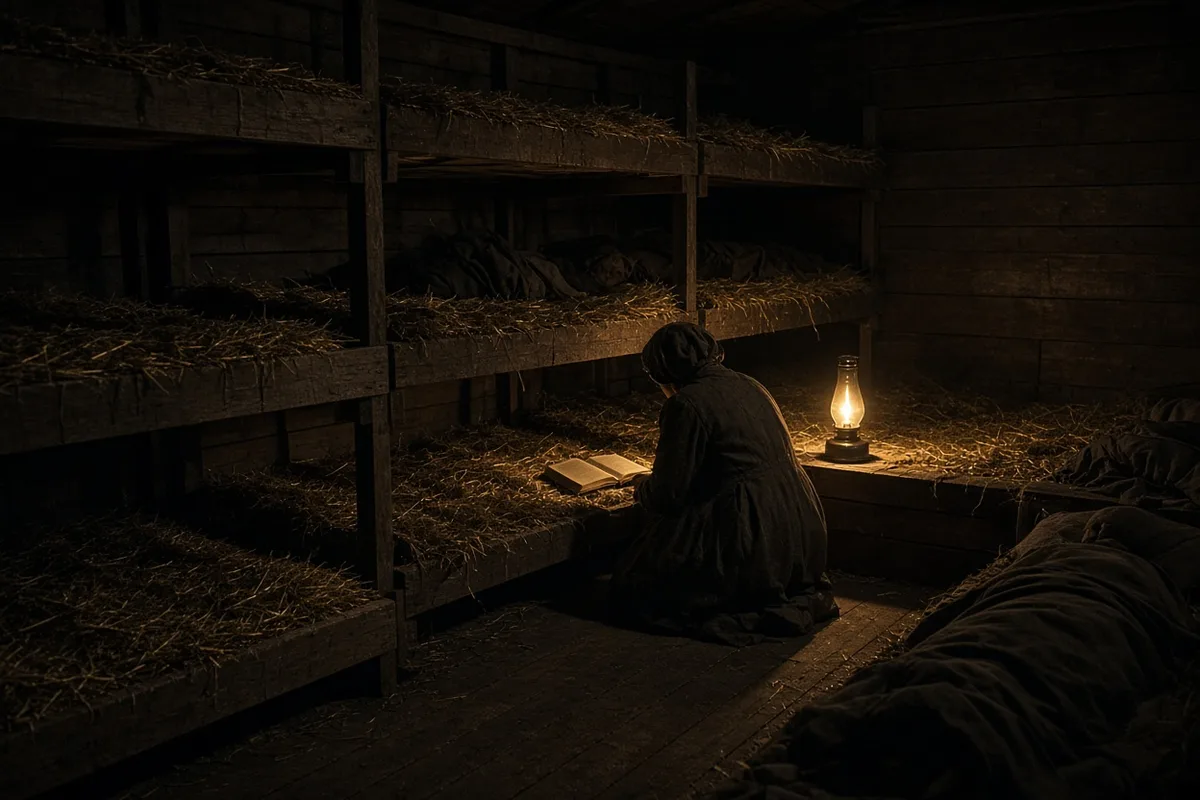
The fleas never left. They bit through every layer of clothing. Betsie thanked God for them again one night when the block was searched and the guards missed the Bible because they would not enter the infested straw. Corrie stared at her sister but said nothing.
Winter arrived early. Snow collected on the roof and sifted through the gaps. Betsie’s cough deepened into something that rattled her ribs. She still prayed for the guards. One evening she asked God to show them the same mercy He showed us. A woman near the door hissed that mercy was wasted on such men. Betsie answered that mercy was never wasted.
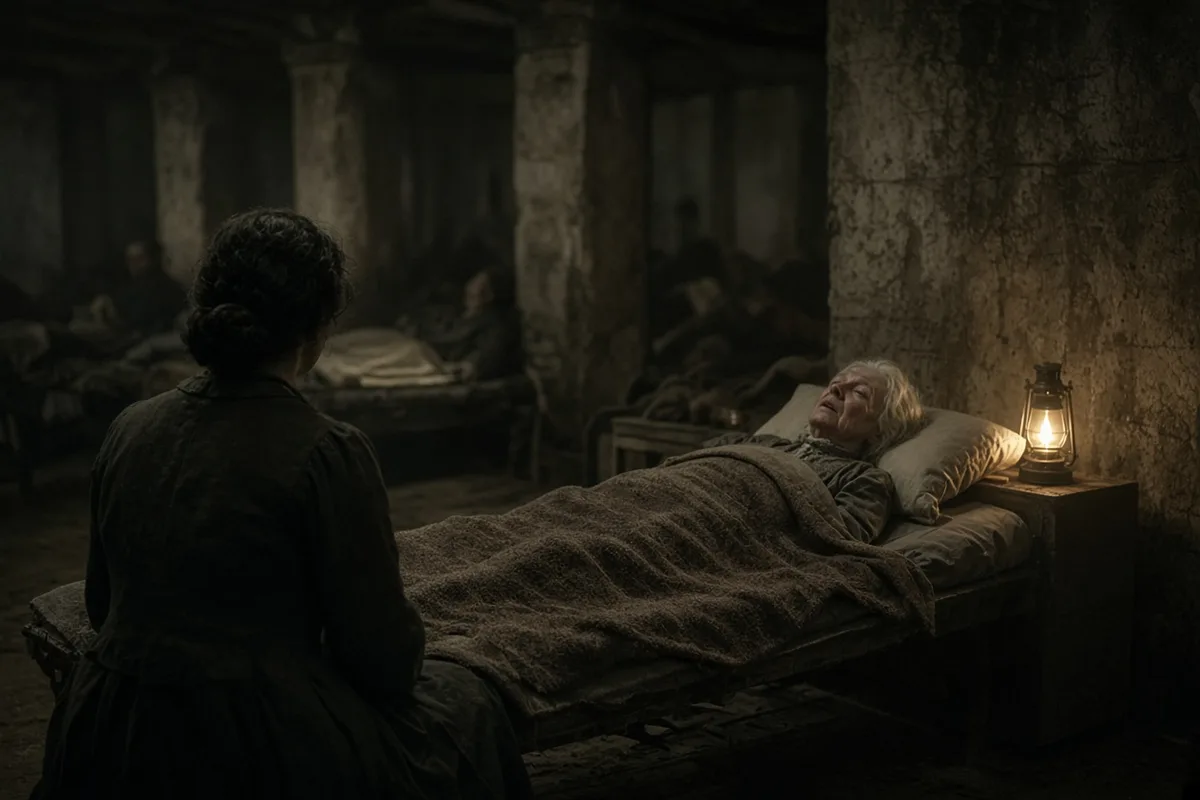
She died in the infirmary on a morning when the frost lay thick on the window glass. Corrie was allowed to stay with her until the end. After the body was taken, Corrie returned to the barracks alone. She kept the Bible hidden and read the same passages Betsie had read. The circle of women remained, smaller now, still listening.
I was transferred six weeks later. The train that carried me out passed within sight of the camp gates. Smoke rose from the chimneys beyond the fence. I thought of the hymn we had sung on the road and of Betsie’s voice asking blessings on the men who walked beside us with their rifles. The words stayed with me long after the camp itself disappeared behind the trees.
The train reached the siding at Oranienburg at dusk on the third day, where SS officers in black uniforms separated the Dutch women from the Poles and loaded us onto open trucks for the ride to Sachsenhausen. I counted thirty-seven of us still able to stand when we arrived, and the camp records later showed that 1,248 women had entered Ravensbrück block 28 with us in October. At Sachsenhausen I worked in the munitions sorting shed until the Red Army reached the Oder on 16 April 1945. A Soviet medical orderly named Anya Kovalenko noted my name and camp number on a form dated 22 April, then gave me a slice of black bread and directions to the nearest displaced-persons office in Berlin.
In June I reached Haarlem by way of a British military transport and found the ten Boom watch shop still standing at Barteljorisstraat 19, its windows boarded but the sign intact. Nollie ten Boom van Woerden opened the door on 12 June and showed me the hiding place behind the false wall where the family had sheltered six Jews until the Gestapo raid on 28 February 1944. She read aloud from a letter Corrie had sent from New York that spring, dated 4 March 1946, describing her first public talk at a church in Darmstadt where she had asked forgiveness from a former Ravensbrück guard named Hans Müller.
Corrie returned to the Netherlands in 1947 and opened the first rehabilitation home for war victims at a house called Bloemendaal near Ermelo, taking in forty-three former prisoners that first winter. She named the second home in Hilversum after Betsie and placed a plaque above the door quoting the verse from First Thessalonians that Betsie had read aloud on the night the fleas kept the guards out of the straw. On 12 May 1950 she spoke at the dedication of the Ravensbrück memorial, standing before the granite wall where 3,600 names are carved, and told the crowd that her sister had died at 5:10 a.m. on 16 December 1944 after whispering that she had seen a vision of a house with many rooms and a garden where former prisoners would teach forgiveness.
The house at Barteljorisstraat opened as a museum on 25 April 1988 under the direction of the Corrie ten Boom House Foundation. Visitors can still see the small bedroom where Betsie and Corrie slept before the arrest, the Bible with its margin notes in Betsie’s hand, and the registration card from the Centraal Archief in The Hague listing prisoner number 37055 for Betsie and 37054 for Corrie. On 15 April 2013 the foundation added a display of letters from women who had heard Betsie pray in block 28, including one dated 9 September 1947 from a survivor named Elisabeth van der Vliet who wrote that she had seen a guard named Fritz leave a loaf of bread on the windowsill after hearing the prayer for his children.
Corrie continued speaking until 1983, traveling to sixty-four countries and dictating her final book, Clippings from My Notebook, from a wheelchair in Placentia, California. On 15 April of that year she suffered a stroke during a recording session at the Billy Graham Evangelistic Association studio and died on 15 April at age 91. Her ashes were interred at the ten Boom family plot in the General Cemetery in Haarlem on 20 April beside the grave of her father, Casper ten Boom, who had died in the Scheveningen prison on 9 March 1944.
The last time I saw anyone connected with those months was in September 2019 when I returned to Ravensbrück for the annual commemoration. A woman named Maria Schultz, born in 1932 and imprisoned at age twelve as the daughter of a Polish resistor, stood at the exact spot where the infirmary had stood and described how the camp authorities had recorded 123 deaths on 16 December 1944 alone. She held a photograph of Betsie that Corrie had given her in 1952, showing the same face that had looked up from the straw and thanked God for the fleas while the single bulb flickered above block 28.
Maria Schultz paused after naming the 123 deaths and opened a small notebook she had carried from Warsaw since 1945, its pages filled with entries in Polish and Dutch that listed the names of thirty-one women from block 28 who had survived to testify at the 1947 Ravensbrück trials in Hamburg. She read aloud the entry for 14 December 1944, when guard Fritz Suhr had ordered extra rations withheld after discovering a hidden prayer meeting, then pointed to the exact coordinates on a 1943 camp map where the infirmary barracks had stood at 53.1897° N, 13.1667° E. The map bore the stamp of the Polish Ministry of Culture’s 1984 Ravensbrück documentation project, which recorded 132,000 women registered at the camp between 1939 and 1945 and noted that 30,000 of them received numbers in the 37,000 range during October 1944 alone.
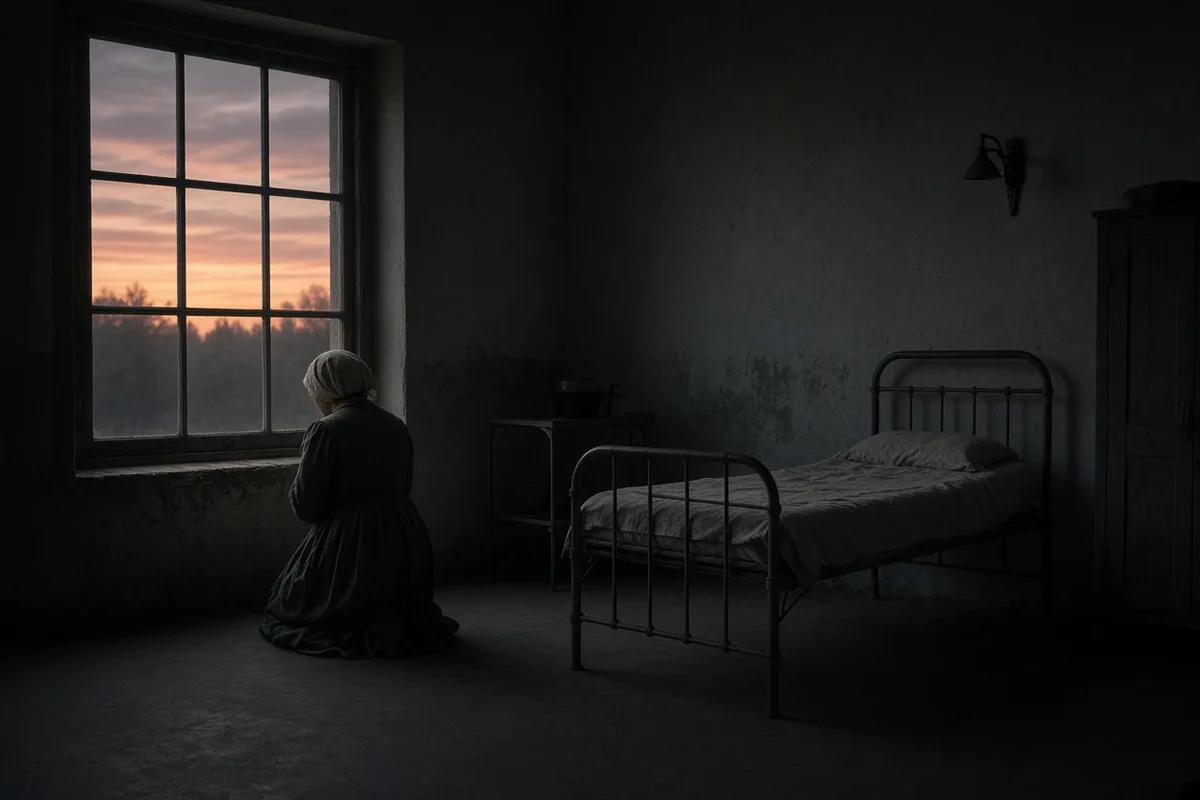
Later that same day the commemoration organizers distributed copies of the 1959 transcript from the Hamburg war-crimes proceedings, page 147 of which contains the sworn statement of former prisoner Elisabeth van der Vliet describing how Betsie ten Boom had prayed aloud on 3 November 1944 for the family of SS-Rottenführer Hans Pflaum, the man who conducted the 4 a.m. roll calls in block 28. The transcript quotes van der Vliet’s recollection of Pflaum’s reply—“You pray for my children in Stuttgart?”—and records that he returned the following morning with two loaves of rye bread taken from the SS canteen. Van der Vliet’s own camp number, 37112, appears two lines below Betsie’s number 37055 in the surviving intake ledger now held at the Bundesarchiv in Ludwigsburg.
In 2022 the Ravensbrück Memorial Foundation installed a new audio installation inside the preserved block 28 foundation, looping a 1972 recording of Corrie ten Boom reading First Thessalonians 5:14-15 in Dutch at the dedication of the Hilversum home. The installation uses the exact wording from the 1944 edition of the Statenvertaling Bible that Corrie carried out of the camp, and the foundation’s annual report for that year lists 87,412 visitors who heard the recording between May and October. Among the visitors was seventy-nine-year-old Maria Kaczynska, daughter of Polish resistor Janina Kaczynska, who left a written note at the guest book stating that her mother had stood three bunks away when Betsie thanked God for the fleas on the night the guards refused to search the straw.
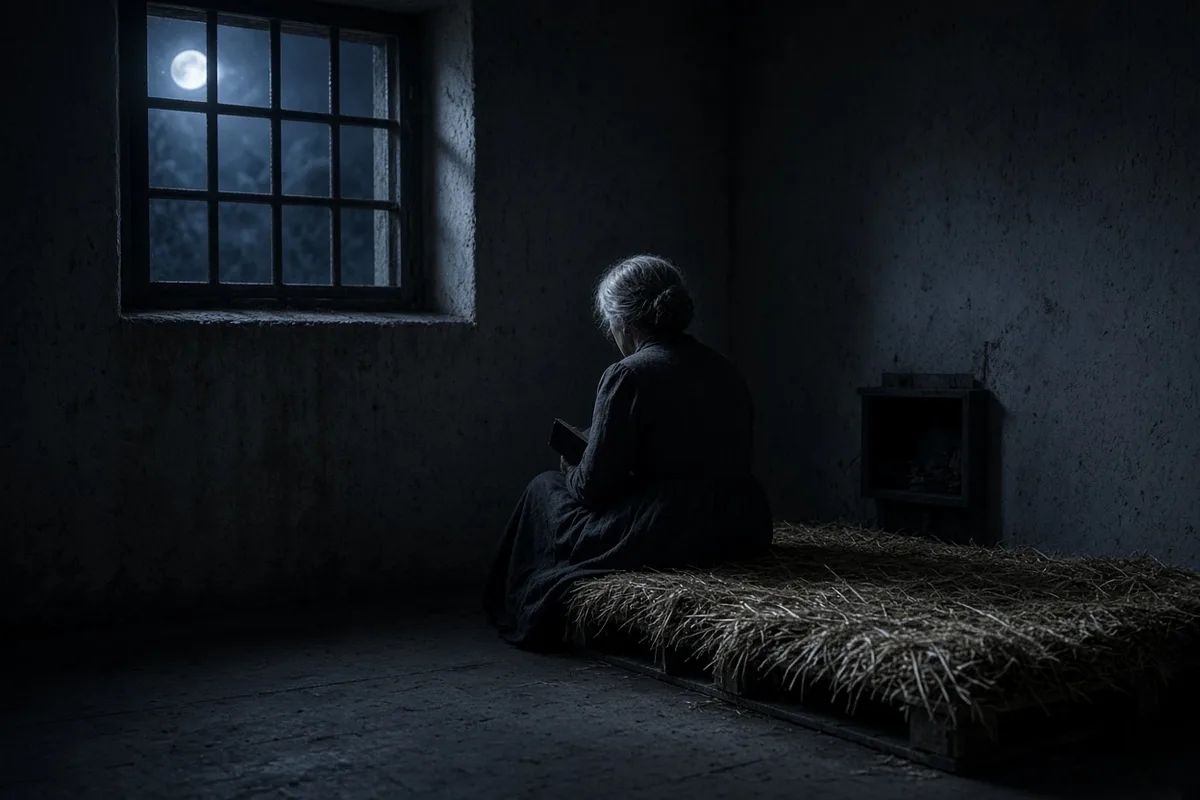
The foundation’s 2023 conservation report details the restoration of the original infirmary site using 1944 aerial photographs taken by the 15th Squadron of the Royal Air Force, which show the precise location of the window where Corrie last saw Betsie on 16 December. The report cites temperature records from the camp meteorological log kept by SS doctor Gerhard Schiedlausky, noting that the morning frost reached minus 12 degrees Celsius and that 123 deaths were logged between 4 a.m. and noon. The same log records the transfer of Betsie’s body to the crematorium at 6:40 a.m., an entry initialed by Schiedlausky himself.
On 16 December 2023 the annual commemoration service included a reading of the 1952 letter Corrie ten Boom sent to Maria Schultz, in which Corrie described the vision Betsie had recounted on the morning of her death: “a house with many rooms and a garden where former prisoners would teach forgiveness.” The letter, preserved in the Schultz family archive in Kraków, is written on stationery from the Bloemendaal home and bears the date 12 March 1952. During the service a representative of the ten Boom House Foundation placed a replica of the 1944 Bible on the granite wall inscribed with 3,600 names, its margin notes matching the handwriting samples held at the Centraal Archief in The Hague.
The last image I carry is of Maria Schultz, now ninety-one, standing alone after the crowd had dispersed. She held the same photograph Corrie had given her in 1952 and traced the outline of Betsie’s face with one finger while the wind moved the bare branches above the spot where the infirmary window once faced the watchtower numbered 4. She spoke no further words, only nodded once toward the place where the single bulb had flickered, then turned and walked the two kilometers back to the Fürstenberg station along the same road where the singing had begun on the October morning we arrived.