



Cosmic scale that quietly recalibrates ordinary human worries

In 60 seconds
- One short book cannot create scientific literacy, yet it can install enough cosmic scale to alter how daily concerns get weighed.
- The earliest universe is reconstructed by running tested physics backward, with precision and open gaps inside the same story.
- Four forces at specific relative strengths make every structure possible, from nuclei to galaxy clusters.
- Atoms heavier than hydrogen and helium in living bodies were forged in stars and scattered by stellar deaths.
- Most mass is undetected dark matter, and expansion accelerates under dark energy that dominates the energy budget yet stays unexplained.
- Starlight’s fingerprints underwrite nearly every distant claim, and repeated contact with scale should loosen tribal grip without killing motivation.
The big idea
Tyson argues that the universe’s basic workings—from the first instants through the forces and stellar furnaces that built the elements to the still-unexplained dominance of dark matter and dark energy—can be grasped in outline without a science degree. That outline is worth having because cosmic scale and the habit of checking claims against converging evidence shrink petty disputes and turn careful evaluation into a civic habit, not only a scientific one.
The book in brief
No one becomes scientifically literate from a paperback read in transit. Tyson treats that limit as the starting point, not a failure. He aims for a portable taste of how the universe works so that distant headlines stop feeling opaque and cosmic scale becomes a quiet background hum to ordinary days. The prize is a feeling common among working astrophysicists: being humbled and enlarged at the same time.
The essays move loosely through cosmic time and then by topic. Early pieces show how known physical law, not guesswork, lets physicists speak about eras before atoms existed, while still naming the puzzles that sit inside an otherwise confirmed frame. From there the book turns to the small set of forces whose particular strengths allow complexity at all, then to the stellar furnaces that turn those forces into the chemistry of planets and bodies.
Later chapters face what cannot be touched or seen directly. Invisible mass appears required to hold large structures together. Empty space itself appears to push expansion faster. Both claims rest on chains of independent, indirect evidence rather than captured particles or finished mechanisms, and Tyson uses that pattern to teach how scientific confidence works when the thing itself stays out of reach.
A methodological turn then isolates the single tool behind almost every distant measurement: decoding light. With that tool established, planets around other stars move from pure theory into a catalog built by rigorous indirect methods, reframing life-elsewhere as a problem of probability and detection. The closing movement leaves physics for psychology and civic life. Repeated contact with time, distance, and cosmic indifference, Tyson claims, should make people more generous and less consumed by small grievances without draining the will to act.
The through-line is method as much as fact. Check claims against evidence. Tolerate uncertainty. Let correct orders of magnitude recalibrate arguments about personal, national, and human importance.
Context
Neil deGrasse Tyson published these short, standalone essays in 2017 for readers who have coffee-break windows rather than free weekends. The book mattered because it took physics normally locked behind jargon and put dark energy and neutron stars onto bestseller lists then dominated by self-help.
The key ideas

1
Taste, not full literacy
A single short book cannot teach astrophysics, but it can install enough cosmic perspective to change how a reader weighs daily concerns.
Tyson concedes the obvious ceiling at once: one paperback creates no experts. His narrower goal is a usable taste of how the universe works, enough that news about black holes or dark matter can be followed without feeling lost, and enough that cosmic scale sits as background to ordinary life.
He frames the project as democratizing a professional feeling—being simultaneously humbled and enlarged by contemplating vast structure. The form matches the claim. Short, self-contained essays, loosely ordered by cosmic chronology and then by topic, each fit a spare moment and need no prior chapter to make sense.
That structure is an argument. Understanding, he holds, does not require a semester, only repeated small exposures to undiluted correct ideas. Literacy itself is cast less as memorized facts than as a habit of checking claims against evidence, extending predictions, and living with uncertainty.
In practice: The everyday glance at a night sky quietly misjudges distances and scales by many orders of magnitude; correcting that misjudgment, Tyson argues, recalibrates claims about personal, national, and human importance.

2
Law-bound first instants
The universe’s earliest moments can be reconstructed with startling precision because physical law, not guesswork, constrains what could have happened in the first fractions of a second.
Tyson walks from the Planck epoch through inflation to the later formation of quarks, protons, and neutral atoms. The central claim is that this is not speculative storytelling. Each stage is pinned by known physics run backward and checked against observable relics.
Inflation enters as the leading account of why the sky looks so uniform and why geometry appears flat, yet he flags it as a model still under test rather than settled fact. Confidence about times before atoms existed rests on a methodological point: equations for particles and forces at high energies have been probed in accelerators, so extrapolating them backward is legitimate, not fantasy.
Precision and candor travel together. An unresolved detail can sit inside an otherwise well-confirmed arc without collapsing the whole frame. That tone—trust the scaffold, name the gaps—sets the rest of the book.
In practice: A tiny matter-over-antimatter asymmetry left matter as the survivor after mutual annihilation; the why remains open inside an otherwise tightly constrained early story.

3
Four forces, one recipe
Only four fundamental forces, in specific relative strengths, are responsible for every structure from atomic nuclei to galaxy clusters.
Slightly stronger gravity
Stars race through fuel and collapse before life-supporting planets can form
Actual relative strengths
Gravity stays weak up close yet rules large scales; nuclei, chemistry, and long-lived stars become possible
Gravity, electromagnetism, and the strong and weak nuclear forces exhaust the list. Tyson’s point is that their particular strengths relative to one another are what allow complexity to exist at all.
Gravity is weakest at short range yet dominates large scales because it only attracts and accumulates. Electromagnetism runs chemistry and light. The strong force binds nuclei against proton repulsion. The weak force governs radioactive decay and the nuclear reactions that power stars.
A thought experiment carries the load. Shift the relative strengths even slightly and the downstream world changes. Stars, planets, and biological chemistry are not separate subjects; they are what these four numbers do under different density and temperature. Learning the forces replaces a pile of disconnected facts.
He presents the values as observed facts about our universe’s constants, not proof of design, while leaving open why the constants take the values they do—the seed of a fine-tuning question that returns later.
In practice: If gravity were only slightly stronger relative to electromagnetism, stars would burn through fuel far faster and collapse before life-supporting planets could form; if the strong force were weaker, nuclei beyond hydrogen would not hold and carbon and oxygen would not exist.
4
Bodies built in stars
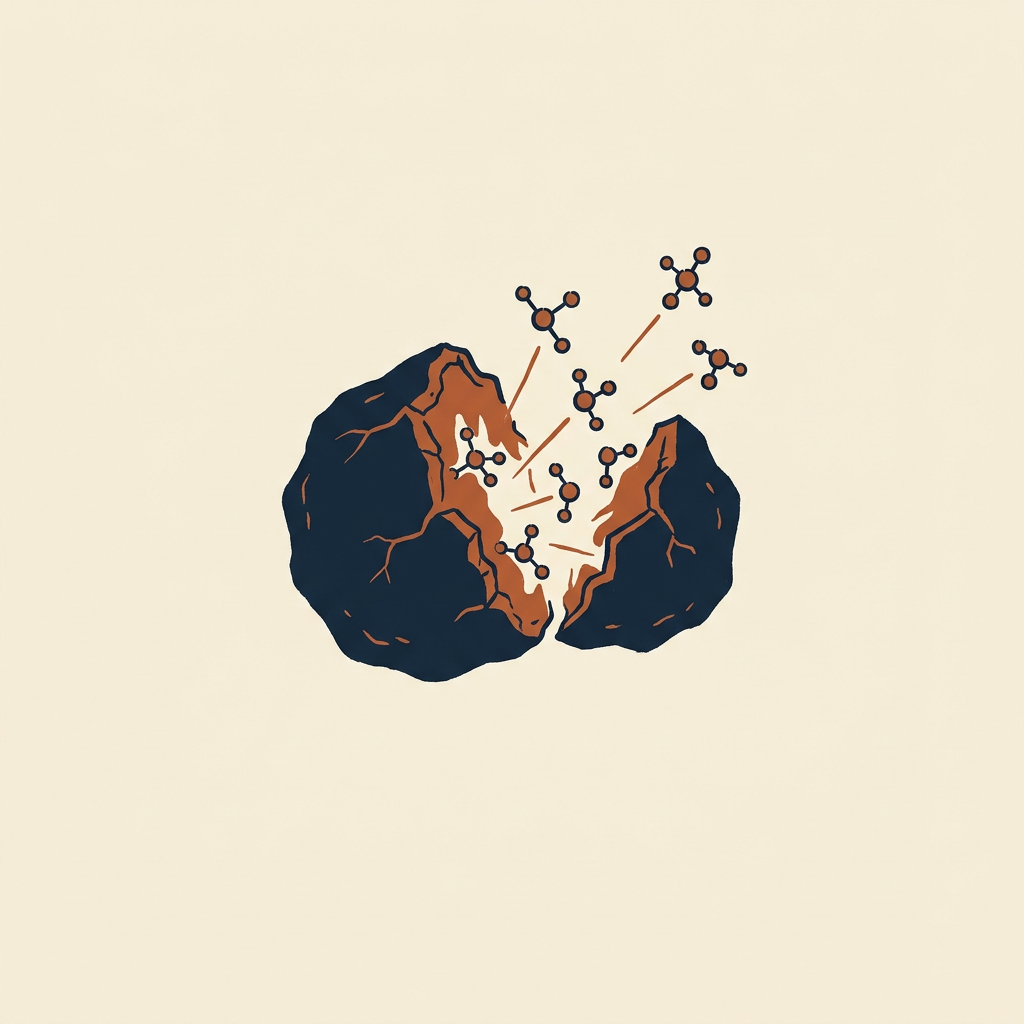
Every atom heavier than hydrogen and helium in a human body was manufactured inside a star and scattered into space by that star’s death.
Stellar nucleosynthesis is the literal engine behind the familiar line that people are star stuff. Stars fuse hydrogen into helium, then under rising gravitational pressure build carbon, oxygen, and heavier elements up through iron.
Past iron the ledger flips. Making gold or uranium costs more energy than fusion releases, so those elements need the extreme conditions of a supernova or a neutron-star collision. Mass decides fate: sun-like stars end as white dwarfs; heavier ones explode and seed the interstellar medium for the next generation of stars and planets.
The four forces set which reactions run at which temperatures and densities. Stars are simply large, hot furnaces that run them. The classroom periodic table becomes a map of stellar life cycles, and Earth’s chemistry a direct inheritance from stars that died before the Sun formed.
In practice: Fred Hoyle and collaborators in the 1950s framed how carbon forms in stellar interiors; the process was fine-tuned enough that Hoyle predicted a specific nuclear resonance in carbon before it was measured.

5
Invisible mass, solid case
Most of the universe’s mass emits no light and has never been directly detected, yet its gravitational effects are as well established as almost anything in astrophysics.
Tyson presents dark matter as a convergence, not a single lucky find. Separate methods point the same way, so doubt should move from existence to nature.
Galaxy rotation curves showed outer stars moving too fast for visible mass to bind them under standard gravity. Gravitational lensing maps mass that outweighs what telescopes see, especially in cluster collisions. Early-universe fluctuation patterns match observations only if far more dark matter than ordinary matter was present.
No dark-matter particle had been captured in underground detectors or produced at colliders as of the book’s writing; that absence is a real problem, not a footnote. Modified-gravity rivals usually fail to cover all the lines at once, which is why dark matter stays the mainstream stance. The chapter trains a larger lesson: confident claims may rest on abundant, consistent indirect evidence.
In practice: Vera Rubin’s 1970s spiral-galaxy rotation measurements, Bullet Cluster lensing, and cosmic-microwave-background patterns together imply roughly five times more dark matter than ordinary matter.
6
Empty space that pushes
Cosmic expansion is not slowing under gravity but speeding up, driven by a repulsive property of empty space that remains almost entirely unexplained.
The chapter extends the prior lesson on indirect evidence into stranger territory. Distant stellar explosions used as standard candles looked dimmer, hence farther, than a decelerating expansion predicted. The expansion rate appears to be increasing.
Theorists assigned the acceleration to dark energy, energy inherent to space itself. On current estimates it supplies roughly sixty-eight percent of the universe’s total energy content, dwarfing ordinary matter and dark matter combined. The name is largely a placeholder for an observed effect, not a finished mechanism; no one knows why space would repel or why the strength takes the value it does.
The mathematical form echoes Einstein’s 1917 cosmological constant, added to keep the universe static and later abandoned. Tyson’s larger point is sharp: inability to explain a cause does not erase strong evidence that the phenomenon is real.
In practice: In 1998 two teams studying Type Ia supernovae found them too dim for a decelerating universe; other methods later confirmed the acceleration even while the driver stayed unknown.

7
Light as the only sample
Nearly everything astrophysicists know about distant objects comes from analyzing light alone, because starlight carries a chemical and physical signature that can be decoded without a visit.
After claims about unseen mass and repulsive space, Tyson steps back to the tool that makes them possible. Pass light through a prism or grating and dark absorption lines appear at wavelengths tied to specific elements. Match the pattern and the distant object’s composition is known without any physical sample.
The same spectrum yields temperature, because hotter sources peak toward bluer light, and motion, through Doppler stretch or squeeze of the lines. That motion signature revealed that distant galaxies are systematically redshifted and that redshift grows with distance—the observational root of expansion, the Big Bang frame, and later dark-energy work.
One technique therefore underwrites almost every major claim in the book: stellar composition, exoplanet atmospheres, expansion itself, even black-hole mass estimates. Light that may have traveled billions of years becomes a measurement, not a guess.
In practice: Edwin Hubble’s 1929 finding that distant galaxies are redshifted in proportion to distance rests on reading those spectral shifts, and later expansion and dark-energy arguments depend on the same tool.

8
Planets by the thousands
Thousands of planets around other stars have turned questions about life elsewhere from philosophical speculation into active observational science.
For most of history, planets beyond the solar system were theory. A space telescope launched in 2009 helped turn them into a large confirmed catalog. Detection still leans on indirect methods because planets are faint and sit beside overwhelming stellar glare; only a handful have been imaged directly.
The transit method catches tiny periodic dimming as a planet crosses its star. The radial-velocity method catches the star’s slight wobble as a rhythmic Doppler shift in its spectrum—the prior chapter’s tool put to new work. Cross-checked indirect detection, Tyson insists, counts as real discovery.
The habitable zone marks orbital distances where surface liquid water could persist, yet he cautions that zone membership is not a life certificate; atmosphere, magnetic field, and geology matter and are harder to measure. He stays restrained on alien life: abundant Earth-sized worlds in the zone raise statistical plausibility without making intelligent life confirmed or even likely. Sheer numbers reframe the old question from pure if into probability and detection technology.
In practice: Kepler’s survey of a small sky patch, by extrapolation, implies hundreds of billions of planets in the galaxy alone.

9
Scale as civic habit
Repeatedly confronting the universe’s scale in time, space, and indifference should make people more generous, less tribal, and less consumed by small grievances, not less motivated.
The closing turn leaves mechanisms for consequences. Tyson lays out figures meant to be felt: on the order of a hundred billion galaxies, each with roughly a hundred billion stars; a cosmos about 13.8 billion years old, against which recorded human history is a fraction of a fraction of one percent; light still arriving from galaxies that has traveled since before Earth formed.
Internalizing those measures produces what he calls a cosmic perspective—a habit of setting disputes, borders, and status fights against a backdrop that makes most of them look small, without declaring them unimportant to the people inside them. The stance is clarifying rather than nihilistic.
He links the same habit to civic life. A public that understands evidence, uncertainty, and scale is better equipped to judge claims in politics and media, not only in science. He acknowledges only briefly that the emotional payoff is asserted through testimony and intuition more than controlled study; the chapter still binds the book’s physics into one reorientation of how a reader might weigh a place in the world.
In practice: Astronauts who have seen Earth as a single unbroken sphere from orbit often report a lasting shift in how they regard national boundaries and human conflict, a pattern noted across memoirs and interviews.
Key terms
- cosmic perspective The mental habit of measuring human disputes against the universe’s true scale in time and space so that many grievances shrink without becoming meaningless.
- inflation A theorized burst of exponential expansion in the universe’s first tiny fraction of a second, offered to explain uniformity and flatness, still under test.
- stellar nucleosynthesis The forging of elements inside stars by fusion, and of the heaviest elements in stellar deaths, that supplies the atoms in planets and bodies.
- dark matter Unseen mass inferred from gravity’s effects on galaxies, lensing, and the early universe, not yet detected as a particle.
- dark energy A placeholder name for the apparent repulsive property of empty space that drives accelerating expansion and dominates the energy budget.
- spectroscopy Splitting light to read absorption and emission lines that reveal a distant object’s composition, temperature, and motion.
- habitable zone The orbital range where liquid water could exist on a planet’s surface—necessary but far from sufficient for life.
- Type Ia supernovae Stellar explosions with consistent peak brightness, used as distance markers that revealed accelerating expansion.
What to do
- Trace one repeated astrophysics claim—dark matter, an exoplanet headline, the multiverse—back to the actual evidence and separate direct measurement from inference.
- When a small status fight or grievance spikes, deliberately recall one concrete scale fact, such as light that has traveled longer than Earth has existed, and notice whether the reaction shifts.
- Reading science news, ask whether the claim rests on one study or on multiple independent lines converging the way dark matter’s case does.
- Use a spare fifteen minutes to reread one short essay and write three sentences in plain words on what evidence supports its main claim.
- Before sharing a cosmic fact, check whether you can name the method—spectrum, lensing, supernova distance—that underwrites it.
Questions to think with
- Which everyday judgment of yours would change most if cosmic timescales sat as a permanent background hum?
- Where do you still treat a single line of evidence as settled when the book’s standard demands several independent methods?
- Does dark energy’s status as a named effect without a mechanism weaken its claim for you, or does the supernova evidence still compel?
- If abundant Earth-sized planets in habitable zones only raise statistical plausibility, what further evidence would actually move your view on life elsewhere?
- Can cosmic perspective reduce tribalism, or does that hope outrun what testimony can show?
The other side
The book names its own limit—accessible depth—then often trades depth for ease once topics turn truly hard; dark energy’s vacuum-energy discrepancy, inflation’s competing models, and the later Hubble tension get little or no grip, the essay format leaves cross-chapter links implicit, the humility-and-reduced-tribalism close rests on anecdote rather than strong evidence, and the messy self-correction of science receives less attention than finished results.
Who it's for
Commuters and parents who want real science in fifteen-minute windows, adults who left physics after high school and need the big picture without equations, and readers of perspective-shifting nonfiction who want cosmic scale to reframe daily anxiety.