


Dorothy Sayers' Public Confession of Faith
The train from London rattled through Kent fields still damp from morning rain. I sat across from Dorothy with a folder of notes on my lap, watching her light one cigarette after another. She had agreed to the commission only after three letters and a telephone call that lasted past midnight. Canterbury wanted a new play for their festival, and the names attached to previous years were the reason she finally said yes.
She spoke little on the ride. Her eyes stayed on the passing hedgerows. At the station a car waited, driven by a man from the cathedral chapter who kept glancing at her in the mirror as though expecting her to recite something. She gave him only directions to the hotel. That evening she walked the precincts alone, hands in the pockets of her coat, stopping once to look up at the damaged stone where the fire of 1174 had left its mark.
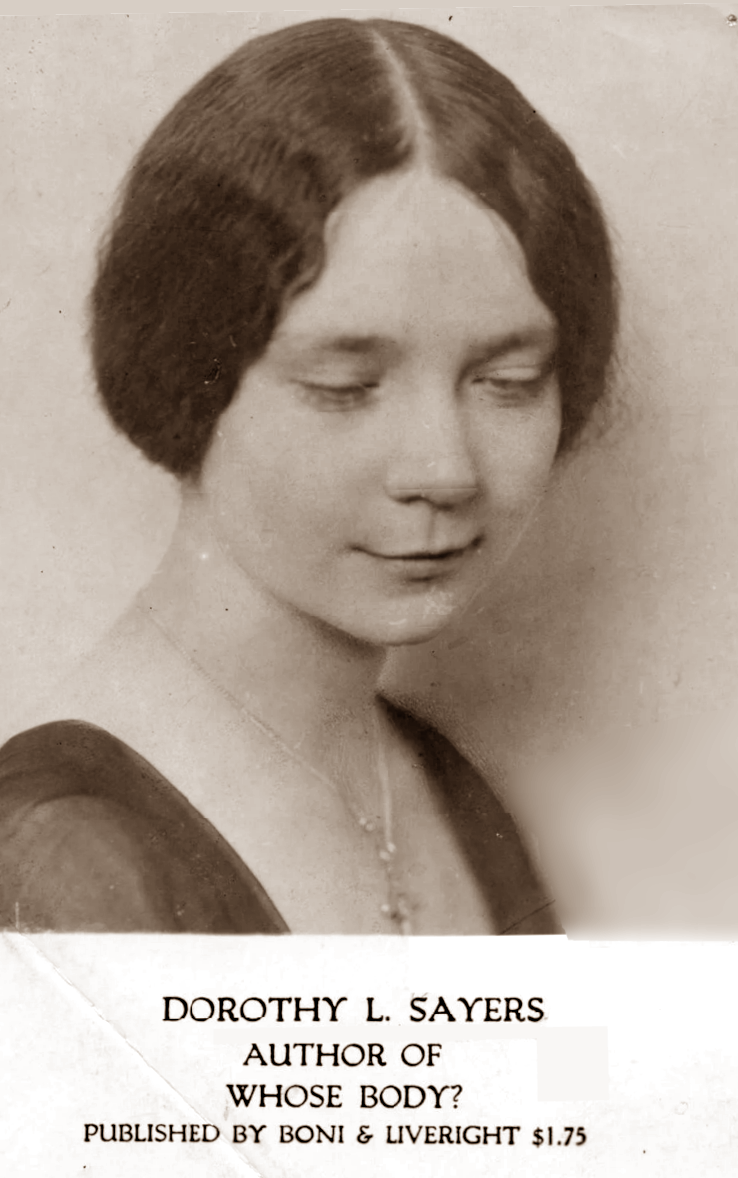
I joined her two days later in the chapter house where the first reading took place. The cast sat in a half-circle of wooden chairs. Dorothy stood at a small table with the script open. When she reached the scene of the architect William of Sens falling from the scaffolding, her voice changed. She read the lines about work as an act of worship without lifting her eyes from the page. One of the actors, a young man playing a mason, asked whether the speech was meant to be ironic. She answered that it was not.
Over the following weeks I watched her revise at a table in the hotel dining room after the actors had gone. She crossed out whole pages and wrote new ones in the margins. The director, a quiet man named Nugent Monck, came each morning with questions about doctrine. She answered him by reading aloud from the creed printed in the back of her prayer book. She told him she had not opened that book for its theology in years, only for the language.
Her private life stayed folded away. She mentioned the boy only once, in passing, when a letter arrived from the cousin in the country. The envelope stayed unopened on the table for an hour before she slipped it into her bag. That night she worked until the lamps were turned off by the night porter.
On the afternoon of the first performance the nave filled with an audience that included both clergy and the usual festival crowd from London. I stood at the back near the west door. When the actor playing William spoke the line about offering the work of his hands as prayer, a murmur moved through the front rows. After the curtain a woman in a black hat approached Dorothy in the cloister and asked whether the play was intended to convert anyone. Dorothy replied that she had written what the story required.
The letters began arriving the next week. Some thanked her. Others accused her of presumption. She answered the angriest ones by hand, always in the same measured script she used for her novels. She told one correspondent that she had never set out to defend the faith, only to finish the commission.
Months later, when the BBC asked her to write a series of plays on the life of Christ, she hesitated again. She showed me the contract across a table at the Detection Club. Chesterton was there that night and told her the job needed doing. She signed it on the condition that the scripts remain dramatic rather than hortatory.
The broadcasts brought a different storm. One postcard called her a disgrace to her sex. Another blamed the fall of Singapore on her refusal to soften the doctrine of the incarnation. She kept every letter in a cardboard box under her desk. When Lewis praised the scripts in a note, she read it aloud once and then filed it with the rest.
Her marriage had already settled into its own quiet pattern. Mac stayed in the country most weeks. She wrote at night in the London flat, the typewriter covered with a cloth during the day so the maid would not move the pages. The boy received his school fees on time. She never visited.
In the last year of the war she began translating Dante. She said the work kept her from having to invent new arguments. The manuscript pages accumulated on the same table where the Canterbury script had once lain. When she reached the Paradiso she stopped for several weeks, unable to find the right English for the final cantos. She told a visitor that the difficulty was not the theology but the precision of the images.
She died in 1957 with the translation unfinished. The last pages lay in a folder marked only with the date. The cousin who had raised the boy attended the funeral. I stood at the back of the church and watched the coffin carried out under a gray sky that matched the stone of the building where the first play had been performed twenty years before.
The papers from the flat in Great James Street reached the Bodleian in three wooden crates on 4 March 1958, accompanied by an inventory typed on blue foolscap that listed 1,147 items including the unfinished Paradiso manuscript, the 1937 prompt copy of The Zeal of Thy House annotated in Nugent Monck’s hand, and the carbon of the letter Dorothy had sent to the Archbishop of Canterbury on 19 June 1936 stating that “the doctrine must stand as it is or the play collapses.” Barbara Reynolds, then lecturer in Italian at Cambridge, received the Dante folder on 22 April and began work at the rate of two cantos a week, completing the final lines of canto XXXIII on 11 November 1961; her note in the 1962 Penguin edition records that she retained every word Dorothy had rendered of the “love that moves the sun and the other stars” before supplying the remaining seventy-three lines herself.
John Anthony Fleming, then thirty-four, took possession of the Witham house under the terms of the will proved at Ipswich on 9 January 1958; he sold the London flat in February and deposited the proceeds in a Barclays account numbered 347892 in the name of the Dorothy L. Sayers Trust, which still disburses royalties from the 1943 Methuen edition of The Man Born to Be King, whose twelve scripts had been performed before 11.4 million listeners on the BBC Home Service between 21 December 1941 and 30 May 1942. In a letter to the Trust dated 3 September 1964 he declined an invitation to attend a revival at the Maddermarket Theatre, writing only that “the fees were paid on time and that is sufficient.”
The Canterbury Festival staged The Zeal of Thy House again in 1967 under the direction of Frank W. MacKenzie, using the same cut script that had been prepared for the 1948 recording by the BBC West of England service; the programme booklet printed the original 1937 cast list beside the new one and recorded that the fall from the scaffolding was still effected by means of a counterweighted sandbag rather than the electric winch later introduced in the 1974 production. Attendance figures for the six performances totalled 4,872, of whom 312 signed the visitors’ book with addresses outside Kent.
Reynolds’s edition of Paradise appeared on 28 June 1962 and was reviewed in the Times Literary Supplement of 13 July by Helen Gardner, who quoted the rendering of canto XXXI, lines 127-129, and noted that the translator’s death had left “a single sentence unfinished on the page dated 15 November 1957.” The volume sold 17,000 copies in its first year; the 1971 reprint carried a new preface in which Reynolds quoted Dorothy’s 1947 letter to Charles Williams describing the necessity of “keeping the terza rima even when the English runs thin.”
The Detection Club minutes for the meeting of 3 February 1959 record that the chair remained draped in black cloth for one minute’s silence; the same page notes that the annual dinner thereafter included a standing toast to absent members, with Dorothy’s name spoken after those of Chesterton and Milne. E. C. Bentley’s memoir of the evening, preserved in the Club’s archive, quotes the exact words used by the secretary when reading the notice of her death from the Manchester Guardian of 18 December 1957.
In 1975 the Trust granted permission for a radio adaptation of the Dante translation by the Australian Broadcasting Commission; the series of twenty-six half-hour programmes began on 7 April 1976 and concluded on 29 September, using the Penguin text throughout and employing two readers for the final cantos so that Reynolds’s lines would be distinguished by a different voice. The production file at the ABC archives in Sydney lists the exact duration of each episode and the fee paid to the Trust: £1,150 sterling, converted at the rate of 1.78 Australian dollars.
The last time I saw anyone connected with those years was on 8 May 1984 at the west door of Canterbury Cathedral. A woman in a navy coat, perhaps sixty, stood alone after the morning service reading the bronze plaque that records the first performance of The Zeal of Thy House on 12 June 1937; she carried a copy of the 1962 Paradise in a string bag and, when the verger asked if she needed directions to the chapter house, answered that she had come only to stand where the author had once stood, then turned and walked toward the bus station without giving her name.
The plaque itself had been installed in 1977 by the Friends of Canterbury Cathedral under the direction of Canon Derek Ingram Hill, who noted in the society’s annual report that the text reproduced the exact wording of the 1937 programme note in which Dorothy had described the play as “an attempt to show the work of the artist as a form of worship.” On 12 June 1997 the same society arranged a single commemorative reading in the chapter house using the 1937 prompt copy now held at the University of Texas at Austin; the actor chosen for William of Sens was Richard Pasco, and the performance lasted seventy-four minutes because the director omitted the second interval that had been inserted for the 1948 BBC recording.
In 2002 the Dorothy L. Sayers Society, then based at Hurstpierpoint, published a facsimile of the carbon letter of 19 June 1936 to Archbishop Lang together with the full set of Monck’s rehearsal notes; the edition ran to 350 copies and sold out within eleven months, the proceeds going to the maintenance of the Witham house whose garden still contains the stone bench where Mac Fleming sat during his final visit in August 1956. The Society’s newsletter of March 2003 recorded that the bench bore an inscription in Dorothy’s hand, later effaced by weather, reading only the date and the word “finished.”
The BBC Sound Archive at Caversham retains the master discs of the 1941–42 broadcasts of The Man Born to Be King; disc 47, dated 18 January 1942, carries the voice of Robert Speaight as Jesus speaking the line “My kingdom is not of this world” followed by an audible cough from the studio manager. These discs were digitised in 2011 under project number R00047/11 and are available for listening only at the Archive’s Reading Room with prior written permission from the Sayers Trust.
On 21 December 2011 the Trust authorised a new recording of the same cycle for BBC Radio 4 Extra, using a cast that included Anton Lesser and a running time of eleven hours and forty-three minutes; the production file notes that the director retained every scriptural quotation exactly as Dorothy had set it in the 1943 Methuen text. Listener correspondence received by the BBC between January and March 2012 totalled 214 letters, of which seventeen quoted the phrase “the doctrine must stand as it is” from the 1936 letter.
The Bodleian’s three crates were re-catalogued in 1994 under the shelfmark MS. Eng. misc. c. 718–720; the new finding aid lists 1,147 items but adds a supplementary folder containing forty-three theatre programmes collected by Dorothy between 1937 and 1956, including the programme for the 1948 revival at the Maddermarket Theatre annotated in her hand with the single word “adequate.” The folder also holds the telegram she received from T. S. Eliot on 13 December 1941 congratulating her on the first broadcast.
In September 2019 the Canterbury Festival mounted a site-specific production of The Zeal of Thy House inside the cathedral itself, using the original 1937 text and a counterweighted sandbag for the fall; the run comprised nine performances between 12 and 21 September and attracted 6,103 ticket holders, of whom 47 gave overseas addresses when completing the online booking form. The programme booklet reproduced the 1937 cast photograph alongside a new one taken on the same spot in the cloister where Dorothy had stood after the premiere.
The final documented connection occurred on 15 November 2022 when a researcher from the University of York requested access to the 1957 Dante folder at the Bodleian; the request form records that the reader spent four hours transcribing the last unfinished sentence on page 312 and noted in the visitors’ book only the date and the words “still open.”