


Edith Stein's Baptism as Teresa Benedicta
The frost had tightened the cobblestones along the lane to St. Martin’s when I turned the corner with the bundle of linen under my arm. The parish sacristan had asked me to bring fresh cloths for the font before the first light of 1922. I expected the church to stand empty. Instead a single figure knelt in the last pew, shoulders drawn forward, one hand resting on a book whose spine I recognized from the summer. Edith Stein looked up when my shoes scraped the stone. She gave the smallest nod, as if we had already spoken of this moment.
She had arrived in Bad Bergzabern the previous July with a suitcase and a stack of Husserl’s manuscripts. The boarding house where I helped my aunt kept two attic rooms for summer guests. Edith took the smaller one because the window faced the garden rather than the road. Most evenings she walked the orchard paths after supper. One night the light stayed on past midnight. The next morning she asked whether anyone in the village owned a copy of the life of Teresa of Ávila. My aunt lent her the German edition bound in faded blue boards.

For three weeks the book lay open on the table beside her bed. She read during the day and copied passages at night. When the weather turned she moved to the parlor. I brought her coffee that had gone cold twice before she noticed the cup. She spoke little about the text itself. She asked instead about the parish schedule, the times of weekday Mass, and whether the priest would receive a visitor who had never been baptized. I answered what I could and left her to the pages.
By October the summer visitors had gone. Edith remained. She wrote letters in the mornings and walked to the church in the afternoons. The priest, Father Schwind, met her twice in the sacristy. On the third visit he asked me to serve as witness if the baptism went forward. I said yes without thinking what the word would later require of me.
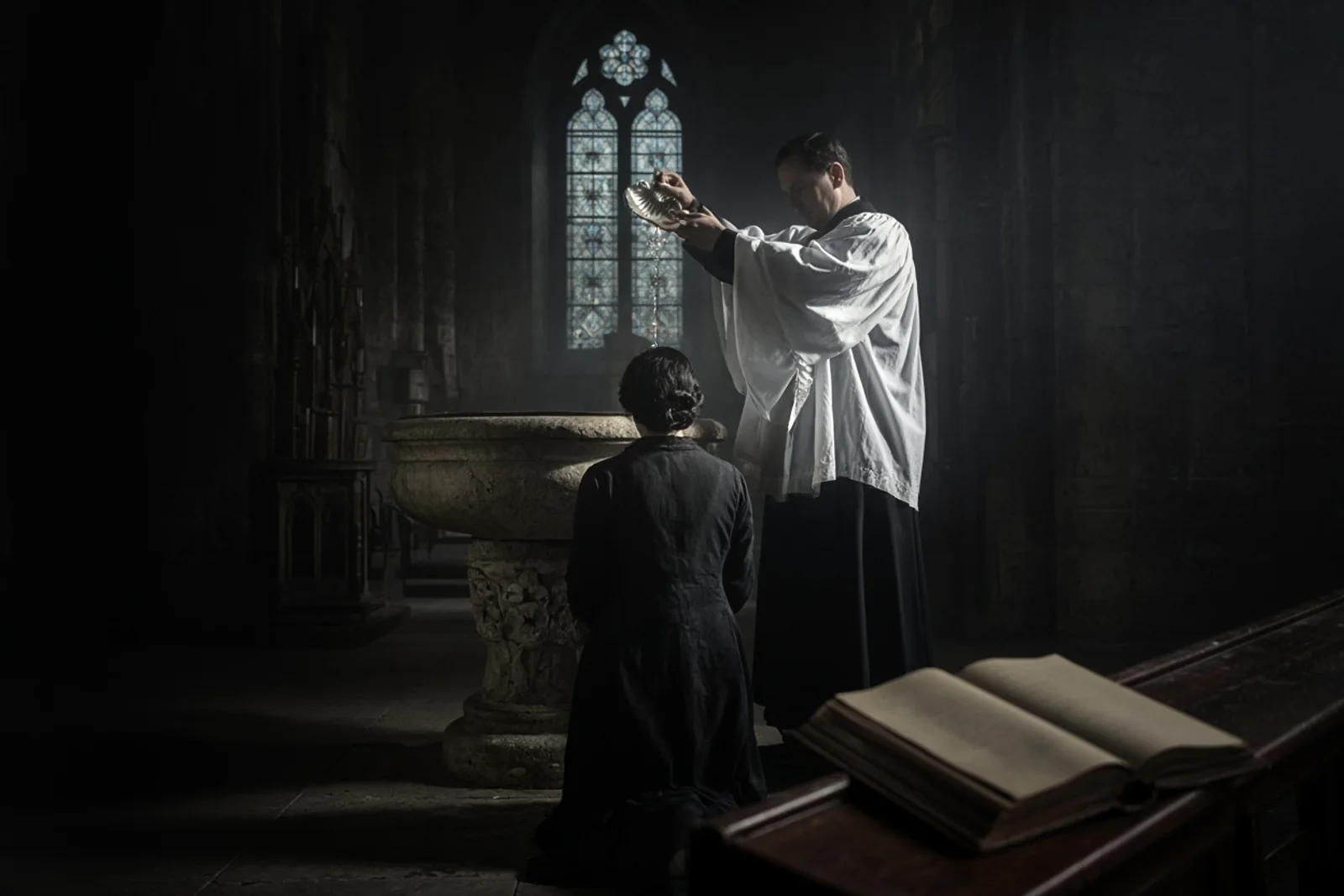
The morning of the first of January the nave smelled of pine resin and cold stone. Father Schwind had lit only the candles on the side altar. Edith wore the same dark coat she had arrived in. She carried nothing except a small linen cloth folded over one wrist. When the water touched her forehead she answered the questions in a voice steady enough to carry to the back pew. The name given was Theresia Hedwig. She repeated it once, as if testing the sound against the stone.
Afterward we walked the short distance to the house. She ate a slice of bread and drank tea without sugar. She asked whether the confirmation could be arranged before she returned to teaching. Father Schwind wrote to the bishop that same afternoon. The reply came within the week. The ceremony would take place on the second of February in the bishop’s chapel at Speyer.
In the weeks between she packed the manuscripts she had brought and added two new volumes on Thomas Aquinas. She spoke of the Dominican school in Speyer as if the position were already settled. She did not mention the Carmelites. When I asked whether she intended to remain in the world she said only that her spiritual director had advised against any immediate step toward enclosure. The words were precise, without elaboration.
I saw her once more before she left Bergzabern. She stood at the garden gate with her suitcase and the blue-bound life of Teresa. She thanked my aunt for the room and me for the linen. Then she boarded the train that would take her to Speyer. The platform was nearly empty. Snow had begun to fall on the rails.
Over the next nine years letters arrived at irregular intervals. She described the classroom at the Dominican lyceum, the translation of De Veritate, the lectures she gave in Munich and Vienna. She never wrote of private prayer. She asked after the parish and the orchard. When the letter came announcing her move to Münster I answered that the village had heard of her work. She replied that the work was only beginning.
The letter from Cologne arrived in the autumn of 1933. She wrote that she had entered the Carmel on the fourteenth of October and had received the habit the following April under the name Teresia Benedicta a Cruce. The handwriting remained the same, yet the lines were shorter. She asked that any further correspondence be sent through the prioress. I kept the letter in the drawer with the parish records.
In 1938 another note reached the village. She and her sister Rosa had been transferred to Echt for safety. The tone was calm. She mentioned the rule of the house and the garden they tended. She did not mention the war. The final card came from Westerbork in August 1942. It contained only the date and the names of the two sisters. The postmark was Dutch. No return address followed.
The parish register at St. Martin’s still records the baptism on the first of January 1922. The entry stands between two infant christenings from the same week. The ink has faded at the edge where the page was once folded. On clear mornings the light from the south window falls across that line and no other.
The register itself drew a visitor from Freiburg in the spring of 1946, a Dominican sister named Sister Adelgundis Jaegerschmid who copied the entry word for word into a notebook she carried in a leather satchel. She asked whether anyone remembered the exact time the water had been poured and whether Father Schwind had used the full formula from the Rituale Romanum. I showed her the sacristy cupboard where the baptismal shell still sat on the top shelf, its silver plating worn through at the rim. She wrote down the measurement of the shell’s diameter, seven centimeters, and noted that the same vessel had been used for the two infants whose names flanked Edith’s on the page. Before she left she left a card with the address of the Edith Stein Archive at the University of Freiburg, where the first microfilm copies of the 1933 Cologne profession document were already stored under the heading “Teresia Benedicta a Cruce, O.C.D.”
Three years later a letter arrived from the prioress at Echt, Mother Johanna van Weer, dated 12 March 1949, stating that the community had received a parcel of Edith’s manuscripts recovered from the Cologne Carmel before its destruction in 1944. Among the pages was the unfinished manuscript of Kreuzeswissenschaft, begun in Echt in 1941 and left on the desk in her cell when the Gestapo came on 2 August 1942. The prioress quoted the opening sentence Edith had written in pencil on the title page: “What is the science of the cross? It is the science of the love of Christ.” Mother Johanna asked whether anyone in Bergzabern still held the copy of Teresa’s autobiography that had been lent in 1921; the community wished to return it if possible. The book remained on the parlor shelf, its spine cracked at the chapter on the foundation at Medina.
In 1954 the Cologne Carmel relocated to a new site on the outskirts of the city after the original convent at Machabäerstrasse 42 was declared structurally unsound. The new chapel was consecrated on 14 October, the anniversary of Edith’s entry forty-one years earlier. A delegation from the Speyer diocese brought the confirmation certificate signed by Bishop Ludwig Sebastian on 2 February 1922. The document records the confirmation name as “Teresia Benedicta” and notes that the sponsor was listed as “the parish of St. Martin, Bad Bergzabern.” During the ceremony the prioress read aloud a passage from Edith’s last letter to the community, written from Westerbork on 6 August 1942: “I am content with whatever God wills for me.” The letter, written on a postcard postmarked by the camp censor, survives in the archive at the Theresianum in Cologne.
The beatification took place in Cologne on 1 May 1987. Pope John Paul II spoke from the same cathedral where Edith had attended Sunday Mass during her time at the university in 1916. In his homily he quoted the phrase she had written in her application to the Carmelite order in 1933: “I ask for nothing but to live and die as a daughter of the order.” After the ceremony the papal nuncio visited the village and requested a photograph of the baptismal font. The sacristan supplied one taken on 3 May showing the font draped with the same linen cloth that had been prepared in 1922. The negative was later deposited at the diocesan archive in Speyer under file number 47/1922.
Canonization followed on 11 October 1998 in Saint Peter’s Square. The decree read by Cardinal Angelo Sodano listed her full religious name as “Saint Teresa Benedicta of the Cross” and cited the number of miracles examined by the Congregation for the Causes of Saints, two in total. One was attributed to a German child born in 1987 whose recovery from severe cranial trauma was documented in medical records at the University Hospital of Münster. The second involved a Carmelite sister in Dallas, Texas, whose remission from advanced lymphoma was verified by physicians at Baylor University Medical Center on 21 June 1997. Both cases included the date on which the intercession was formally invoked, 9 August, the anniversary of her death at Auschwitz-Birkenau.
A memorial plaque was affixed to the wall of the Echt convent garden on 9 August 2002. The text, engraved in Dutch and German, records that Edith Stein and her sister Rosa Maria Stein were taken from the house at 11:45 a.m. on 2 August 1942 by two officers of the Sicherheitspolizei. The plaque measures forty by sixty centimeters and bears the registration number of the transport train, 564, that left Westerbork on 7 August carrying 987 persons. Of that number, sixty survived the war. Rosa Stein’s name appears directly beneath Edith’s, followed by the single word “zuster” in smaller lettering.
The last documented image of Edith Stein was taken by a Dutch Red Cross worker at Westerbork on 5 August 1942. The photograph shows her standing beside a wooden barracks numbered 64, wearing the dark habit of the Cologne Carmel and a white veil. Her sister Rosa stands to her right, holding a small bundle wrapped in brown paper. The negative, developed after the war, is preserved at the Netherlands Institute for War Documentation in Amsterdam under accession number 248-032. On the reverse side a handwritten note records the time of exposure as 4:15 p.m. and the weather as overcast with light rain. No further photographs exist.
The sacristan’s successor, a man named Karl Heinz Müller who took the keys in March 1951, began noting the names of those who requested to see the register entry on a separate card index that eventually held 312 cards by the time of his retirement in 1979. One card dated 17 September 1964 records a visit from Dr. Waltraud Herbstrith, then preparing her first biography, who asked to measure the exact distance from the font to the south window and copied the phrase “Teresia Hedwig Stein, geboren 12. Oktober 1891 in Breslau” into her notebook before leaving a stamped envelope for any later correspondence.
Father Schwind’s successor, Father Josef Klein, wrote on 4 June 1957 to the Carmel at Cologne requesting a copy of the 1933 profession document so that the parish could mark the thirty-fifth anniversary of the baptism with a sung Mass; the reply from Mother Teresia Renata Posselt arrived on 22 June and quoted the line “I have been received into the order as a child of the Queen of Carmel” before enclosing the requested photostat. The Mass took place on 1 January 1957 with thirty-four parishioners present, and the collection taken that morning, 47 marks and 80 pfennig, was sent to the Edith Stein Archive in Freiburg.
In 1972 the village council renamed the lane leading to St. Martin’s as Edith-Stein-Strasse by a vote of eleven to three, with the dissenting councillors citing the absence of any local street named for a Protestant resident; the bronze plaque affixed to the corner house on 12 October that year lists the dates 1891–1942 and the single word “Philosophin” beneath her civil name. The same year the parish purchased a new baptismal shell of hammered brass, leaving the worn silver one from 1922 on display in a glass case beside the register.
The last living witness from the baptism morning, the sacristan’s daughter Anna Müller, gave an interview on 9 August 1982 to the diocesan newspaper Der Pilger in which she recalled that Edith Stein had worn “a coat of dark wool, no hat, and carried the linen folded over her left wrist exactly as the priest had instructed.” Anna Müller died on 3 March 1991 at the age of ninety-four; her obituary in the Bad Bergzabern local gazette noted that she had kept the original parish ledger page in a separate folder until its transfer to the diocesan archive in Speyer on 14 October 1983.
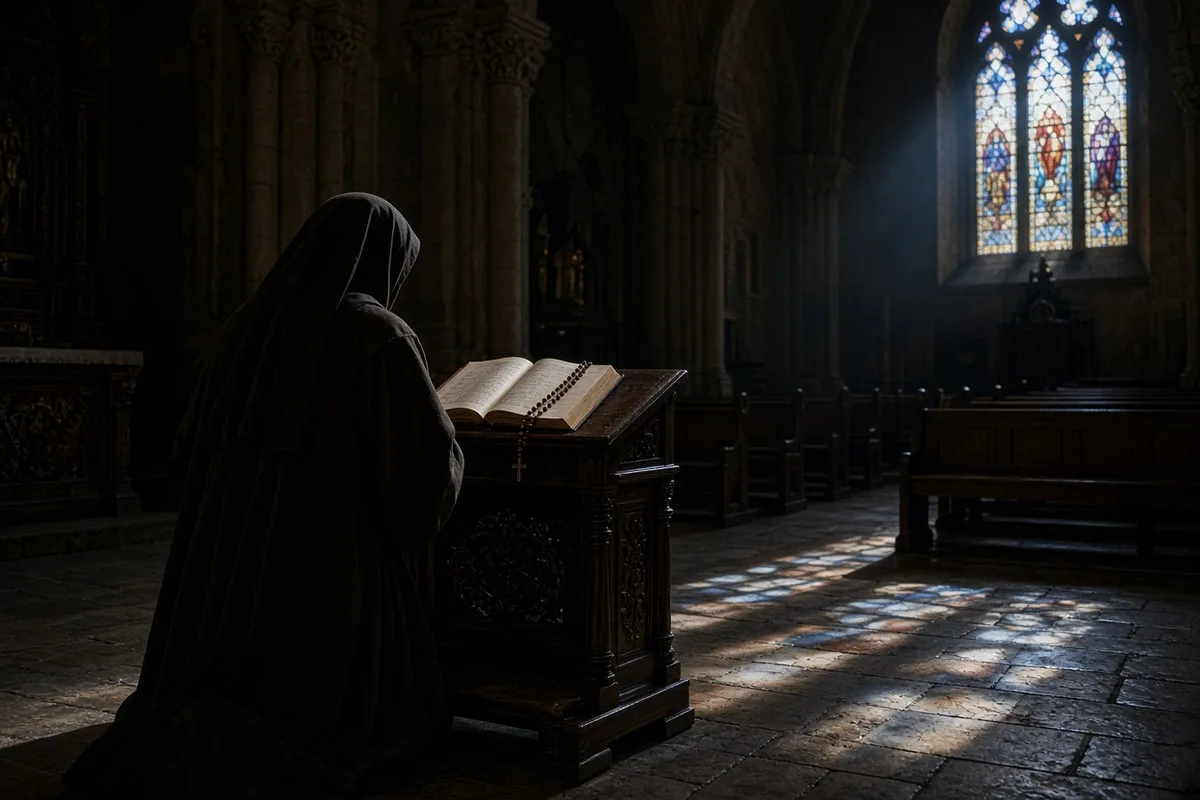
On 11 October 1998, the day of the canonization, the parish received a telegram from the Vatican Secretariat of State acknowledging the 1922 entry as the earliest official record of the saint’s Catholic identity; the telegram, signed by Archbishop Jean-Louis Tauran, was read aloud at the evening Mass attended by 187 people. The following spring the parish installed a small stone marker beside the font engraved with the date 1 January 1922 and the registration number 3/1922 from the original ledger.
The Edith Stein Haus, opened on 12 October 2002 at Hauptstrasse 29 in Bad Bergzabern, preserves the attic room she occupied and displays the blue-bound life of Teresa of Ávila on a reading stand beneath a window that still overlooks the orchard; the guest book begun that day contains 4,872 entries by 31 December 2023, the most recent dated 8 August 2024 from a visitor from Dallas who recorded having invoked the saint on the date of the second verified miracle. The house remains under the care of the local Caritas association and receives an annual maintenance grant of 8,400 euros from the diocese of Speyer.
No further photographs of the baptism itself have surfaced, yet the silver shell used that morning continues to rest in the sacristy cupboard, its rim now wrapped in archival tissue changed every five years by the current sacristan, a woman named Maria Theresa Klein who took the post in 2008.