



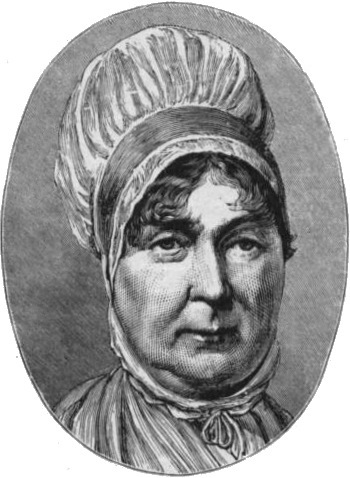
Elizabeth Fry Begins Prison Visiting at Newgate
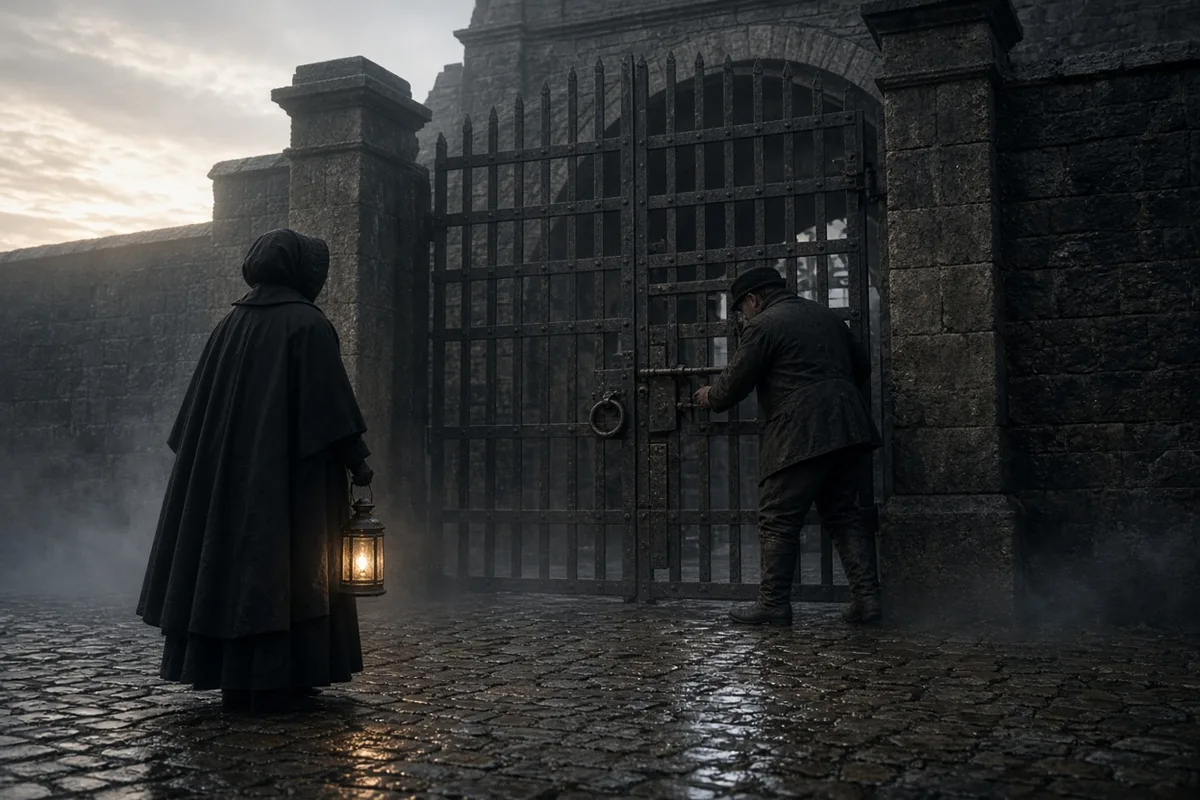
The iron gate slammed shut behind us before the turnkeys had finished their warnings. One of them, a heavy man with a ring of keys at his belt, kept shaking his head at Elizabeth Fry. He said the women inside would tear the caps from our heads and worse. She thanked him without raising her voice and asked only that the basket of bread and cheese be carried through. I walked at her shoulder, carrying the smaller bundle of shawls we had brought from the meeting house. The smell met us at the threshold, thick as standing water.
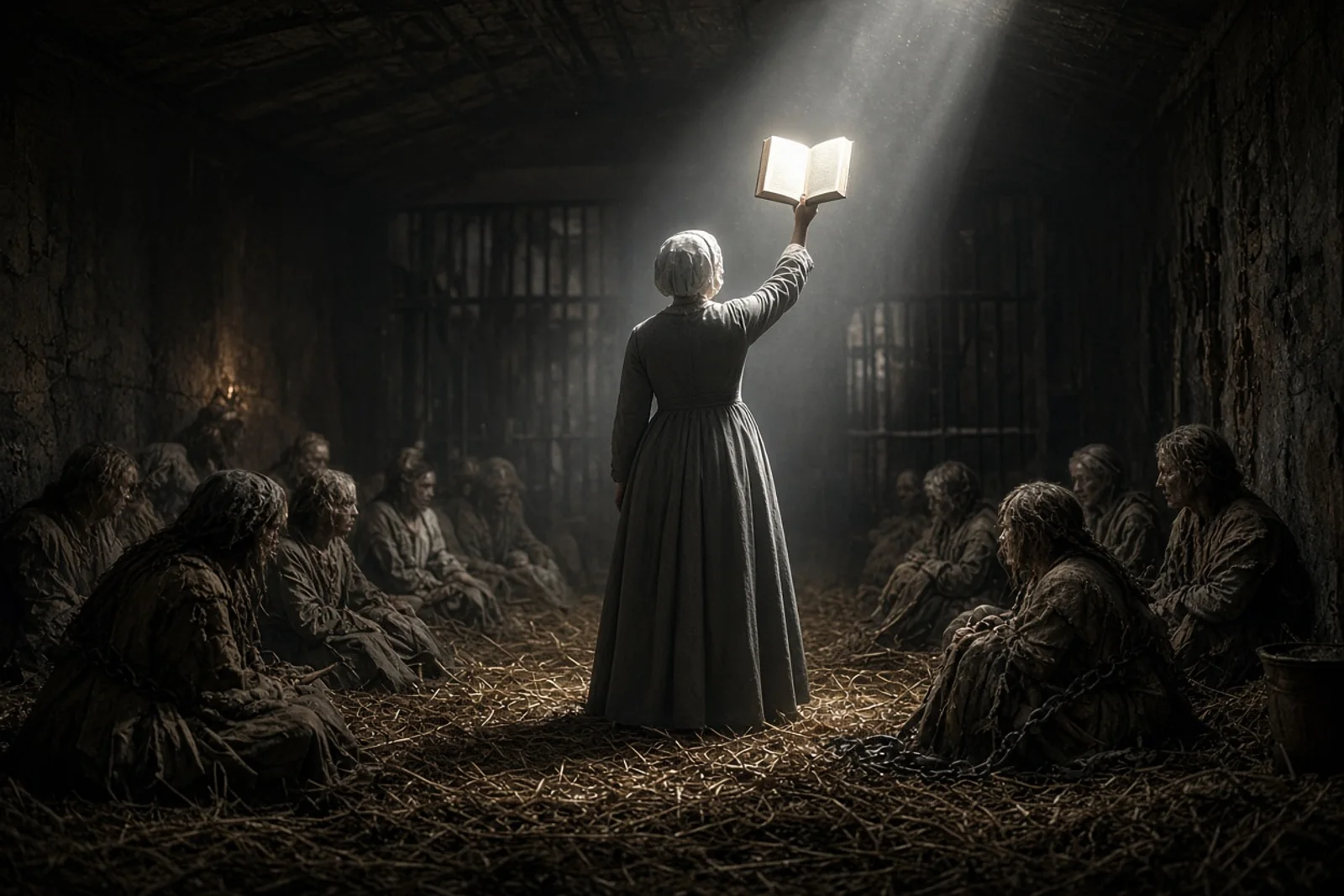
We stepped into the women’s yard. Three hundred bodies pressed into space meant for sixty. Straw covered the floor in places, black with use. Children ran between the legs of the women, some barefoot, some wrapped only in rags. A woman near the wall shouted at another over a tin cup. The second woman answered by flinging the cup, and the liquid spattered across the straw. No one moved to stop them.
Elizabeth set the basket down on a low bench. She did not speak at once. She looked at the nearest group of women, then at the children clinging to their skirts. One child, no more than two, sat on the floor with a piece of bread in both hands, chewing slowly. Its mother lay on her side nearby, eyes half open, breath loud. The guard who had followed us muttered again that we should leave while we still had our shoes.
A woman in a torn shift pushed forward and reached for the basket. Another caught her wrist. They began to shove. Elizabeth stepped between them without touching either. She asked their names. The first gave hers as Mary. The second would not answer. Elizabeth opened the basket and handed each a piece of bread. The shoving stopped. More women came toward the sound of voices.
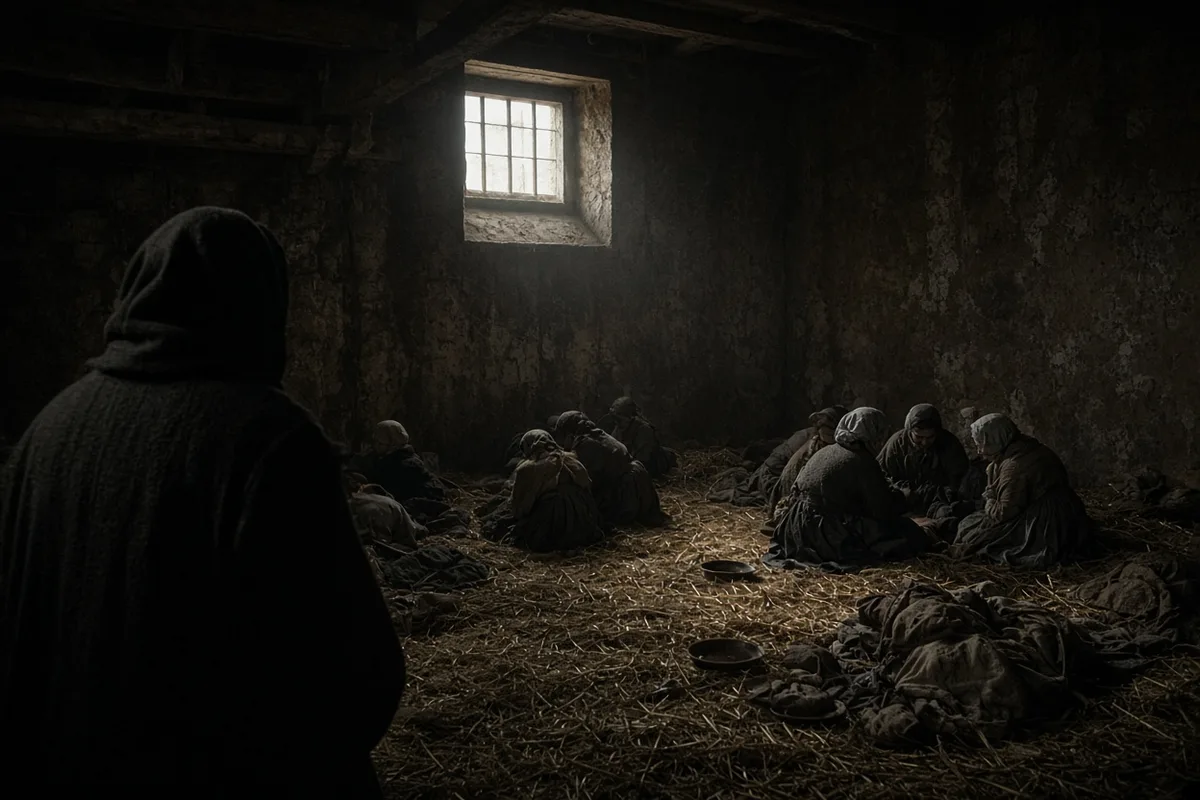
We moved farther into the ward. The straw gave underfoot. In one corner a woman sat with a newborn wrapped in her apron. Beside her lay another infant, still and small. Two older women bent over it. One lifted the tiny body and began to strip the cloth from it. She passed the cloth to the woman with the living child. The living child cried once, then quieted when the cloth was wrapped around it. Elizabeth watched without speaking. She reached into her own cloak and took out a folded square of linen she had brought. She gave it to the woman with the newborn.
The afternoon light came through a high grating and fell in narrow bars across the floor. The women who had taken the bread sat in a half circle now, eating. Some still shouted across the yard, but the nearest ones stayed quiet while Elizabeth asked after their children. One woman said her boy had been taken to another ward the week before. Another said she expected to be sent to the ships soon. Elizabeth listened to each. She did not write anything down. She only nodded and asked whether they had enough water for the day.
When the basket was empty we turned back toward the gate. The turnkey who had warned us stood with his arms folded. He asked whether we had lost anything. Elizabeth said we had not. She asked him how many women were held without trial. He gave a number. She thanked him and said she would come again with more bread.
Outside the gate the air felt thin after the yard. We walked to the carriage without hurry. Elizabeth sat with her hands folded over the empty basket. She did not speak of what she had seen. I watched the street pass. A boy sold matches at the corner. A cart loaded with cabbages rolled past. The ordinary sounds of the city seemed distant, as if heard through the same grating that had let in the light inside.
She returned the next week with another basket and two more women from the meeting. The turnkeys let us through without argument this time. The women in the yard recognized her. Some came forward at once. Others stayed back until the bread was passed. The child who had worn the dead infant’s cloth was still there, now walking unsteadily between the women’s legs. Its mother sat against the wall, eyes clearer than before.
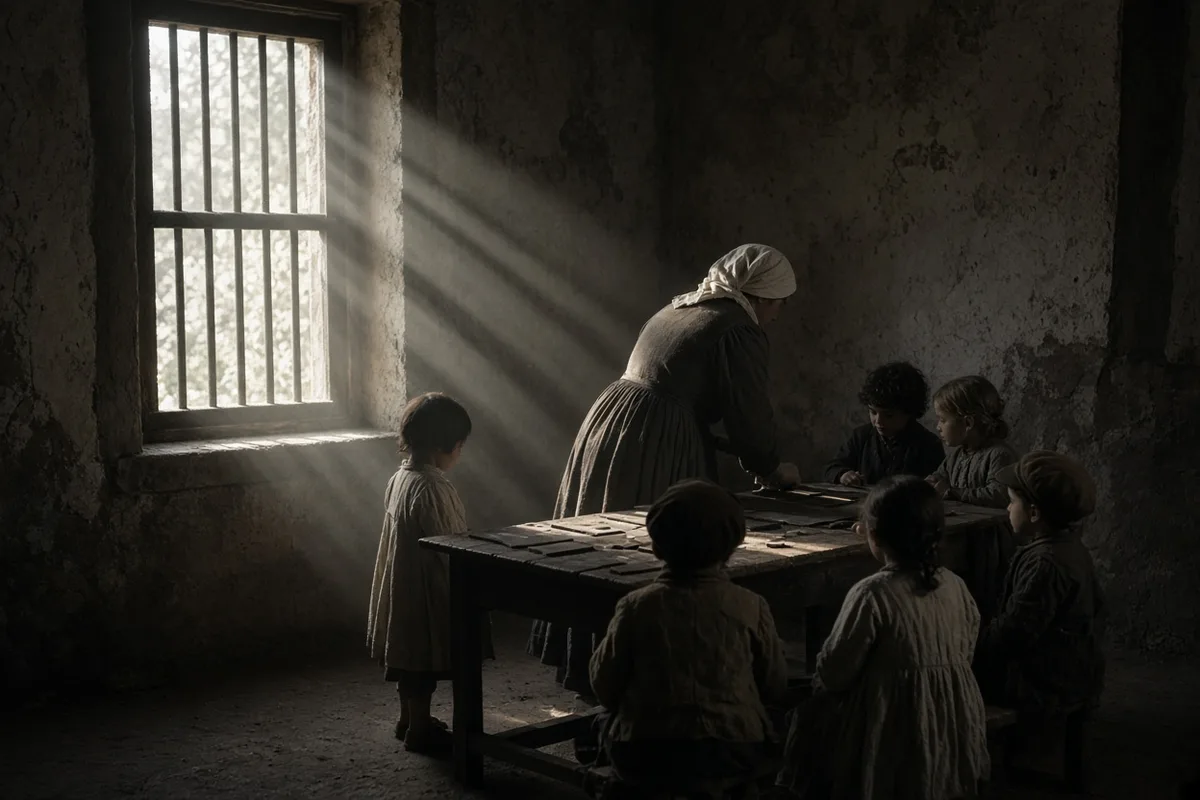
Over the following months the visits settled into a pattern. Elizabeth brought work—pieces of cloth and thread—and showed the women how to sew shifts that could be sold. She brought slates and taught letters to the older children. The yard grew quieter on the days she came. The women who had once fought over a tin cup now waited in line for their share of the work. The turnkeys watched from the gate but no longer warned us away.
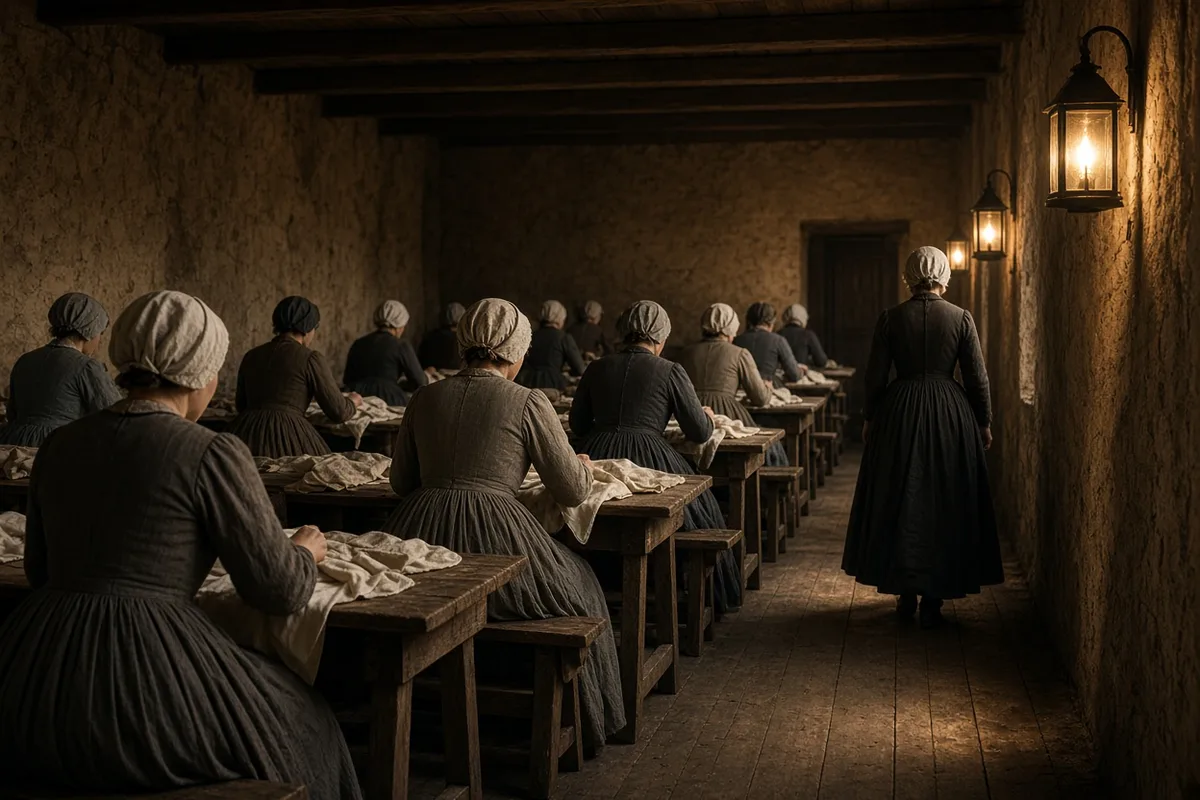
By the spring of 1817 she had gathered eleven other women willing to come regularly. They called themselves the Ladies’ Newgate Association. They trained one of the prisoners as a matron and paid her a small wage from their own funds. The City authorities were brought to see the change only after the new order was already in place. The men stood at the gate and stared at women sitting in rows, sewing in silence, while their children played at their feet.
Elizabeth continued the visits for years. She spoke to committees in Parliament and traveled to other prisons in Britain and on the continent. The women she had first met in the yard wrote to her after their release or from the ships. Some asked for work. Some asked only that she remember their names. She kept every letter in a box at home.
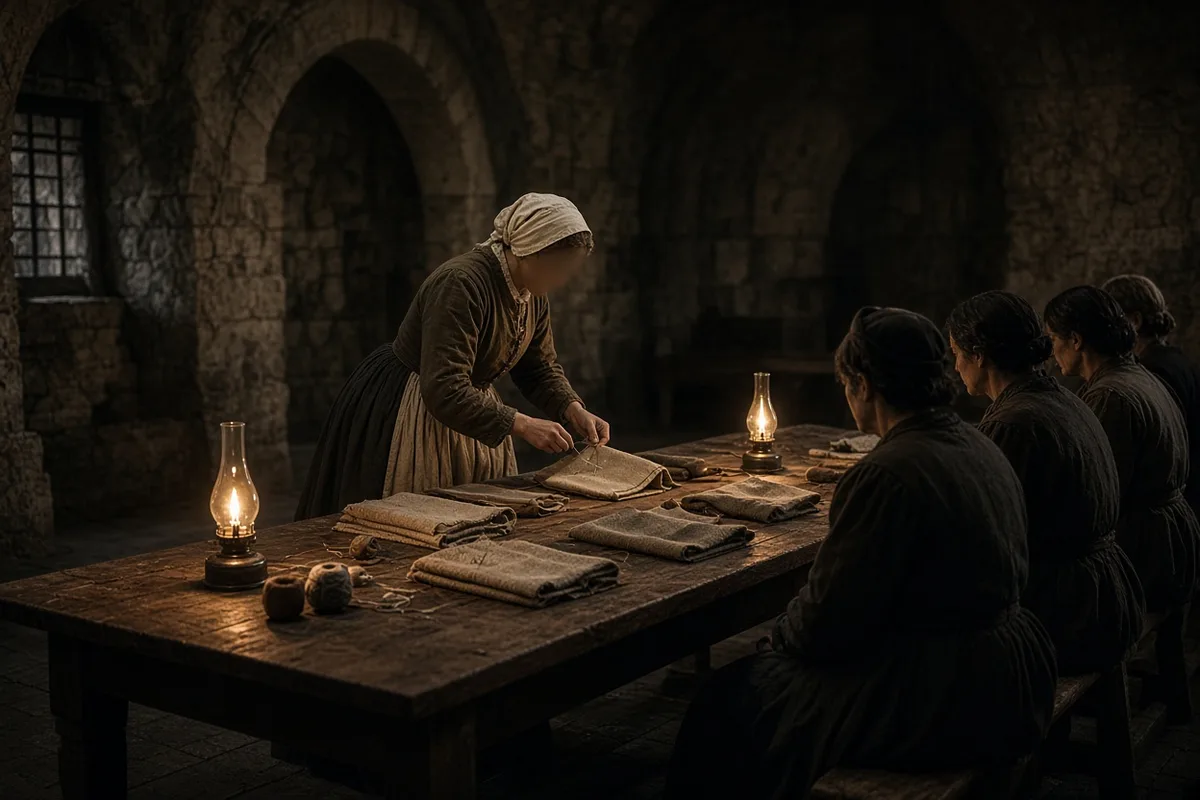
On the last visit I made with her, the yard held fewer women than before. The high grating had been widened, and more light reached the floor. A new matron walked among the rows, checking the stitches on each piece of sewing. Elizabeth stood near the gate for a moment before we left. She watched a girl of ten or eleven spelling words on a slate for two smaller children. The girl looked up, saw her, and smiled without leaving her place. Elizabeth smiled back, then turned and walked out into the street where the ordinary carts still passed.
She returned the following week with fresh bundles of flannel and a copy of the New Testament bound in plain boards. On 12 February 1817 she asked the women seated on the benches to choose a passage, and one named Sarah Martin read aloud from the fourteenth chapter of John while the matron, a prisoner named Mary Connor paid two shillings weekly from the Association funds, kept order. Elizabeth noted the number of women then held on the common side—two hundred and seventeen—and asked the turnkey whether any had received visitors that month. He answered that only three had, all from the sheriffs’ office. Later that same day she wrote to William Crawford at the London Orphan Asylum requesting six more slates and a supply of copybooks ruled for the children’s use.
In March 1818 she appeared before the Select Committee on the State of the Prisons in London and Westminster. She told the members that two hundred and fifty women and their children occupied the two wards and that the only separation between felons and those awaiting trial was a chalk line drawn across the floor. When asked what change she had observed after the introduction of employment, she answered that the women now earned between fourpence and ninepence a day by sewing and knitting, and that the money was placed in a savings box opened each Friday under the eye of the sub-matron. Sir Thomas Fowell Buxton recorded her words in the committee minutes: “They have been known to return thanks for the smallest act of kindness.”
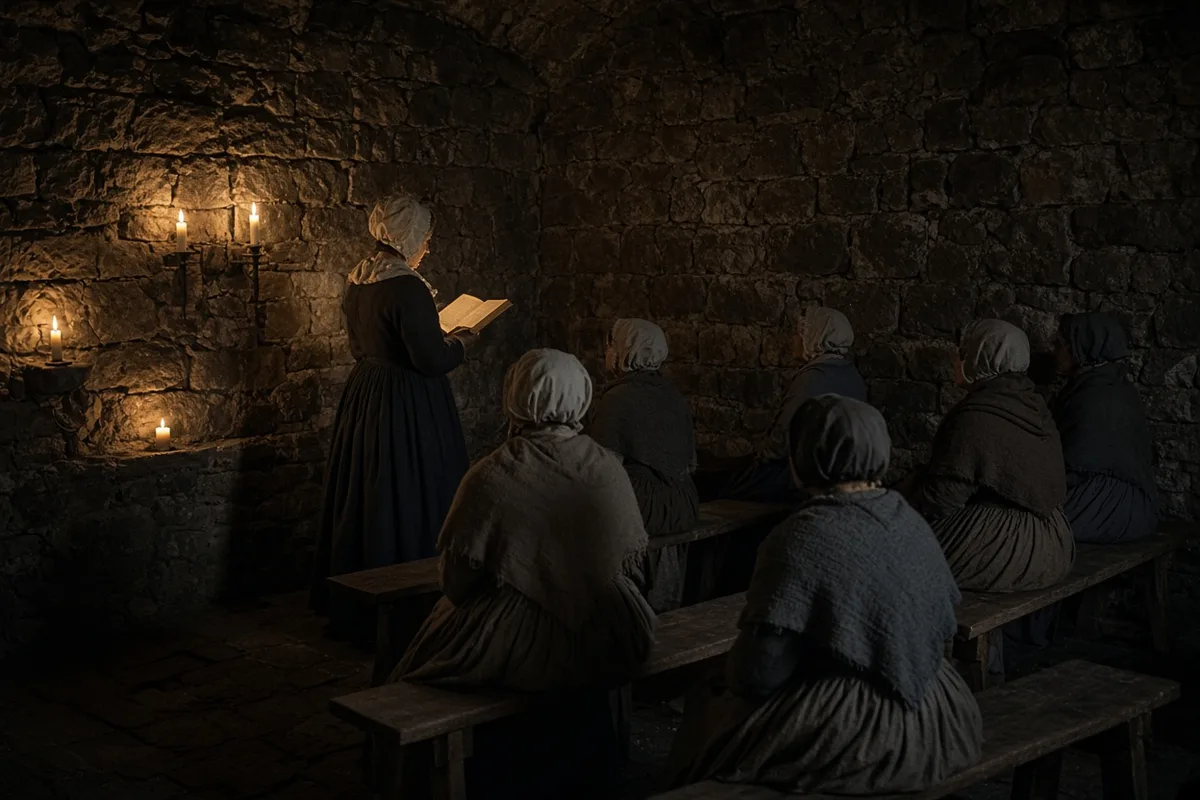
By the summer of 1820 the Association had fitted the upper ward with deal tables and forms and had employed a second matron, Elizabeth Fricker, at the same wage. The City surveyor measured the space and reported that the new arrangement allowed one hundred and eighty women to work at once without crowding the passages. Elizabeth brought a supply of printed tickets marked “Newgate Female School” so that the older girls could mark their own copybooks. One girl, aged twelve, wrote her name as Ann Watts and asked that the ticket be sent to her brother at the Marine Society school in Deptford.
In 1823 she sailed on the convict ship Harmony bound for New South Wales, carrying letters of introduction from the Home Office. She visited the women twice daily during the three-month voyage, distributing flannel petticoats and arranging for each to receive a Bible and a workbag marked with her name. The surgeon-superintendent, Dr. Thomas Reid, noted in his log that no woman was punished for fighting after the first fortnight and that the daily allowance of rice and peas was supplemented by potatoes purchased from the ship’s stores at Elizabeth’s expense. On landing she left twenty pounds with the colonial chaplain for the purchase of further materials.
Her health began to fail in the winter of 1840 after a journey to the prisons of Glasgow and Edinburgh. She continued to receive letters from former prisoners, among them one dated 3 June 1842 from Mary Proctor, transported in 1819, who wrote that she now kept a small shop in Parramatta and had taught her two daughters to read from the same Testament given at Newgate. Elizabeth answered each letter in her own hand, filing the replies in the same oak box that held the first notes from the yard.
She died at Plashet House on 12 October 1845. Her daughter Katharine recorded that she asked for the twenty-third Psalm to be read and that she repeated the words “The Lord is my shepherd” before becoming unable to speak. The funeral took place three days later at the Friends’ meeting house in Barking, attended by members of the Ladies’ Committee and by several women who had been released from Newgate more than twenty years earlier. One of them, seated on the bench nearest the door, held a small piece of knitted lace she had finished that morning.
Newgate Prison itself was closed in 1881 and the site cleared between 1902 and 1904 for the new Central Criminal Court. When the building opened in 1907 a marble statue of Elizabeth Fry by Sir William Hamo Thornycroft was placed in the principal hall, showing her seated with an open book. The figure remains there, the only statue of a woman inside the court, and the bench beneath it is still used by counsel waiting to be called.
In 1911 the Court’s resident architect, Edward Mountford, ordered the statue’s pedestal raised four inches so that the carved book would catch the light from the new electric lamps installed along the north wall. A ledger entry dated 4 July records the cost as three pounds twelve shillings and notes that the work was done by the firm of Farmer and Brindley after the marble had been dusted with a soft brush each morning for a fortnight. Counsel waiting on the bench beneath it began to leave folded newspapers on the seat; one such paper, the Morning Post of 22 November 1924, carried a notice that the Fry family had given an additional twenty pounds toward the upkeep of the Newgate memorial fund.
During the air raids of 1940 the statue was lowered into the basement strongroom on a block and tackle rigged by the Court’s maintenance staff under the direction of the senior usher, George T. Wickens. Wickens’s diary for 17 October lists the operation as taking four hours and records that the marble surface was wrapped in three layers of felt before being placed on wooden rollers. When the statue was returned to the hall on 9 May 1945, a small chip was discovered on the lower left corner of the book; the chip was later set back in place with a mixture of marble dust and lime putty supplied by the same firm that had raised the pedestal thirty-four years earlier.
On 3 February 1958 the Lord Mayor, Sir Denis Truscott, stood before the figure while addressing the annual meeting of the Howard League for Penal Reform. He quoted from Elizabeth Fry’s 1818 committee evidence the sentence “They have been known to return thanks for the smallest act of kindness” and then asked the assembly to observe a minute of silence. The minute was timed by the Court’s clock, which struck the quarter-hour at the end of the pause.
In 1973 the Central Criminal Court installed a bronze plaque on the wall to the right of the statue listing the names of the twelve founding members of the Ladies’ Newgate Association. The plaque gives the date of the Association’s first formal meeting as 19 April 1817 and records that the original subscription list totalled forty-seven pounds six shillings. Visitors to the hall sometimes run a finger along the raised lettering of Mary Sanderson’s name, the first on the list.
During the major refurbishment completed in 1988 the marble was cleaned with a neutral pH solution applied by conservators from the Victoria and Albert Museum. The treatment record notes that the open book was left untouched because the carved pages showed traces of graphite from years of contact with gloved hands. A single fingerprint in pencil was documented on the upper right corner of the right-hand page and photographed before being left in place.
On 12 October 1995, the one hundred and fiftieth anniversary of Elizabeth Fry’s death, the present Lord Chancellor, Lord Mackay of Clashfern, placed a single white rose at the base of the statue before the start of the morning session. The rose remained there until the ushers cleared the hall at six o’clock; a night security officer later recorded in the logbook that the petals had fallen onto the bench and were swept away at seven the following morning.
In March 2014 the Court’s heritage officer, Rachel J. Adams, received a letter from a descendant of the prisoner Mary Connor requesting permission to photograph the statue for a family archive. Adams granted the request on condition that the photograph be taken between 8:15 and 8:45 a.m. before the public galleries opened. The resulting image shows the marble figure with the bench in the foreground and, on the bench, a single barrister’s wig box left overnight by its owner, whose initials, J. S. R., are stamped on the lid in faded gold leaf.
Each weekday morning the first person to enter the principal hall is the junior clerk assigned to Court 1, who unlocks the doors at 8:05 and walks the length of the room to switch on the lights above the statue. On 7 November 2023 that clerk, a woman named Priya Sharma, paused for three seconds in front of the marble book before continuing to the switch panel; the pause was long enough for the motion-sensor camera mounted on the ceiling to register her outline against the white stone.