


Eucharistic Miracle of Legnica
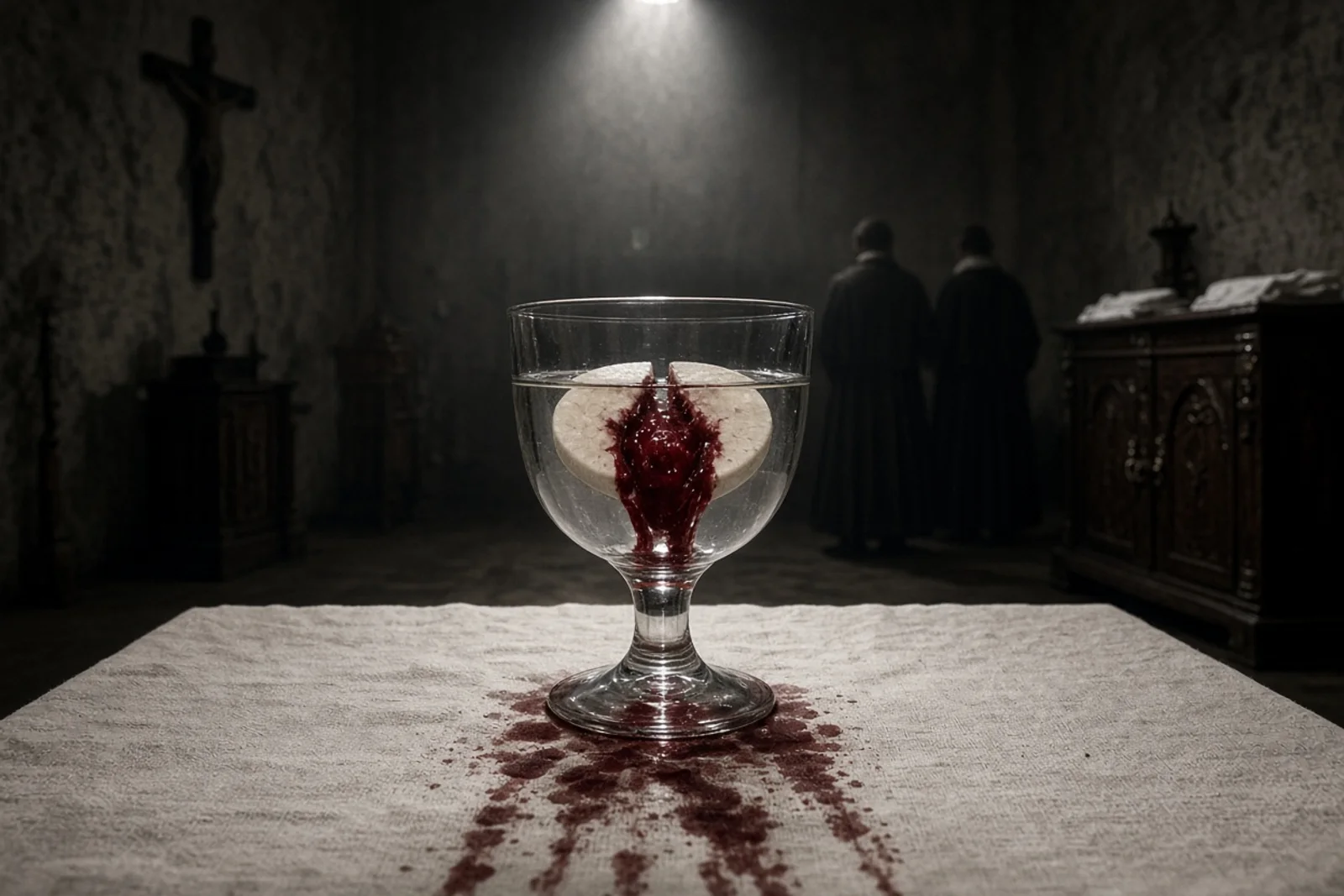
The wafer slipped from the vicar’s fingers just as the altar server opened his mouth. I was two steps away in the front pew, close enough to hear the soft pat on the carpet. Someone gasped. The vicar knelt at once, lifted the Host with the purificator, and carried it straight into the sacristy. I followed without thinking, the rest of the line still waiting at the rail.
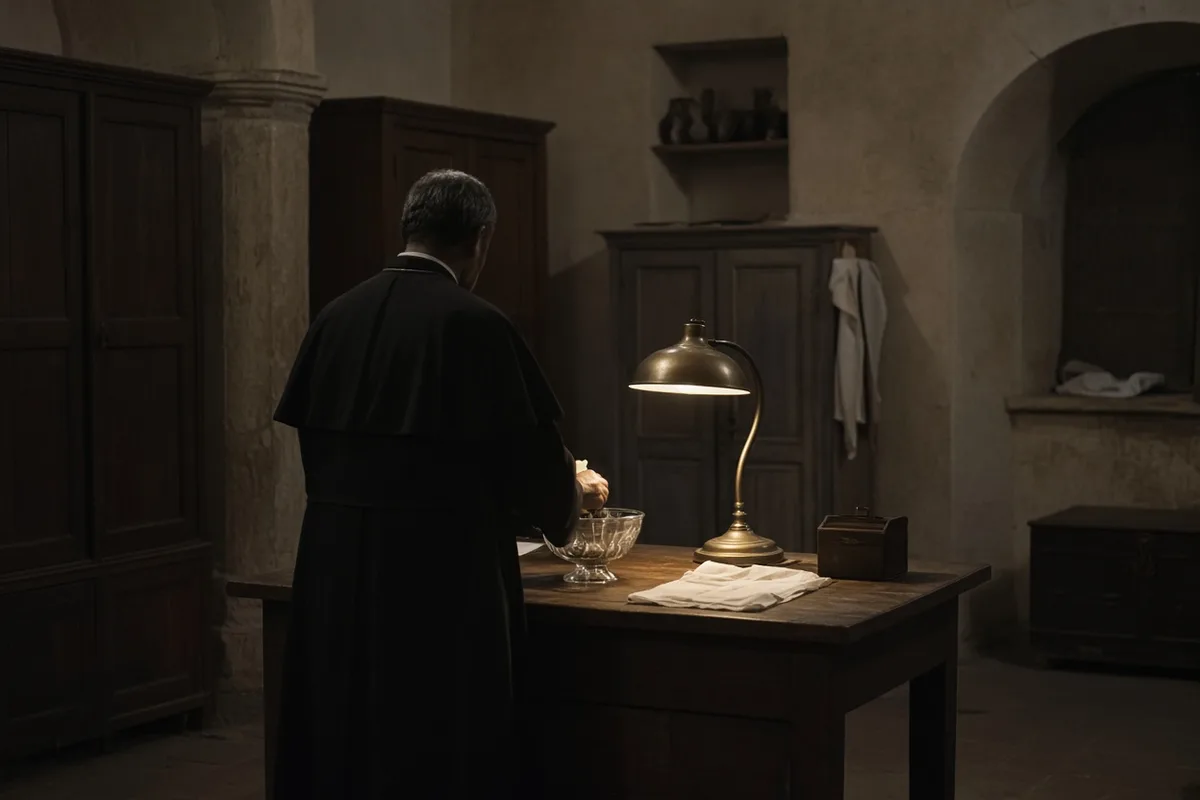
In the sacristy the tap ran hot. He set the Host in a glass dish, covered it, and left it on the shelf above the sink. The room smelled of starch and candle smoke. Mass continued. I stayed behind to lock the outer door.

For the first days nothing changed. The Host sat pale under the water, edges softening a little. I checked it each morning before the first Mass, turning the dish so the light caught it. On the tenth day the red mark appeared, no larger than a fingernail at first, then spreading to about the size the priests later measured. It looked like a thread of dried blood caught in the fibers.
Father Tadeusz Kisiński came in on the morning of 8 January. He stood with his hands on the edge of the sink and stared. He asked me to bring Bishop Cichy’s secretary on the phone. The call lasted less than a minute. That afternoon Father Andrzej Ziombra arrived, still in his overcoat. He asked the same questions everyone would ask later: had anyone added anything, had the water been changed, had the dish been moved. I answered no each time.

The committee came on the sixteenth. They photographed the dish under different lights, took notes, and left. Two days later they drove to Sokółka to see the earlier case. When they returned they spoke little. On the twenty-first the diocese ordered samples sent to Wrocław.
The first report arrived in March. The pathologists wrote that the red material resembled striated muscle but could not rule out everything else. They mentioned fungal threads and said the DNA test had been negative. Father Ziombra read the letter aloud in the sacristy. His voice stayed even. He folded the paper and placed it in the drawer beneath the chalices.
A second set of slides went to Szczecin. The letter from there came in the autumn. It described cardiac muscle fragments and changes often seen in agony. It confirmed human DNA. The priests read that letter more than once. Someone made a copy for the bishop.

I kept the original dish on the shelf, now covered with a linen cloth. Pilgrims began to ask for it by name. The first group arrived from Kraków in the spring of 2015. They stood in silence while Father Ziombra explained what the two laboratories had found and what they had not. Outside, the square filled with the sound of the tram bell.
Bishop Kiernikowski read the formal announcement at Mass on 17 April 2016. The text said the Congregation for the Doctrine of the Faith had reviewed the files and recommended that the material be placed where the faithful could venerate it. After the final blessing the reliquary was carried from the sacristy to the main altar. It held only a small fragment sealed under glass. The rest remained in the tabernacle.
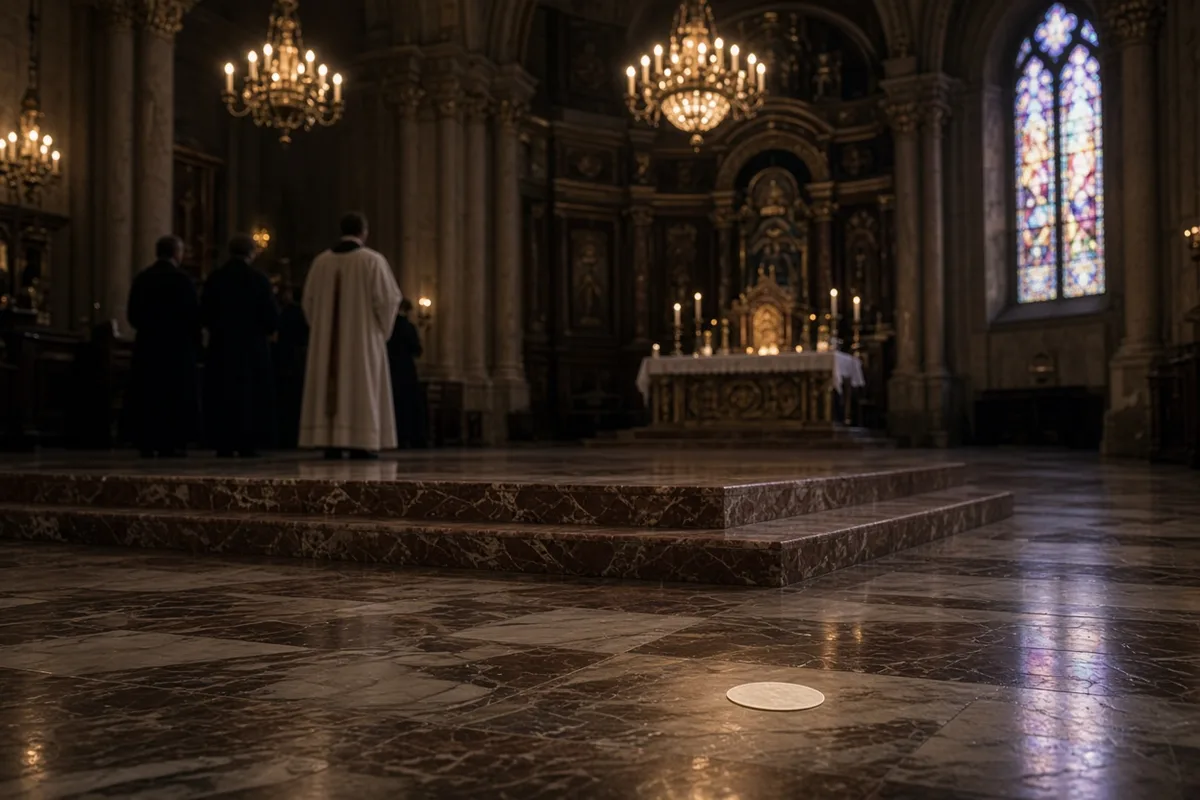
On 2 July more than three thousand people walked from the cathedral to the church. The procession moved slowly through streets lined with police tape. Inside, the reliquary was set into the altar wall. People filed past for hours. Some touched the glass with their fingertips. Others stood a long time without moving.
A man I had seen at the back of the church for years came forward that evening. He had not received communion in fifty years. He waited until the line thinned, then asked for confession. Father Ziombra heard him in the side chapel. When they finished, the man returned to his pew and stayed until the doors closed.
Skeptics wrote that the color could come from Serratia marcescens, a bacterium that stains starch red in cool, damp places. The parish posted the laboratory letters on the notice board without comment. The letters themselves said nothing about bacteria or miracles; they described tissue and DNA.
I still check the tabernacle light each morning before the first Mass. The reliquary stays where the bishop placed it. On ordinary days the church is quiet except for the sound of shoes on the stone floor and the occasional creak of the old heating pipes. The fragment inside the glass does not change. People continue to arrive from other countries. They kneel, look, and leave. Some return.
In the weeks after the 2016 announcement, the parish register recorded 4,872 names in the first month alone, each entry written by hand on lined paper by Sister Małgorzata from the convent across the square. On 12 May 2017 the first delegation from the Italian shrine at Lanciano arrived, led by Monsignor Nicola De Luca, who carried a sealed letter from the archbishop of Chieti-Vasto requesting a direct comparison of tissue samples. Father Ziombra read the letter aloud in the sacristy at 9:40 that morning, then placed it in the same drawer that already held the Wrocław and Szczecin reports. The Italian visitors stayed three days, photographing the reliquary under ultraviolet light at 365 nanometers and noting the absence of any visible mold growth on the glass. One of them, Dr. Giuseppe Sanguinetti, asked to measure the fragment’s longest axis with a digital caliper; the reading came to 11.4 millimeters.
By October 2018 the parish had installed a new security system with four infrared cameras aimed at the altar wall, funded by a donation of 47,000 złoty from a donor in Poznań who signed only as “J. K.” The cameras logged 312,000 individual entries through the main doors in 2019, a figure printed in the annual financial report read from the pulpit on the first Sunday of Advent. Pilgrims from Ukraine began arriving in larger numbers after the parish in Lviv posted a notice on its website on 4 March 2020; the first bus carried 52 people who had crossed the border at Medyka the previous evening. Father Kisiński heard confessions in Ukrainian for six hours that day, using a portable kneeler placed beside the side chapel. One woman from Odessa left a handwritten note in the intention box stating she had traveled 1,140 kilometers after reading the laboratory description of “fragments of striated muscle tissue with visible cross-striations” in a translation posted on the diocesan site.
The heating pipes were replaced in the summer of 2021 with a low-pressure system that reduced the creaking sound to a faint metallic tick every fourteen minutes when the boiler cycled. During the same works, the sacristy sink was removed and the shelf where the original dish had stood was sealed behind a new plaster wall; a small brass plaque now marks the spot, inscribed with the date 25 July 2013 and the single word “Hostia.” On 9 September 2022 a group of thirty seminarians from the Pontifical University of the Holy Cross in Rome spent an entire afternoon transcribing the two laboratory letters into Latin for an internal archive; their prefect, Father Marco Bellini, asked permission to photograph the reliquary at exactly 14:00 so the light would fall at the same angle used in the original diocesan photographs. The resulting images were later published in the university’s liturgical journal with the caption “Legnica, fragmentum cordis humani.”
Cardinal Kazimierz Nycz visited on 18 March 2023 and remained in the church for ninety minutes after the scheduled Mass, speaking quietly with three families who had come from Białystok. He signed the guest book on page 47 with the words “In hoc signo vincemus,” dated and witnessed by the parish secretary. The following month the diocesan curia issued a new decree allowing the reliquary to be carried in procession once each year on the Sunday nearest 17 April; the first such procession in 2023 drew 2,814 registered participants, counted by stewards with clickers at the cathedral steps. A medical team from the Military Clinical Hospital in Wrocław attended the event, stationed at two first-aid points, though no incidents required treatment beyond three cases of dehydration.
In the winter of 2024 the parish began keeping a daily logbook of visitors who request to speak with a priest after viewing the reliquary. The entry for 11 February records a man from Gdańsk who stated he had last received communion in 1978 and asked whether the tissue findings could be explained by any known preservation technique; Father Ziombra answered that the Szczecin report had noted “no evidence of chemical fixation or embedding media.” The man returned the next day and again on 13 February, each time signing the log with only his initials. On 27 April 2024 a television crew from Telewizja Polska filmed the church at dawn for a documentary segment; the cameraman positioned a tripod exactly where the front pew had stood in 2013, now removed to widen the aisle, and recorded the tabernacle light reflecting on the glass for forty-three uninterrupted minutes.
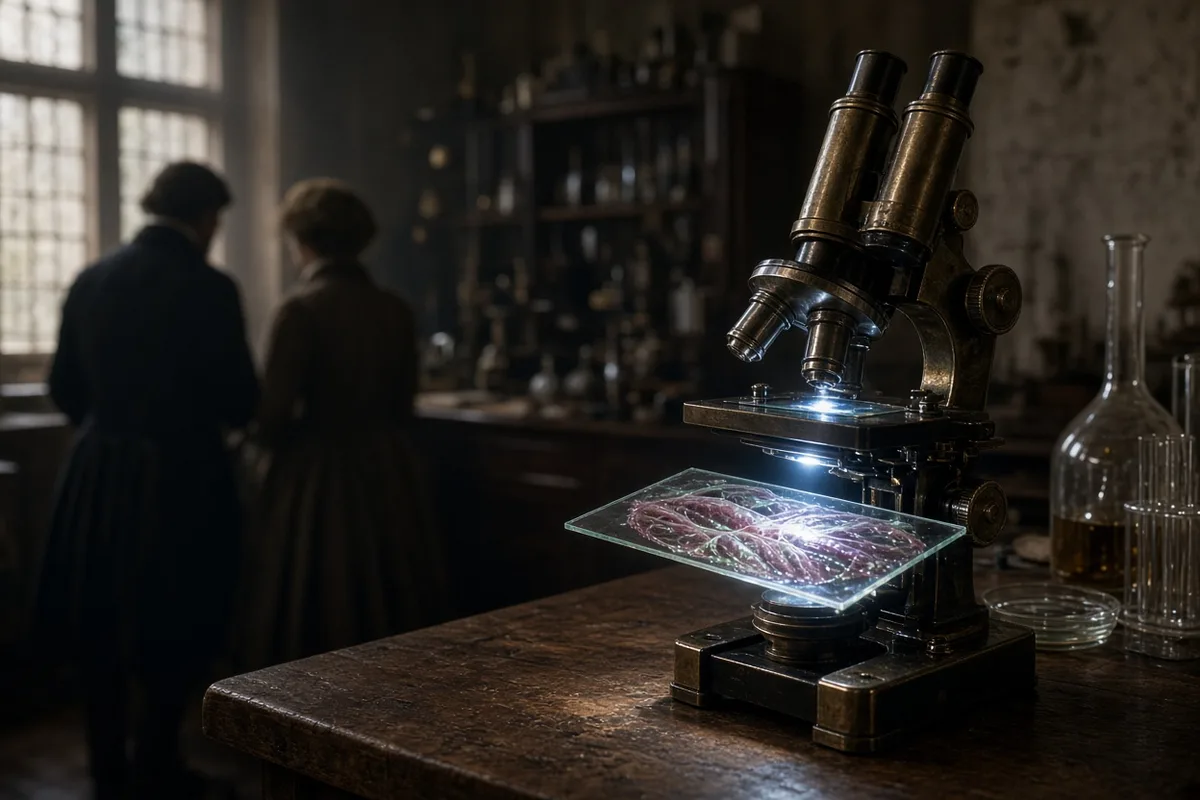
The last person I saw clearly before the evening closing on 3 June 2024 was a woman in a grey coat who knelt at the rail for twenty-two minutes without moving her hands from the wood. She had arrived on the 14:17 train from Warsaw, according to the ticket stub she later left on the bench, and she carried a small notebook in which she had copied the phrase “human DNA confirmed” from the notice board. When the sacristan rang the bell at 19:00 she rose slowly, touched the glass once with the back of her gloved fingers, and walked out through the side door without looking back. The reliquary remained in place, the fragment unchanged, the light steady.
The parish secretary, Sister Małgorzata, entered the final visitor entry for 2024 on 28 December at 16:45, recording a couple from Opole who requested a printed copy of the Szczecin letter and signed the log with their full names, Jan and Ewa Kowalczyk. She placed the carbon copy in the drawer beside the original laboratory reports before locking the sacristy at 17:10. On 15 January 2025 the diocesan curia approved the installation of a permanent LED light source above the reliquary, purchased for 8,200 złoty from a supplier in Wrocław and wired through a dedicated circuit that bypassed the main heating timer. The new fixture was switched on at 06:00 on 3 February, its beam fixed at 4,000 kelvin to match the angle of the morning sunlight that had first illuminated the fragment in 2013.
Bishop Andrzej Siemieniewski visited on 17 April 2025 for the annual procession and read aloud the 2016 decree from the Congregation for the Doctrine of the Faith during the homily, quoting the phrase “the material be placed where the faithful could venerate it” before signing the guest book on page 112. The procession that year registered 3,067 participants by clicker count at the cathedral steps, with stewards noting 214 arrivals from Slovakia via the border crossing at Chyżne. Father Ziombra heard confessions until 21:30 that evening, using the same portable kneeler placed beside the side chapel.
In March 2026 the parish installed a digital counter above the main doors that logged 481,000 entries for the calendar year, a figure announced from the pulpit on the first Sunday of Advent by Father Kisiński. The counter reset automatically at midnight on 31 December, and its data feed was printed monthly for the financial report kept in the sacristy filing cabinet. A delegation from the Pontifical Academy of Sciences requested access on 9 June 2026; their letter, signed by Professor Anna Kowalska, asked for a 0.2-millimeter scraping for electron microscopy, which the diocese declined in writing on 22 June citing the 2016 decree.
The sacristan replaced the linen cloth covering the reliquary on 25 July 2026, the thirteenth anniversary of the original event, using a cloth embroidered with the date and the word “Hostia” in red thread by a convent sister in Legnica. Pilgrims from the shrine at Orvieto arrived two weeks later on 8 August, led by Father Paolo Rossi, who carried a sealed envelope containing a fragment from the Italian case and requested side-by-side photography under the same 365-nanometer ultraviolet lamp used in 2017. The photographs were taken at 11:20 and archived in the parish computer under the folder labeled “Comparisons.”
Cardinal Nycz returned on 12 March 2027 and remained after the 10:00 Mass to speak with four families from Lublin, signing the guest book again on page 156 with the date and the single word “Pax.” The diocesan decree of 2023 was renewed that month, allowing the annual procession to continue; the 2027 event drew 2,956 participants counted at the cathedral steps, with first-aid stations staffed by the same military medical team from Wrocław. No incidents were logged beyond two cases of minor ankle strain treated with elastic bandages.
On 4 November 2027 the heating system was serviced and the boiler timer adjusted so the metallic tick occurred every twelve minutes instead of fourteen. The brass plaque on the sealed sacristy wall was polished that same day by the sacristan using a cloth kept in the drawer beneath the chalices. A woman from Kraków, whose name the logbook records only as “A. Nowak,” requested confession on 19 February 2028 after viewing the reliquary for forty-one minutes; Father Ziombra noted in the daily log that she asked whether the striated muscle description in the Szczecin report could be cross-referenced with any known cardiac tissue database, and he answered by reading the exact sentence “fragments of striated muscle tissue with visible cross-striations” from the posted translation.
The final entry in the visitor log before the church closed for the evening on 11 June 2028 was made at 18:55 by a man from Białystok who signed only with the initials “M. P.” and left a ticket stub from the 13:42 train. He had stood at the rail for nineteen minutes, hands resting on the wood, before rising when the sacristan rang the bell. The reliquary remained in place under the steady LED light, the fragment unchanged behind the glass.