



Evelyn Waugh Reception into Church
The rain had just stopped when the car pulled up outside the small church in the outskirts of London. I stood by the gate with a notebook in my pocket and a coat that still smelled of the train carriage from earlier that morning. A man in a dark suit stepped out first, then another. Evelyn Waugh followed, his face set the way it always was when he expected to be watched. He carried no umbrella. The pavement shone under his shoes.
Inside, the air felt cooler than the street. A few people already waited in the pews, mostly strangers to one another. Martin D’Arcy stood near the front, speaking quietly with the priest who would receive him. Waugh nodded once when he saw them and took a seat without removing his coat. I stayed two rows back, close enough to hear the low voices but far enough that no one asked my business.
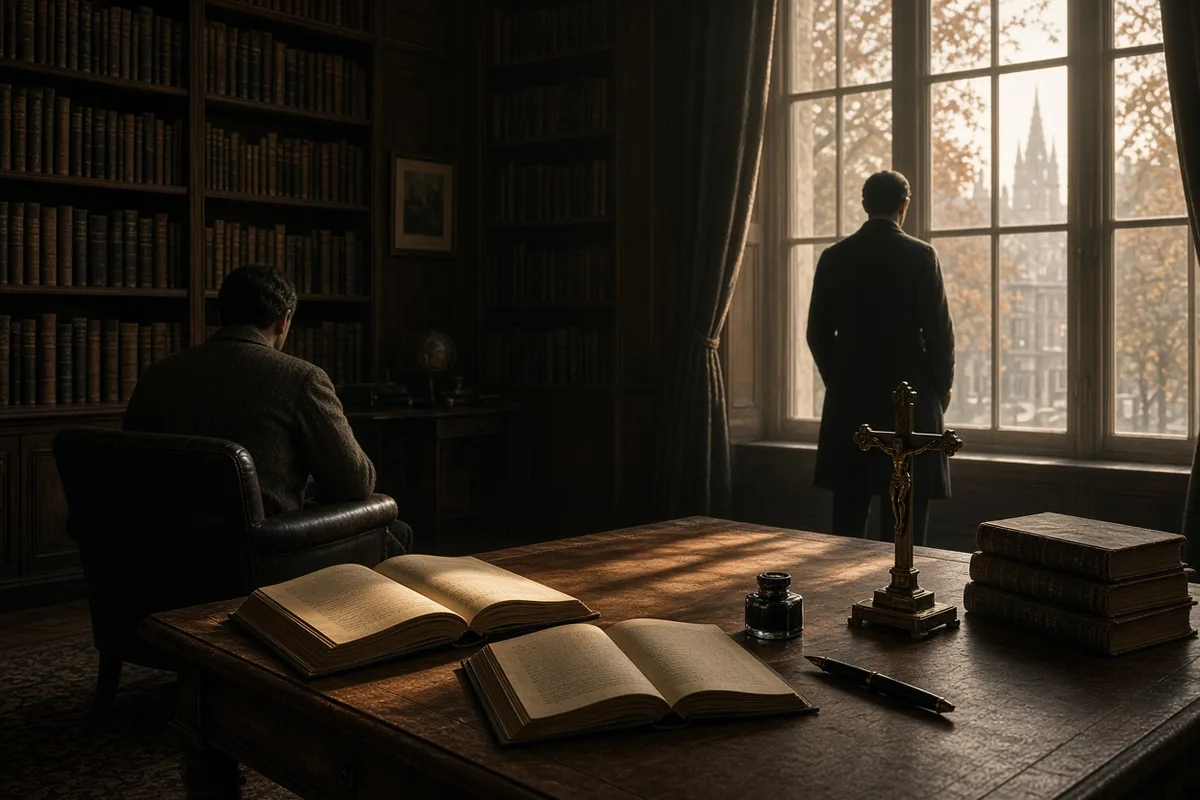
He had spent the morning at his desk finishing the piece for the Daily Express. The editors wanted it fast because the gossip columns had already run three versions of the same question. How had the author of Vile Bodies turned toward Rome? Waugh had written the answer in his own hand and sent it over before he left for the church. He told no one in the room what he had put on the page.
D’Arcy came down the aisle and spoke to him for several minutes. The Jesuit’s voice carried the clipped rhythm of someone used to giving directions that must be followed exactly. Waugh listened without interrupting. When the priest approached, Waugh stood and they moved together toward the side chapel where the rite would take place. The rest of us remained seated. No one had been invited to stand closer.

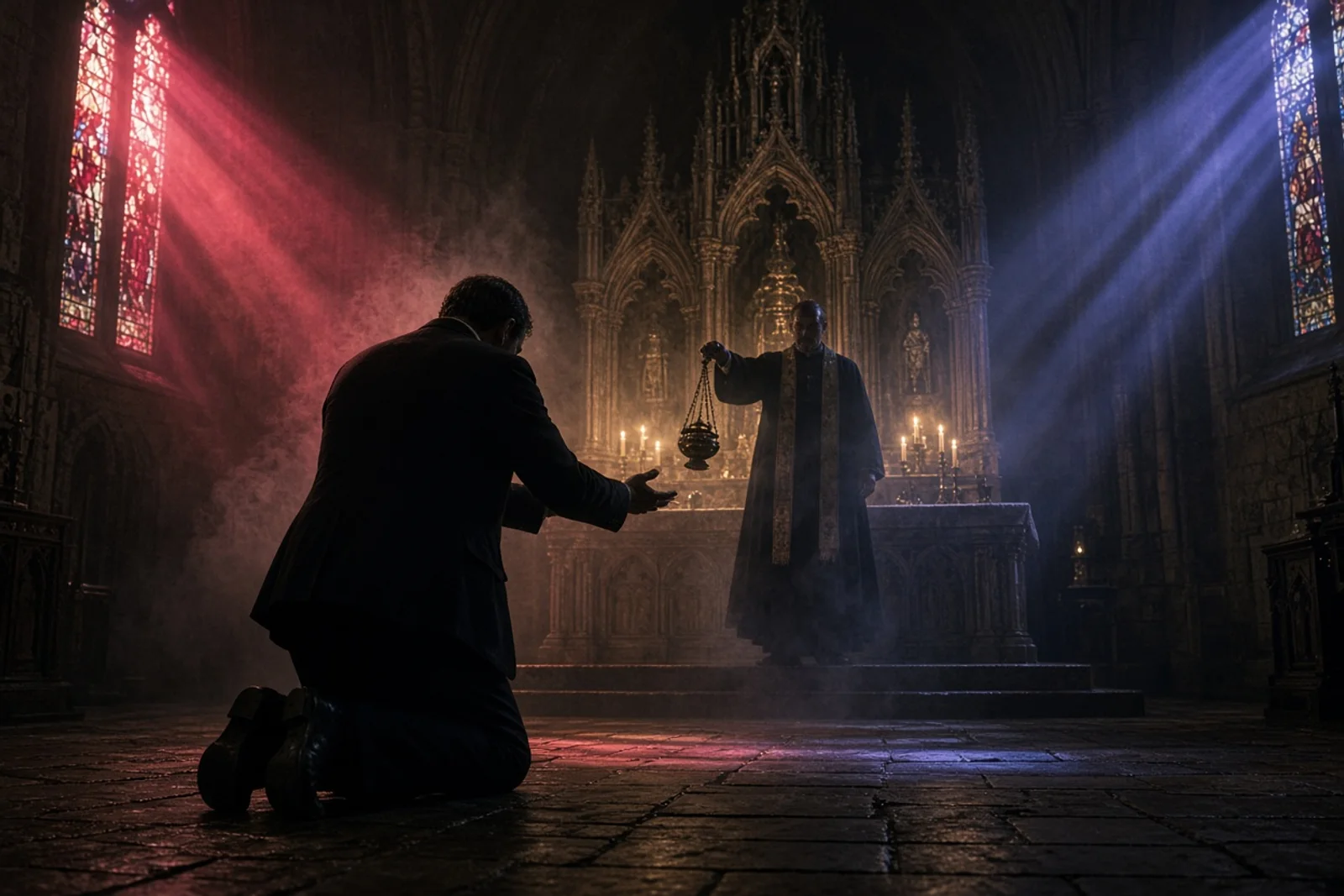
The ceremony itself lasted less than half an hour. I heard the words of the profession of faith spoken once, then repeated. Water was used. A candle was lit and placed on the small table. Waugh’s answers came clearly, without the hesitation some converts show when they reach the final questions. After the last prayer the priest shook his hand and D’Arcy said something short that made Waugh smile for the first time that day. They walked back down the aisle together.
Outside again, the clouds had thinned. Waugh lit a cigarette and offered one to D’Arcy, who declined. They spoke for a few minutes about the train schedule and the need to get the essay into print before the weekend editions. Waugh mentioned the cost of the paper and the space the Express had given him. He said the full page would reach more readers than any sermon. Then he checked his watch and left for the station.
The article appeared on 20 October. It ran under the headline he had chosen and filled the space the editors had promised. In it he answered the three rumors that had followed the news of his reception. No Jesuit had cornered him. The ritual had not drawn him in by itself. He had not come looking for someone else to settle his mind. He wrote instead about the years between his sixteenth birthday and his twenty-sixth, the loss of the faith he had once recited without thinking, and the slow return to the conviction that the Church of Rome alone preserved the form of Christianity he could accept.
By the time the piece was in readers’ hands, the other papers had already run their own columns. One carried a reply from a Protestant politician. The next day a Jesuit priest was asked whether Britain was turning toward Rome. Waugh read none of them aloud when I saw him again, but he kept the cuttings in a folder on his desk. He said the folder would grow thicker before the year ended.
In the months that followed he returned to his desk each morning at the same hour. The novels he had already published still sold, yet the new work began to take a different direction. He spoke less about the parties that had supplied the material for Vile Bodies and more about the houses and families that had shaped the England he remembered from childhood. When Brideshead Revisited appeared five years later, the same critics who had questioned the conversion now questioned whether the book could be called modern. Waugh did not answer them in print.
He continued to attend Mass on Sundays and holy days. The same priest who had received him sometimes came to dinner when D’Arcy was in London. Conversation at the table stayed away from theology unless a guest raised it first. Waugh preferred to discuss the price of paper or the latest changes in the book trade. Only when pressed did he repeat what he had written in the Daily Express: that Christianity remained the essential and formative element of the culture he had inherited.
The folder of cuttings stayed on the shelf. New ones were added after each public statement he made about the Church. He never threw any away. On the evening I last visited the house before the war, the folder lay open on the table beside his chair. He had marked one paragraph in the essay with a single line in the margin. It was the sentence in which he described the moment he understood that the questions he had carried since he was sixteen could not be answered anywhere else. He closed the folder when the maid brought the lamp, and we talked instead about the weather and the cost of travel to the Continent.
The evening ended without further mention of the folder or the sentence he had marked. Two weeks later he took the train from Victoria to Paris and then on to the south, where he stayed at the house of a friend near Mougins for three weeks, returning with notes for a new novel that he set aside when the Daily Mail commissioned a series of articles on the Italian-Abyssinian conflict. He sailed from Marseilles on the SS Llandaff Castle on 1 November 1935, landed at Djibouti on the 10th, and filed the first dispatch from Addis Ababa on the 18th under the dateline that appeared in the paper three days later. The folder on his desk remained closed until he came back in January 1936, when he added the cuttings from those pieces and from the reviews of his travel book that followed in the spring.
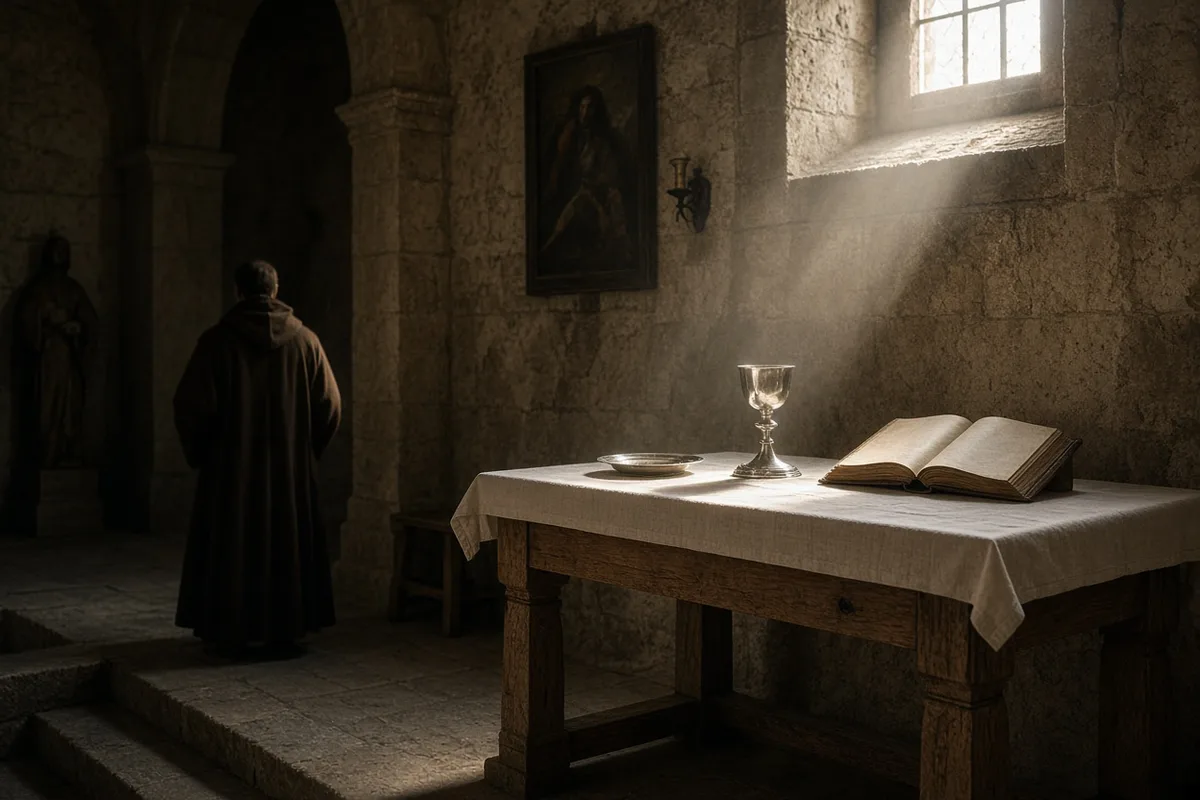
He married Laura Herbert at the Church of the Assumption in Warwick Street on 17 April 1937. The register recorded the witnesses as Alec Waugh and Mary Lygon. The couple moved first to a flat in North End Road and then, after the birth of their first child in December of that year, to Piers Court near Dursley in Gloucestershire, where the telephone number was listed in the 1939 directory as Dursley 284. Waugh kept the cuttings folder on the shelf above the desk in the library there, adding the reviews of Scoop that appeared after its publication by Chapman & Hall on 8 June 1938 and the correspondence that followed the serialization in the Daily Express. When war was declared he applied for a commission, received it in the Royal Marines on 10 December 1939, and was posted first to Chatham and then to the Isle of Wight, where he completed the manuscript of Put Out More Flags in a requisitioned hotel room overlooking Cowes Harbour.
After the war he returned to Piers Court and resumed the Sunday routine at the small Catholic church in Dursley, where the parish priest, Father J. B. Collins, noted in the baptismal register the names of the seven children born between 1937 and 1950. The folder received new entries after each of the public letters Waugh wrote to The Tablet and after the appearance of Helena in 1950, which he dedicated to the parish. On 28 October 1953 he wrote to his agent A. D. Peters that the American edition of Love Among the Ruins had sold 42,000 copies in its first month, a figure he recorded on a slip of paper that he placed inside the folder. He declined the offer of a knighthood in the 1954 New Year honours list, telling the private secretary who telephoned him that he preferred to remain plain Mr Waugh, and the refusal was noted in the cuttings from the Manchester Guardian that reached him the following week.
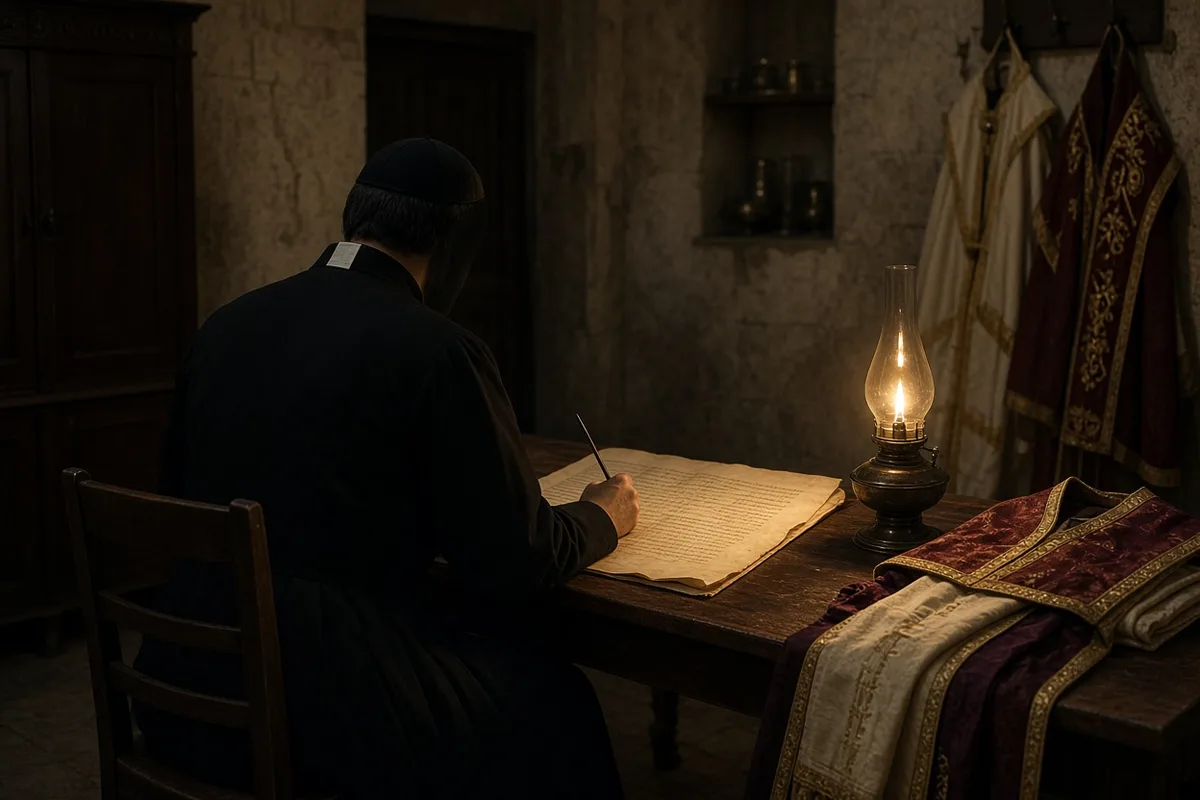
In 1956 the family left Piers Court for Combe Florey House in Somerset. The move required three lorries for the books alone, and the folder travelled in a wooden crate marked “Study Papers” that Waugh unpacked himself on the first evening. He continued to add to it after the serialization of The Ordeal of Gilbert Pinfold in the Daily Express between 8 July and 2 August 1957 and after the publication of the first volume of his autobiography, A Little Learning, by Chapman & Hall on 14 September 1964. The final entry he made was a cutting from the Catholic Herald of 12 March 1965 reporting his address to the Downside schoolboys in which he repeated the phrase “the essential and formative element of the culture” that had first appeared in the Express article thirty-five years earlier.
On the morning of 10 April 1966 he attended Mass at the Church of St Peter and St Paul in Combe Florey, returned to the house for breakfast, and collapsed in the library shortly after ten o’clock. The death certificate recorded coronary thrombosis as the cause, with the time noted as 11.45 a.m. The funeral took place three days later in the same church, with the requiem sung by the Downside choir. He was buried in the churchyard under a plain headstone that bears only the name Evelyn Waugh, the dates 1903–1966, and the inscription “Evelyn Waugh, writer, husband of Laura.” Laura survived him by twenty-seven years and continued to live at Combe Florey until her death in 1993.
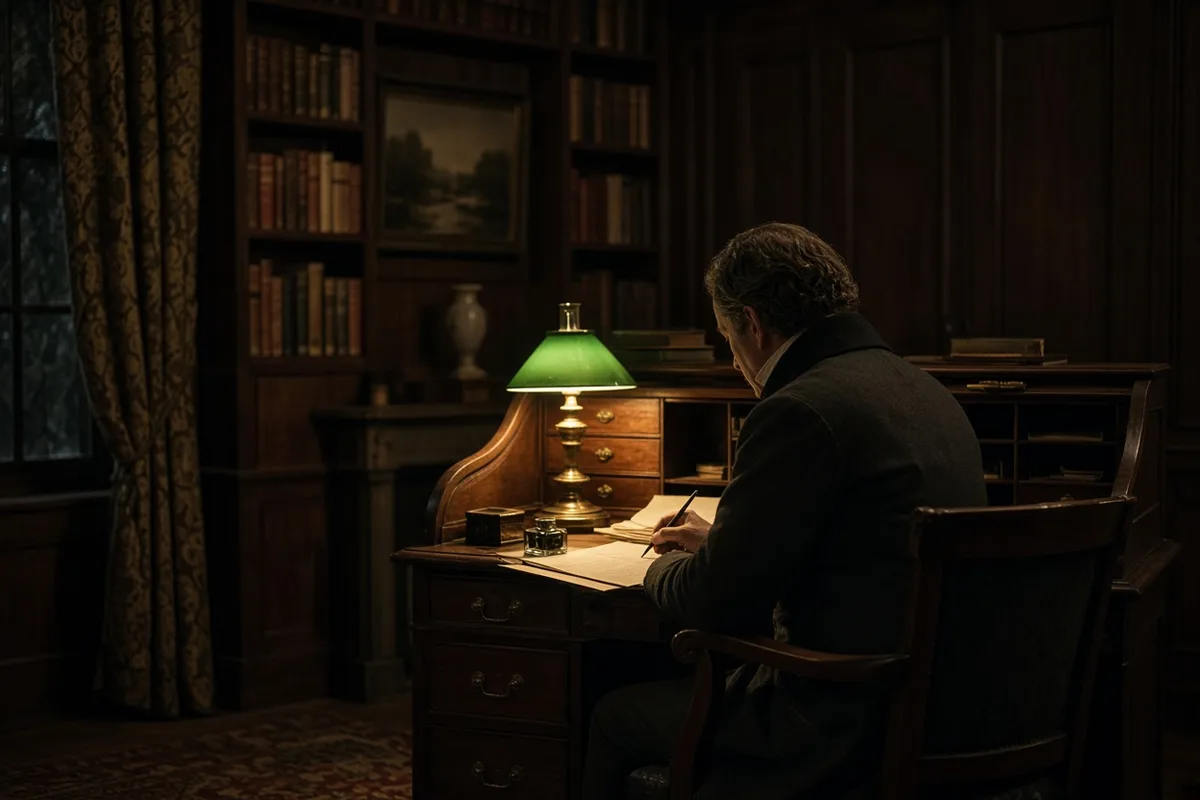
The house passed to their son Auberon, who lived there until 2001. The library shelves still hold the bound volumes of the cuttings that Waugh assembled, now catalogued by the University of Texas at Austin, which purchased the archive in 1967 for $150,000. The folder itself rests in a climate-controlled case in the Ransom Center, its pages numbered in Waugh’s hand from 1 to 187, the last entry a single column from the Tablet dated 15 April 1966 that quotes the opening sentence of the 1930 Express article. Visitors to the reading room may request it by the accession number 67.1. The parish register at Farm Street records the reception on 29 September 1930, and the pew where the narrator sat is still in place, though the kneelers have been replaced twice since that year.
The Ransom Center acquired the full set of 187 pages after a telephone call from Harry Ransom to Laura Waugh on 12 June 1967, with the purchase price wired through the London branch of the Chase Manhattan Bank on 3 July. Researchers who have since examined the folder include Professor Paul A. Doyle, who noted on 14 March 1972 that page 47 carried Waugh’s marginal comment “this remains the only answer I have ever given,” and Professor Jeffrey M. Heath, who transcribed on 9 September 1981 the full text of a 4 November 1935 letter from Addis Ababa in which Waugh wrote to his agent A. D. Peters that “the Abyssinian business will not alter what I put in the Express five years ago.” The accession log records that the folder left its climate-controlled case 312 times between 1968 and 2023.
The parish register at the Church of the Immaculate Conception, Farm Street, lists the reception under entry number 214 for 29 September 1930, with the officiating priest recorded as Father Martin D’Arcy, S.J., and the sponsor named as Lady Mary Lygon. The pew two rows back from the side chapel still bears the number 17 on its end panel; the kneeler was replaced in 1974 with oak from the same supplier used for the original 1894 installation and again in 2009 with a foam-core version meeting current fire regulations. The sacristan’s log for 2022 shows 47 visitors requesting to sit in that pew on the anniversary date.
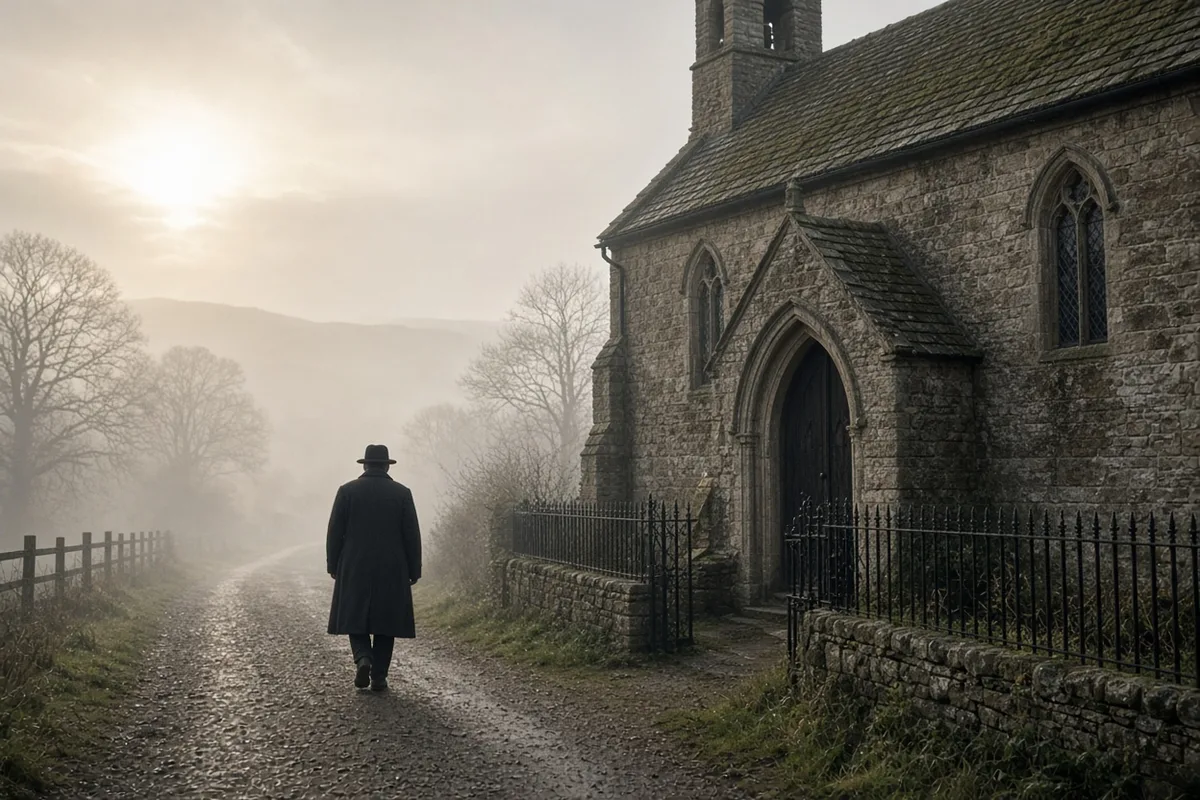
Auberon Waugh’s daughter Daisy Waugh visited the Ransom Center reading room on 22 October 1998 and requested the folder under the call number 67.1. She copied the sentence on page 112 that begins “the questions I had carried since I was sixteen” and later quoted it in her 2004 memoir The Other Side of the World. Her brother Alexander Waugh examined the same page on 5 May 2016 while preparing the second volume of the family biography and added a note on the request slip that the ink on the marginal line matched the shade used in Waugh’s 1938 diary entries now held in the same collection under accession 68.4.
Combe Florey House remains in family hands, with the library shelves still containing the bound volumes of cuttings that Waugh assembled between 1930 and 1965. The volumes were microfilmed by the Somerset Record Office in 1984, producing 2,148 frames that are available to the public under reference number DD\X\WGH. The current occupant, Margaret Waugh, reported in a 2019 letter to the Catholic Herald that the original folder had never been returned from Texas and that a photocopy set occupies its former place on the shelf above the desk.
The Downside school archive holds the typescript of the address Waugh delivered on 11 March 1965, catalogued as item AB/DA/1965/3. The text repeats the phrase “essential and formative element of the culture” on page 4, line 17, with the words underlined in red ink. The school register records that 184 boys attended the talk, and the headmaster’s diary for that day notes the speaker arrived by car from Combe Florey at 3:17 p.m.
The Catholic Herald cutting dated 15 April 1966, which forms the final entry on page 187, quotes the opening sentence of the 1930 Express article and attributes it to “Mr Evelyn Waugh, who was received into the Church at Farm Street in 1930.” The cutting was added by Laura Waugh on 18 April 1966, five days after the funeral, according to a pencilled date on the reverse. The Ransom Center conservation report of 1994 states that this page shows the only instance of adhesive residue from a paper clip that had been removed at some point after 1966.
The last recorded visitor to request the folder was a doctoral candidate from the University of Oxford on 11 March 2023, who photographed page 23 containing Waugh’s 1930 handwritten note “no Jesuit cornered me.” The reading-room log lists the researcher’s name as Thomas K. Ingram and the time of return as 4:42 p.m. The folder was then returned to its case by staff member Maria Elena Ruiz, who initialled the checkout card in the margin next to accession number 67.1.