



Peck argues discipline in facing problems leads to growth

In 60 seconds
- Most unnecessary suffering comes from dodging life's problems, not from the problems themselves.
- Four disciplines—delaying gratification, claiming the right share of responsibility, revising your map of reality, and balancing rules with judgment—are Peck's toolkit for suffering well.
- Love is a chosen effort to nurture growth, not the temporary euphoria of falling in love or the relief of dependency.
- Growth means treating every worldview, religious or secular, as a map that must keep being redrawn.
- Grace aids that work from beyond conscious will, yet laziness—the refusal to extend yourself—is the deepest barrier to receiving it.
- Maturity is effortful, chosen daily, and never finished.
The big idea
Peck contends that life is a series of problems and that psychological and spiritual health arrive only when a person meets that difficulty with discipline instead of avoidance. He treats love, truthfulness, and an expanding worldview as the same deliberate extension of the self against natural inertia.
The book in brief
Peck opens with a blunt claim: life is difficult, and the wish that it were otherwise creates most unnecessary suffering. Problems bring pain; people spend huge energy on denial, distraction, and blame. Avoidance does not erase the problem. It lets problems compound. Many patients, he found, arrived not because their troubles were uniquely severe but because they had spent years defending against naming them at all. Discipline, in his account, is the set of techniques for suffering well—trading short-term discomfort for longer-term order and freedom.
He then names four concrete disciplines. Delaying gratification means doing the hard, unpleasant part of a task first so the easier work becomes a genuine reward. Accepting responsibility means diagnosing two mirror errors: taking on too much blame or too little. Dedication to truth means continually revising the internal map of reality rather than defending an outdated one. Balancing, or bracketing, means judging case by case when a useful habit should be applied fully, restrained, or set aside.
From discipline he turns to love and clears away what he sees as a popular confusion. Falling in love is a temporary, largely involuntary collapse of ego boundaries that fades on its own. Real love, he argues, is the will to extend oneself for the purpose of nurturing one's own or another's spiritual growth. That will looks like attention, risk, and honest confrontation, not comfort or agreeable feeling.
He scales the map metaphor to whole worldviews. A rigid religious inheritance and a closed scientific atheism can both become obstacles when a person refuses to revise them against new experience. Growth requires treating one's deepest framework as a hypothesis under test.
In the final movement he names grace—serendipity, dreams, unbidden insight—as help that originates outside conscious will. The decisive human failure is not usually malice but laziness: the fear-driven reluctance to do the uncomfortable work growth demands. He reads that resistance as a psychological version of original sin. The book lands on the claim that maturity is never finished; it is chosen daily against entropy.
Context
Peck was a psychiatrist who blended clinical case studies from his practice with Christian and Eastern spiritual ideas. The book mattered because it carried therapeutic language into a mass audience and normalized inner work as a lifelong project rather than a crisis response.
The key ideas
1
Life is difficult
Most psychological suffering comes not from life's problems but from the effort spent avoiding them.
Avoidance
Denial, distraction, and blame let problems grow and compound
Discipline
Feel the pain now, solve the problem, gain longer-term freedom
Peck opens by treating life as a continuous series of problems. Pain is unavoidable. The wish for life to be otherwise, he argues, is itself the root of most unnecessary suffering.
People pour energy into denial, distraction, and blame. That avoidance does not remove the problem. Unsolved problems accumulate and compound. The eventual reckoning arrives later and heavier.
His clinical experience convinced him that many patients reached his office less because their troubles were unusually severe than because they had spent years building elaborate defenses against acknowledging problems at all. Discipline is his antidote: the deliberate choice to experience appropriate pain now in exchange for later order and freedom.
He frames the exchange as an economic transaction of the psyche. Spiritual and psychological growth cannot be separated from this willingness to suffer well.
In practice: A person who refuses to face a failing marriage does not stop the marriage from failing; they delay the reckoning and add years of quiet resentment.
2
Delay the reward
Doing the hard, unpleasant part of a task first is a learnable skill, not a fixed character trait.
Peck treats delayed gratification as the first specific discipline. The structure is simple: reverse the usual order so the difficult work comes before the easy work.
He generalizes from one pattern to many that look unrelated on the surface. Procrastination, addiction, impulsive spending, and short-lived romantic attachments all share the same preference for a smaller reward now over a larger reward later.
He traces the capacity to early childhood. Children who receive consistent, loving structure internalize the sense that discipline is safe and worthwhile. Children raised in chaotic or neglectful homes often never develop the trust required to defer pleasure, because their experience has taught them that rewards deferred are rewards lost.
The concrete technique is to reorder the day so the hardest hour comes first; the resulting relief becomes the reward structure itself rather than raw willpower.
In practice: An accountant client habitually did the pleasant parts of reports first and left the hard analysis for when she was tired; Peck had her reverse the order so the easier tasks became a real reward.
3
Responsibility cuts two ways
Suffering splits into taking on too much responsibility and refusing to take on enough.
Neurosis
Assumes too much blame; guilt, anxiety, self-doubt
Character disorder
Assumes too little blame; externalizes harm onto others or luck
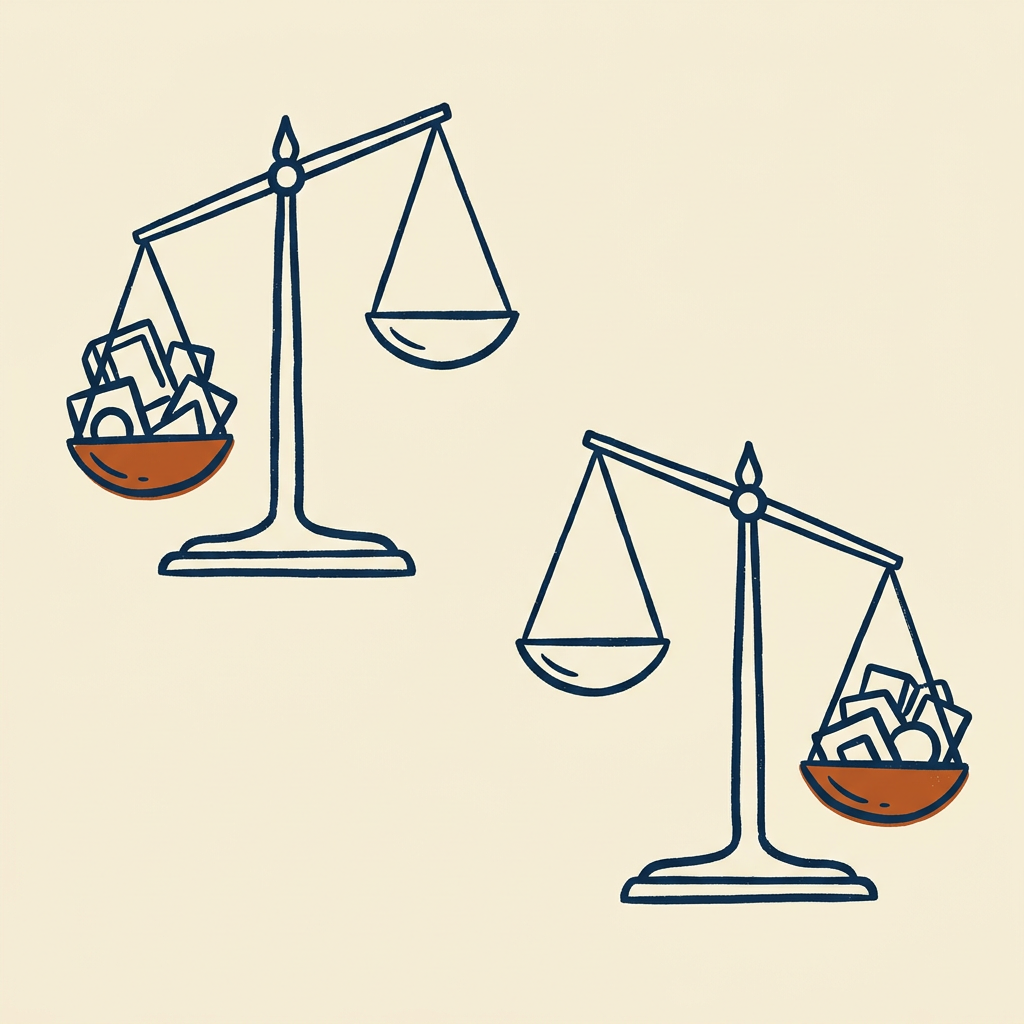
Peck's second discipline is assigning responsibility accurately. He names two broad patterns: neurosis and character disorder.
The neurotic person assumes too much responsibility, blaming themselves for situations that are not their fault, and suffers guilt, anxiety, and self-doubt. The character-disordered person assumes too little, externalizing blame onto other people, bad luck, or the system, and often harms others without much internal distress.
Most people, he notes, carry a mixture of both tendencies depending on the domain of life. A large part of psychotherapy consists of helping neurotic patients loosen excessive self-blame while helping character-disordered patients accept blame they have avoided.
Both errors distort the map used to solve problems. Over-blame paralyzes a person who is not the cause; under-blame prevents anyone from fixing the part that is actually theirs.
In practice: A housewife apologized for problems her husband created and catalogued her own inadequacy; a military officer facing repeated disciplinary trouble described every setback as the fault of superiors or an unfair system.
4
Keep revising the map
Refusing to update your partial map of reality under new evidence is a form of dishonesty even when no spoken lie occurs.
Peck's third discipline concerns truthfulness larger than not lying to others. Everyone operates from an internal map built from childhood, culture, and prior decisions. That map is always partial and somewhat outdated.
Dedication to truth means continually revising the map against new information, even when the revision is uncomfortable. Withholding truth from others can sometimes be necessary for kindness or timing. Withholding truth from oneself, he treats as always corrosive.
He uses transference to make the point concrete: a patient who reacts to the therapist with the fear or deference once felt toward a harsh father is applying an old childhood map to present terrain that does not warrant it. Therapy is largely the slow work of noticing those mismatches and updating them.
He extends the claim to institutions and marriages: they decay when members stop telling one another unwelcome truths. The discomfort of honest feedback is the price of staying oriented to reality.
In practice: A patient who insists a marriage is fine despite years of contrary evidence is not mainly lying to a spouse; they are lying to themselves, and the navigational map grows less accurate every year.
5
Bracket the rule
Genuine flexibility means temporarily setting aside a usually useful rule or emotion and judging case by case.
The fourth discipline Peck names is balancing, also called bracketing. Most useful psychological habits are double-edged. Caution protects against danger yet can become cowardice; assertiveness protects against exploitation yet can become aggression.
Balancing is the ongoing judgment of when to apply a habit fully, when to restrain it, and when to abandon it for the situation at hand. This is harder than good instincts because it requires giving up a simpler, more comfortable fixed rule in favor of situational complexity.
Peck notes that the move toward complexity is itself painful; it removes the certainty of a fixed rule and carries more risk of error. Psychological maturity, in his account, is not the accumulation of more rules but the willingness to hold fewer fixed rules and more contextual judgment.
Bracketing is the meta-discipline that governs the other three. Even honesty or responsibility-taking can be overdone in a given moment; each earlier discipline must itself be balanced rather than applied absolutely.
In practice: Anger can signal a crossed boundary, yet a person who has learned to express it productively must still set that expression aside in a professional negotiation where an outburst would cost more than it gains.
6
Falling in love is not love
The euphoria of falling in love is a temporary collapse of ego boundaries, not love, and mistaking the two drives most romantic disappointment.
Falling in love
Involuntary, temporary collapse of ego boundaries; fades on its own
Love as will
Chosen extension of self to nurture growth; effortful and sustained
After the discipline section Peck turns to love by clearing what he considers a widespread misconception. He defines love as the will to extend oneself for the purpose of nurturing one's own or another's spiritual growth. The key word is will: an act of choice and effort, not a feeling that arrives unbidden.
Falling in love, by contrast, he treats as a temporary erosion of the boundary between self and other—closer to a regression to infantile fusion than to a mature bond. It happens involuntarily and fades on its own once the practical friction of daily life reasserts separateness.
Couples who built their foundation entirely on that fused state often experience its ending as a crisis. They mistake the return of ordinary separateness for the death of love, when real love had not yet begun.
He also separates love from dependency counterfeits. A person who needs another to feel whole is engaged in a kind of parasitism. Real love requires two people secure enough to choose the other's growth even when it is inconvenient. The test is whether the relationship orients toward each person's growth or toward relief of one person's anxiety.
In practice: Couples who rested everything on the early fused state often treat the natural return of two separate selves as proof that love has died.

7
Love is attention and risk
Loving well requires deliberate attention and the willingness to risk rejection through honest confrontation.
Building on the definition of love as will, Peck describes what that will looks like. Attention is the most basic form: really listening to a spouse, friend, or child, setting aside one's own preoccupations. Most relationships shortchange it.
He argues that the quality of parenting is measured less by material provision than by genuine attention. Children who receive consistent attention learn they are worth attending to; that becomes a foundation of later self-discipline and self-worth.
Love also requires risk. Extending the self toward another's growth exposes a person to loss, rejection, and the discomfort of change. A parent who lets a child struggle through a hard problem rather than rescuing them risks temporary unhappiness for longer-term capability.
He is especially pointed about confrontation. Withholding honest feedback to spare short-term feelings, while calling it kindness, is often a failure of love disguised as compassion. Caretaking done mainly to relieve one's own anxiety about another person's choices is a counterfeit that can look identical from the outside.
In practice: A parent who steps back so a child can struggle through a difficult problem, rather than rescuing them, accepts the child's temporary unhappiness for the sake of lasting capability.
8
Outgrow a narrow map
A closed religious map and a closed scientific atheism can block growth equally when either refuses revision.
Closed inheritance
Literalist or secular map defended as settled fact
Living hypothesis
Worldview kept under test against new experience
Peck extends the map metaphor to religion and worldview. Every person inherits or constructs a working theory of reality—formal doctrine, secular scientific outlook, or something improvised from family experience. That theory guides every decision.
Growth requires periodically testing the map against lived experience and revising it, even when the revision is unsettling. A map that stops updating eventually diverges badly from the territory.
He illustrates with two equally closed patients: one raised in a strict literalist household who had never questioned inherited beliefs and whose rigidity damaged adult relationships; another, a self-described rationalist who dismissed all mystical experience as primitive yet refused to examine personal moments of unexplained meaning because they did not fit his framework.
The issue was not which map they held but their refusal to revise it. Science itself, he argues, can function as a religion in the sense of an unexamined total framework. Genuine growth treats one's worldview as a hypothesis under ongoing test.
In practice: A rigid literalist and a dismissive rationalist were, in Peck's reading, equally closed—just to different content—and both suffered for the refusal to update.
9
Grace meets laziness
Forces beyond conscious will aid growth, yet the greatest obstacle to receiving them is laziness—the fear-driven refusal to extend oneself.
Grace
Dreams, serendipity, unbidden insight pulling toward growth
Laziness
Fear-driven inertia that refuses the discomfort extension requires
In the final movement Peck introduces grace as a name for phenomena that support growth but originate outside deliberate effort: serendipitous events, dreams that carry suppressed insight, a sense that something beyond willpower is available if a person is open.
He points to dreams and unbidden insight as evidence that the unconscious often holds more accurate and compassionate self-knowledge than the conscious mind admits. Psychotherapy's task is partly to make that hidden wisdom usable.
He frames the struggle as a contest between grace, which pulls toward higher order and expanded consciousness, and entropy, the pull toward inertia and the comfort of staying as one is. The decisive failure is rarely malice. It is laziness: the reluctance to do the effortful, uncomfortable work of extending oneself—whether attention in a relationship, revision of a cherished belief, or the risk of honest confrontation.
He treats this laziness as a plausible psychological reading of original sin: not a doctrine to accept on faith, but a description of an observable resistance in every person to the effort growth demands. Grace can support the extension; it cannot substitute for the willingness to make the effort.
In practice: Dreams that seem to carry insight the waking mind had suppressed stand, for Peck, as one ordinary sign that help is available beyond conscious will.
Key terms
- Discipline Techniques for choosing appropriate short-term pain now to gain longer-term order and freedom
- Delayed gratification Doing the hard, unpleasant part of a task first so easier work becomes the real reward
- Neurosis The pattern of taking on too much responsibility and drowning in guilt or self-doubt
- Character disorder The pattern of taking on too little responsibility and blaming others or circumstance
- Map of reality The always-partial internal picture of the world a person uses to navigate decisions
- Bracketing Temporarily setting aside a usually useful rule or emotion to judge what the present situation actually needs
- Love The will to extend oneself to nurture one's own or another's spiritual growth
- Falling in love A temporary, involuntary collapse of the boundary between self and other that fades on its own
- Grace Help toward growth—dreams, serendipity, insight—that originates outside conscious effort
- Laziness The fear-driven unwillingness to extend oneself into the discomfort growth requires
What to do
- Do the hardest, most unpleasant part of one postponed task first thing Monday before anything easier.
- In one important relationship, replace a comforting silence with one honest, specific piece of feedback you have been withholding.
- Before your next disagreement, pause and ask whose responsibility the problem actually is, resisting both total self-blame and total other-blame.
- Treat each of those moves as a weekly practice rather than a one-time fix.
- Notice one place this week where you are defending an old map against clear new evidence, and name the evidence out loud to yourself.
Questions to think with
- Where in your life are you still eating the frosting first and saving the hard work for last?
- In your current hardest conflict, are you over-claiming responsibility or under-claiming it?
- Which feedback have you been withholding in the name of kindness that might actually be a failure of love?
- What part of your worldview—religious, scientific, or personal—have you stopped testing against experience?
- Where is laziness, rather than lack of knowledge, the real barrier to the next step of growth?
The other side
The evidence is almost entirely Peck's own remembered caseload of mostly white, middle-class American patients, with no systematic data or comparison groups, so vivid anecdotes often leap to sweeping claims about human nature. Later critics have argued the book is less a neutral bridge than a personal theology in clinical dress; attachment research complicates his sharp split between falling in love and real love; earlier editions' treatment of homosexuality is now dated; and posthumous accounts of his own chronic infidelity, drinking, and estrangement from his children undercut any implied claim that he had fully integrated the disciplined love he taught.
Who it's for
Readers stuck repeating the same relationship or work pattern who suspect the problem is internal, people in or considering therapy who want a plain framework for what growth requires, and anyone drawn to spiritual questions but wary of dogma who wants a psychological bridge to them.