



Felony records rebuilt racial caste without saying race
In 60 seconds
- Alexander traces a pattern in which slavery, Black Codes, Jim Crow, and mass incarceration each reinvented racial hierarchy once the prior legal form became indefensible.
- U.S. prisons grew from about 300,000 people in 1980 to past 2 million while crime stayed stable or fell, tracking the 1982 Reagan drug war more than drug use.
- Black and White Americans use and sell drugs at similar rates, yet Black men were imprisoned on drug charges at rates more than twenty times higher in some states.
- A felony record then bars housing, jobs, welfare, jury service, and voting for life, legally permitting discrimination race law would forbid.
- Courts demand proof of racist intent, so statistical disparity cannot topple the system the way it once toppled Jim Crow.
- Ending it, she says, requires naming caste and building a broad movement, not narrow technocratic tweaks that fade when attention moves on.
The big idea
Alexander argues mass incarceration is a racial caste system that replaced Jim Crow by using felony status instead of race laws. Because it looks race-neutral, well-meaning people can treat it as ordinary crime policy while it strips millions of Black Americans of full citizenship.
The book in brief
Alexander starts from a historical pattern: each time one racial control system collapsed, another adapted to the new climate. Slavery yielded to Black Codes and convict leasing; those yielded to Jim Crow; civil-rights victories yielded to mass incarceration. Prison numbers exploded after 1980 even as crime did not, and she ties the surge to the Reagan drug war launched before crack was a major public crisis.
She then maps the legal machinery. Pretextual traffic stops, consent searches, Byrne-grant arrest incentives, mandatory minimums, and plea bargains shifted power to police and prosecutors. Over ninety percent of cases end in pleas, so sentences are bargained under threat rather than tried. None of this needs personal racism; race-neutral incentives plus stereotypes produce wildly disproportionate results.
The empirical core follows. Federal surveys showed similar drug use and sales across races, yet enforcement and sentencing hammered Black communities. Patrols concentrate in poor Black neighborhoods; the 1986 law punished crack one hundred times more harshly than powder for the same amount. Media racialized crack while White use continued.
After release, the felony label does durable work. Employers reject the box; housing and welfare bars push people out; jury and voting bans shrink civic membership. In several states nearly a quarter of adult Black men lost the vote. Alexander then makes the namesake comparison: Jim Crow used literacy tests and poll taxes; mass incarceration uses the felon category. Both create second-class status without race in the statute. McCleskey v. Kemp required intent proof and, she argues, insulated disparity the way Plessy once insulated segregation.
She closes on strategy. Mainstream civil-rights groups under-prioritized criminal justice; colorblind technical fixes get reversed. She wants the drug war named as caste and a coalition that includes working-class Whites harmed by the same machinery, treating the fight as a decades-long moral project.
Context
Michelle Alexander published the book in 2010. It reframed mass incarceration as a civil-rights crisis rather than a mere crime-policy failure and reshaped debate and activism afterward.
The key ideas

1
Caste keeps reinventing
Alexander argues each American racial caste system collapsed only when its legal form became indefensible, then reappeared in a form suited to the new politics.
- post–Civil WarBlack Codes and convict leasing replace slavery
- Jim Crow eraSegregation laws lock in racial hierarchy
- 1960sCivil-rights victories dismantle Jim Crow
- 1980About 300,000 people incarcerated
- 1982Reagan administration launches War on Drugs
- book’s writingMore than 2 million incarcerated
She walks a sequence: slavery, then Black Codes and convict leasing, then Jim Crow, then mass incarceration after the 1960s. White America did not abandon hierarchy; specific mechanisms became obsolete or morally unsustainable. Convict leasing faded as industrial labor needs shifted. Jim Crow fell under civil-rights pressure.
The successor always adapted. Mass incarceration is race-neutral on its face and devastating in racial effect. She starts with scale: roughly 300,000 people locked up in 1980, past 2 million by the book’s writing, with the U.S. imprisoning a larger share of its Black population than apartheid South Africa did at its height.
Crime rates stayed relatively stable or fell during the steepest expansion. Growth tracked policy, especially the Reagan drug war begun in 1982 before crack was a major public concern. Timing, she says, shows a political initiative first and a drug-crisis response second.
Reading prison statistics as evidence of a system, not just of crime, sets her method for the rest of the book.
In practice: The 1982 drug-war launch preceded the crack crisis that later justified it, which Alexander treats as proof of political design over reactive public safety.

2
Legal machinery of lockdown
Supreme Court rules on stops and searches, plus funding and mandatory minimums, made race-based policing almost impossible to challenge in court.
Alexander details how doctrine and incentives stacked. Whren v. United States in 1996 let police use any traffic violation as pretext regardless of real motive, rendering stops of Black and Latino drivers essentially unreviewable. Consent searches stood even when people barely knew they could refuse.
Byrne grants paid departments to maximize drug arrests, rewarding quantity over safety outcomes. Mandatory minimums from the 1980s and 1990s moved sentencing power from judges to prosecutors, who could threaten decades to force pleas. Over ninety percent of criminal cases end in plea bargains, so most drug defendants never reach trial.
SWAT-style raids, federally funded, became routine even for minor warrants. A chief chasing grants, a prosecutor stacking charges, and a legislator performing toughness can each follow race-neutral incentives.
Discretion at every stage still runs against stereotypes about who uses and sells drugs, producing disproportionate arrest and imprisonment without anyone needing to declare racist intent.
In practice: Whren allowed officers to stop drivers for any minor traffic violation and then search, with the officer’s true motive legally irrelevant.
3
Enforcement tracks race
Similar drug use across races but vastly higher Black imprisonment rates show the system follows enforcement choices, not underlying crime.
Alexander’s central empirical claim rests on federal surveys, including National Institute on Drug Abuse data from the era: White Americans used and sold illegal drugs at rates comparable to, or in some studies higher than, Black Americans. Yet Black men went to state prison on drug charges at dramatically higher rates—in some states more than twenty times higher.
Discretion explains the gap. Police flood low-income Black neighborhoods rather than White suburbs or campuses, so arrests follow patrol density. Mid-1980s crack coverage racialized drug crime in the public mind while White use continued at similar levels.
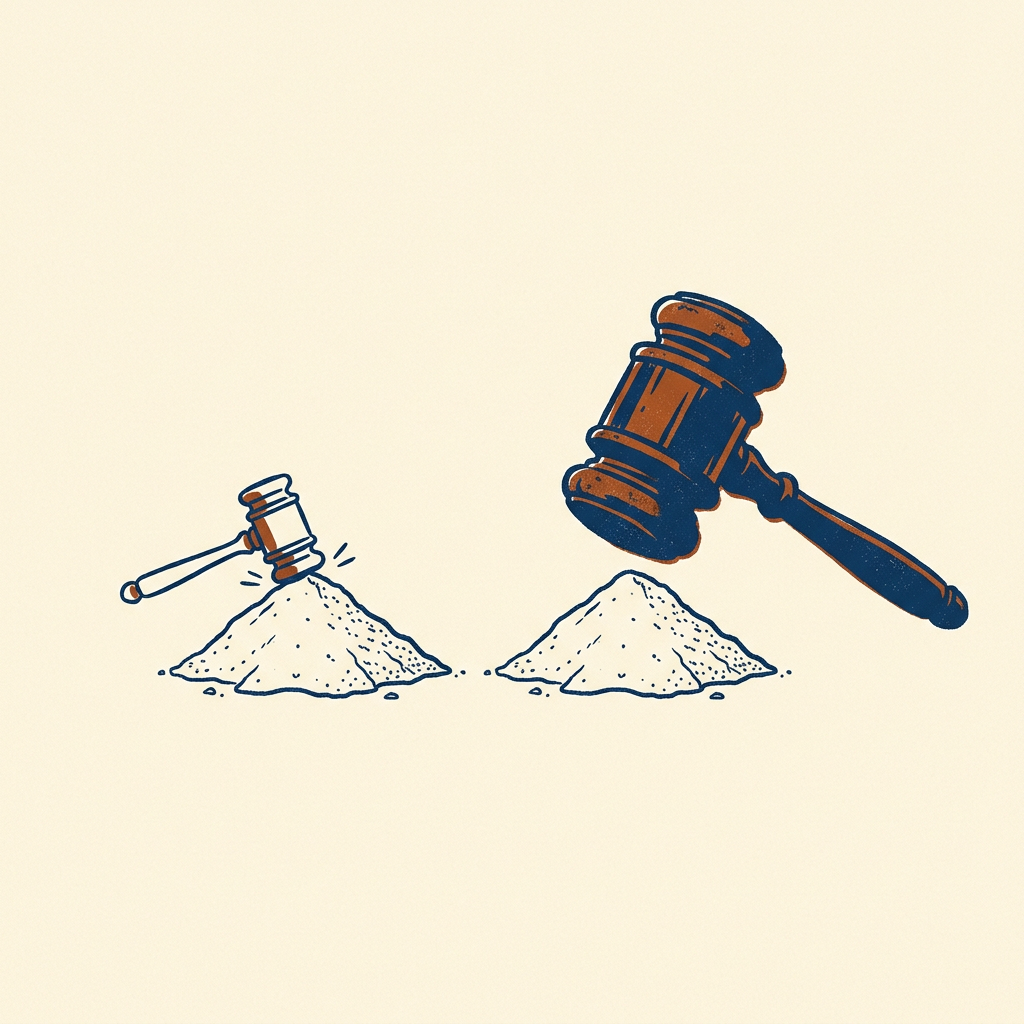
Sentencing compounded enforcement. The 1986 Anti-Drug Abuse Act punished crack, associated with Black users, one hundred times more severely than powder cocaine, associated with White users, for the same quantity, though the drugs are pharmacologically almost identical. Congress defended the split with racialized rhetoric about crack’s unique harm that later research did not back.
Behavior cannot explain the combined pattern. Where the state looks and how hard it punishes what it finds must.
In practice: Matched federal survey data on similar use rates sit beside state imprisonment rates more than twenty times higher for Black men on drug charges.

4
Felony as permanent status
Release begins a new legal subjugation: a felony record permits lifelong exclusions race discrimination law would ban.
Alexander shifts to life after prison, where caste does durable work. Employers routinely reject anyone who checks the felony box. Sociologist Devah Pager’s Milwaukee matched-résumé studies found a White applicant with a record more likely to get a callback than a Black applicant with none.
Public housing rules from 1990s federal law can deny people with drug convictions, sometimes permanently, pushing them toward homelessness or the same networks that led to arrest. Drug felonies barred food stamps and welfare in many states. Most states barred felons from juries, so defendants face panels stripped of people from their own background.
Voting is the starkest cut. Many states disenfranchise felons temporarily or permanently; in several, close to a quarter of the adult Black male population had lost the vote when she wrote.
These are not side effects. They form a colorblind exclusion system whose racial targeting was set upstream by who gets the record.
In practice: Pager’s Milwaukee study showed White applicants with criminal records receiving more callbacks than Black applicants with clean records.
5
Function matches Jim Crow
Mass incarceration defines a subordinate racial caste through neutral legal status the way Jim Crow did through neutral voting rules, and intent doctrine blocks the same statistical challenges that once worked.
Alexander compares mechanisms, not surface forms. Jim Crow used literacy tests, poll taxes, and grandfather clauses to exclude Black citizens while claiming equal application. Mass incarceration uses the convicted-felon category to exclude people from housing, work, welfare, and the vote while claiming the same.
Both produced sanctioned second-class citizenship for a racially defined group without race in the statutes. That is why civil-rights law built against explicit racial classifications cannot touch the new system. Courts require discriminatory intent.
McCleskey v. Kemp in 1987 is her hinge. The Supreme Court accepted massive racial disparity evidence in Georgia death-penalty sentencing yet held it insufficient without proof of racist intent in the specific case. She likens the ruling’s protective effect to Plessy v. Ferguson’s sanction of segregation.
She denies identity of form—no racial signage, no lynching terror. Her claim is functional: each system decided who counted as a full citizen along racial lines while contemporaries could call the current rules raceless.
In practice: McCleskey accepted statistical proof of racial disparity in death sentencing but still demanded case-specific intent, closing the path disparity evidence once opened.
6
Name caste, build movement
Because the system runs on passive complicity from people who do not see themselves as racist, Alexander says only a mass movement that names racial caste—not narrow technical fixes—can dismantle it.
Her closing chapter turns from diagnosis to strategy and is deliberately less empirical. She faults the mainstream civil-rights establishment of the 1990s and 2000s for ranking affirmative action in jobs and schools above criminal justice, leaving mass incarceration barely challenged as it became a central control system.
Colorblind reforms—tweaking guidelines, funding reentry—fail when they skip the racial logic underneath. Political pressure fades and the gains hollow out, much like post-Reconstruction symbolic wins once national attention left.
She wants journalists, advocates, and citizens to speak of the drug war as an earlier generation spoke of Jim Crow: a moral emergency of caste, not a race-neutral bureaucratic mess. Real change needs a broad coalition, including poor and working-class White Americans also harmed by incarceration’s collateral damage, aimed at dismantling the system rather than sanding its edges.
She frames the work as decades long, comparable in scale to the original civil-rights movement.
In practice: She compares thin technical sentencing tweaks to post-Reconstruction gains that collapsed once national focus moved elsewhere.
Key terms
- racial caste system A structure that locks a racially defined group into permanent second-class legal status across work, housing, welfare, and voting
- War on Drugs The policy drive Alexander dates to Reagan in 1982 that expanded arrests and sentences and, she argues, rebuilt caste
- pretextual stop A traffic stop justified by any minor violation while the real aim is a drug search; blessed by Whren
- mandatory minimum A fixed long sentence set by statute that shifts power to prosecutors and fuels coercive pleas
- felony disenfranchisement State rules that strip voting rights from people with felony records, temporarily or for life
- crack-powder disparity The 1986 federal rule treating crack as one hundred times worse than powder cocaine by weight
- discriminatory intent doctrine The court rule, crystallized in McCleskey, that statistical racial disparity alone cannot prove an equal-protection violation
- colorblindness The claim that rules without racial words are racially fair; Alexander says it hides caste
What to do
- Look up your state’s felony disenfranchisement and occupational licensing rules for drug convictions this week.
- If you help hire, ask whether applications demand criminal history before interviews and push to drop that box.
- Learn your local district attorney’s name and how that office uses charging discretion and plea bargains.
- Track whether reentry or sentencing bills in your state confront racial enforcement patterns or only fund narrow programs.
- If you write or teach about crime policy, practice describing drug-war outcomes as caste questions rather than only bureaucratic ones.
Questions to think with
- If two groups use drugs at similar rates but face wildly different prison rates, what should count as proof the system is about race?
- Does requiring racist intent to win in court protect fairness or protect the system Alexander describes?
- How should reformers weigh Black officials’ past support for tough-on-crime laws without erasing racial disparity data?
- Which exclusions after prison—jobs, housing, voting, juries—do the most to turn a sentence into lifelong caste?
- What would a coalition that includes working-class White people harmed by the same machinery have to name in common?
The other side
Critics argue the Jim Crow analogy flattens history: Jim Crow used explicit racial statutes and state-backed terror, while mass incarceration does not state racial subordination as its purpose. James Forman Jr.’s work highlights Black mayors and police chiefs who backed tough-on-crime policies amid real violence, a form of agency Alexander’s White-caste frame struggles to explain. Others say class and prison profit explain more than race alone, note that poor Whites are also locked up at historically high rates, and point out that crack-powder reforms such as the 2010 Fair Sentencing Act already narrowed a disparity the book treats as stubbornly resistant. The final chapter calls for a consciousness shift more than a concrete legislative sequence, leaving a strong diagnosis with thinner guidance on what to pass first.
Who it's for
Criminal-justice advocates, social workers, lawyers, and educators who need historical framing for felony-record harm will get the most. Readers who want a full account of Black-led tough-on-crime politics, class-first analysis, or a detailed reform playbook should not treat this as their only source.