



Fighting unwanted feelings is what keeps you stuck

In 60 seconds
- Harris argues the belief that happiness means feeling good most of the time is a cultural myth that produces chronic disappointment.
- He claims most psychological suffering comes from struggling against feelings rather than from the feelings themselves.
- Cognitive defusion treats self-critical thoughts as mental noise instead of facts that must be obeyed or argued away.
- Willingness to feel discomfort enables movement toward what matters; experiential avoidance keeps people stuck.
- Values are ongoing qualities of action, not finishable goals, and can be enacted immediately regardless of mood.
- Committed action means returning to value-guided behavior after expected lapses without treating setbacks as total failure.
The big idea
Harris argues that chasing constant good feeling is a losing game because fighting or avoiding unwanted thoughts and emotions tends to intensify them. Drawing on Acceptance and Commitment Therapy, he claims a rich life comes from noticing thoughts as passing events, making room for discomfort, staying present, and orienting behavior around chosen values rather than the pursuit of feeling good.
The book in brief
Harris opens by naming cultural myths that treat happiness as the natural human state and negative emotion as proof something is wrong with you. He reframes the core problem as a second layer of suffering created by the belief that ordinary pain should not be there.
The argument then shows how fighting internal experience amplifies distress, how the mind’s commentary gets treated as reliable fact, and how lives get organized around dodging discomfort. Each move deepens the same trap: the harder people push away normal pain, the more stuck they become.
The middle of the book turns to a different relationship with inner experience. Harris walks through making room for feelings without a war against them, noticing thoughts without obeying them, and returning attention to the present moment where action is actually possible.
He then supplies the direction those skills serve. Values are clarified as continuous qualities of living rather than trophies to collect, and insight is declared useless unless translated into concrete, repeatable behavior that survives setbacks.
The book lands on one practical claim: you do not need to feel ready, calm, or confident before you act on what matters. You only need willingness to move while carrying whatever discomfort shows up.
Context
Russ Harris published the book in 2007 to bring Acceptance and Commitment Therapy, a clinical evidence-based model, to a general audience frustrated with positive-thinking advice. The summary notes it mattered as a more honest account of how emotions work for readers who had tried affirmations without lasting relief.
The key ideas

1
The happiness myths
The belief that happiness means feeling good most of the time is a cultural myth that sets people up for chronic disappointment.
The myth
Happiness means feeling good most of the time; negative emotion means something is wrong with you.
Harris’s claim
A full life includes discomfort; fighting normal pain creates a second layer of suffering.
Harris names assumptions most people never question: that happiness is the natural human state, that unhappiness signals something wrong with you, that you should control what you think and feel, and that you need to feel good before you can live well. He traces these beliefs to advertising, self-help culture, and a therapeutic industry that treats negative emotion as pathology.
He points to a plain observation: surveys of psychological distress have not fallen despite decades of self-help sales and rising antidepressant prescriptions. If the myths were true, people should be getting happier as they get better at controlling their minds. They are not.
The chapter’s real move is separating two problems: the original unwanted feeling, and the second layer of suffering created by believing that feeling should not be there. He calls that second layer the happiness trap—the harder you fight normal pain, the more distressed and stuck you become.
This reframes the whole project. The aim is not eliminating negative emotion but changing your relationship to it. A rich human life necessarily includes discomfort, and treating discomfort as an emergency generates avoidance, rumination, and the sense of being broken.
In practice: A client rates herself a failure for feeling anxious before public speaking, treating the anxiety itself as proof of inadequacy rather than a normal human response.
2
The struggle switch
Most psychological suffering comes not from painful thoughts and feelings themselves but from the struggle to suppress or escape them.
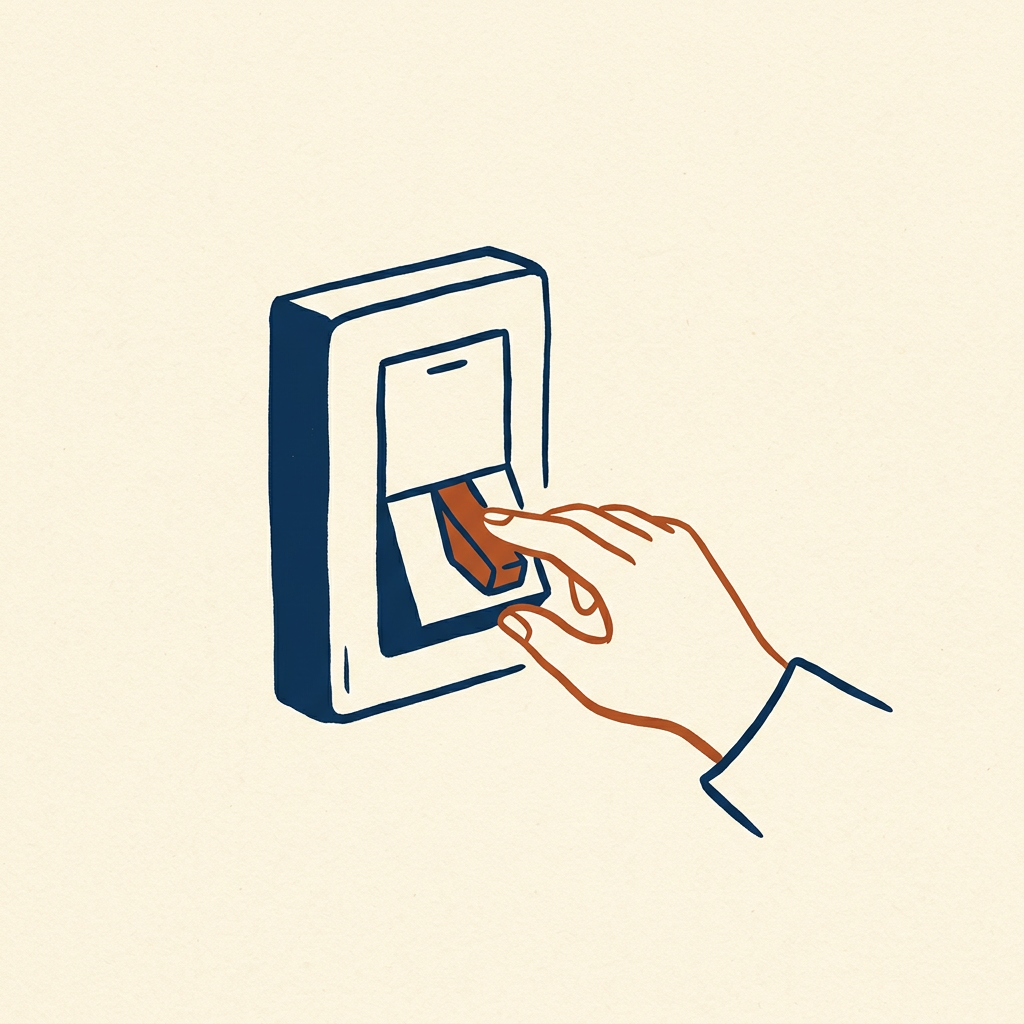
Switch on
Fight, resent, and force the feeling away; tension and self-criticism multiply.
Switch off
Let the feeling exist without a war; original pain stays, the second wave does not.
Harris describes an internal struggle switch that can flip on or off in response to the same feeling. Two people can feel identical sadness; one fights it, resents it, and tries to force it away, generating a second wave of tension and self-criticism, while the other lets it exist without a war. The suffering difference is not the sadness—it is the struggle.
He backs this with the everyday pattern that trying not to think about something reliably makes you think about it more, the rebound effect from thought-suppression research. Applied to emotion, telling yourself to calm down or stop feeling anxious usually amplifies the feeling rather than removing it.
The switch is usually invisible. People do not notice they have turned it on; they just experience life as a constant low-grade fight. Turning it off does not mean resigning to misery. It means recognizing that a feeling can be present without demanding immediate action to remove it.
That distinction—between having a feeling and being at war with it—becomes the hinge for the rest of the book’s techniques.
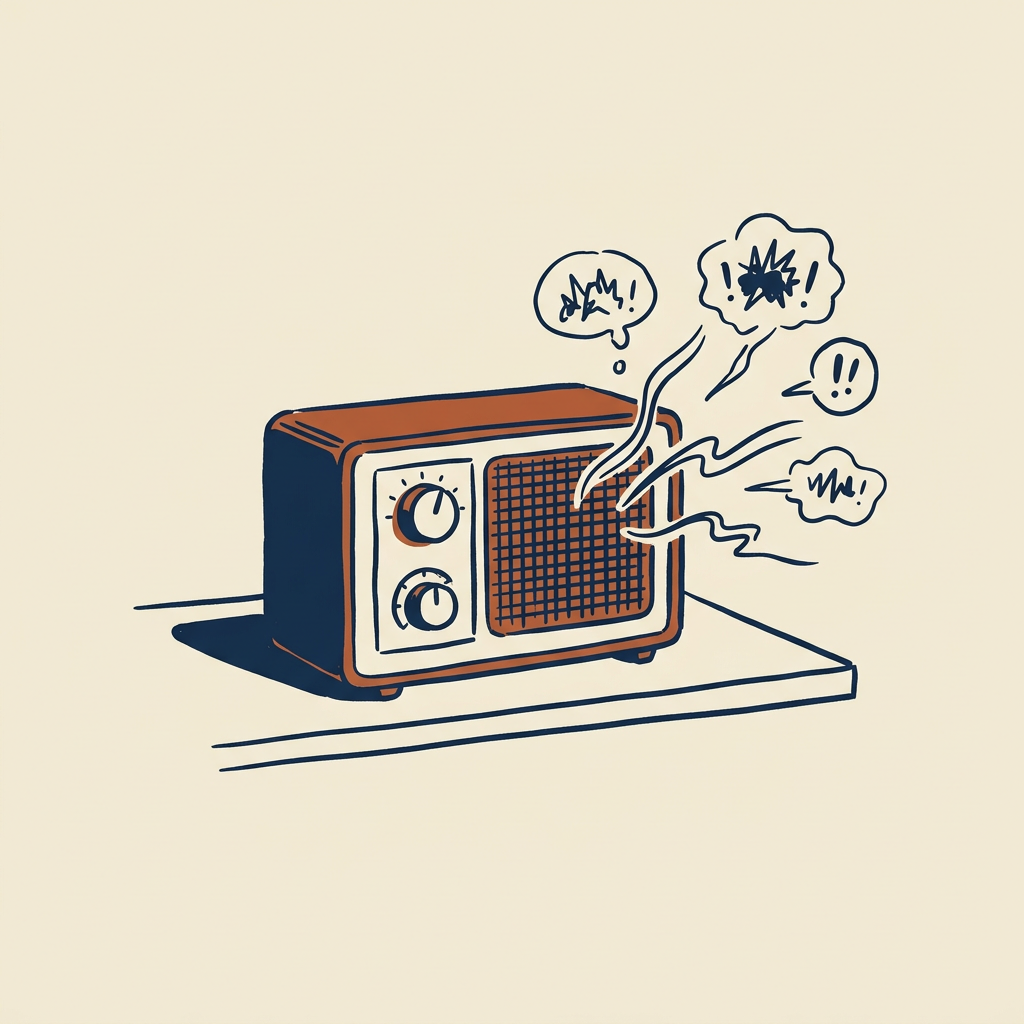
In practice: A man with panic attacks finds his fear of racing heart and shortness of breath becomes larger than the sensations themselves because he constantly monitors and braces against them.
3
Thoughts are not facts
The mind’s habit of generating self-critical, catastrophizing, or rule-bound commentary is normal mental noise, not an accurate report on reality that must be obeyed.
Harris introduces cognitive defusion: the skill of noticing a thought as a mental event rather than automatically treating it as true. Fusion is when a thought like “I’m going to fail” feels identical to a real prediction of the future. Defusion is recognizing the same thought as just a sentence from a mind that generates thousands of thoughts a day, most never checked for accuracy.
He asks readers to notice how the same thought, said in a silly voice or slowed down and repeated, loses its emotional grip. The content has not changed—only the relationship to it. One exercise is silently adding “I’m having the thought that…” before a troubling thought to create distance.
Harris claims that arguing thoughts away, a hallmark of classic cognitive therapy, sometimes backfires by giving the thought more airtime and importance. Defusion does not require proving a thought false; it only requires seeing it as a thought.
That shift removes the need to win an argument with your own mind before you can act. You can move forward with an unhelpful thought still present, just no longer steering.
In practice: A man convinced “I’m not good enough” has treated the sentence as settled fact since childhood and organized decades of avoidance around it—never applying for promotions, never asking someone out—without testing whether the thought was accurate or simply persistent.

4
Willingness over avoidance
Long-term wellbeing requires willingness to feel unwanted emotions rather than structuring life around avoiding them.
Harris defines acceptance not as liking, wanting, or resigning to pain, but as making room for it. In ACT, acceptance is active and purposeful, done in service of living the life you want rather than as an end in itself.
He identifies experiential avoidance—the effort to dodge internal discomfort—as the common thread behind behaviors that look unrelated on the surface: drinking, overworking, procrastinating, staying in a bad relationship, avoiding intimacy. Each can function as a way to escape a feeling rather than face its source.
The paradox he puts at the center of ACT is that willingness to feel pain, briefly, is what allows people to move toward what matters, while unwillingness keeps them circling the same avoidance behaviors indefinitely.
The passengers-on-the-bus metaphor captures the stance: unwanted thoughts and feelings can ride along without grabbing the wheel and dictating the route. The book does not promise relief from anxiety or sadness; it promises the ability to act meaningfully while those feelings are present.
In practice: A woman avoids dating because she cannot tolerate the vulnerability of possible rejection; her avoidance protects her from short-term discomfort while permanently blocking the connection she says she wants.

5
Stay in the present
A mind constantly relitigating the past or rehearsing the future disconnects people from the only place action is actually possible—the present moment.
Harris links fusion and avoidance to mental time travel: replaying past failures or rehearsing future threats instead of noticing what is happening now. You cannot act skillfully on a situation you are not attending to. Much anxious or depressive thinking is rumination and worry that feel productive but produce no decisions.
He draws on mindfulness research showing that sustained attention training reduces the automaticity of rumination, echoing relapse-prevention findings from mindfulness-based cognitive therapy without treating that work as identical to ACT.
Simple drills—noticing five things you can see, hear, and feel—are offered not as relaxation tricks but as practice in redirecting attention on command. Mindfulness here is not about achieving calm; a person can be fully present while anxious.
The point is contact with reality as it is. That contact is a prerequisite for acting on what you actually value rather than on the story your mind is telling about the past or future.
In practice: An athlete’s performance drops not from lack of skill but from an internal monologue about a past mistake running throughout the game, pulling attention away from the ball in front of him.

6
Values as a compass
A meaningful life requires clarifying values as ongoing directions to move toward, not goals to achieve and check off.
Goals
Specific, finishable outcomes you check off—promotion, marriage, weight loss.
Values
Ongoing qualities of action that never complete—courage, generosity, being a loving partner.
Harris draws a sharp line between goals and values. Goals are specific, achievable, and finishable—get married, get promoted, lose ten pounds. Values are qualities of action you choose to bring continuously—being a loving partner, being courageous, being generous—and they never get completed.
He argues people often chase goals believing achievement will produce lasting happiness, then feel hollow once the goal is reached because it was never tied to a named value, or because reaching it does not force the mind to feel satisfied.
Identification exercises span work, relationships, health, and growth. One is imagining your eulogy or a milestone birthday speech and noticing what qualities you would want said about how you lived.
Values can be enacted immediately, whatever the circumstances or feelings. You can act with kindness today even if you are anxious and even if a related goal is years away. Motivation stops waiting on readiness; you choose a value and take the smallest available step consistent with it.
In practice: A man spent fifteen years pursuing partnership at a law firm, achieved it, and felt flat within months, because the underlying value—perhaps security, or proving himself to a critical parent—was never named or examined.

7
Committed action
Values only matter if translated into concrete, repeatable behavior, including plans for what to do when motivation and comfort are absent.
Harris insists insight and acceptance are inert without action. Committed action is not willpower theater. It is a value-guided behavior pattern you return to even after lapses, rather than a streak you either keep perfectly or fail entirely.
People often quit after one setback because they treat the lapse as proof the whole effort failed, rather than as an expected part of a long-term pattern. When avoidance reappears as procrastination or excuse-making, he frames it not as weakness but as the struggle switch and experiential avoidance reasserting themselves.
The response is to reapply acceptance and defusion, not to pile on self-criticism. He recommends breaking values into concrete near-term actions explicitly tied to a named value so the work does not drift into an empty checklist.
Earlier skills are not the endpoint. They are conditions that make sustained, meaningful action possible: myths create false expectations, struggle and fusion keep people stuck, acceptance and presence create room, and values plus committed action give that room a direction.
In practice: Someone recovering from social anxiety who values connection treats committed action not as one triumphant dinner party but as the repeated practice of accepting invitations even when anxious, with relapses into avoidance expected and simply returned from.
Key terms
- happiness trap The extra suffering created by believing ordinary pain should not be there and fighting to avoid it.
- struggle switch The internal stance of warring with a feeling versus letting it be present without a fight.
- fusion Treating a thought as identical to reality or as a command that must be obeyed.
- defusion Noticing a thought as a mental event or sentence rather than as a fact that steers behavior.
- experiential avoidance Organizing life to dodge uncomfortable inner states, often at the cost of what matters.
- acceptance Actively making room for unwanted feelings in service of a valued life, not liking or resigning to them.
- values Ongoing qualities of action you choose to enact continuously; unlike goals, they never get finished.
- committed action Value-guided behavior you return to after lapses, rather than a perfect streak that collapses at the first miss.
What to do
- Pick one value for this week and name one small action tied to it that you can do regardless of mood.
- When an anxious or self-critical thought appears before that action, silently preface it with “I’m having the thought that…” and proceed anyway.
- At the end of each day, spend two minutes noticing sounds, textures, and temperature around you to practice returning attention to the present.
Questions to think with
- Which feelings have you been treating as emergencies that must be fixed before you can live?
- What would you do this week if an unhelpful thought no longer got to steer?
- Where is avoidance protecting you from short-term discomfort while blocking something you say you want?
- If a eulogy named qualities of how you lived rather than trophies you won, what would you want it to say?
- After your last setback on something that mattered, did you treat the lapse as failure of the whole effort or as a place to return from?
The other side
The book is a popularization that compresses Relational Frame Theory into simplified metaphors, so readers get techniques without the underlying account of why language and cognition work this way. The ACT evidence base in 2007 was thinner than for CBT on conditions such as panic disorder and OCD, and later meta-analyses have generally found ACT roughly comparable to CBT rather than superior, despite an implicit framing of ACT as a corrective. The contrast with cognitive restructuring is overstated; many CBT practitioners already use distancing and behavioral activation. The book is light on severe mental illness, psychosis, ongoing trauma, or real danger, where acceptance is a poor fit and professional help beyond self-help is needed. The values chapter assumes introspective access and stable circumstances that readers facing poverty, discrimination, or chronic illness may lack. Alone with a workbook, people doing difficult defusion or exposure-adjacent work may need more support than the format can supply.
Who it's for
Readers who have tried self-help books and affirmations without lasting relief from anxiety or low mood, and anyone skeptical of positive thinking who wants a more honest account of how emotions work. It also serves people stuck avoiding situations, relationships, or decisions because of fear of discomfort.