



France deploys 70,000 officers after mass looting
By The Conservative Desk (/journals/conservative-desk)
Near Porte d’Aix in Marseille on Saturday, masked demonstrators dragged large metal plates into the street and built barricades. They threw stones and bottles and set off fireworks at officers. Police answered with heavy tear gas, then advanced with shields and batons.
France had put about 70,000 police and gendarmes on the streets nationwide, backed by helicopters, armored vehicles, water cannons, drones and anti-drone systems. Interior Minister Laurent Nuñez had told reporters the day before that the state would “let absolutely nothing pass.”
“We will be uncompromising with rioters, looters and all those who commit acts of violence,” Nuñez said. “We will be extremely vigilant.” He added that forces had to be “ultra, ultra responsive.”
The show of force followed the October 17 unrest, when 3,000 stores were damaged or looted and 2,700 people were arrested. Justice Minister Gérald Darmanin said 217 people had already been sent to prison, half of them first-time offenders. Shopkeepers across Paris boarded their windows. The Louvre, the Musée d’Orsay, the Paris Opera and other museums closed for the day. Art Basel Paris ended two days early. A Paris Saint-Germain match against Lyon was postponed. More than 20 Paris metro stations shut.
France’s 10-year bond yield rose above 5 percent on Friday for the first time since 2002. Moody’s opted not to downgrade the sovereign credit rating, sparing the government one more immediate blow while investors watched both the deficit and the disorder.
President Emmanuel Macron canceled a planned trip to Nigeria and Senegal. He accused ultra-left groups of having sought to “bring down the republic” the prior weekend and called for the utmost severity against acts of delinquency.
In Paris, authorities rerouted the main authorized march at the last minute to the southeastern edge of the city. The change angered some who had come to be seen. Vincent Charache, a 35-year-old municipal employee who had traveled two hours by train from Nevers, called it “a strategy to divide and discourage people.” Police put the Paris crowd near 110,000; other counts ran as high as 250,000. Nationwide the Interior Ministry estimated 410,000 protesters; the CGT union claimed 800,000. Separate wires put the day’s total near 440,000, down from about 550,000 the week before, while one early official figure cited 35,000.
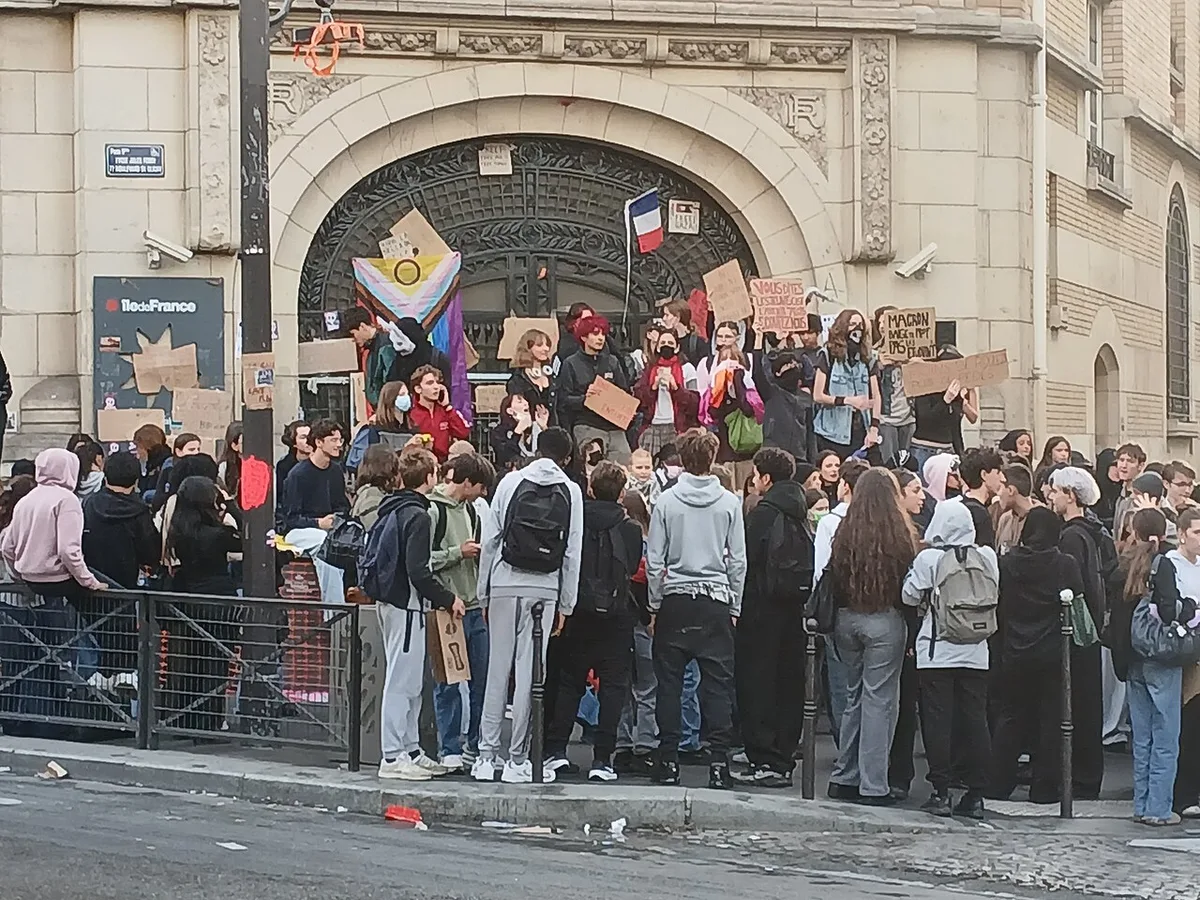
Most of the marching stayed calm until evening. In Paris, clashes broke out as the crowd dispersed. Nuñez said the confrontations lasted two hours and involved about 500 rioters at the rear of the column. Journalists saw repeated police charges, tear gas and baton use against mostly young protesters.
“The police started moving towards everyone, telling them to get down and back off. They were just taking people down, you know, beating protesters,” said one demonstrator bleeding from a baton blow to the face who gave only his first name, David.
“I hear the media talking about repression in Iran and China. And now I see that France is doing the same, if not worse,” said Victor Lejendre, a 22-year-old student.
In Nantes, protesters broke through police lines under tear gas and water cannon to reach the city center. In Lyon, officers used tear gas to disperse roughly 1,000 people. “If they prohibit protests then that means we are heading more and more towards a regime that is fascist, that is dictatorial,” said a 20-year-old there who gave his name only as Silem.
Those claims are the protesters’ case in their own words: that heavy deployments, last-minute route changes and downtown bans amount to repression of the right to assemble. The record that answers them is concrete. Nuñez reported 135 arrests by Saturday afternoon, many after pre-march checks that recovered fireworks, ball bearings and other items usable as weapons, including a Japanese-style sword. By evening he put nationwide arrests near 1,000 and described an extremely elevated level of violence from black-clad ultra-left extremists. Two people were seriously injured—one man in Toulouse who reportedly had fingers blown off, and another person in Clermont-Ferrand.
Authorities had approved a single union march in Paris and rejected permits for the student union UNEF and Yellow Vest groups; UNEF said it would proceed anyway. Several cities, including Le Havre, Toulon and Nice, banned demonstrations in their downtown cores. Nuñez later called Saturday’s result more positive than the week before: more officers on the ground, faster response, more pre-checks, and better protection for businesses.
A shooting in Trappes on Friday added to the tension. One person was killed and four wounded, including a 12-year-old girl. A 39-year-old man was arrested. Nuñez said a racist motive was possible, the investigation was continuing, and the act was clearly a terrorist crime.
In Orléans, where Marine Le Pen’s National Rally held its congress, a counter-demonstration drew between 11,000 and 13,000 by police counts and 20,000 to 30,000 by organizers. It ended without major incident.
Far-left candidate Jean-Luc Mélenchon marched in Paris and said Macron “is going to understand that this is going to repeat itself every week.” Demonstrators leaving the Paris clashes taunted officers with a promise of “see you next Saturday.”
Fox News reported that the Paris protests had ignited demonstrations across Europe and that 135 people had been arrested across France as police recovered potential weapons from protesters. The next test arrives on the calendar the taunt already named.