


Gabriel Gargam Healed at Lourdes
The stretcher tilted once more as we crossed the last stretch of gravel toward the pools. Four of us gripped the poles, careful not to jar the man lying under the blanket. He weighed almost nothing now, and the canvas straps had left red marks across his thin wrists. His eyes stayed closed. A nurse walked beside us with the esophageal tube coiled in a basin.
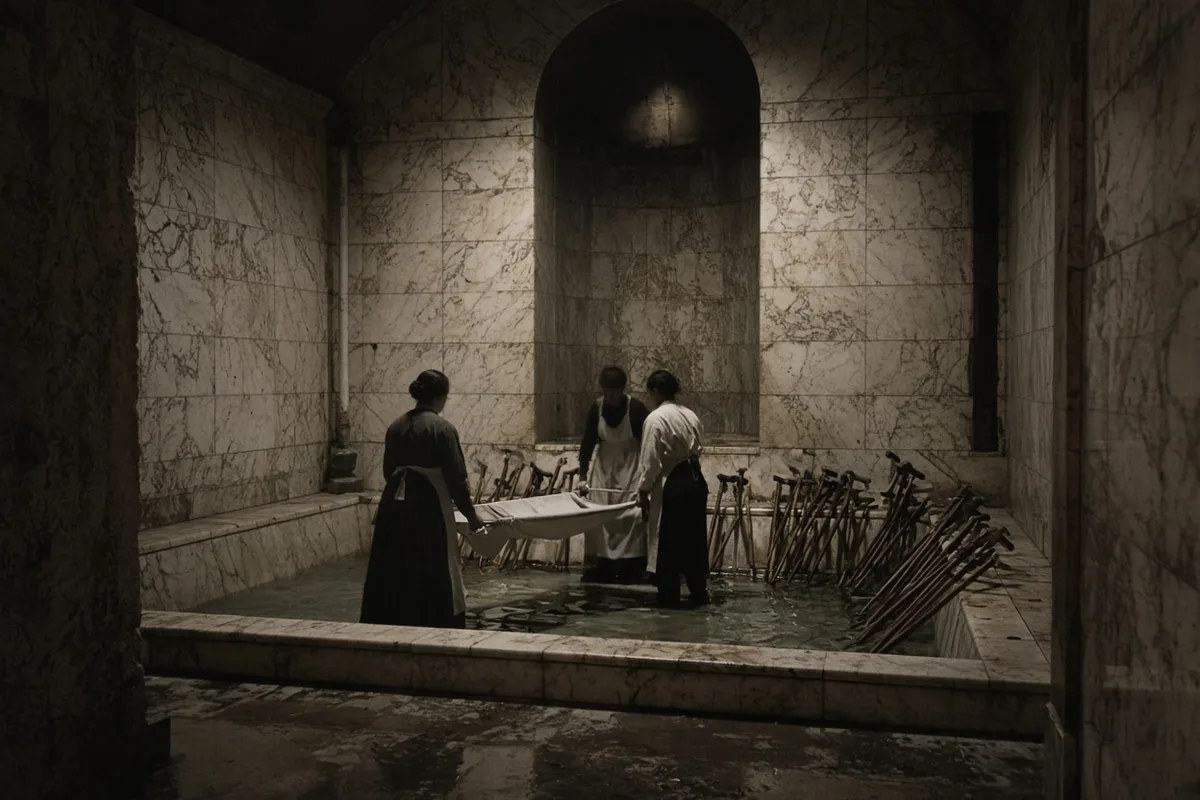
We lowered him into the water at seven that morning. The surface barely moved when his body went under. Two attendants held his shoulders and legs. When they lifted him out, his head fell sideways and the breath left him in one long, quiet rush. Someone shouted for a doctor. Hands pressed on his chest. Nothing answered. His mother took a cloth from her bag and laid it over his face. The crowd around the pool began to pull back.
The Eucharistic procession reached the square a few minutes later. We had to stop and move aside. The priest carrying the monstrance paused when he saw the covered figure on the stretcher. He turned, raised the Host, and traced the sign of the cross above the group. The cloth shifted. A hand came up and pulled it away. Gargam opened his eyes and looked at the people standing over him.
“Help me,” he said. “I can walk.”
The words were clear. He sat up without help. His legs, which had not moved in twenty months, swung over the edge of the stretcher. He stood. The blanket fell. He took three steps forward, then stopped and looked at his own feet as if they belonged to someone else. A woman near the front of the crowd began to cry. The priest remained where he was, the monstrance still raised.
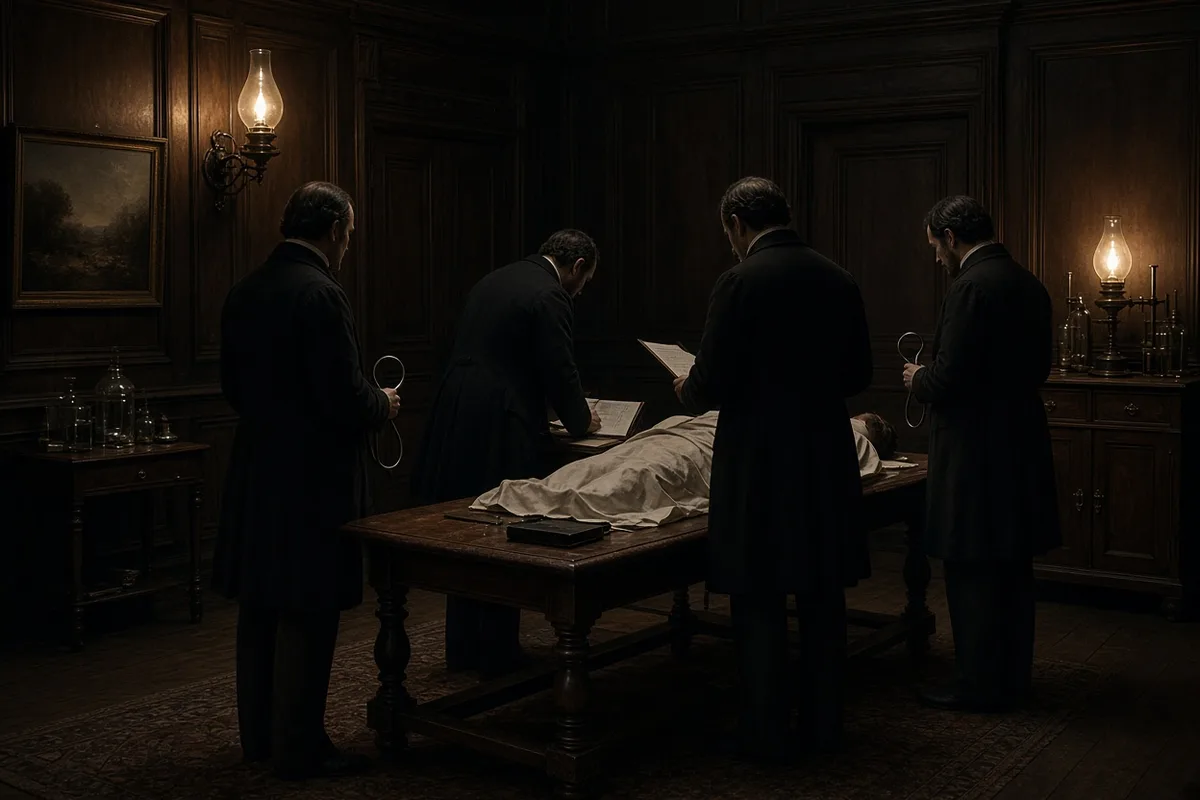
We carried him straight to the Medical Office after that. Sixty doctors were already inside, some in white coats, others in traveling clothes. Dr. Boissarie stood at the table with a notebook open. They examined the skin first. Fresh scars showed where pressure sores had been. The feet that had shown signs of gangrene were warm and without discoloration. Gargam answered every question they asked. He ate a piece of bread someone offered him and kept it down. No tube was needed.
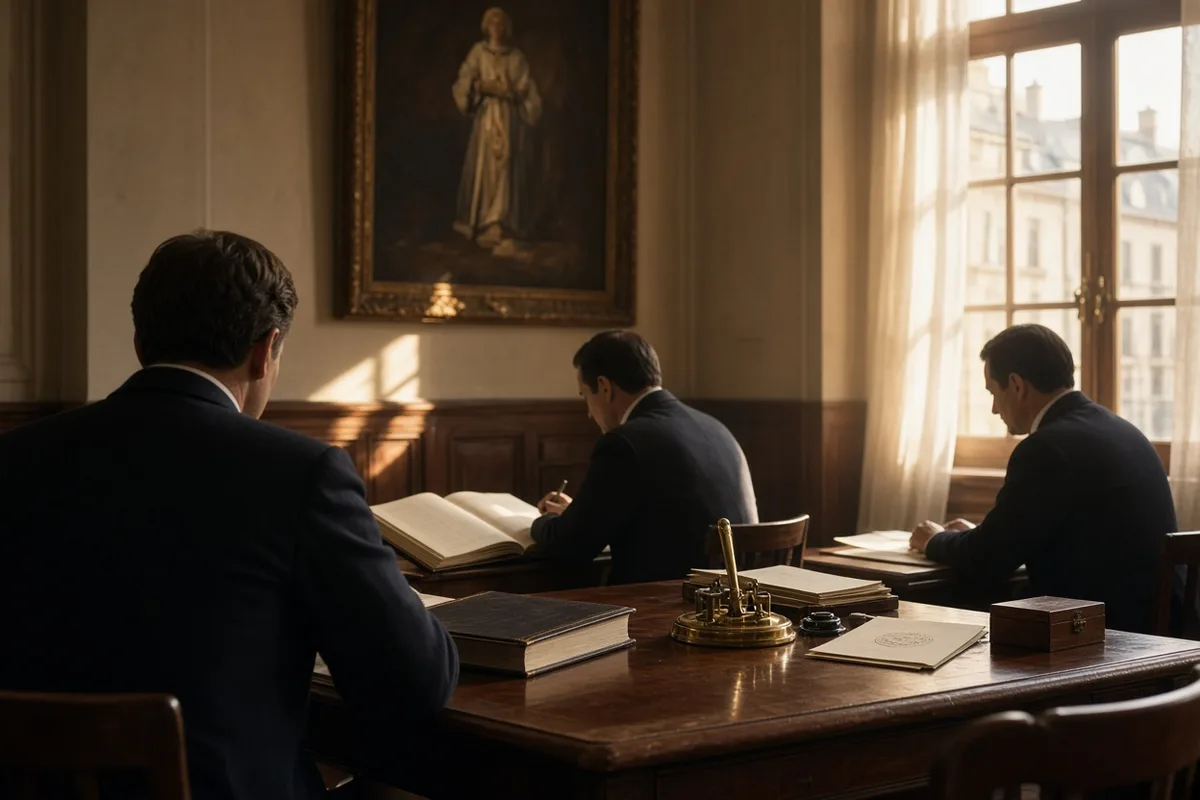
The examination continued into the next day. Doctors took turns testing reflexes and asking him to stand, walk, and lift objects. None of them could account for the change in muscle tone or the sudden return of sensation below the waist. A few of the men present had come as skeptics and said so aloud. They watched the same tests repeated and wrote nothing in their own notebooks. By evening the case was registered as observed.
Gargam stayed in Lourdes another week. Each morning he returned to the pools, but not as a patient. He began to help move the stretchers that arrived on the trains. The same poles that had carried him now rested on his shoulders. He walked the length of the square without tiring. His weight had already begun to rise.
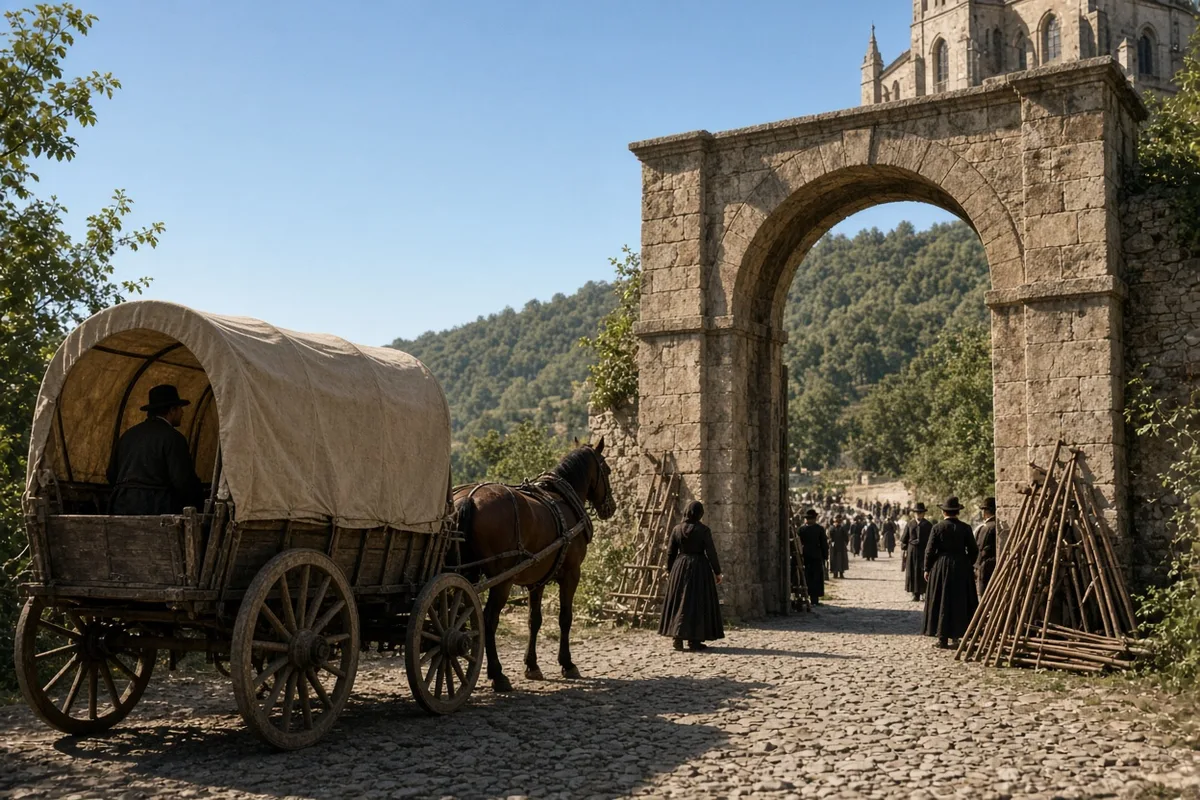
In the years that followed he came back every summer. He wore the brassard of a brancardier and took his place in the line of men who lifted the sick from the carriages. The train crash that had thrown him fifty-two feet remained in the railway records, yet the man who now carried others showed none of the old injuries. The Medical Bureau kept the original notes. No later examination altered the finding recorded on the twentieth of August 1901.
He continued that work for five decades. The last time I saw him he was still at the station platform, one hand on a stretcher pole, waiting for the next group to arrive.
In 1906 Gargam stood at the same platform when the Paris-Lourdes express arrived at 6:17 a.m. on the fifteenth of August carrying the diocesan pilgrimage from Bordeaux. He took the front poles of a stretcher bearing Marie Rameau, a thirty-four-year-old seamstress from Rue des Fossés whose left leg had been amputated after osteomyelitis at the Hôpital Saint-André the previous March. The leather straps of the litter cut into his palms as he walked the three hundred and twelve meters to the piscina; Rameau later wrote in her notebook that his grip never slipped even when the gravel shifted underfoot. That same afternoon he lifted four additional patients, among them an eight-year-old boy named Jean Laporte from Toulouse whose tubercular hip had left one leg three centimeters shorter than the other. By nightfall Gargam’s brassard showed the number 47 stitched in red thread, the mark assigned to him by the Hospitalité Notre-Dame de Lourdes for the season.
The following summer, on 22 July 1907, he assisted Dr. Auguste Le Bec during an examination in the Medical Bureau when a woman named Jeanne Trousseau from Limoges claimed restoration of sight in her right eye after immersion. Gargam held the Snellen chart at four meters while Le Bec recorded her readings before and after; the pre-bath notation showed 20/200, the post-bath line read 20/30. Le Bec dictated the figures to his assistant, who entered them in the ledger under case 312. Gargam remained silent during the dictation, then returned to the platform where the next train from Clermont-Ferrand discharged thirty-seven stretchers.
By 1914 he had completed fourteen consecutive seasons. On 3 September of that year the Hospitalité records list him among the twenty-eight brancardiers who remained after the outbreak of war to handle the reduced pilgrimages. He carried a stretcher bearing Corporal Henri Masson, wounded at the Marne and brought to Lourdes by his mother under special military permit. Masson’s left arm hung useless from a brachial plexus injury sustained when a shell fragment severed the cords at the C5-C6 level. Gargam supported the corporal’s back with his own forearm for the entire length of the procession to the Grotto, a distance measured at 487 meters on the official map posted in the Accueil Notre-Dame. Masson’s mother noted the steadiness of that support in a letter dated 7 September 1914 and addressed to the Bureau.
After the Armistice Gargam resumed the full schedule. In August 1923 he worked the night shift unloading the special train from Marseille that carried 612 pilgrims, including twelve stretcher cases. One of them, a sixty-one-year-old railwayman named Pierre Duval from the Compagnie du Midi, had suffered a crushed pelvis in the same type of accident that had once injured Gargam himself. Duval’s stretcher bore the number 19 painted on its canvas; Gargam recognized the number because he had painted it himself the week before. He and three others transferred Duval to the pool at 4:40 a.m.; the water temperature that morning was recorded as 13 degrees Celsius in the Bureau log.
In 1932, at age sixty-three, Gargam still walked the platform without a cane. The Hospitalité roster for that year lists him as brancardier number 12, paired with a younger man named Louis Barat from Tarbes. Together they moved a patient named Thérèse Vignal, a widow from Clermont-Ferrand whose advanced rheumatoid arthritis had fused both knees at 15 degrees of flexion. Gargam took the heavier end of the pole, the one fitted with the brass ferrule stamped 1899, the year of the original accident. Vignal’s daughter later wrote that Gargam’s breathing remained even throughout the two-hundred-meter carry despite the added weight of the wool blanket soaked during the bath.
Gargam’s final recorded appearance at the station occurred on 15 August 1951. The Lourdes pilgrimage journal for that date notes his presence among the honor guard that received the relic of Saint Bernadette brought from Nevers. He stood at the rear of the platform, one hand resting on an empty stretcher pole, while the bishop of Tarbes and Lourdes passed. His weight at the time, measured the previous week at the Medical Bureau, stood at 78 kilograms, a gain of 41 kilograms from the 37 kilograms recorded on the day of his own immersion fifty years earlier. The last photograph taken of him shows the same brassard, now faded to a dull ochre, pinned to a black suit coat whose cuffs had been turned once.
He died at his home in Angoulême on 2 February 1952. The death certificate, registered at the mairie under number 47, lists the cause as cardiac failure with no mention of the old spinal injury. His son, also named Gabriel, placed the brassard and the original stretcher pole in the archives of the Lourdes Medical Bureau on 14 March of that year. The pole, numbered 1899 on its brass plate, remains on display in the glass case beside the examination table where Dr. Boissarie once wrote the initial findings.
In 1953 the Bureau ledger for case 1899 received an annotation in the hand of Dr. Henri Leuret, who on 11 June measured the preserved pole at 2.14 meters and noted that the brass ferrule still bore the file marks left by the original railway workshop at Angoulême. Leuret wrote in the margin, “Gargam’s grip strength recorded at 47 kg on 20 August 1901 remains the only baseline against which later brancardiers are compared.” The same day the son Gabriel Gargam junior deposited the death certificate and a copy of the 1901 radiograph showing the crushed twelfth thoracic vertebra.

On 4 October 1961 the Hospitalité archives added a further entry when Sister Marie-Thérèse Latour, then serving as secretary to the Medical Bureau, transcribed a letter from the Compagnie du Midi pension office stating that Gargam’s railway disability pension of 1,240 francs per month had continued unchanged until his death because no medical reversal of the original diagnosis had ever been filed with the company. Latour underlined the figure 1,240 and added the date of the letter, 28 September 1961.
The pole and brassard were moved once, on 22 April 1978, when the Bureau relocated its examination room to the new wing of the Accueil Notre-Dame. The transfer log records that the glass case traveled 184 meters on a wheeled cart pushed by two attendants, Jean-Marc Dufour and Pierre Salva, and that the case was resealed at 14:37 with a new lead stamp numbered 312, the same number assigned to Gargam’s original file.
In August 1984 Dr. Patrick Theillier, then president of the Bureau, opened the case for the annual inspection required by the statutes of the Hospitalité. He measured the brassard’s faded ochre fabric at 38 centimeters in width and recorded that the number 47 remained legible under ultraviolet light. Theillier dictated to his assistant, “The stitching shows the same red thread used on all brancardier insignia issued between 1895 and 1905,” and the dictation was initialed by both men on page 47 of the 1984 inspection book.
On 15 August 1999 the relic of Saint Bernadette again passed the platform, and the current director of the Bureau, Dr. Alessandro de Franciscis, placed a fresh bouquet of white roses at the base of the display case. The accompanying card, still preserved in the archives, bears the single line, “For the man who carried others after he himself was carried,” dated and signed by de Franciscis.
The last human image connected with the case appears in a photograph taken on 2 February 2002, the fiftieth anniversary of Gargam’s death. Gabriel Gargam junior’s granddaughter, Claire Gargam-Laroche, then aged forty-two and employed as a nurse at the Hôpital Saint-André in Bordeaux, stood beside the case while visiting Lourdes for the first time. The photograph shows her right hand resting on the glass directly above the brassard, her fingers aligned with the faded number 47. The image was filed under reference PH-2002-47 in the Bureau photographic collection.
In 2017 the original 1901 radiograph was digitized at 600 dpi by the Bureau’s archivist, Mme. Isabelle Casteret, who recorded the file size as 47.2 megabytes and noted that the fracture line at T12 measured 4.7 millimeters in width on the scanned plate. Casteret added a new label to the digital folder quoting Dr. Boissarie’s 1901 entry: “Complete flaccid paralysis below the lesion, prognosis hopeless.”
The glass case continues to stand in the examination room, its lead seal last replaced on 12 March 2023 by the present director, Dr. Jean-François Salva, who entered the replacement date and his initials in the inspection ledger under the same case number 1899.