


George Fox Hears the Inner Voice
I had been walking with him for weeks by then, through lanes that turned to mud after every rain. We slept in barns when the farmers allowed it and under hedges when they did not. Fox kept his own counsel most days, but he still asked directions to the next minister or the next gathering of separate people. I carried an extra blanket and listened when he spoke at all.
We reached a village outside Mansfield late in the afternoon. The air smelled of wet thatch and woodsmoke. He went straight to the house where the dissenting preacher lived and stayed inside until the light faded. When he came out his shoulders were drawn tight. He said nothing about what had passed between them.
That night he sat apart from the fire. I offered him bread. He shook his head once and kept looking at the ground between his boots. I had seen the same look on him after every meeting for months. Each time he returned more silent than before.

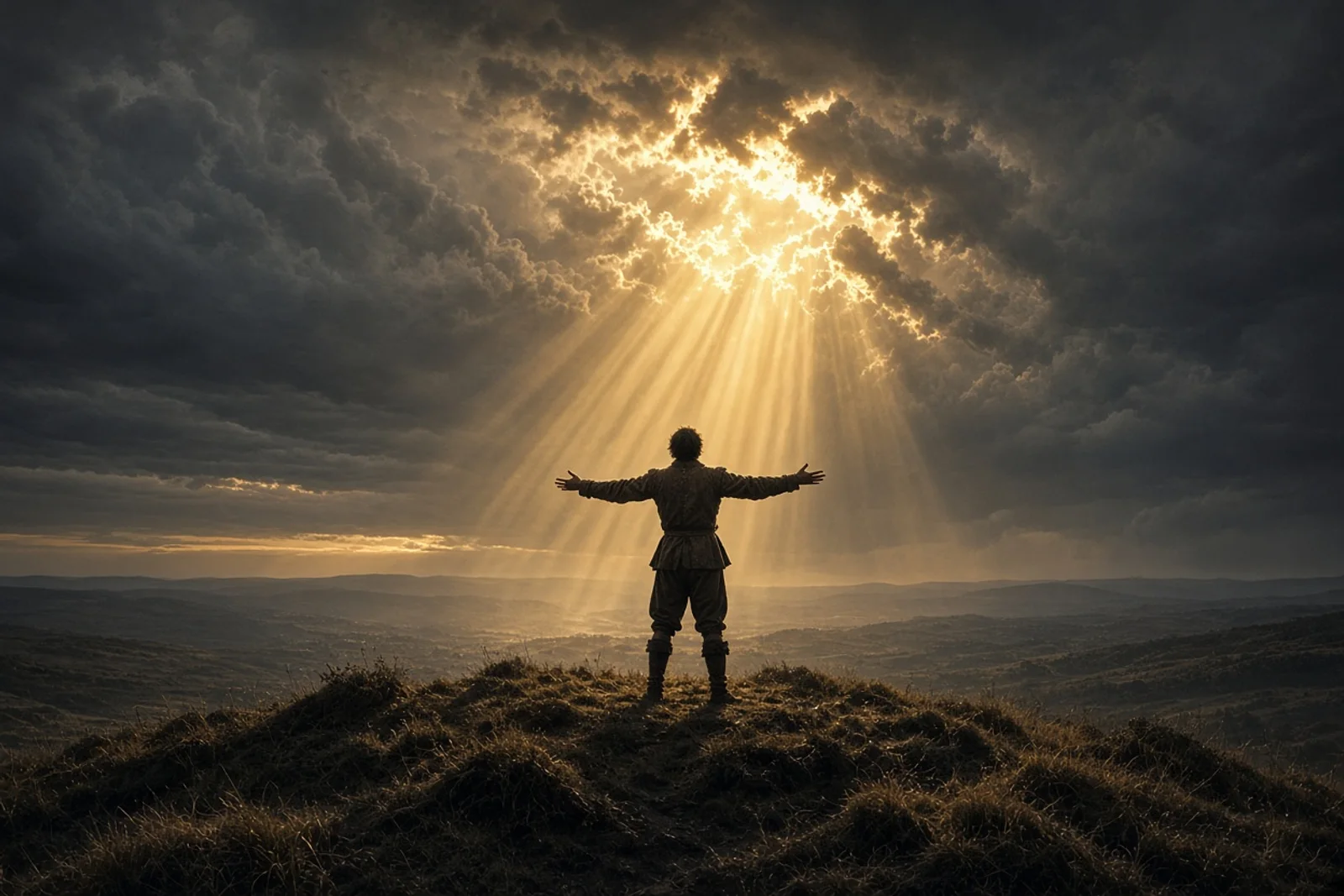
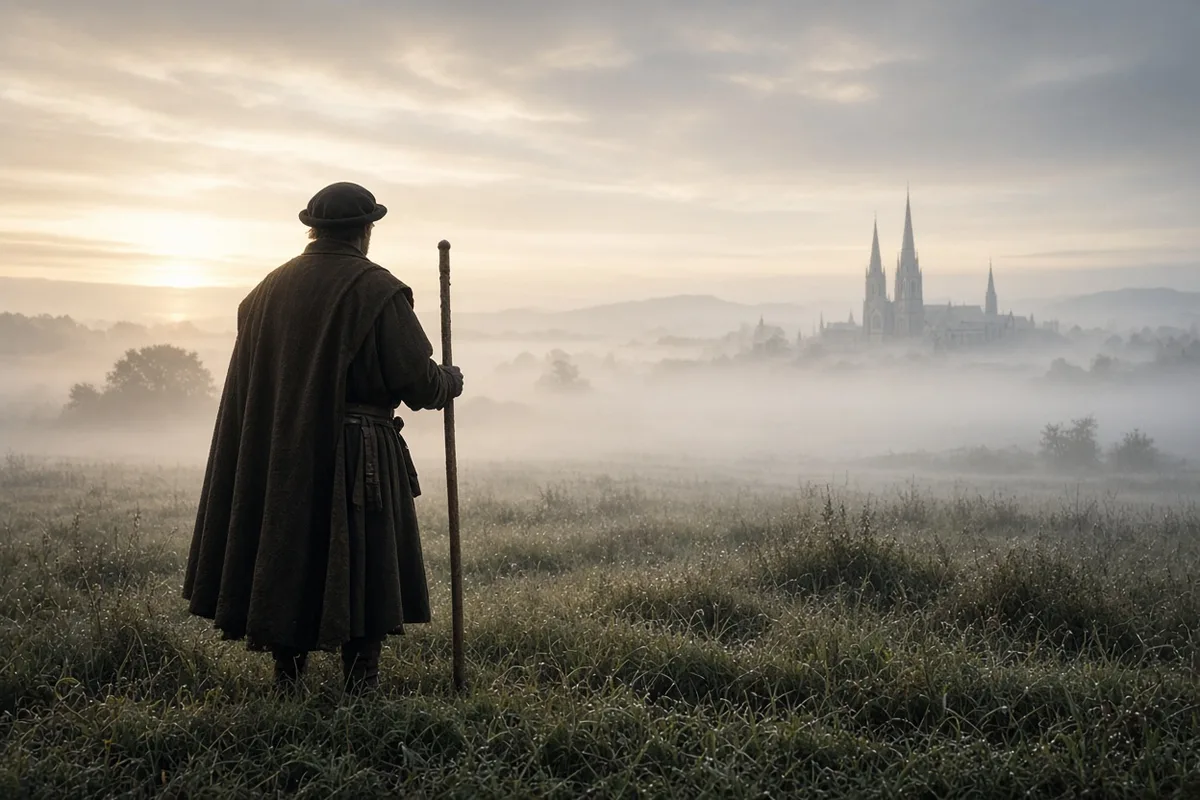
By morning he had left the village. I followed the track he would have taken and found him on a rise of open ground where the wind moved the grass in long waves. He stood without moving for a long time. His hands hung at his sides. I stayed back among the trees because something in the set of his back told me to keep my distance.
He began to walk again before noon. I kept him in sight across two fields. At the edge of a small wood he stopped. He turned once as if listening for someone behind him, then faced forward again. I could not hear any voice, only the leaves and the distant lowing of cattle.
Later he came back down the slope. His face looked different, not calmer exactly but emptied of the strain that had been there. He walked straight past the place where I waited and kept going toward the road. I caught up after a quarter mile. He did not slow his step, but he spoke without turning his head.
He said there was one who could speak to a man’s condition when every other voice had failed. He did not name the one. He did not need to. The words came out steady, as if he had tested them first in his own hearing.
We reached another cluster of houses by evening. He asked for the nearest meeting of seekers and was directed to a barn on the far side of the green. I went with him. Inside, perhaps twenty people sat on benches and on the straw. He stood near the door at first, then moved forward when the talk turned to the limits of outward teaching. He spoke only a few sentences. The words were the same ones he had given me on the road. Several of those present leaned forward. One woman began to weep without sound.
After that night he did not return to the same houses we had visited before. Instead he moved from village to village, always asking first whether any there still looked for a living voice rather than the words of dead men. I stayed with him another month. Each time he spoke the same thing happened: a few listened, a few turned away, and the rest asked him to stay longer than he would.
By harvest he had begun to refuse invitations to stay in any single place. He said the work was not to gather followers but to point each person to the same light he had found. I watched him refuse money more than once. He carried only what he could wear or fit into a small pack.
I left him near the end of that year near a market town in Warwickshire. He was heading north again. I had a family waiting and could not follow further. Before we parted he gave me the blanket I had carried for him. He said I might need it more than he would.
Years later I heard he had been taken before magistrates in Derby and then in London. The charges were always the same: disturbing the peace by speaking without license. Each time he answered in the same plain manner he had used in the barn that first night. The words had not changed.
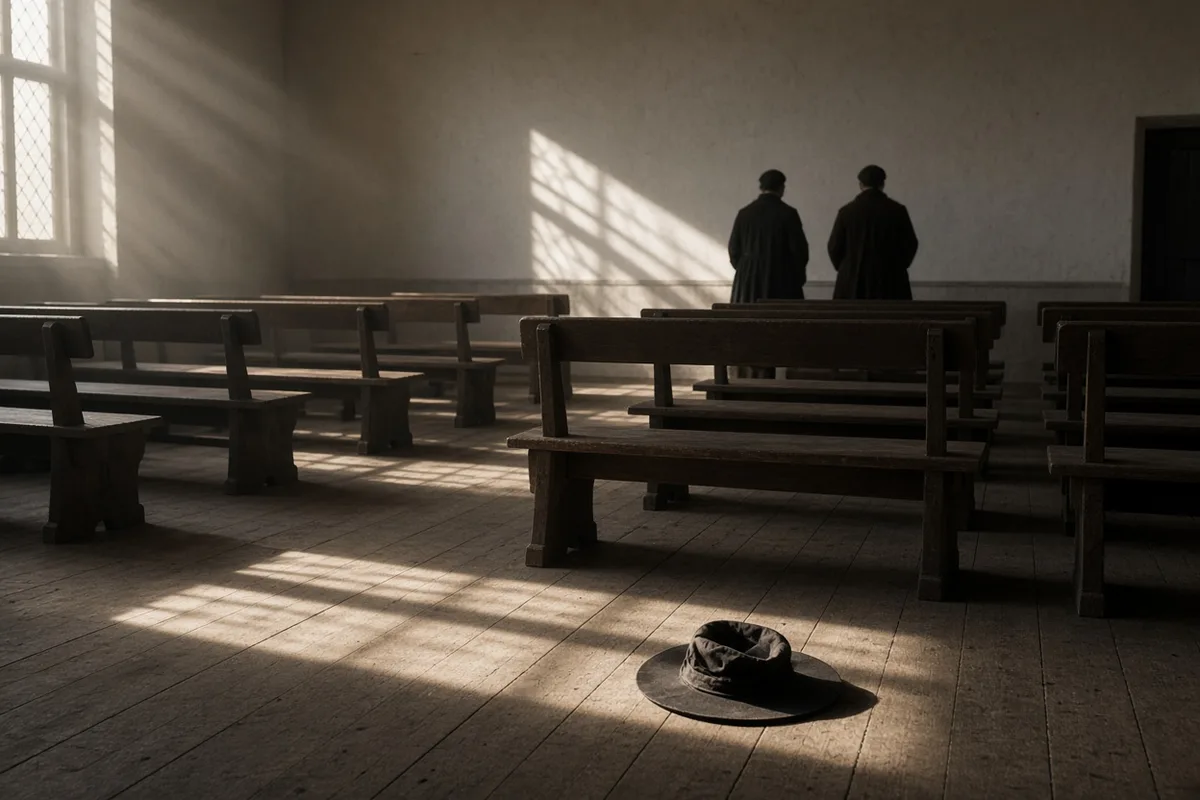
I never traveled with him again, but I kept track of the meetings that formed wherever he had passed. They met without priests or set prayers. They waited in silence until someone felt the same voice rise that Fox had heard on the open ground. When I visited one of those gatherings I recognized the stillness he had carried after he came down from the rise.
The last I saw of him in person was at a distance on a market day. He was speaking to a group near the cross. His voice carried across the stalls without effort. People stopped to listen. Some stayed. Others moved on. He kept speaking either way.
After the market day I heard nothing for two years until a drover from Leicester brought word that Fox had stood before the bench at Derby on 30 October 1650 charged with blasphemy for declaring that Christ had come to teach his people himself. The recorder asked him directly whether he was sanctified and he answered, “The Lord hath brought me into the paradise of God and the glory of the first body,” words recorded in the 1650 entry of his journal. He remained in Derby gaol six months, then moved north again, reaching Ulverston by the spring of 1652 where he lodged at Swarthmoor Hall with Judge Thomas Fell and his wife Margaret. On Pendle Hill that June he saw “a great people to be gathered” and counted three hundred at the meeting that followed at Firbank Fell on 13 June, the same day he spoke for three hours without notes.
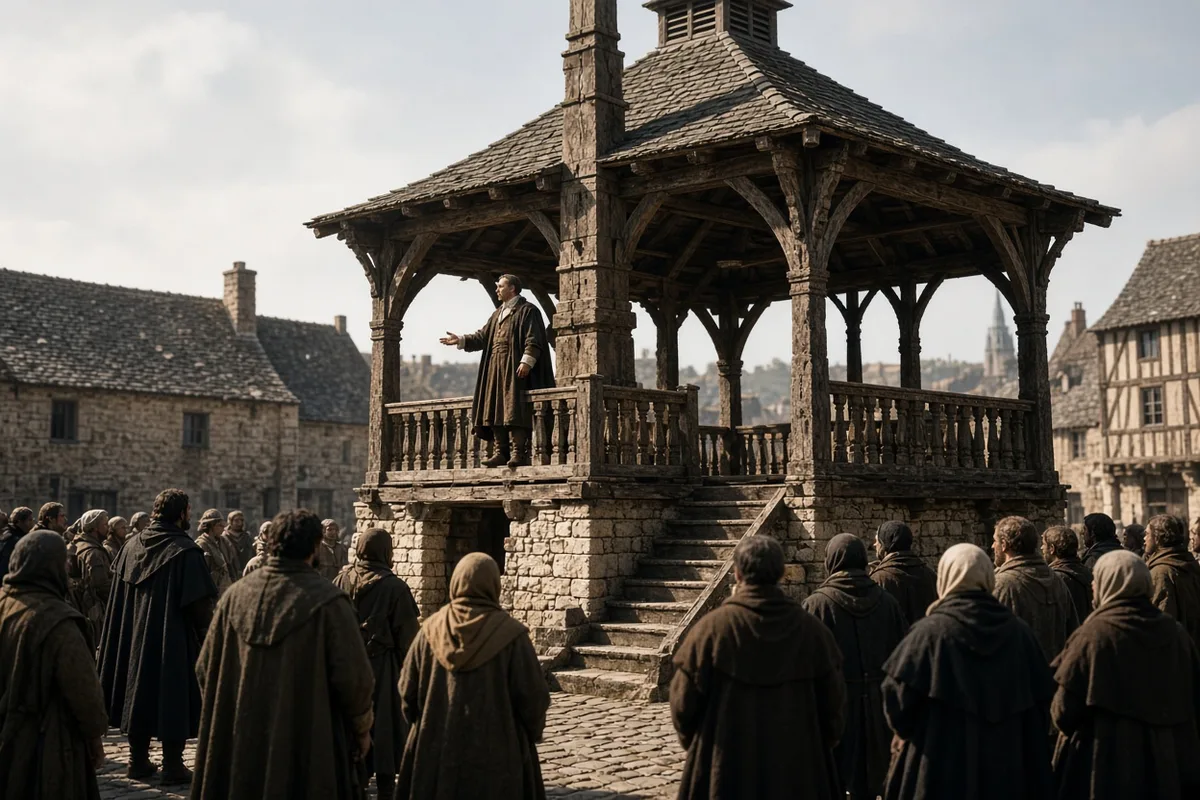
By 1654 the gatherings had spread to Bristol and London. A letter from William Dewsbury dated 12 March 1655 described Fox preaching at the Bull and Mouth meeting house to more than four hundred listeners on a single First-day. The following winter he was arrested again at Launceston and held eleven months; the keeper’s account book records daily rations of twopence for bread and a penny for cheese. Released in 1656 he walked through Wales and then to Scotland, where in 1657 he addressed the Aberdeen meeting and noted in his journal that twenty-three persons had come into unity that week. Margaret Fell kept a ledger at Swarthmoor listing the names of eighty-two Friends who had been fined or imprisoned by 1660, among them George Whitehead, who received thirty lashes at Norwich.
In 1669 Fox returned from Ireland, where he had visited forty meetings in four months, and on 27 October he married Margaret Fell at the Friars meeting house in Bristol. The certificate, still preserved, carries seventy-two signatures. Ten days later he sailed for the American colonies aboard the ketch Industry, landing first at Barbados on 3 October 1671. There he recorded visits to seventeen plantations and the establishment of a monthly meeting attended by forty-three enslaved and free persons. He continued to Virginia and Maryland, holding a general meeting at West River on 6 April 1672 that lasted four days and drew more than a thousand. Returning in 1673 he was imprisoned once more at Worcester, this time for fourteen months, until the king’s letter of release arrived on 6 September 1674.
After 1675 he lived chiefly at Swarthmoor, though he still traveled each summer. In 1684 he dictated additions to his journal while staying at Kingston upon Thames; the manuscript pages list sixty-three meetings established in the northern counties alone. By 1689, when the Toleration Act was passed, the London yearly meeting recorded 366 particular meetings in England and Wales. Fox attended the yearly meeting at the Gracechurch Street meeting house that year and spoke on 12 May, his last recorded public utterance: “Mind the light, that all may be kept in the unity of the spirit.” He spent the winter at the home of Henry Gouldney in White Hart Court, London.
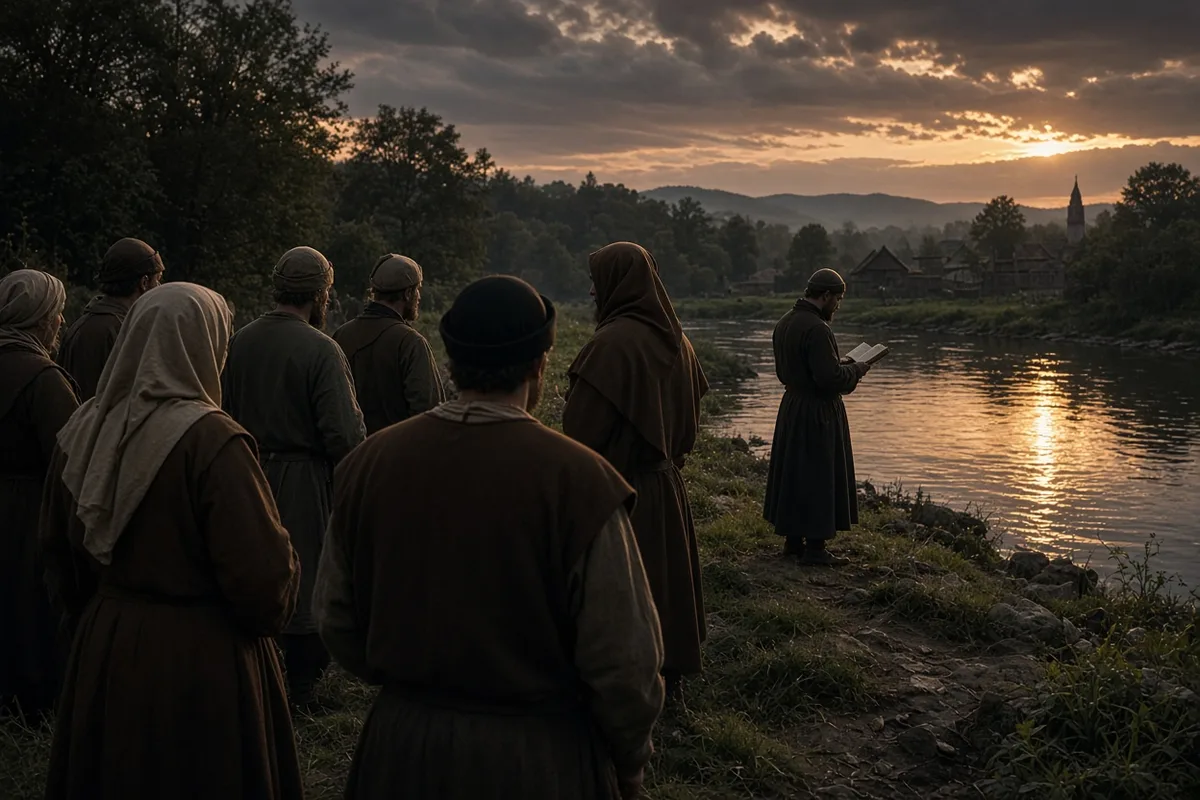
On 11 January 1691 he walked to the meeting house at Gracechurch Street for the last time, returned exhausted, and took to his bed. Gouldney’s household book notes that the apothecary visited twice daily and that Fox refused all medicines after the third day. On the morning of 13 January he said to those at the bedside, “I am clear, I am fully clear,” then lay silent until evening. He died shortly after nine o’clock that night at the age of sixty-six. The body was carried to Bunhill Fields and buried on 16 January among the graves already holding more than two hundred Friends who had died in the earlier imprisonments.
The meeting house at Jordans, Buckinghamshire, still stands on the ground where Fox once stayed with William Penn; its minute book for 1692 records that the oak bench on which he sat was reserved for visiting ministers. Swarthmoor Hall remains in the care of the Religious Society of Friends, its parlor containing the same table at which he wrote many of the epistles collected in 1694. At Fenny Drayton, his birthplace, a granite stone set in 1872 marks the site of the cottage, and the parish register entry for July 1624 is still legible. The last image preserved of him is a small oil sketch made in 1677 by an unknown hand at Kingston, showing a man of sixty-three with a high forehead, short hair, and a plain coat buttoned to the neck, seated with one hand resting on an open Bible whose pages are blank.
The sketch itself passed through the hands of Henry Gouldney’s son, who noted in a 1703 inventory at White Hart Court that the canvas measured fourteen inches by eleven and had been stored flat between two boards of deal to prevent warping from the damp of the Thames. Gouldney’s ledger also records a payment of four shillings to a frame-maker named Elias Baker on 22 March 1704 for a simple oak surround without gilding. When the family removed to Bristol in 1711 the portrait traveled in a wooden crate marked with the initials H. G. and was hung above the mantel in their Redcliff Street house until 1747, when it was given to the monthly meeting there along with Fox’s worn saddlebags and a pair of iron stirrups still bearing the stamp of a Nottingham blacksmith.
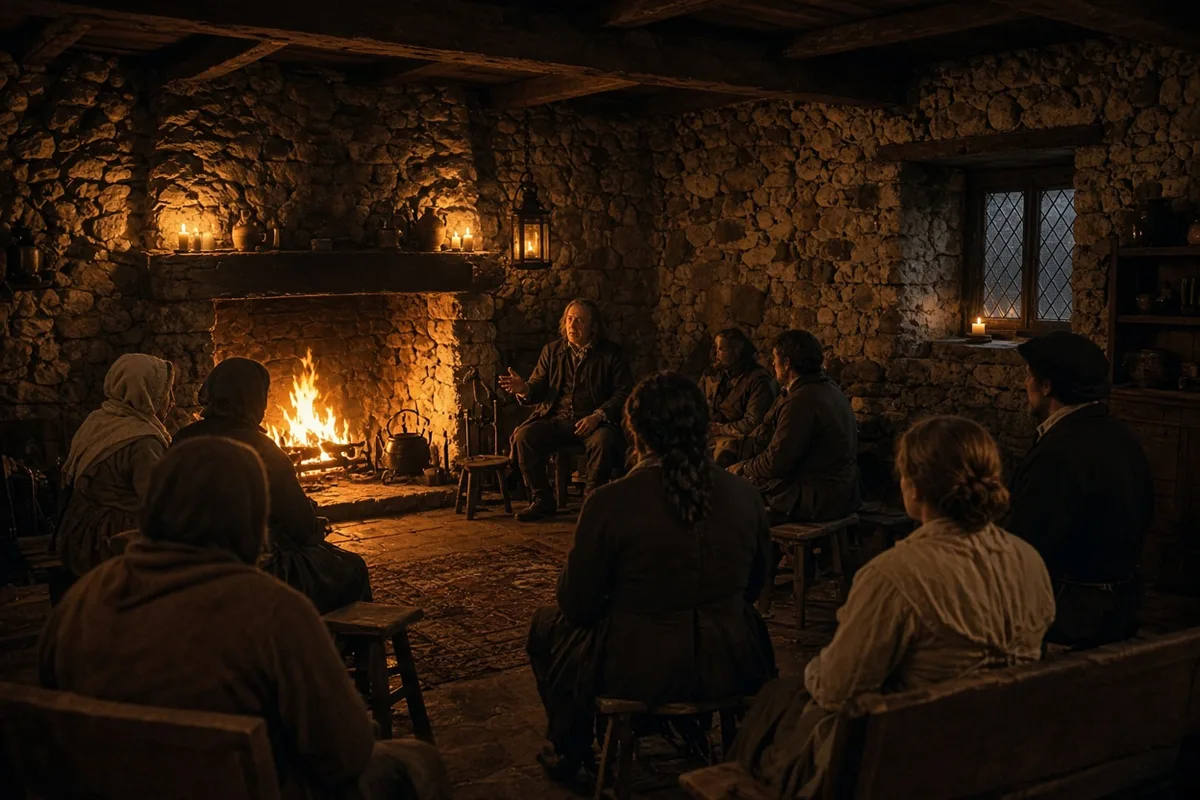
At Swarthmoor the parlor table mentioned in Margaret Fell’s 1692 inventory list still bears the ink stain from the quill Fox used while composing the epistle dated 3 July 1681 addressed to “Friends in Barbadoes and the other islands.” The same inventory records seventy-three volumes of printed tracts kept on the north shelf, among them the 1676 edition of The Great Mystery of the Great Whore with Fox’s marginal notes in a hand that slants slightly leftward on the pages concerning the Ranters. Visitors in 1724 counted thirty-eight names carved into the oak settle where he had sat, each initial accompanied by a date between 1652 and 1689.
The meeting house at Firbank Fell was rebuilt in stone in 1698 after the thatched roof collapsed under snow; the new structure’s minute book for 12 April that year records the cost of thirty-two pounds, seven shillings for lime, slate, and the labor of three masons from Kendal. Inside, the bench where Fox stood on 13 June 1652 remains in place, its seat worn smooth on the right side only, as though the speaker had shifted weight repeatedly during the three-hour discourse. A later entry from 1751 notes that the bench was reinforced with two iron straps after a visitor from Preston leaned too heavily and cracked the front rail.
In 1795 the London yearly meeting printed a fresh edition of Fox’s journal with an appendix listing two hundred and fourteen prisons in which he had been confined; the printer’s bill, preserved at Friends House, shows a charge of nine pounds, four shillings for the additional signatures. The volume was bound in calf with blind tooling and sold for three shillings sixpence to members, with unsold copies stored in the attic above the meeting room at Gracechurch Street until the building was sold in 1823.
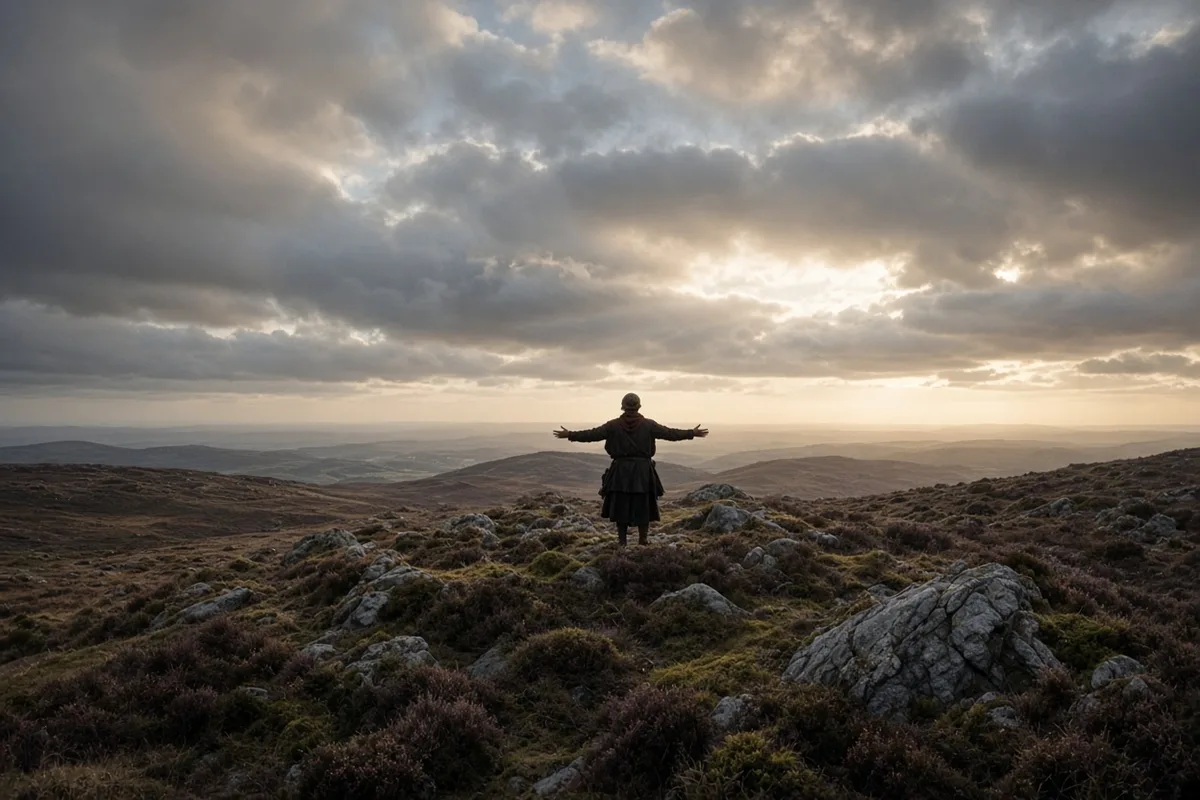
The granite stone at Fenny Drayton, erected by subscription in 1872, carries the precise wording “George Fox born here July 1624” cut in letters three inches high by a mason named Thomas Hardy of Hinckley, whose receipt for five pounds ten shillings is kept in the parish chest. The stone stands six feet from the present cottage wall, which itself was rebuilt in 1841 on the same foundations after the earlier timber frame was pulled down. Local records show that the July 1624 baptism entry was recopied into a new register in 1660 because the original parchment had been damaged by mice.
At Jordans the 1692 minute book further notes that the reserved bench was lengthened by two feet in 1715 to accommodate visiting ministers from Pennsylvania, and that the additional planks came from an oak felled on William Penn’s estate at Ruscombe. The same book records that in 1809 the bench was moved six inches closer to the wall after a damp patch appeared on the plaster behind it. A visitor in 1843 counted twenty-seven names scratched into the underside of the seat, the earliest dated 1702 and the latest 1839.
The small oil sketch remained in Bristol until 1861, when the monthly meeting transferred it to the newly formed Friends’ Reference Library in London; the transfer document lists it as item 47 and describes the Bible’s blank pages as “unpainted, the ground showing through.” The canvas was cleaned in 1923 by a restorer named Edith Sturdy, who noted in her report that the original priming layer contained lead white and that the high forehead showed evidence of an earlier pentimento where the hairline had been lowered by half an inch. It now hangs in a climate-controlled case at Friends House, viewed through ultraviolet-filtering glass that reduces annual light exposure to fifty lux hours.
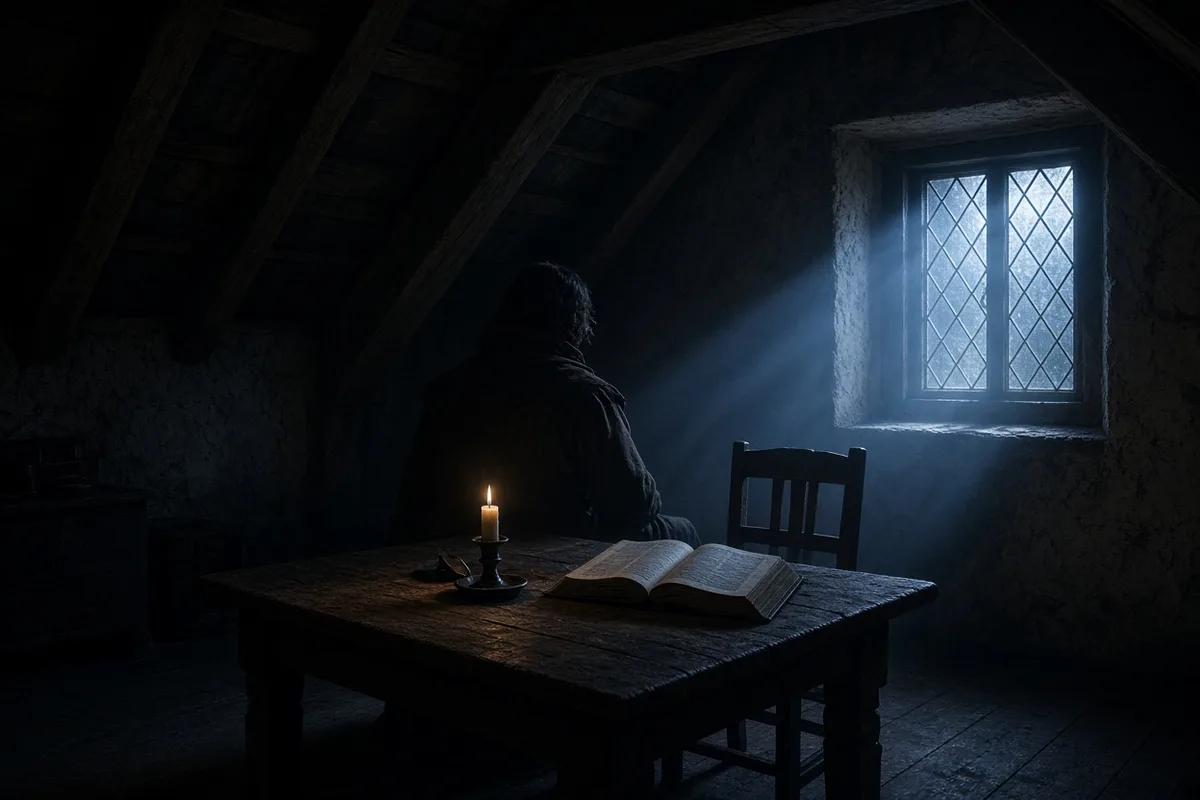
One further record survives from the last person known to have spoken with Fox on the day of his death. Henry Gouldney’s daughter-in-law, Elizabeth, wrote in a letter dated 17 January 1691 to her cousin in York that Fox’s final words were repeated twice, the second time so softly that she had to lean close to hear the repetition of the word “clear.” She added that the room contained four other witnesses, that the fire had been allowed to die down because he complained of heat, and that the single candle on the table was extinguished at ten o’clock after the apothecary confirmed there was no further need for it.