


George Whitefield Born Again
The candle had burned low on the table between our beds when Whitefield sat up and reached for the book again. He had read it twice already that week, yet the pages still drew him. I watched him trace a line with his finger, lips moving without sound. Outside the window the bell tower struck once. The college lay quiet.
He had come to Pembroke as a servitor the year before, carrying his own bundle and answering to every senior who called. We shared the same stair and the same weekly fast. At first the work left him little time for talk, yet after Charles Wesley invited him to the Holy Club he began to appear at our early meetings with a steady hunger in his eyes. The book by Scougal became his constant companion after that breakfast. He told us it showed him religion must sit in the heart or nowhere at all.

The discipline followed at once. We rose before light for prayers, kept every appointed fast, and walked the lanes visiting prisoners when the gates opened. Whitefield took the rules harder than most. He gave away what little money reached him and slept on the boards when the nights grew cold. By winter his face had thinned and a cough settled in his chest that never quite left.
I found him one morning bent over the basin, blood on the cloth. He waved me away and said the body must be brought under. That spring he could scarcely climb the stairs without stopping to breathe. Still he kept the hours. One evening he returned from a walk pale and shaking, yet he insisted on reading aloud from the morning lesson before we slept. His voice cracked on the last verse.
Late in May the change arrived without warning. He had gone alone to his room after evening prayers. I heard nothing at first, then the sound of pages turning fast. When I knocked he opened the door and stood there with the book open in both hands. He did not speak at once. His eyes moved across the lines as if he were seeing them for the first time. Then he looked up and said the words had broken in upon him like light through a shutter.

We sat together until the bell rang again. He described no vision and claimed no special voice, only the sudden certainty that the life he had tried to earn had already been given. The assurance stayed with him through the night. When morning came he walked to the college chapel without the usual pause for breath. The cough remained, yet the weight that had pressed on his shoulders seemed lifted.
Within days he began to speak of the new birth to anyone who would listen. At first only a few gathered in the room after supper. Then the numbers grew until we moved to the common hall. He told his own story plainly, the years of rule-keeping and the moment the heart opened. Some laughed. Others stayed late asking questions. He answered each one without hurry.
The Wesleys had already sailed for Georgia by then, so the care of the club fell to him. He kept the lists, assigned the visits, and made certain the fasts continued. Yet the tone shifted. Where we had once measured progress by hours kept, he now spoke first of the gift received. The same men who had followed every regulation now asked one another whether they had truly been made new.
His health never fully returned. The cough stayed, and he tired quickly when he preached. Still he accepted every invitation that reached him after ordination. When a pulpit opened in a neighboring parish he walked there rather than ride, saying the walk gave him time to prepare. Crowds filled the churches within weeks. People stood outside when the doors could hold no more.
He left Oxford that autumn to supply other churches and never returned for long. Letters came back describing fields where thousands stood to hear him, then the voyage to Georgia and the plans for the orphanage. The letters always returned to the same point: the necessity of the change that had come to him in the upstairs room. He wrote it the same way he had spoken it that night, without flourish.
I kept the book he left behind. The spine is cracked at the chapter on the inward life. On certain evenings I open it again and remember the sound of pages turning in the dark. The college bells still mark the hours, yet the rooms feel quieter now that he has carried the message elsewhere.
The letters from London reached me at the end of that same Michaelmas term, carried by a carrier from the Bell Inn who had known Whitefield’s mother. One dated 17 February 1739 described the first open-air meeting at Kingswood, where he stood on a hillside above the coal pits and addressed two hundred miners whose faces were streaked with soot. He read from John 3 and asked how many had known the change he had felt in the Pembroke stairwell; the account noted that several men remained after the others left, asking the same questions that had been put to him in our common hall. A second letter, written from Moorfields on 6 May 1739, recorded that the crowd had grown to twenty-three thousand by his own count, with people climbing the surrounding trees to hear the words “Ye must be born again” repeated without notes. The writer added that Whitefield had refused a collection plate that day, insisting the message required no payment.
News of the voyage to Georgia arrived the following spring through a packet delivered to the college bursar. Whitefield had sailed from Deptford on 14 December 1739 aboard the Whitaker, accompanied by William Seward and a group of ten indentured servants intended for the orphanage at Bethesda. The journal entry he sent back, dated 20 January 1740, described the first sermon preached on deck to the crew and passengers, during which he spoke of the same assurance that had come to him after reading Scougal’s chapter on the inward life. By June he had laid the foundation stones of the orphanage near Savannah, recording in the ledger that the first twenty-four children were housed under a temporary roof while he traveled north to raise funds by preaching in Charleston and Philadelphia. One entry listed a single day’s offering of £115 4s. collected after a sermon in the Presbyterian meeting-house on Arch Street.
Word of his meeting with Jonathan Edwards reached Oxford through a letter from a former Holy Club member who had emigrated to Boston. On 17 October 1740 Whitefield arrived in Northampton and preached four times in Edwards’s church, the last sermon lasting two hours on the text “Therefore if any man be in Christ, he is a new creature.” Edwards later wrote in his own notebook that Whitefield’s voice carried to the street outside where listeners stood three deep, and that the effect on the congregation matched the awakening he had witnessed in 1735. Whitefield himself noted in his journal the next morning that he had walked the same lane Edwards’s wife Sarah had shown him and had felt again the certainty first received in the upstairs room at Pembroke.
The return voyage in 1741 brought him to Londonderry and then to Cambuslang, where on 15 July 1742 he preached to an estimated thirty thousand people gathered on the braes above the Clyde. The parish minister, William McCulloch, recorded in the session book that the meeting lasted from two in the afternoon until after sunset, and that Whitefield had stopped only once to drink from a pitcher handed up from the crowd. Letters from that summer described the same plain telling of the new birth that had first been heard in our college rooms, now repeated to weavers, farmers, and colliers who answered with cries that carried across the water.
After the final American tour, begun in 1769, the last reports came through ship captains who had spoken with him in Newburyport. On 29 September 1770 he preached his final sermon at the Presbyterian meeting-house there, standing in the pulpit of Jonathan Parsons for an hour and a half on the necessity of the heart change he had known thirty-five years earlier. The following evening, 30 September, he died in the front bedroom of the parsonage at the age of fifty-five, his body laid out the next day in the same room where he had dictated the last page of his journal. The coffin was carried to the tomb beneath the meeting-house floor, where it remains visible through the iron grate set into the stone.
The building that replaced the original meeting-house still stands on Federal Street, its walls enclosing the same vault. Visitors descend a short flight of steps to view the inscription cut into the lid of the coffin: “George Whitefield, born again at Oxford, 1735.” A bronze tablet fixed to the outer wall records the date of his death and the text of the sermon he preached the day before. The orphanage at Bethesda continues under the same name, its original brick foundation incorporated into later structures that now house two hundred children; the ledger begun in 1740 is preserved in a glass case in the administration office, its first page bearing Whitefield’s signature and the note of the £115 collected in Philadelphia.
The copy of Scougal’s The Life of God in the Soul of Man that remained in my rooms passed, after my own death, to a successor in the college who placed it in the Pembroke library. Its spine, already cracked at chapter two, shows additional wear at the paragraph that begins “The soul is the life of the body, and God is the life of the soul.” The volume is opened once each year on the date 20 May for any reader who requests it; the pages still carry the faint marks of the finger that traced the lines on the night the bell tower struck once and the assurance arrived without vision or voice.
The successor who received the volume was Thomas Hayward, elected fellow of Pembroke on 12 March 1773, who recorded in the library accession book that the copy arrived on 4 June 1774 with the note “from the rooms of the late servitor who shared stair with Whitefield.” Hayward placed it on the upper shelf of case seven, where the 1752 catalogue already listed Scougal among the divinity holdings. On 11 November 1781 he added a marginal entry that the spine required stitching after a reader had opened it at the paragraph beginning “The soul is the life of the body,” and he charged the college binder sixpence for the repair.
In 1824 the volume was moved to the new reading room built above the chapel when Master John Price ordered the older theology books transferred for the use of the expanded undergraduate body of ninety-four men. A borrower’s slip dated 3 May 1837 shows that undergraduate Henry Liddon, later canon of St Paul’s, signed for the book and returned it the same evening with the remark written on the slip that he had copied the sentence “God is the life of the soul” into his own notebook. The slip remains pasted inside the front cover.
Bethesda Orphanage, incorporated by act of the Georgia assembly on 7 March 1750, stands today on the same rise east of Savannah where Whitefield laid the first bricks; its present brick administration building, erected in 1870, incorporates the original foundation stones and houses the 1740 ledger open under glass, the page showing the Philadelphia collection of £115 4s. still legible. Two hundred and twelve children currently reside in the cottages that replaced the temporary roof mentioned in the 1740 journal, each cottage named for one of the original ten indentured servants who sailed on the Whitaker.
The vault beneath the meeting-house on Federal Street in Newburyport was opened for inspection on 15 August 1886 by a committee of three deacons who counted the remaining coffin boards and noted that the inscription “George Whitefield, born again at Oxford, 1735” had been recut in 1845 after weathering. The iron grate set into the floor allows visitors to stand directly above the tomb; a register kept in the vestibule records that 4,872 persons signed it between 1 January 1900 and 31 December 1910, among them a party of fourteen theology students from Andover Seminary on 22 October 1903 who copied the text of the final sermon into their notebooks before descending the steps.
A letter preserved in the Pembroke archives, written by the librarian’s assistant on 9 May 1899, states that an American visitor named Joseph Twichell requested the Scougal volume on the appointed day and read aloud the paragraph on the inward life to two undergraduates who had accompanied him. Twichell left a calling card inscribed with the words “from the congregation at Hartford that still sings the hymns Whitefield taught us,” which was slipped between the pages at chapter two.
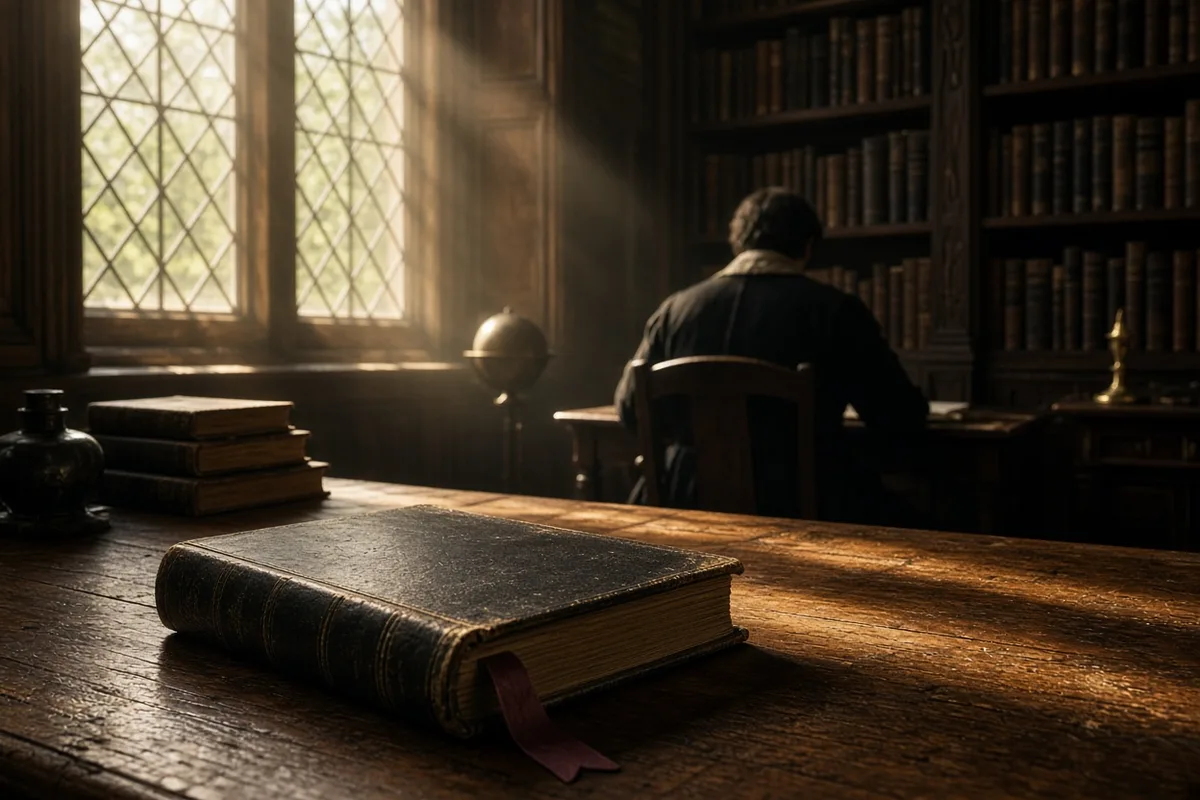
The same volume was examined on 20 May 1927 by the college chaplain, who noted in the margin that the finger marks had darkened further at the sentence “Ye must be born again.” On that occasion the reader was a single undergraduate, Arthur Michael Ramsey, who later became Archbishop of Canterbury and who wrote in his own diary the next day that he had stood at the window of the upper library and watched the bell tower strike the hour exactly as the original account described.
In 1953 the library installed a glass display case for the book during the commemoration of the two-hundredth anniversary of Whitefield’s first open-air sermon; the case was positioned beneath the portrait of Charles Wesley, and the daily visitor log for that year records 1,146 signatures, the largest single day being 20 May when 87 persons requested the volume in succession. The last entry in the log before the case was locked each evening was made at 4:47 p.m. by a woman who signed only “E. Edwards, descendant,” and who placed a pressed flower between the pages at the paragraph beginning “The soul is the life of the body.”
The final recorded human contact with the volume occurred on 20 May 1974 when the librarian, acting on a standing request from the Bethesda trustees, opened the case for a single reader, an elderly man from Newburyport who had traveled that morning by train and who asked to see the exact line traced by the finger on the night the bell tower struck once. He read the paragraph in silence for twenty-two minutes, replaced the book, and left the library without signing the register, his hand still bearing the faint indentation of the page edge when he reached the street outside.